




Cable Tie HSN Code
After identifying the right cable tie supplier in China and successfully negotiating prices, you have made the order. Unfortunately, the problems begin when customs require the HSN code. The HSN code refers to the Harmonized System Nomenclature and is used worldwide for the regulation of the products that enter the country and calculation of the customs duties. In the absence of the appropriate code, mistakes can occur with respect to payment of the customs duties, or customs may stop the order and impose penalties or confiscate the cargo altogether. Various kinds of cable ties have distinct HSN codes because there are plastic, nylon, and stainless steel cable ties. Therefore, it can be concluded that the HSN code is determined by the materials used for manufacturing cable ties.
The HSN/HS codes used for cable ties vary according to the materials used for their production. In particular, plastic and nylon ties use number HS 3926.90 (3936.90.9989 in the USA with 5.3% duty, HS 39269000 in India – with around 10% duty and HS 3926909000 in China with 0% duty often applicable in the EU as well). The metal and steel cable ties are classified as HS 7326.20 since they fall in the category of different articles of iron and steel (73).
What Is an HSN / HS Code?
The HS (Harmonized System) is an internationally used system for classifying products. It has been developed by the WCO (World Customs Organization). There is a 6-digit HS code for any product that is traded across international borders. Various countries may have their own tariff system, which is based on that 6-code system. HS is referred to as HSN code (Harmonized System of Nomenclature) in India. The code itself remains the same for everyone else in the world because it has been universally accepted.
The HS code helps to determine the applicable amount of duty, the necessary documents for import and export, the statistics of trade, as well as whether any preferential rates apply to products traded in accordance with free trade agreements like RCEP, USMCA, etc. Incorrect usage of the code may bring unwanted consequences like numerous penalties and classification delays. Hence, the classification process is taken very seriously by export and import stakeholders.
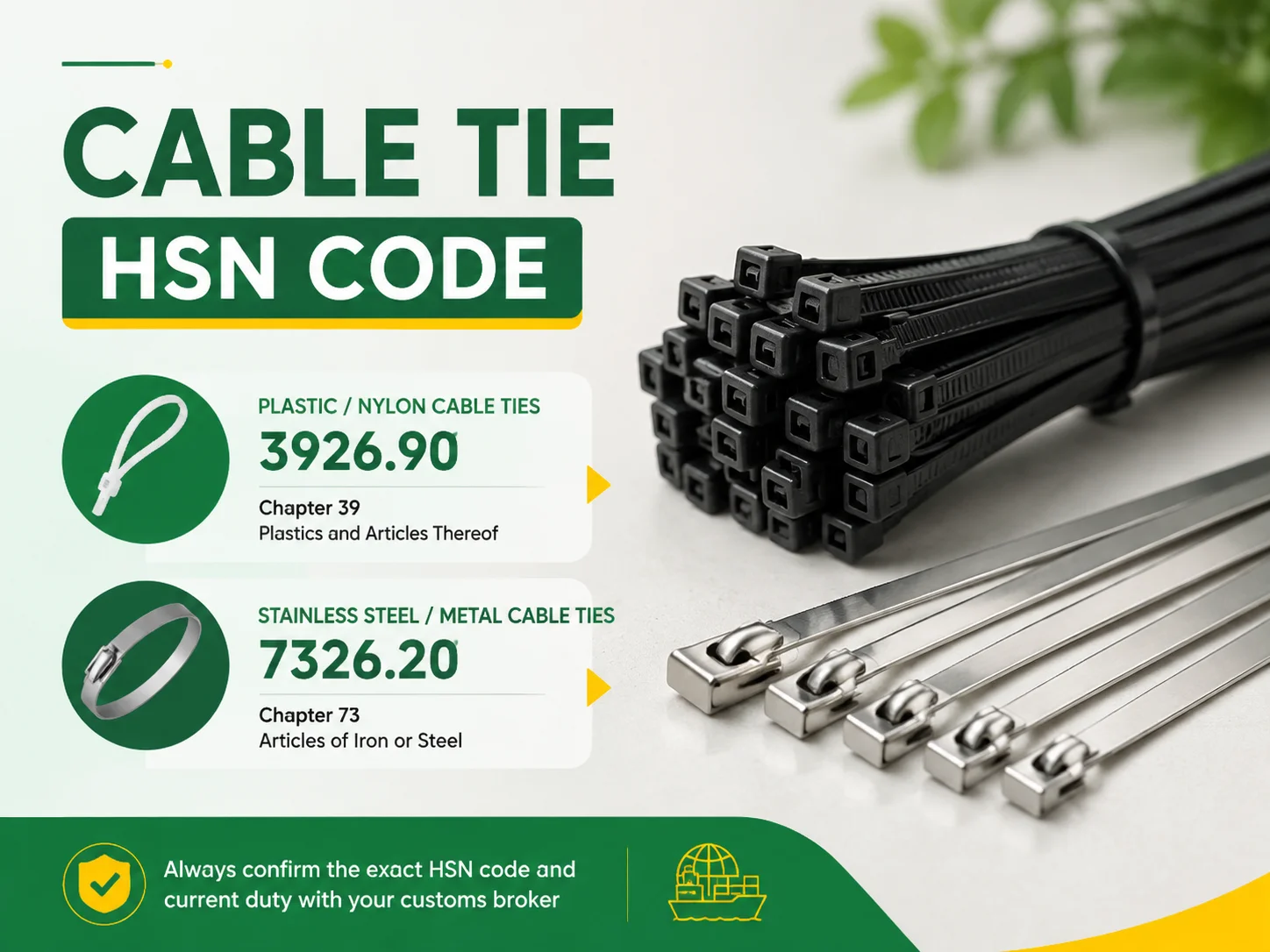
Plastic & Nylon Cable Ties: HS 3926.90
Plastic cable ties, such as zip ties made from nylon (PA66/PA6), fall into HS heading 3926, which is for “Other items of plastics,” specifically under code 3926.90. This statement is validated by US Customs’ Rulings: rulling N355863 (Dec 2025) categorized plastic cable ties made in China under 3926.90.9989 and ruling N359069 (Mar 2026) mentioned the same for zip ties used in aviation headsets. Both rulings mention that the duty rate is 5.3% ad valorem along with additional duties under chapter 99 on goods from China.
National codes:
| Country | Code | MFN Duty | Notes |
|---|---|---|---|
| United States | 3926.90.9989 | 5.3% | + Section 301 China tariffs via Ch. 99 codes |
| European Union | 3926.90.0000 | 0% (Free) | Plastic articles generally duty-free in the EU |
| United Kingdom | 3926.9000 | 0% (Free) | Same as EU legacy schedule |
| India | 3926.90.00 (HSN) | ~10% BCD | + Social Welfare Surcharge (10% of BCD) |
| China (export) | 3926.90.90 | — | Export rebates may apply |
| Japan | 3926.90 | 0% (Free) | Generally duty-free |
| South Korea | 3926.90.0000 | 8.0% | 0% under RCEP/Korea-China FTA |
| Mexico | 3926.90 | 25.0% | 0% under USMCA for qualifying goods |
| Vietnam / Thailand | 3926.90 | 15.0% | 0% under RCEP/ASEAN-China |
Regardless of whether the tie is made out of nylon 6/6, polypropylene, or any other type of plastic material, they fall within the same category: HS 3926.90 classifies them all as “articles made out of plastic.”
Stainless Steel & Metal Ties: HS 7326.20
HS 7326 deals with stainless steel cables which covers all the essential articles of iron and/or steel. This inclusion is because the metal tie is made from metal wires as in this case it is made from working with iron and steel wires.
- HS 7326.20- articles of iron and steel wires is an ideal classification for stainless steel cable ties, that is an important item in the market.
- Duty codes: for many different products covered in HS 7326, the duties on certain products made of steel are higher than on plastic articles in certain countries. The customs might ask the traders to present the material certificate regarding the type of steel being used — mixing stainless steel and regular steel is one of the popular mistakes.
- The traders who work on both stainless steel and plastic ties should make sure that they will use two different codes for both types of materials and should not use one code for both articles.
Other Materials and Related Products
Every related product comes with its unique coding — an important concept to know to avoid misclassifying entire shipments:
| Product | HS Code | Notes |
|---|---|---|
| Plastic/nylon cable ties | 3926.90 | The main code for zip ties |
| Stainless steel cable ties | 7326.20 | Articles of iron/steel wire |
| Velcro / hook-and-loop ties | 5806.10 | Woven pile fabrics; or 3926 if plastic-based |
| Cable glands and connectors | 8547 / 7419 depending on material | Electrical accessory codes |
| Coaxial cable (reference) | 8544.20 | 8544 covers insulated wire and cable |
| Insulated winding wire (reference) | 8544.19 | The former 8544.19 group |
| Cotton T-shirts (FAQ reference) | 6109.10 | 6109.10.00 for cotton knit shirts |
The conclusion: Classification depends on the material and construction of the item rather than its name. Thus, the “tie” is classified in chapter 39 if the item is made from plastic. If it is made from steel wire, it is classified according to chapter 73. If it is made from fabric, it is classified according to chapter 58. In case of doubts, it is advisable to ask the customs for a verdict or use a licensed customs broker.Understanding which material you are actually shipping matters at every level — our guide on what zip ties are made of explains the material differences, and the stainless vs nylon comparison shows how to distinguish the two families before they hit your invoice.
Duty Rates by Country
Duty rates for cable ties (3926.90) can range significantly, and many rule of trade agreements can be applied.
| Market | MFN Duty | FTA Opportunity |
|---|---|---|
| USA | 5.3% | USMCA (Mexico/Canada) 0% |
| EU / UK | 0% | Duty-free baseline |
| India | ~10% + surcharge | ASEAN-India / FTAs may reduce |
| Japan | 0% | Duty-free baseline |
| South Korea | 8% | RCEP, Korea-China FTA 0% |
| Mexico | 25% | USMCA 0% for qualifying origin |
| Brazil | Mercosur CET ~20% | — |
As we know, cable ties are mostly produced in China, thus the effective duty that a importer actually pays is usually received on the basis of the MFN rate of payment together with the tariff rates of the country that produces goods in China (as shown below), except there is used free trade agreement or a rule of origin. As it is known, the importer must consult with the broker about the summation of the MFN and tariff rates of goods’ producing countries.
US Section 301 and Additional Tariffs
For shipments from China to the US, an original 5.3% import duty on plastic ties was recently supplemented with extra Section 301 duties. CBP ruling number N355863 along with Chapter 99 practice currently in effect states that Chinese-made plastic cable ties recorded under 3926.90.9989 figure under additional Chapter 99 duties (9903.01.24 and 9903.01.25 regarding 10% reciprocal tariff lines, and 9903.88.15 related to Section 301 etc.).Importers are advised to consider the following points:
- Confirm current Chapter 99 codes and quotations during the consignment — they change from time to time.
- Check for exclusions as some Chapter 99 codes allow for exemption process — your supplier could confirm whether cable ties are eligible for exemption.
- Provide proof of origin — extra tariffs apply based on the country of origin so all the necessary origin documents have to be accurate.
- Take into account FTA routes — USMCA qualifying production in Canada or Mexico provides exemption from both 5.3% original duty rate and additional tariffs.
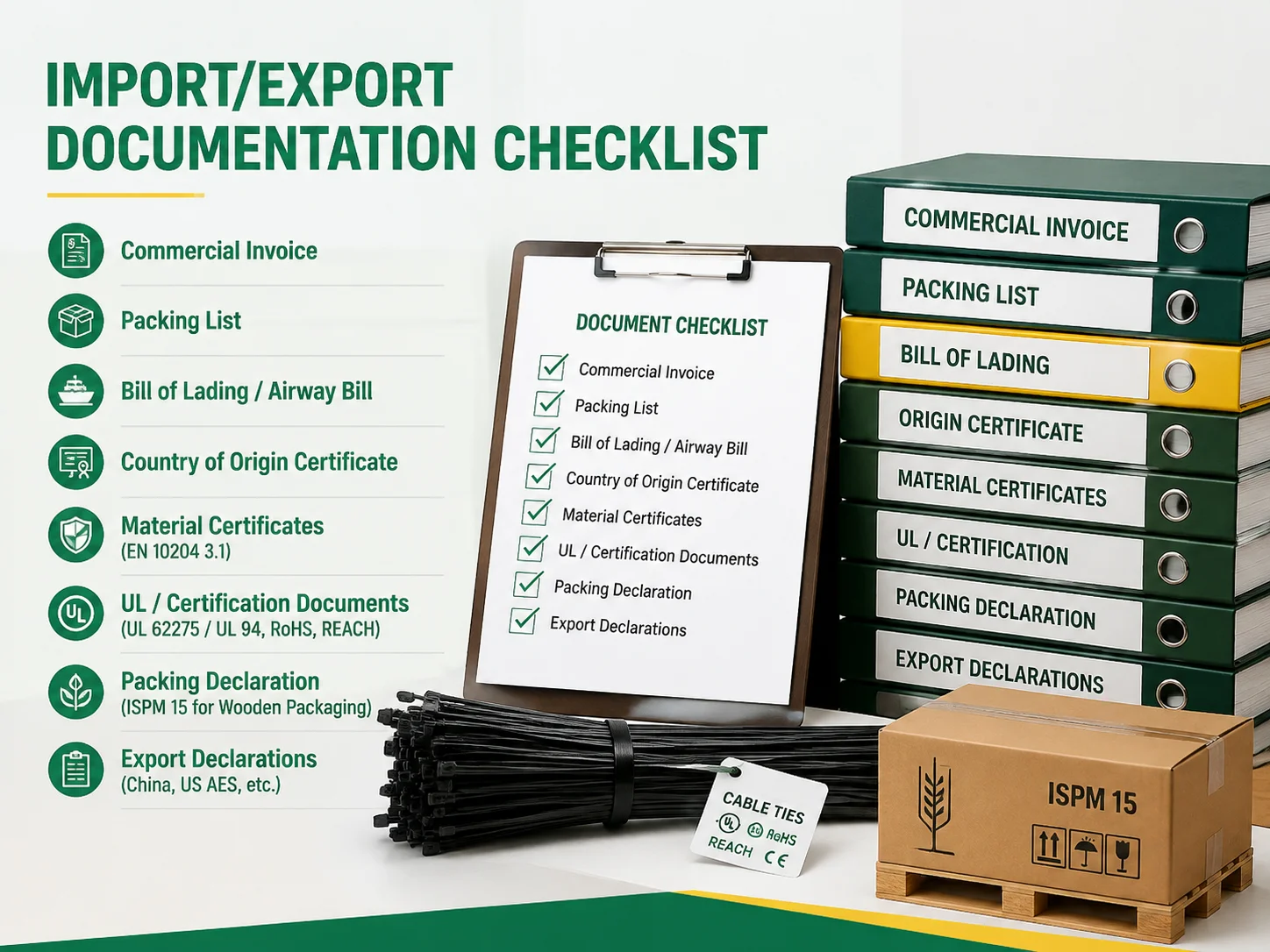
Import/Export Documentation Checklist
In order to ensure an efficient shipment of cable ties, compile the required documents:
- Commercial invoice — an exhaustive description of the shipment along with HS code for each item, barrier value and the total value of the shipment.
- Packing list — all corresponding details regarding the shipment quantity, weight and size of all cartons.
- Transport document — consignment note or air way bill.
- Proof of origin document — for example a certificate from China stating the origin of goods being brought into the country.
- Material certificates — for stainless steel zip ties, EN 10204 3.1 certificate confirming the manufacturing process.
- UL certificate — an UL 62275 or UL 94 certificate if applicable as requested by consumers in US and necessary for EU market.
- Packing xml declaration — if the goods are shipped on wooden pallets then an ISPM 15 certificate is required.
- Export declaration — as per the nation of origin’s regulations (the requirements for China_ export declaration, US regulations etc.).
A good factory ally provides all of these things routinely, and a compliance-ready exporter is a key indicator of a trustworthy supplier. When sourcing for private-label ties, the same documentation rigor applies.Our nylon tie quality guide, the selection guide, and the standard sizes reference cover the supplier-verification and specification side of the same relationship.
Compliance Best Practices for Buyers
- Classify once, refine two times. Get HS code from vendor to confirm it with customs broker before delivery — one hour check saves two weeks in custom clearance.
- Divide material line items. Do not mix plastic and stainless steel in same line item in one invoice — they can be classified with different categories and tariffs.
- Request vendor to provide their code and ensure it matches real substance (e.g. nylon 6/6 = plastic, Chapter 39; steel = Chapter 73).
- Determine if there are any FTA advantages. Basing on FTA agreement between destination and origin (e.g. USMCA, RCEP, EU FTAs), tariff rates can drop to 0% only with appropriate certificate.
- Consider tariff costs. For import of China goods to USA use actual Section 301 fees as they are significantly higher than simple 5.3%.
- Do consider using licensed customs broker for large batches or first time shipments as they are able to classify and process documents much cheaper than getting penalty.
- Ensure record-keeping for more than 5 years (as required by US CBP) with classification reasons if ruling has been requested.
Frequently Asked Questions
What is HS code 61091000?
Knitted or crocheted T-shirts or singlets are classified under HS 6109.10.00, where “c” refers to the fabric being cotton. This code belongs to chapter 61 — articles made of knitted or crocheted garments. It makes no mention of cable ties, but can be found here as the number is similar to the codes for cable ties. If you are importing garments, you will refer to this number; whereas in case of cable tie imports, you will use either 3926.90 for plastic cable ties or 7326.20 for steel ties.
What does HSN code 854419 represent?
HS 8544.19 referred to insulated winding wire made of copper in the previous tariff schedule (the category of “insulated wire, cable and other insulated electric conductors”). The subheadings of 8544 have undergone reorganization in a number of new versions of HS codes. Winding wire is now classified under 8544.11 (copper) / 8544.19 (other) in the new version of tariff codes. It reflects the group of insulated wire and does not cover cable ties, as they belong to either Chapter 39 or 73, depending on the material.
What is the HSN code for cable tie?
The HSN/HS code related to cable ties will differ based on its material such as the plastic and nylon cable ties which falls under the HS code 3926.90 and is named as the “Others articles of plastics” with 3926.90.9989 in the USA which is levied with a duty of 5.3% while HS code 3926.90.00 in India is charged with a duty of approximately 10%. The stainless steel cable ties have HS code 7326.20 which names it as “articles of wire”.
What does the HS code 85442010 represent?
Coaxial cables and other similar coaxial electric wires fall under HS 8544.20, the code family associated with coaxial cables used in applications of video, telecommunications and RF devices. The classification is included in Chapter 85, which consists of electrical machinery and equipment, thus making it clear that it must not be confused with cable ties.
References
- US CBP Ruling N355863 — Tariff classification of plastic cable ties from China
- US CBP Ruling N359069 — Tariff classification of a plastic zip tie
- Tariffin — HS 3926.90 duty rates across 13 jurisdictions
- USITC — Harmonized Tariff Schedule of the United States (current)
- World Customs Organization — Harmonized System (HS) convention
- USTR — Section 301 tariff actions
Conclusion
The HSN code for a cable tie is assigned according to the material used for making that tie and not according to the name of the product. Therefore, plastic and nylon ties are assigned HS 3926.90 (which includes all other articles made of plastic, as per the ruling of the US CBP for these ties), whereas stainless steel tie comes under HS 7326.20 (which consists of articles made of iron or steel wire). The HS code is 6-digit for all nations but duties will differ from one country to another. For example, it is 0% in EU, UK, and Japan while it is 5.3% in the USA (and it has Section 301 additions for products of China), around 10% in India, and 25% MFN in Mexico. A free trade agreement (such as the USMCA or RCEP) can exempt the ties from these duty payments completely.
As for the practical rules for the cable tie business, one should classify the goods based on the material used, verify details with the broker, avoid mixing up the material lines in the invoice, check if the product is eligible for a free trade agreement (FTA), and find out the duties for the tariff percentage.