


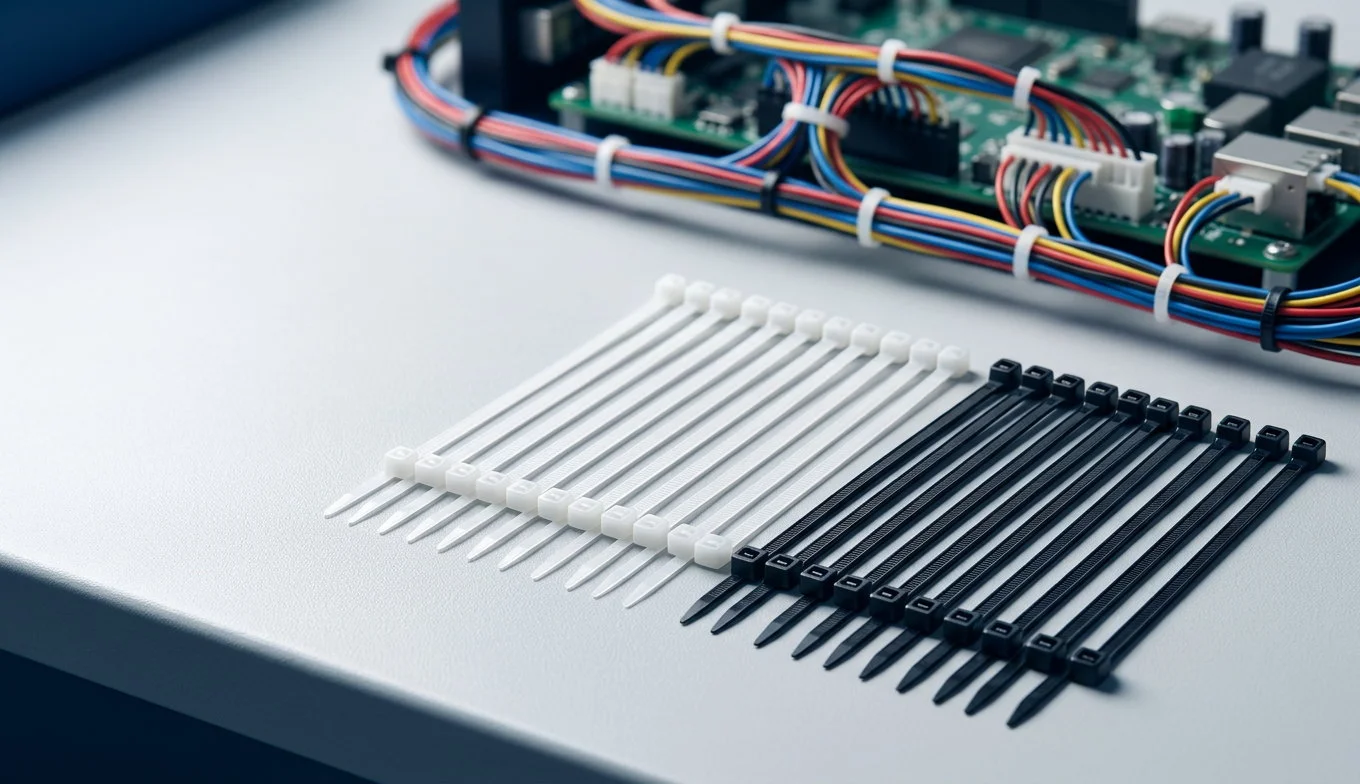



When Were Cable Ties Invented?
Every workshop in the world has some. They help tie together wire harnesses in planes, factories, server cabinets; they seal bread bags and tag products; they are used in construction of garden support systems and bike repairs. But if you ask most people when cable ties were invented, they are bound to look confused. Actually, there is an interesting and documented story behind this invention, whose creator is Maurus C. Logan, an engineer with the company Thomas & Betts. He was watching how workers were tying wires together using wax strings, and thought that a better solution was needed. As a result, he invented Ty-Rap®, which is still considered one of the most famous fastening devices ever and used in manufacturing of around 100 billion products each year.
The article reveals all the boundaries of this story: what people used before cable ties, how Logan’s invention took place, history of the patent and manufacturing of Ty-Rap, improvements in the design and materials, and present-day cable ties.
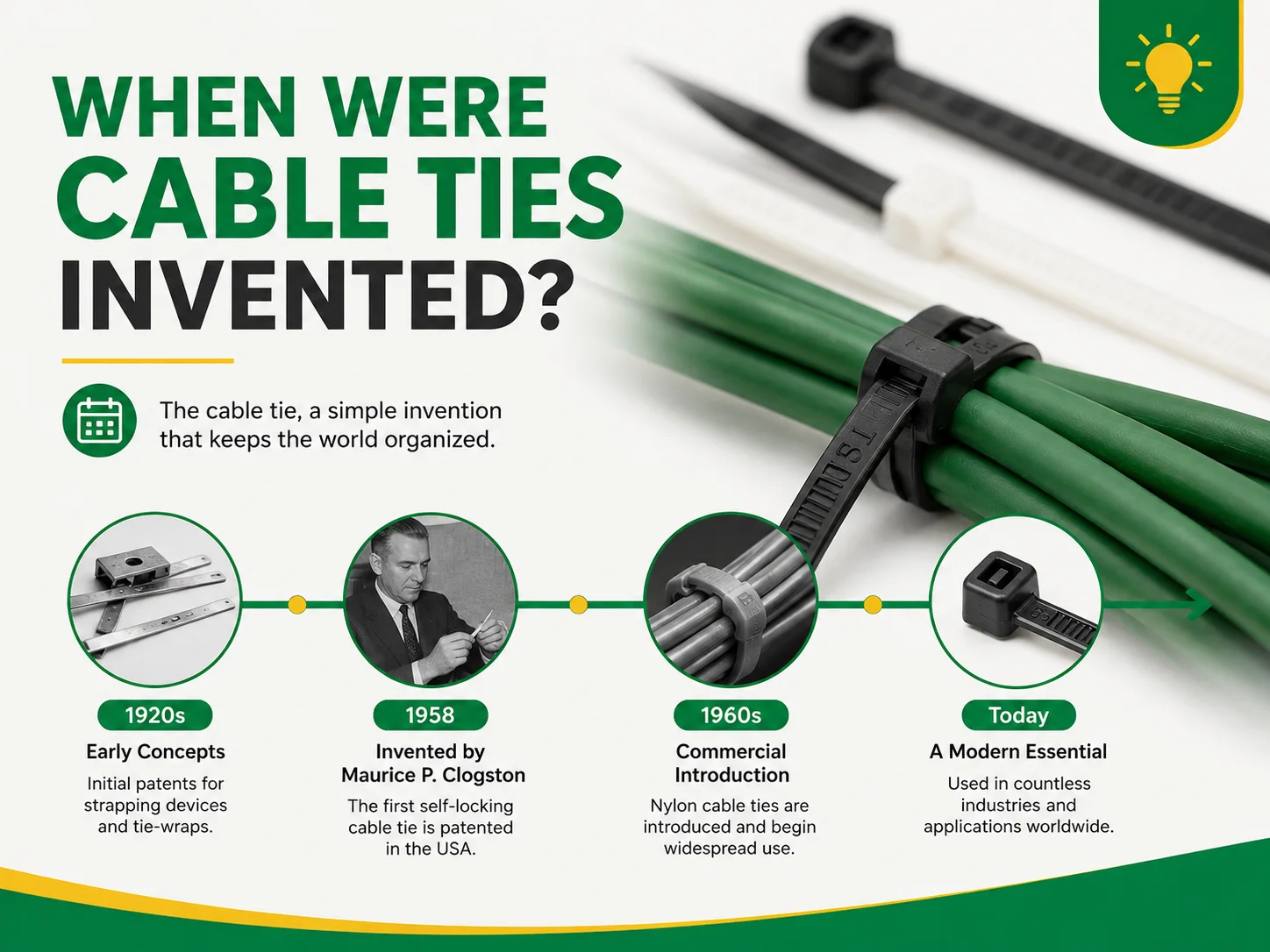
Quick answer: Cable ties were invented in 1958 by Maurus C. Logan, an engineer at the American electrical-components company Thomas & Betts, and were sold under the brand name Ty-Rap®. Logan got the idea in 1956 while touring a Boeing aircraft plant, where workers bound wiring harnesses by hand with wax-coated braided nylon cord — a slow, painful process that left their hands cut and callused (known in the trade as “hamburger hands”). He filed the patent on June 24, 1958. The first Ty-Raps combined a toothed plastic strap with a small metal locking barb inside the head; modern ties are molded in one piece from nylon (usually nylon 6.6) with an integrated ratchet pawl. Thomas & Betts, founded in 1898, is now part of ABB, and cable ties today are produced by more than 45 manufacturers worldwide at an estimated 100 billion units per year. The term “zip tie” — the American colloquial name — comes from the zipping sound the tie makes as it is pulled tight.
Before the Zip Tie: What People Used for Cable Bundling
Prior to 1958, the process of electrical wiring was purely manual. Cables shipped in aircraft factories, motor vehicle plants, and telecom stations were tied up with waxed braided nylon or linen threads through the method known as cable lacing. A worker would lay around the wire with the twist of the cord on the wiring and tie a number of knots: clove hitches, running hitches, and special lacing known today from the military manuals. Many thousands of knots may be made in a single aircraft wire bundle.
Other alternatives did not achieve better results. Metal clamps and tube clips worked, but they were somewhat heavy, costly, and lengthy to attach. Adhesive tape (the predecessor of duct tape) was clinging but was also gone as fast as it arrived. Some facilities also used ordinary twine or string without any coating, which frayed. All methods suffered from the same drawbacks: they were slow, caused damage to plastic insulation over time, and had to be removed entirely for modifications.
The Inventor: Maurus C. Logan and Thomas & Betts
The individual responsible for bringing about this change was Maurus C. Logan, who was born on 6th July 1921 in Dalmuir, Scotland. By 1956 he was based in Elizabeth, New Jersey — where he resided for 60 years — and working as an engineer for Thomas & Betts, an electrical component company. The company was established by Robert M. Thomas and Hobart D. Betts in 1898 in New York City after they began selling conduits to electrical wholesalers as electric lights first entered the city. The company shifted to Elizabeth in 1917 and established a good reputation in the production of electrical connectors and fittings — the kind of products that made Logan’s subsequent discoveries gain commercial acceptance soon after.
Being a very practical-minded engineer, Logan used a hands-on approach in his work. In a few words, his son Robert described him as follows: “My dad was not highly educated but he was the smartest person I have ever known. He didn’t think that doing things the traditional way was good enough.”
The Origin Moment: A Boeing Factory in 1956
In 1956, while the Cold War and the race to space were at their peak, Logan was called to a Boeing plant. At that time, American factories were producing bombers, missiles, and satellites in unprecedented quantities, needing huge amounts of wiring. Logan saw that the aircraft company used huge boards of plywood for their electrical wiring, and all the connecting wires were secured with knotted and waxed braided cords done by hand. This work caused great harm to workers’ hands, as their palms were being hurt by constant knotting and pulling, and became covered with thick calluses and cuts, which the industry called “hamburger hands”. The waxed cord had a downside as well, as it was prone to developing fungi, which caused more steps in the process of working with it and the risk of failing the final product.
Convinced that he could invent a better alternative, Logan dedicated the next two years to the development of his inventions while still doing his ordinary job at Thomas & Betts. He was also not working alone on this because it was clear that the need for such wires existed in the market, and the facilities of Thomas & Betts were ideal to turn this idea into a product.
The 1958 Patent and the Ty-Rap Launch
On June 24, 1958, Logan presented to the patent office his invention for the “long-lasting, easy-to-use tie-Rap cable tie.” The patent described a self-locking strap composed of a flexible band with a series of interlocking teeth, a head comprising a locking mechanism, and a tail to pull through the head. The design patent from 1958 depicts something that could still very much be recognizable as the very similar version of a long-lasting tie-Rap cable tie.
The early Ty-Raps were not made entirely from plastic as the new ties. At first, the molded plastic strap was combined with the small stainless steel barb in the head of the tie, which locked into the strap to securely prevent slipping. Even if the two part design offered the solution to the problem of slip under continuous vibration, it was rather costly in terms of manufacturing. In a few years, with the perfection of the one-piece injection molding plastic processes, the steel barb had been taken out of production, thus modernizing Ty-Rap considerably. Ty-Rap’s commercial launch took place in 1958 and the first month of sales showed rather poor results — $350 which seem to be very little in comparison to the millions that would be produced by the company later. Logan remained working for Thomas & Betts until his retirement.
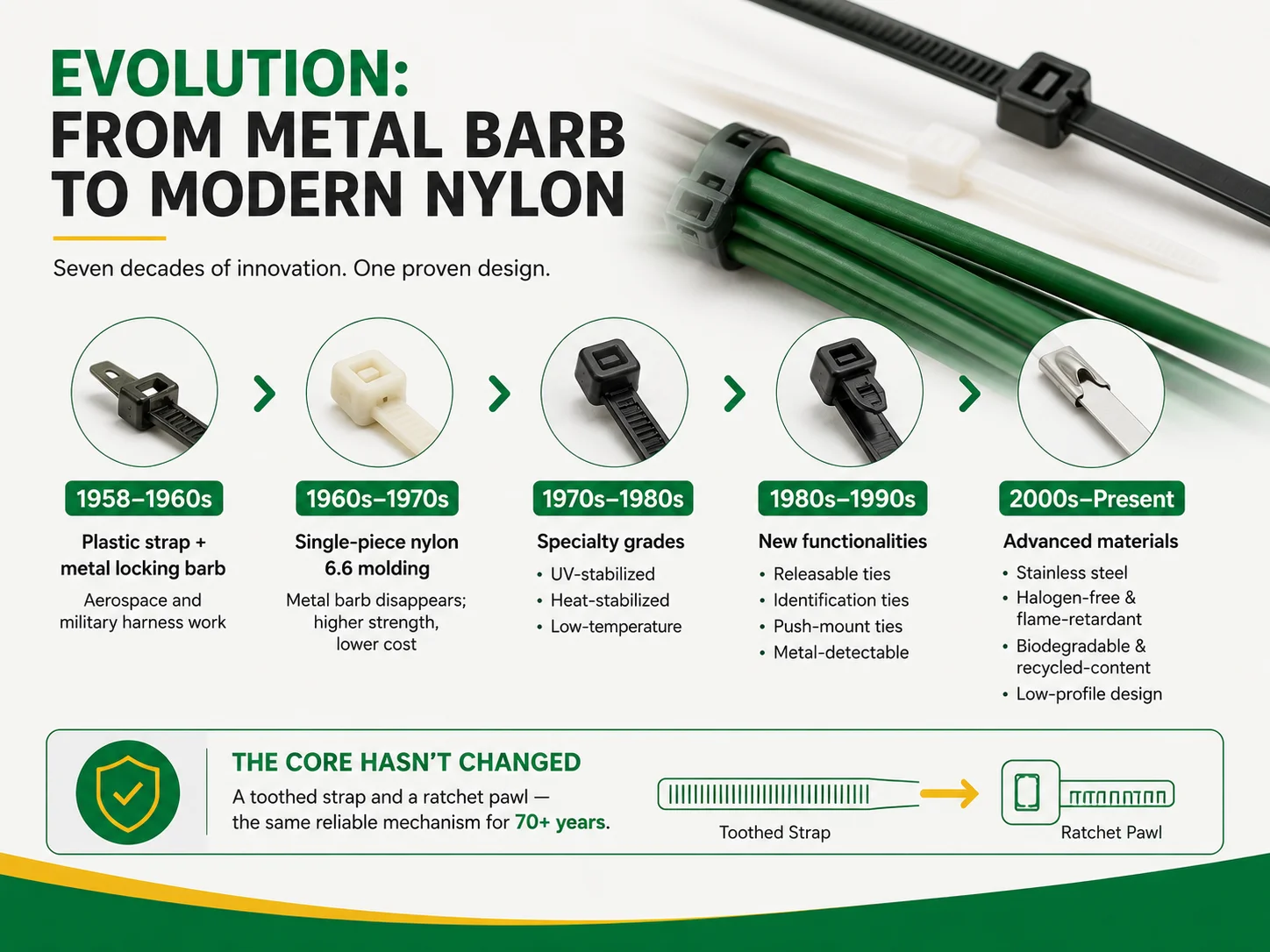
Evolution: From Metal Barb to Modern Nylon
The rise of the cable tie mirrors the history of plastic manufacturing:
- 1950s-1960s: It consisted of a plastic strap and a metallic lock, targeting aerospace and military industries.
- 1960s-1970s: It started to take shape by using an entire piece of nylon 6.6 through the technique of injection molding, it eliminated the metal component thereby increasing strength and decreasing costs.
- 1970s-1980s: Different types started appearing including UV-stabilized nylon for outdoor use, heat-stabilized for motor bays, and low-temperature formulations for areas of extremely cold temperatures.
- 1980s-1990s: This era brought in releasable ties that featured a release tab providing the possibility of lifting the pawl, as well as what are called identification ties using tags to write information, push-mounting ties for the automobile, and metal-detecting ties used also in the food industries.
- 2000s-and beyond: The most exciting changes in this type of product were the introduction of stainless steel ties for extremely low conditions, halogen-free and fire retardant grades, biodegradable and recycled versions, and having a better ergonomics including lower profile of the ties and rounder edges.
The same mechanism — a notch tape and a ratchet — has remained intact for the last seventy years and this fact is the best proof of ownership of Logan’s design.
Why “Zip Tie”? The Naming Story
Ty-Rap is the name given to the product sold by Thomas & Betts although professionals call them cable ties or tie wraps in their specification documents. However, the term which became famous among the populace is “zip tie” which was coined as a result of the peculiar sound called zip produced by the strap while it is pulled through the strap head and fastened. In the UK and many other countries, including Commonwealth countries, the term cable tie or tie wrap is popular. Australians preferred the term cable tie while telecom employees used tie wrap. The term Ty-Rap has been general in these markets and has stopped being a trademark of the invention.
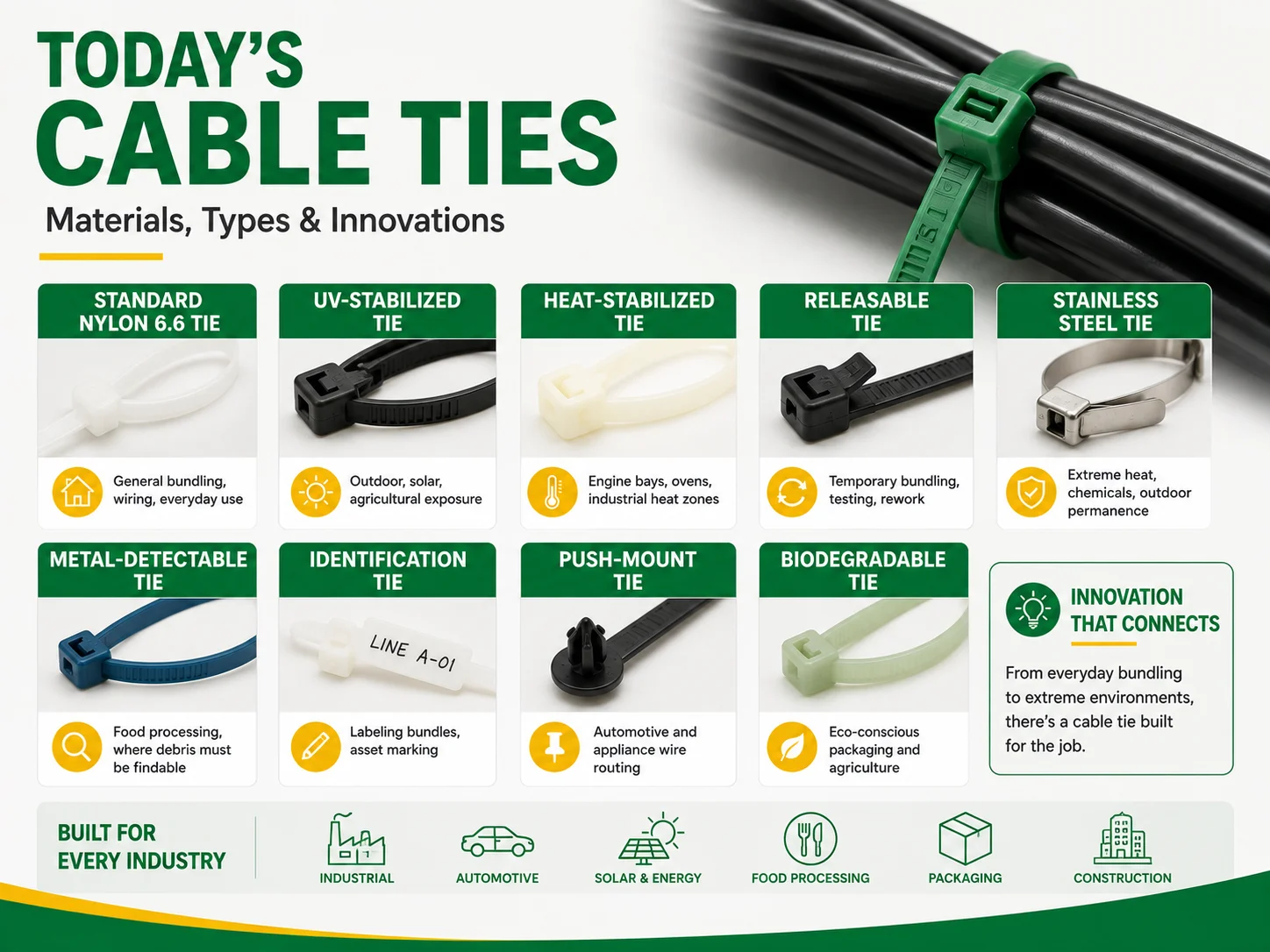
Today’s Cable Ties: Materials, Types, and Innovations
Modern cable ties span an enormous range of materials and configurations, and choosing among them is its own skill — our guide to what zip ties are made of digs into the material science, and the cable tie selection guide covers matching the tie to the job:
| Type | Material / Feature | Typical Use |
|---|---|---|
| Standard nylon 6.6 tie | Single-piece injection molding, 8-250 lb tensile | General bundling, wiring, everyday use |
| UV-stabilized tie | Nylon with UV additives (often black) | Outdoor, solar, agricultural exposure |
| Heat-stabilized tie | Nylon rated for continuous high temperature | Engine bays, ovens, industrial heat zones |
| Releasable tie | Release tab lifts the pawl | Temporary bundling, testing, rework |
| Stainless steel tie | 304/316 steel, all-metal | Extreme heat, chemicals, outdoor permanence |
| Metal-detectable tie | Nylon with metal additive | Food processing, where debris must be findable |
| Identification tie | Integrated writable tag | Labeling bundles, asset marking |
| Push-mount tie | Integral mounting head | Automotive and appliance wire routing |
| Biodegradable tie | Recycled or bio-based polymers | Eco-conscious packaging and agriculture |
For most jobs, the choice still comes down to the basics: tensile strength, length, material grade, and environmental rating — the subjects of our standard cable tie sizes reference and our stainless vs nylon comparison. Quality differences between manufacturers are real and visible — the nylon cable tie quality guide shows what to inspect on a tie before you trust it with a wiring harness.
Cable Tie Facts and Figures
- Date of invention: 1958 (patent filed in June 24, 1958)
- Inventor: Maurus C. Logan, an engineer from Thomas & Betts
- First brand: Ty-Rap® (Thomas & Betts, part of ABB today)
- First-month sales: around $350
- Current global production: 100 billion units every year and produced by more than 45 manufacturers
- Year of establishment of Thomas & Betts: 1898, New York; currently part of ABB.
Frequently Asked Questions
What did people use before zip ties?
Prior to the use of cable ties, wiring was bundled using waxed braided nylon or linen string, which was employed by hand knotting, in addition to metal clamps and adhesive tapes. In the airplane manufacturing plants, the manual process involved in knotting caused injuries to workers’ hands such that the term “hamburger hands” was coined to refer to the injuries experienced by workers.
What do British call zip ties?
In the UK and the Commonwealth region, the term cable tie is used, which is the technical term and the name used in the engineering specifications or tied wraps. The origin of the term “zip tie” is in its use in North America, where the name is derived from the sound associated with tightening the cable tie.
When were zip ties first used?
The Ty-Rap cable tie was first introduced in the commercial market in 1958 by Thomas & Betts, after Maurus C. Logan observed the product at the Boeing manufacturing facility. The initial use of Ty-Rap cable tie was in assembling wires for the manufacture of aircraft wiring harnesses. The product was then used in the industry, the packaging, the electrical and electronics industry and many more.
Why do people cut zip ties at an angle?
Angle cutting of the tail of the zip tie has two advantages. One is that it creates a sharp point that prevents snagging. Second, angle cutting of the zip tie tail makes it easy to reinsert the tail in the head. Angle cutting was adapted from electrical work where pointed tails were regarded as hazardous.
References
- BBP Mag — Who invented cable ties? A history of ingenious fastening
- Cable Ties UK — Who invented cable ties? The life of Maurus C. Logan
- Hackaday — Excuse me, your tie is unzipped: history of the zip tie
- Wandu Cable Ties — When were zip ties invented? Origins and evolution
- Wandu Cable Ties — Who invented zip ties? The complete story
Conclusion
The cable tie exemplifies an invention that was made because there was a need for it. An engineer from Scotland visited a Boeing plant in 1956 and saw workers injuring themselves trying to tie knots of cords, then spent two years making a better product. The patent for the cable tie was issued on 24-june-1958. It was a strap with teeth, a lock and a ratchet. The cable tie survived the engineer who invented it, the company that produced it and the planes it was used for. After seventy years, the design has not changed, but the materials have varied a lot. Today cable ties can be made of nylon, stainless steel, UV stabilized material, etc. The product is produced in the amount equal to 100 billion units yearly.