



What Are Aerial Support Cable Ties Used For?
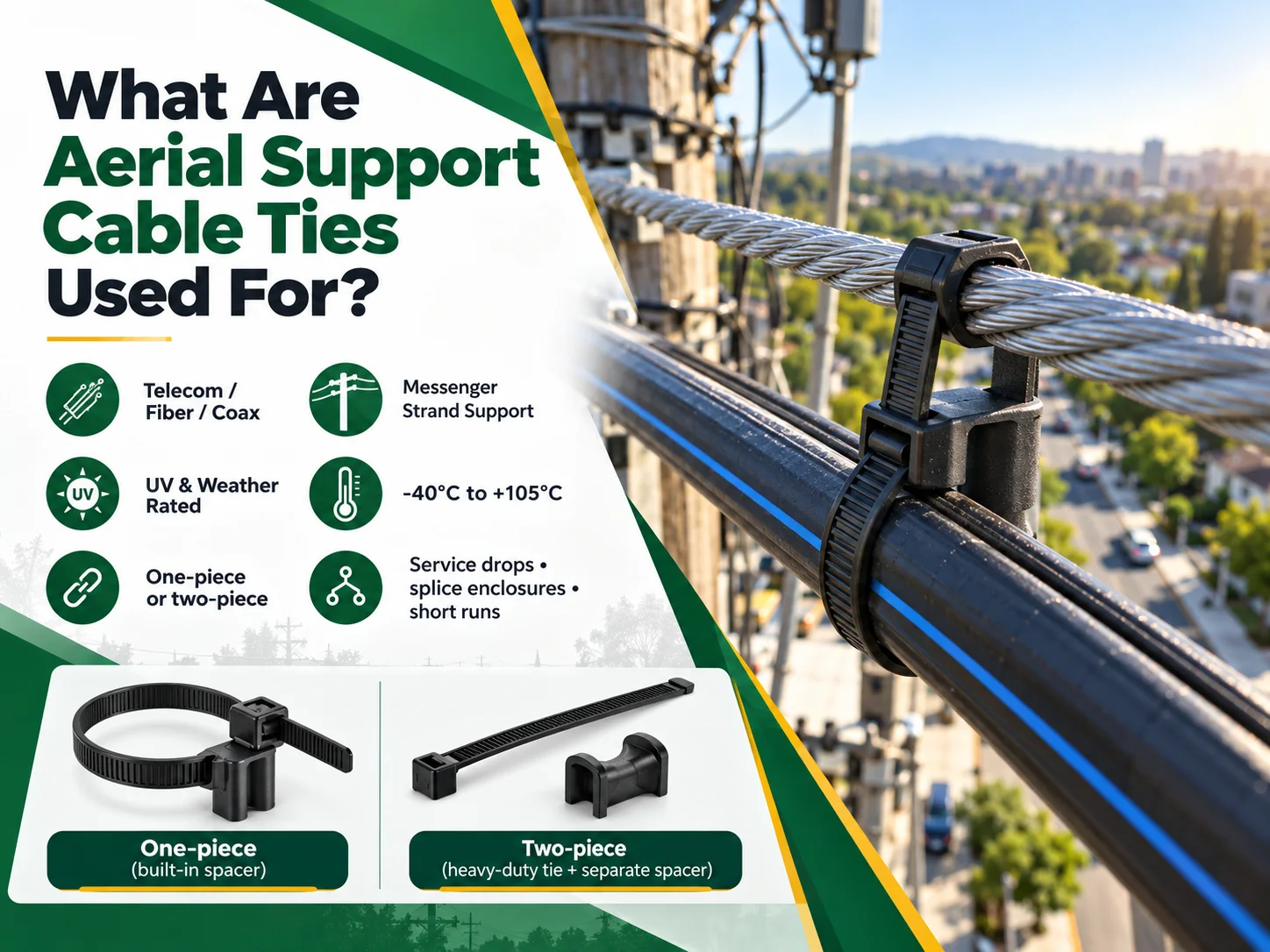
Aerial support cable ties are highly durable products designed to withstand harsh weather conditions. Their main function entails fastening telecommunications, coaxial or fiber optic cables on steel cables placed on utility poles. Most of them consist of two loops and a small spacer produced using molding process. Quite simply, one loop wraps around the cable, while the other one is fastened around the strand. With the help of the spacer, the two do not touch each other.
This guide is aimed at educating the people on aerial cable ties, the most popular types of ties used by workmen, the important parameters of an aerial cable tie, how far apart the aerial cable ties are supposed to be fixed as well as how to determine whether the aerial cable tie will withstand severe weather conditions.
An aerial support tie, often referred to as an aerial support cable tie or an aerial spacer tie, is an outdoor-rated cable tie that serves to attach a cable to a messenger strand or any other support cable. A one-piece aerial support tie will consist of a cable loop, a strand loop and a built-in spacer of about 12.7 mm (1/2 inch), while a two-piece system is based on a conventional heavy-duty aerial tie fitted with a separate stackable spacer. Since aerial ties serve outdoors on posts and wires for many years, they are made from UV-stabilized, heat-stabilized and often impact-modified nylon 6/6 or weather-resistant polypropylene with the operating temperature varying from −40 °C to +105 °C.
What Are Aerial Support Cable Ties?
The cable on typical overhead telephone lines has no weight of its own. The steel messenger wire is supported using poles to pull the cable in its place. The messenger wire can bear a load of about 6,000 pounds, depending on its thickness.
One method of attaching the overhead cable is the aerial support tie. Its common one-piece design consists of the following steps:
1. The strap wraps around the cable and goes through the first slot of the head to form the loop around the cable.
2. The strap wraps around the messenger and goes through the second slot in the head to complete the loop around the messenger wire.
3. A spacer is created in the head’s design to hold the cable away from the messenger wire, preventing wear of the cable jacket.
In operation, ties are installed with the use of hands, possibly while wearing gloves, from a bucket truck or ladder. Thus, most designs have big heads and a bent tail for easier fastening.
Where Cable Ties Fit in Aerial Plant
Understanding what ties should and shouldn’t do on an aerial path is essential. For long spans, the usual process is still lashing where lashing wire that is made of stainless steel is spun continuously around the cable and strand usually measuring between 0.038 to 0.045 inches. In general, municipalities will have specifications considered lashing wire as default and permits black outdoor nylon cable ties as a substitute material whenever its use is specified in a given contract.
The messenger strand is responsible for carrying the load on a span while the tie is not. The role of the tie is to hold and position the cable properly along the strand under the required tension. Therefore, should a design require ties to support a cable, then such a design is incorrect and not the tie.
Cable ties take over at the points where lashing is awkward or impossible. On a typical pole line, those spots look like this:
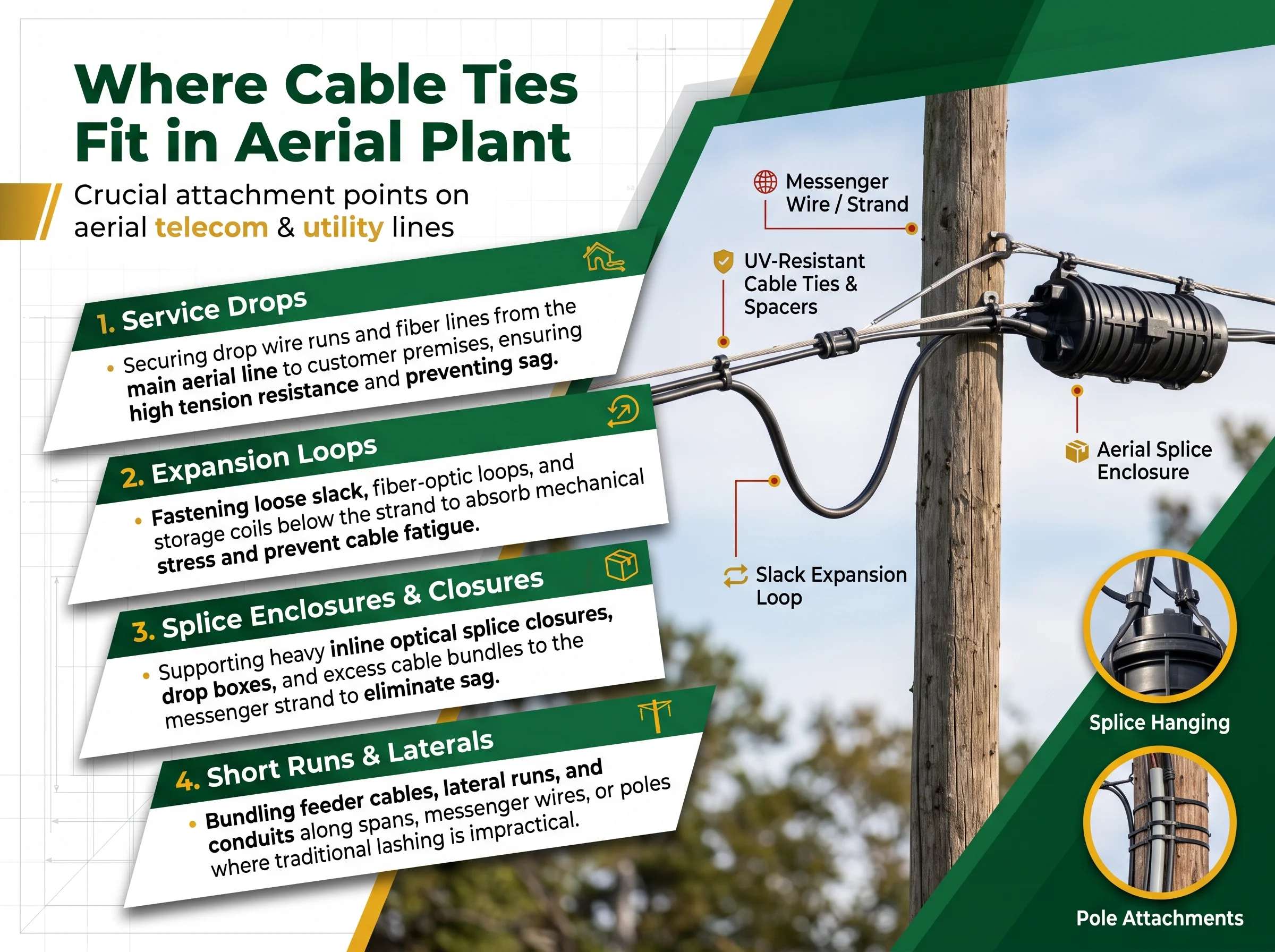
Here is what each of those jobs involves.
Service Drops
The drop connected from the pole to the premises is the basic aspect of installations. The drop cable is anchored to support wire through aerial support ties.
Expansion Loops at Poles
Installation crew makes expansion loops at the poles so that the cable can expand and sag when the strand warms up in summertime and contracts in wintertime. The cable installation guidelines require that the loop is more than twice as long as its depth, and more than twice as big as the minimum bend radius of the cable. Ties and spacers keep the shape of the loop and prevent it from contacting the hardware of the pole.
Splice Enclosures and Slack Storage
As the fiber enters the aerial splice closure, it needs to be fed at the right angle. A stack of spacers is used to segregate fiber entries.
Short Runs and Figure-8 Cable
Some norms state that on short runs of traffic signal interconnect, either locked ties or lashing wire may be used, where either is put with the spacing of 12 inches maximum, or otherwise ties are supposed to be used with the installation of figure-8 cable.
Temporary Holds and Risers
It is also important to hold the cable temporarily by means of using strong wire ties with UV-resistance when it is necessary to lash the cable.
The Primary Types of Aerial Support Ties
One-Piece Ties That Include Pre-built Spacers
This is the typical type. A representative section measures 270 mm in length and 12.7 mm in width, can hold cable bundles having an approximate diameter of 70 mm, molded from heat- and UV-stabilized, impact-modified nylon 6/6 rated at −40°C to +105 °C. There is no way for releasing the ties once attached.
Releasable Polypropylene Aerial Ties
A different family uses weather-resistant polypropylene with built-in spacers of 1/2 long to fit into 1/4 or 5/16 size lines, coax, and telephone wires. Ties can be detached which makes the arrangement of drops easier, although their minimum loop pull is lower than 75 lb, also the lengths vary from 142 mm for a 25 mm bundle up to 254 mm for a 63 mm bundle.
Standard Ties Equipped With Spacers
A two-part solution utilizes a spacer block between two pieces. Stackable aerial spacers are clicked into one another and allow increasing the space in increments of 1/2 inch which is effective in connecting points or where several lines join one strand. Spacers make the shape while ties bring the strength. The guide to zip ties spacers contains information about how to correspond tie length and width to the spacer’s slot.
Stainless Steel Ties
In the environments like coastal areas, heavily industrialized zones, or in conditions with intense heat one has to switch to stainless steel ties. Such ties resist corrosion and UV, however, installation difficulty is greater compared to all other types.
Specifications That Actually Matter
| Spec | What to look for | Why it matters |
|---|---|---|
| Material | UV-stabilized, heat-stabilized nylon 6/6, ideally impact-modified; or weather-resistant polypropylene | Sunlight and heat cycles are what kill outdoor ties |
| Color | Black | Carbon black is the UV stabilizer in most outdoor nylon |
| Width | About 11 to 12.7 mm on dedicated aerial ties | Wider straps spread load and resist wind abrasion |
| Tensile | From about 75 lb (polypropylene) to 120 lb and up (nylon 6/6) | Ice load and wind add force well beyond the cable’s weight |
| Temperature | −40 °C to +105 °C or better | Strands in desert sun and northern winters see both ends |
| Closure | Non-releasable for permanent work; releasable for drops that change often | Permanent spans should never rely on a release tab |
| Strap design | Outside serrations | Keeps teeth off the cable jacket |
Using common nylon zip ties, white nylon or indoor nylon is never allowed for aerial span applications. Over time, without any UV stabilization, the tie becomes brittle when exposed to sunlight. Snapping of ties 20 feet above dramatically increases the risk of sagging cables which, in turn, will generate the need for locksmithing and additional repairs.
The absolute minimum for outdoor aerial work is black nylon 6/6. Some manufacturers state that their specialized ties can last 15 years or more when made of special resins. However, actual conditions will matter, so the performance of aerial ties will depend on the climate. For general outdoor tie work at poles, risers and cabinets, our UV resistant black cable ties are made for solar, telecom and outdoor electrical jobs, and the comparison of the best zip ties for outdoor use covers when to step up to nylon 12 or stainless steel.
Spacing and Placement
There is not a conclusive number, which is universally applicable. The cable owner’s construction standards, the utility’s joint-use agreement, and local regulations form the basis of how the spacing is set. Still, some patterns keep on cropping up repeatedly:
Tight spacing on tie-only runs. One interconnect standard required by a public agency states that locking cable ties or lashing wire should be no more than 12 inches apart.
A tie at every transition. Where the cable leaves a strand for a drop, a riser, or closure, place one tie where it makes the departure and another approximately 4 inches from it.
Respect the bend radius. Ties at an expansion loop or closure entry should hold the shape yet not force the cable tighter than its minimum bend radius. Fiber optic cable is especially sensitive to this.
Stay clear of the pole hardware. Spacers and tie heads should not rub on bolts, clamps, or guy attachments.
How to Install Aerial Support Ties
Once a crew has the rhythm, each tie takes well under a minute. The order never changes: cable first, strand second, spacer in between.
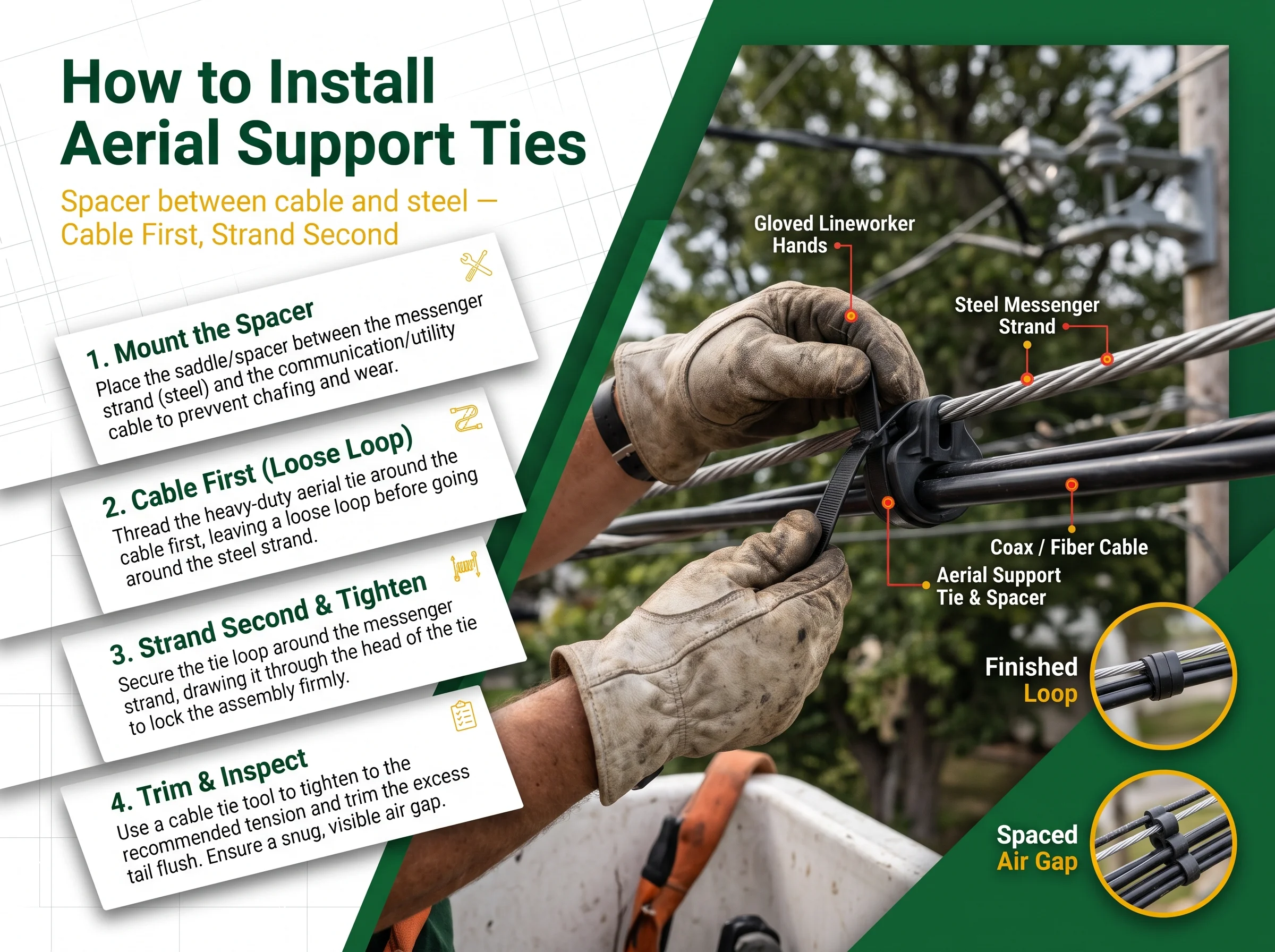
Step by step:
- Verify the size of both the strand and the cable. Make sure the diameter of the strand, measured in 1/4, 5/16 or 3/8 inches, and that of the cable lies within the specifications of the tie.
- Begin with the cable. Loop the strap around the cable with the prongs outward and pull it through the cable-side of the strap.
- Wrap the messenger. Bring the strap around the strand and send the strap through the strand-side of the strap.
- Tighten to an appropriate amount. Hand-tighten it till the union cannot slide down the strand anymore. For long linear installations, a tool can apply effective tension as is shown in the guide for how to use a zip tie gun. Overtightening will damage the coaxial cable and perhaps affect its performance.
- Cut the excess properly. A long tail will whip in the wind and damage the cable while an uneven one will catch on the gloves during the next job. The tools and technique in how to cut cable ties leave a smooth edge.
- Examine the line visually. Check the installation for proper spacing and orientation and make sure nothing is pinched in the loops or joints.
Aerial work close to parked power lines can be done only by licensed personnel who observe the respective regulations and safety rules.
Choosing Ties for Hot, Cold and Coastal Sites
The climate plays a greater part in the choice of materials than the majority of the data sheets are willing to acknowledge.
Desert and Gulf temperatures. Constant ultraviolet (UV) light and high temperatures demand the use of UV-stable black nylon and impact-modified plastics to ensure the ties can handle the expansion and contraction caused by daily temperature changes.
Cold weather. Nylon becomes less flexible when temperatures drop below freezing. Impact-modified plastics stay tough, and installers must not use ties that have been stored in a truck overnight at freezing temperatures until they warm up.
Ice and wind zone. Ice adds weight, wind adds vibration. Therefore, wider straps should be considered, more strict spacing standards adhered to, and tensile load verified.
Coastal and industrial air. All the chemical and salt exposure have to be addressed by the use of stainless steel wire and stainless fasteners at crucial parts and nylon ties for drops and bends.
For pole, riser and cabinet work alongside dedicated aerial ties, a 4.8 mm tie in the 50 lb (22 kg) class, such as our high strength cable tie, handles most small bundles, and our cable tie sizes guide helps match longer and wider ties to bigger bundles.
Common Mistakes on Aerial Runs
- Not enough ties. By increasing spacing beyond the accepted norm, the cable droops in-between ties creating additional loads on them due to wind and ice.
Skipping spacers. Cables pressed directly against strands of steel wear out faster than expected, especially in areas with wind.
Over-tightening coax and fiber. A tie that squashes coax changes its impedance and a tie that applies pressure to fiber creates signal loss.
Mixing tie grades in one run. A single natural nylon tie in a series of dark UV ties is the first one to fail.
Leaving long tails. They flap in wind, damage the cable and fail the inspection.
Ignoring the aged ties. An existing run should have failed or damaged ties removed altogether instead of just adding new ones beside them. Our guide on how to remove cable ties covers cutting them off without nicking the cable.
Inspecting Aerial Ties Over Time
Once an aerial plant is installed, it is easy to overlook it, which is why tie issues often go unnoticed. Most problems can be caught early simply by checking aerial plant equipment periodically during regular inspections or whenever a crew visits the pole.
Color and texture. Black ties that have turned gray, appear chalky, or have developed fine surface cracks show signs of UV protection failure.
Flexibility. If a tie breaks under light stress, all ties from the same batch should be suspected.
Location. Ties that have slipped along the span, turned to the point at which the spacer is no longer between the wire and the rod, or moved from where they are supposed to be need adjustment.
Jacket damage. The presence of shiny or flattened areas in the vicinity of a tie indicates the presence of vibration-induced friction, which occurs when either the spacer is absent or the tie is not tightened enough.
Ties that have been identified as potentially faulty should be replaced either all at once in one operation or in batches. The date and details of the ties should be logged so that the next crew that arrives knows what has been done.
Frequently Asked Questions
What are aerial support cable ties used for?
They connect telephone, fiber optic, coax or a signal cable to a messenger wire between different poles, usually at some service drops, expansion loops, splice chambers or short runs. The integrated spacer keeps the cable away from the steel wire to avoid damage.
Can I use regular zip ties on a messenger strand?
Only if the black outdoor ties are UV-stabilized, are of suitable width and strength, and are permitted by the specifications of the cable owner. Indoor-style ties deteriorate under sunlight and are not suitable for outdoor use.
How far apart should aerial cable ties be?
Adhere to the construction standard of the cable’s owner or agency. For instance, the public agency’s interconnect standard specifies that ties must not exceed 12 inches apart, and that there must be additional ties wherever the wire leaves the strand at any point.
Are aerial support ties better than lashing wire?
Their functions differ. Lashing wire is quicker and the default solution to long distances, while ties are better suited for drops, loops, closures and other short distances where a lashing technique is not viable. Numerous roads use both.
How long do aerial support ties last outdoors?
High-grade heat- and UV-stabilized nylon ties are designed for many years outdoors, with some manufacturers claiming 15 years or more. Actual life depends on UV intensity, heat, wind and installation quality, so inspect aerial plant regularly.
References
- Cable tie, Wikipedia
- Aerial interconnect design standard, Florida Department of Transportation
- Construction specification, Section 804 Cables, City of Toronto
- Aerial workmanship, The Fiber Optic Association
Conclusion
Aerial support cable ties are small parts with a long, exposed working life. The load is carried by the messenger strand while the function of the tie is to hold the cable in position and keep it well spaced throughout the period of the heat wave, ice storms and wind. Use black and UV- and heat-stabilized cable ties of proper width and strength, have the cable properly spaced from the strand with a spacer, stick to the guidelines in your construction code when it comes to spacing specifications, tension the cables without crushing them and cut off the excess tails making them flush. For the standard outdoor ties that support aerial work at poles, risers and cabinets, browse our nylon cable ties and cable glands.