



Does Nylon Shrink?
While changing a corroded cable tie on machinery near a steam line, a maintenance technician at a food processing facility picked a typical nylon cable tie from the stores. He made the tie tight. One week later the bundle was hanging loosely, with the cable tie shrinking and tightening the tie around the tubes. However, while locking the cables, the cable tie’s width had diminished to some extent, taking away part of its tension. The findings of the technician confirmed an important characteristic of nylon which is often disregarded: nylon tends to shrink under high temperatures, impacting its performance regardless of the type of product – cable tie or textile or injection-moulded element. It is crucial for everyone who selects, uses, or relies on nylon cable ties to know the following information about nylon shrinking: where and under what circumstances it shrinks and by how much. In this guide, the basic principles of nylon shrinking are explained together with the impact of this process on the manufacture and use of nylon cable ties.
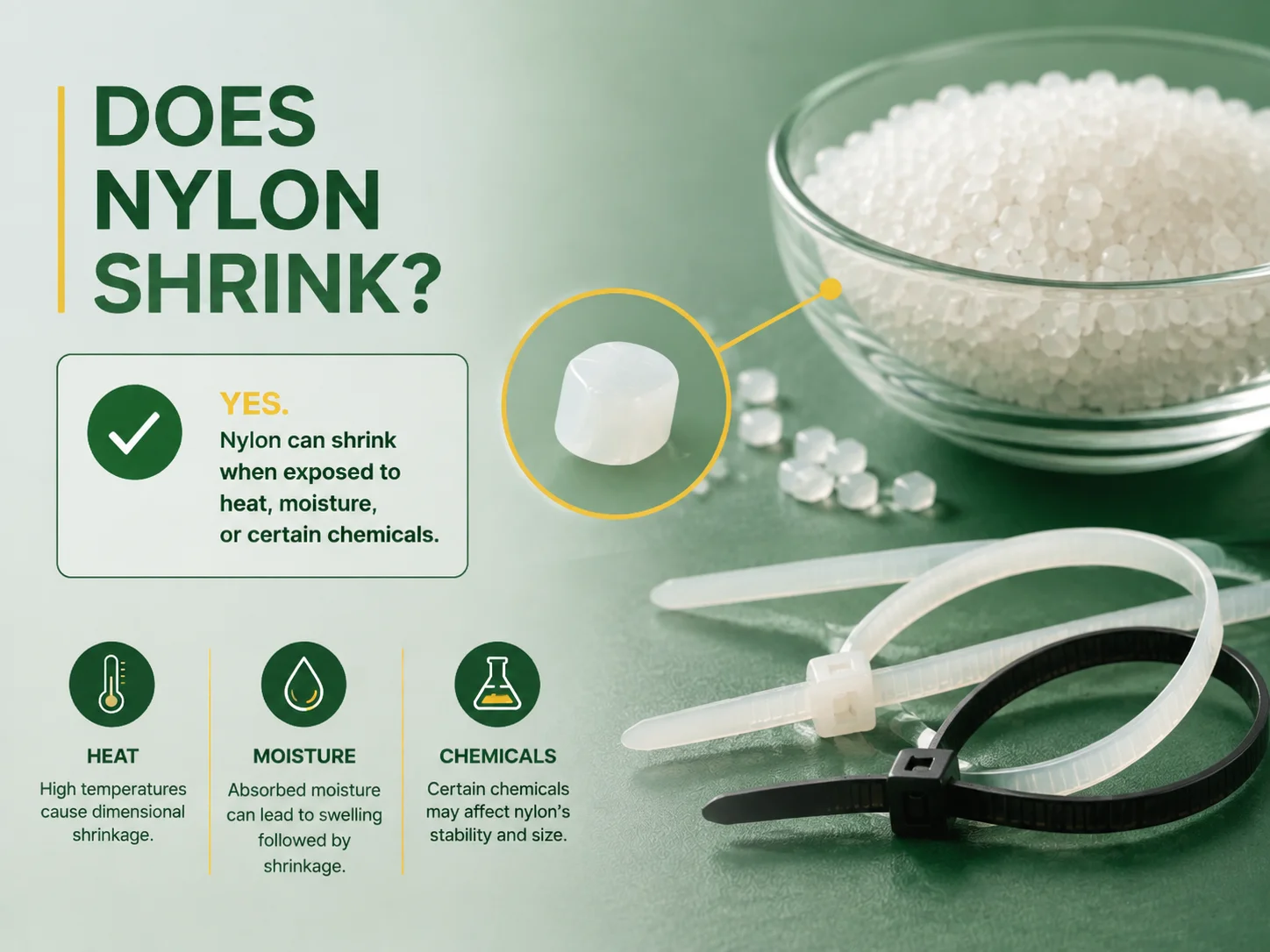
Nylon 6/6 is the substance from which most cable ties are made from. This material can contract when heated and also change size slightly due to moisture absorbance or loss. In use, the shrinking of a nylon cable tie mostly results from thermal relaxation of the strains that were created in it during the injection molding. When the nylon is subjected to a temperature above its glass transition point (its actual value depending on the moisture content of the material, the approximate range being from 50 to 60 degrees Celsius), the polymer chains obtain mobility enabling them to relax from a stretched the oriented state back to the less efficient random state and therefore to decrease in size.
Why Nylon Shrinks: The Science of Moulded‑In Stress and Thermal Relaxation
To understand the reason for the shrinking of nylon, first, we have to know what happens inside the nylon while it is being injected molded. Nylon 6/6 is a semi-crystalline polymer. While it is melted and injected into the mold cavity under great pressure, the long chain of polymers has to move through the narrow channels of the mold cavity. After the cooling process and solidification, the chains remain in the stretched, oriented form with alignment in the flow direction, being in stress. This is not a mistake; this is just a basic property of the injection molded nylon and happens to every nylon cable tie produced. The orientation provides the cable tie with high strength in the length direction since in the stretched form, it can withstand greater tensile forces compared to the randomly-oriented polymer. Nevertheless, this constitutes non-optimal conditions for the material as we still have a chance that with heating the polymer chains will start relaxing to the more randomized form. Upon this happening, the material will be shrinking along the initial flow direction of the cable tie. Because of this, the cable tie made of nylon shrinks when heated, meaning that its molded-in orientation is relaxing. The temperature at which this relaxation process starts is called the glass-transition temperature (Tg). The Tg for nylon 6/6 equals about 50-60 degrees Celsius. When the temperature is lower than this value, cable tie dimensions are stable. When the temperature is higher than Tg, the cooling process will cause the shrinkage of 1-3% for hours or days.For a deeper understanding of how nylon 6/6 behaves at elevated temperatures and how heat‑stabilised grades extend the service range, our guide on whether zip ties are heat resistant provides the continuous‑service and melting‑point data for every common cable tie material.
Moisture Effects: The Second, Smaller Dimension Change
Nylon is hygroscopic, meaning that it absorbs moisture from the environment. This is a very well-known property of this material which is why nylon cable ties are shipped in hermetically sealed bags and feel slightly stiff when stored in low humidity conditions. When nylon absorbs moisture, it expands slightly as water molecules acting as plasticizers distance the polymer chains from each other. When nylon dries up, it shrinks a bit. This moisture-induced dimension change is minimal compared to the thermal shrinkage mentioned above, usually being no more than a fraction of a percent and reversible in nature with nylon swelling again upon re-absorption of moisture. In normal indoor surroundings, nylon cable tie moisture content stabilizes as per the humidity of the environment in which it is used. The only case when moisture-related shrinkage is of any importance is when nylon cable ties are exposed to excessive dryness at high temperatures, for example, when being located inside an industrial oven or a heated enclosure in dry climate conditions.
How Nylon Shrinkage Affects Cable Tie Performance in Practice
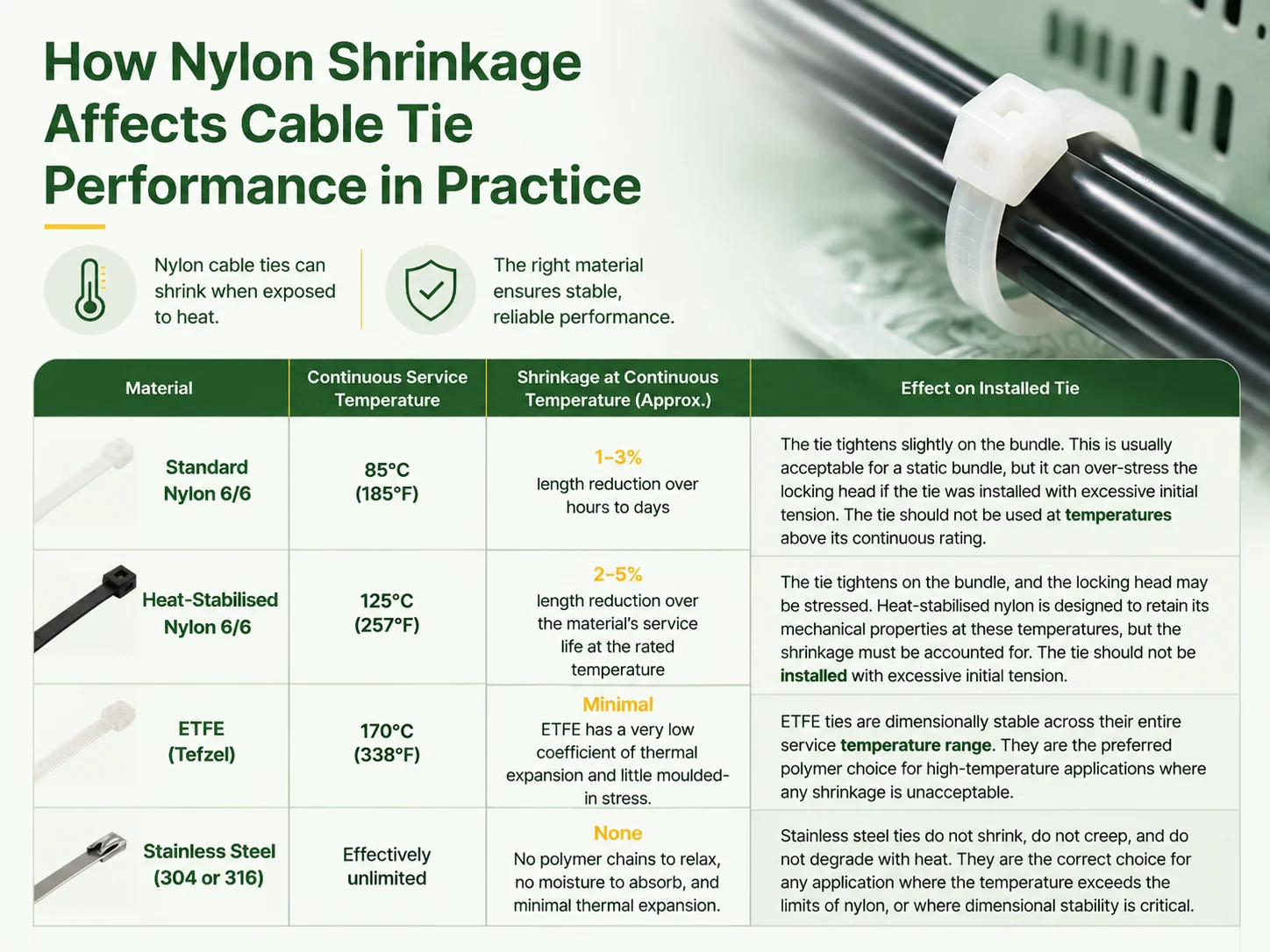
In the vast majority of indoor, room‑temperature applications, the shrinkage of a nylon cable tie is negligible and has no effect on the performance of the installation. A tie that is installed at 20°C and that remains at 20°C for its entire service life will not shrink. The shrinkage becomes a practical concern only when the tie is exposed to sustained elevated temperatures, and the table below summarises the behaviour of different cable tie materials under thermal stress.
| Material | Continuous Service Temperature | Shrinkage at Continuous Temperature (Approx.) | Effect on Installed Tie |
|---|---|---|---|
| Standard Nylon 6/6 | 85°C (185°F) | 1–3% length reduction over hours to days | The tie tightens slightly on the bundle. This is usually acceptable for a static bundle, but it can over‑stress the locking head if the tie was installed with excessive initial tension. The tie should not be used at temperatures above its continuous rating. |
| Heat‑Stabilised Nylon 6/6 | 125°C (257°F) | 2–5% length reduction over the material’s service life at the rated temperature | The tie tightens on the bundle, and the locking head may be stressed. Heat‑stabilised nylon is designed to retain its mechanical properties at these temperatures, but the shrinkage must be accounted for. The tie should not be installed with excessive initial tension, and a stainless steel tie should be considered if the application is critical. |
| ETFE (Tefzel) | 170°C (338°F) | Minimal—ETFE has a very low coefficient of thermal expansion and little moulded‑in stress due to its different processing characteristics | ETFE ties are dimensionally stable across their entire service temperature range. They are the preferred polymer choice for high‑temperature applications where any shrinkage is unacceptable. |
| Stainless Steel (304 or 316) | Effectively unlimited for any environment a cable tie would encounter | None—stainless steel has no polymer chains to relax, no moisture to absorb, and a thermal expansion that is orders of magnitude smaller than any polymer shrinkage | Stainless steel ties do not shrink, do not creep, and do not degrade with heat. They are the correct choice for any application where the temperature exceeds the limits of nylon, or where dimensional stability is critical. Our guide on stainless steel zip ties vs nylon cable ties covers the trade‑offs in detail. |
Nylon Shrinkage in Other Industries: Textiles and Injection‑Moulded Components
Nylon shrinkage does not occur only with cable ties. It is one of the properties of the material and it is the same for any product made of nylon 6/6 and other nylon types. It is used in textiles—nylon fabrics used for activewear, swimwear, outdoor clothing, etc. are usually mixed with spandex or other elastomers to provide stretch and recovery. Thus, a garment made of 100% nylon does not shrink during normal washing and drying cycle as the temperatures are close to or just above the glass-transition temperature and the degree of relaxation is almost negligible. As for a garment made of a nylon-spandex blend like 80% nylon and 20% spandex, it shrinks more because spandex fibers are more heat-sensitive than nylon and the structure of the fabric is changed in the dryer. The instructions on the care labels of every nylon garment—”lay flat to dry”, “do not tumble dry”—are a result of the same process of thermal relaxation and minersment processes in the case with a nylon cable tie placed in a hot industrial environment. The material is the same. The effect is the same. The only difference is the application.
When it comes to injection molded components like gears, bearings and parts of electrical connectors and under the hood parts of the automobile the shrinkage is compensated for in the design of the mold. The mold cavity is cut a bit larger than the dimensions of the part after it has cooled down in the mold. Thus, the shrinkage is taken into account when the mold is made. This is a common practice in the action of injection molding and this is what makes the measurements of a cable tie—length, width and thickness—refer to dimensions after the molding process, and not the mold cavity.
Best Practices for Using Nylon Cable Ties in Hot Environments
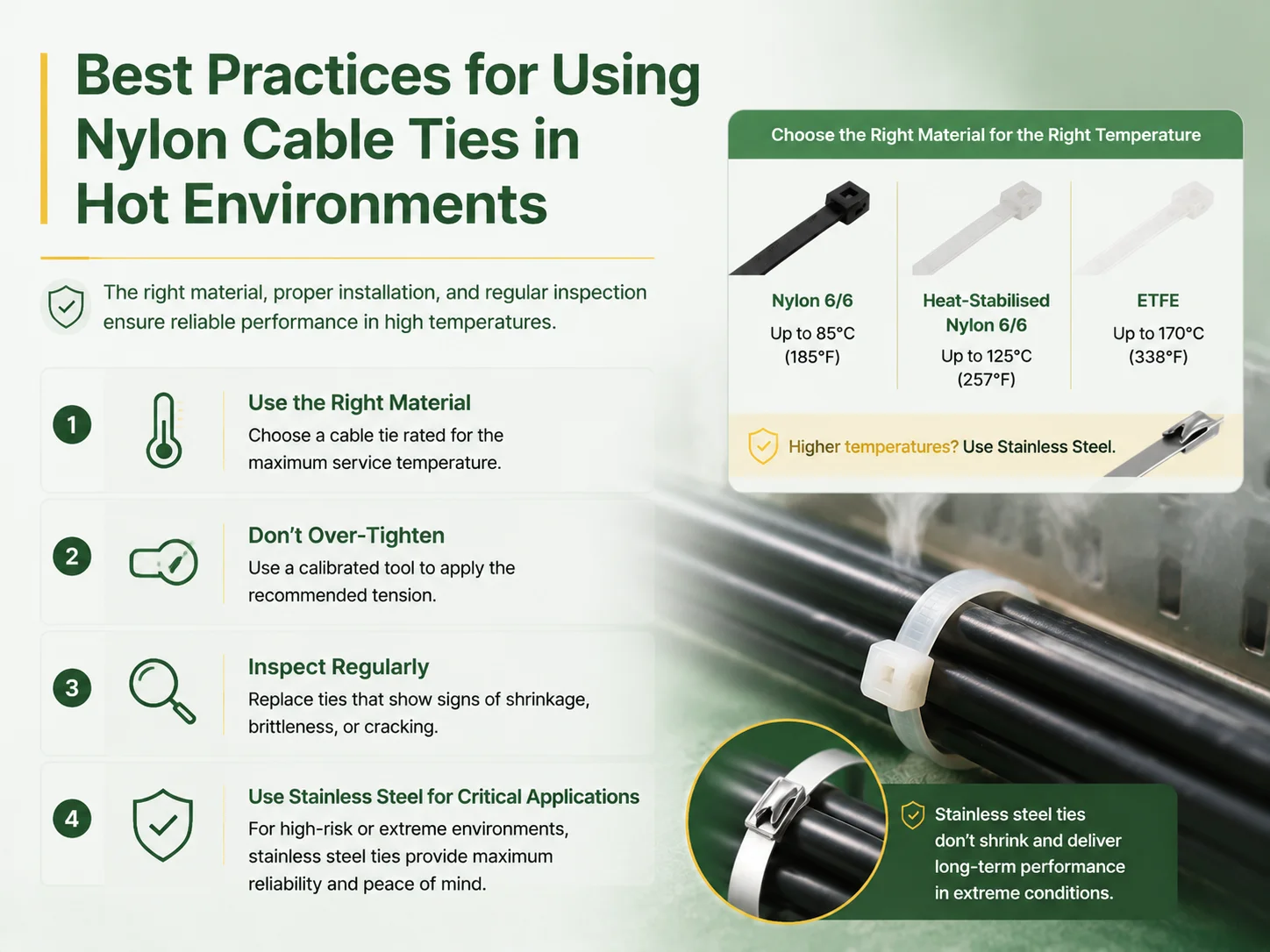
For the installer or designer using nylon cable ties in a hot environment, the next best practices will prevent shrinkage failures that can be predicted and avoided.
First, use material suited to the maximum service temperature. If the ambient temperature at the location is higher than 85°C—be that of an engine bay, a steam pipe or an industrial oven—standard nylon 6/6 must not be used; a heat-stabilised nylon tie that can withstand up to 125°C must be used or ETFE or stainless steel for higher temperature ranges.
Second, don’t over-tighten ties. A cable tie that is tightened to its maximum at room temperature is going to be strained due to the shrinking during operation, which may result in failure as far as the breaking of the splitting head or snapping of strap due to the excessive tension plus the contraction of the tie takes place. When employing a calibrated tool for tensioning ties that operates under the preset stress for a given size of a nylon tie avoids the problem.
Third, monitor installation of ties in hot environments that are used. If the tie has shrunk or became brittle or cracked it needs to be replaced; moreover, the replacement must be of the material appropriate for the temperature conditions causing the failure.
Fourth, in the case of a critical application such as suspended cable ties, safety fastening and outdoor use in deserts where the failure of the cable tie is highly undesirable, use stainless steel from the very beginning. The small additional cost of the stainless steel cable tie as compared to the nylon cable tie is negligible to the cost of a failure incident.
Frequently Asked Questions
Can 100% nylon go in the dryer?
Indeed, a fabric made of rayon and nylon can be placed in a clothes dryer on air or low heat. Nevertheless, high heat must be avoided. The high heat of the dryer reaches temperatures of 70 to 80 degrees Celsius, temperature much exceeding the glass transition of nylon thus resulting in material shrinkage, wrinkling, and changes in shape. Only the manufacturer’s instructions listed on the care label are offered to follow, and tumble dry on low or lay flat to dry can be mentioned.
Will 80% nylon 20% spandex shrink?
When it comes to high heat, it is possible for the fabric combination of 80% nylon and 20% spandex to shrink. As spandex is more heat sensitive than nylon, spandex can begin to shrink and lose its elasticity at temperatures which would not affect nylon. This fabric can also shrink due to the relaxation of nylon and its mechanical action in the dryer. To prevent shrinking of the fabric one should wash it in cold water and air dry it or set the dryer on low temperature.
Does 90% nylon shrink?
Yes, 90% nylon fibers are susceptible to shrinkage just like those of 100% nylon, especially upon exposure to extreme heat and in case the item was not pre-treated before production. The shrinkage, although not exceeding 5%, might considerably change the way the item fits. As for the remaining 10% of the fabric, which could be spandex, polyester, or any other kind of fibers, they also play an important role. A fabric made with 90% nylon and 10% spandex will shrink more than a 100% nylon fabric because spandex is reactive to heat.
What shrinks more, nylon or cotton?
Cotton shrinks much more than nylon. Cotton is a naturally occurring cellulose fiber that shrinks because of relaxation of tensions caused during spinning, weaving, and finishing, and it can shrink 5-10% or more after its first wash and drying cycle, especially if it has not been pre-shrunk. Nylon is a synthetic thermoplastic that shrinks mainly due to thermal relaxation of built-in or drawn-in stresses, with shrinkage usually between 1-5% and only occurring at high temperatures. Cotton clothing shrinks quite noticeably after just one wash in hot water and in a dryer. Nylon clothing will experience no shrinkage at all if washed in cold water and air-dried.
References
- American Chemistry Council — Plastics Division. Information on the thermal and hygroscopic properties of nylon (polyamide), including the glass‑transition temperature and the mechanisms of thermal shrinkage.
- Panduit — Cable Tie Material Specifications and Thermal Performance Data. Manufacturer of nylon, heat‑stabilised nylon, ETFE, and stainless steel cable ties, with published thermal shrinkage data and maximum service temperature ratings.
- HellermannTyton — Cable Tie Material Properties and Environmental Performance. Global manufacturer providing technical data on the thermal behaviour, moisture absorption, and dimensional stability of nylon 6/6 and specialty cable tie materials.
- ASTM D2732 — Standard Test Method for Unrestrained Linear Thermal Shrinkage of Plastic Film and Sheeting. The standard test method for measuring the thermal shrinkage of plastic materials, including the nylon used in cable ties.
Does nylon go through shrinkage? Yes, it does—but only when exposed to temperatures that exceed its glass-transition temperature. In this process, the polymer chains that were frozen during the injection-moulding procedure get back to the configuration of lower energy, consequently during which they shrink. However, the amount of shrinkage is insignificant (about 1 to 3% at a temperature of sustainability) and predictable and manageable and can be completely avoided by choosing appropriate nylon for a particular job. Therefore, it can be stated with confidence that for the cable tie made of nylon will not shrink in an indoor environment at room temperature. Still, the tie is going to shrink in hotspots such as the engine space, in a steam pipe, or in an industrial oven, which result in losing the strength ability of the tie, thus it will ultimately fail. If the installer picks the right type of the nylon cable tie suitable for a specific temperature that withstands it, there will be no failures caused by thermal shrinkage of the tie in practice.