


What Is the Company Name for Identimark.com?
Follow the link identimark.com, and you will see that this company is focused on providing engineering-led infrastructure protection. This is distinctly different from the more mundane offerings of an average electrical wholesale supplier because this company primarily markets its products to transmission utilities and solar developers. The most logical first question to ask when exploring this site might be who this company is and what is their name and where are they based. To answer this question accurately requires knowledge of a couple of different elements, including a trading name, a registered entity and a detailed chronology of how an engraving company established in New Zealand began providing safety signs for solar farms in Australia. This document will answer questions about the name, and as we progress through the sections you will learn about the various types of products offered by this company, who their customers are, what kinds of certification they have, etc.
Identimark operates through its own website and provides Engineering-driven, Infrastructure Protection Solutions for Energy Assets. Through its offerings Identimark produces Identification/Protection Systems for Energy Assets such as Safety Signs/Labels, Cable Safety Management, and Markers. Business Registry indicates that the Legal Entity for Identimark’s operations is Novare Global Limited and Identimark Solutions is the Australian entity of Novare Global Limited (ABN 36 477 982 585) that operates from North Ryde, New South Wales. Identimark Solutions operates under the same legal entity as Identimark. Over thirty years ago, Identimark began as a small engraving shop that was located in New Zealand, but now operates from multiple locations (Brisbane, Sydney, Melbourne, Auckland, Tauranga and Blenheim).
The Name Question Answered
The response includes three layers that differentiate between each other.
When it comes to the name under which the company operates, its trading name is Identimark. This is the name that occurs in its communications with customers and on the website. The website promotes the business as one brand, which is how the consumers meet it.
When it comes to the legal registered entity, the situation is different. Business registry aggregators give the name of the company as Novare Global Limited and provide details on its other business names – Novare Global, Identimark Group, and IdentiMark Solutions. Such corporate structure is common for companies that have been formed through acquisition or take-up businesses in two different countries in which case the trademarks are unified for the market but the legal status of the company differs depending on its history.
When it comes to the operating entity in Australia, it is listed in supplier directories as Identimark Solutions with the ABN 36 477 982 585 and showing its registered address at Macquarie View Estate, Unit 18b.2, 112-188 Talavera Road, North Ryde, New South Wales. Its Australian phone number is 1800 980 182 according to the information on the company site while 0800 700 300 is the number for New Zealand.
It should be mentioned that all of the mentioned names, ABNs, and company names are just formal information that can be changed due to corporate restructuring, which means that the databases of business aggregators cannot be considered trustworthy. If you are going to enter the name of the legal company in the contract, tender, or application, make sure that you confirm that information with ASIC in Australia or New Zealand Companies Office rather than your own website.
What the Company Actually Does
The firm’s terminology is accurate, so it is important to keep it in mind: it is about “engineering-based infrastructure protection”. The firm does not manufacture electrical units, nor does it produce signs in the traditional way. The company creates the identification and protection layer acting on energy infrastructure — these are all those labels, tags, markers, coverings, and signals that indicate to an engineer which cables run where, caution people against approaching substations, and remain readable during the whole 30 years of service life of the asset.
Once you work in an aging system, you understand why this is a real product and not just a niche item. Transmission substations are comprised of dozens of conductors, devices and protection devices requiring identification at any emergency situation, at night, in poor weather, by someone who has never been to the site. If a cable label has worn off completely, it is a danger. If a warning sign has become unreadable, it is a legal breach. If a cable cover has disintegrated, it is a hazard.
Thus, due to this, it appears that it is an engineering concern rather than a simple printing issue. The engineering behind the materials matters — a sign that lasts for one summer is a risk, while a sign that lasts for 30 years is an asset. The company puts it this way: identification and labeling solutions need to last for at least as long as the infrastructure itself.The electrical industry applies the same lifecycle logic to its other components, and the reasoning behind equipment families and their service expectations is the same discipline covered in our overview of the different kinds of switches used in electrical installations.
The Product Range
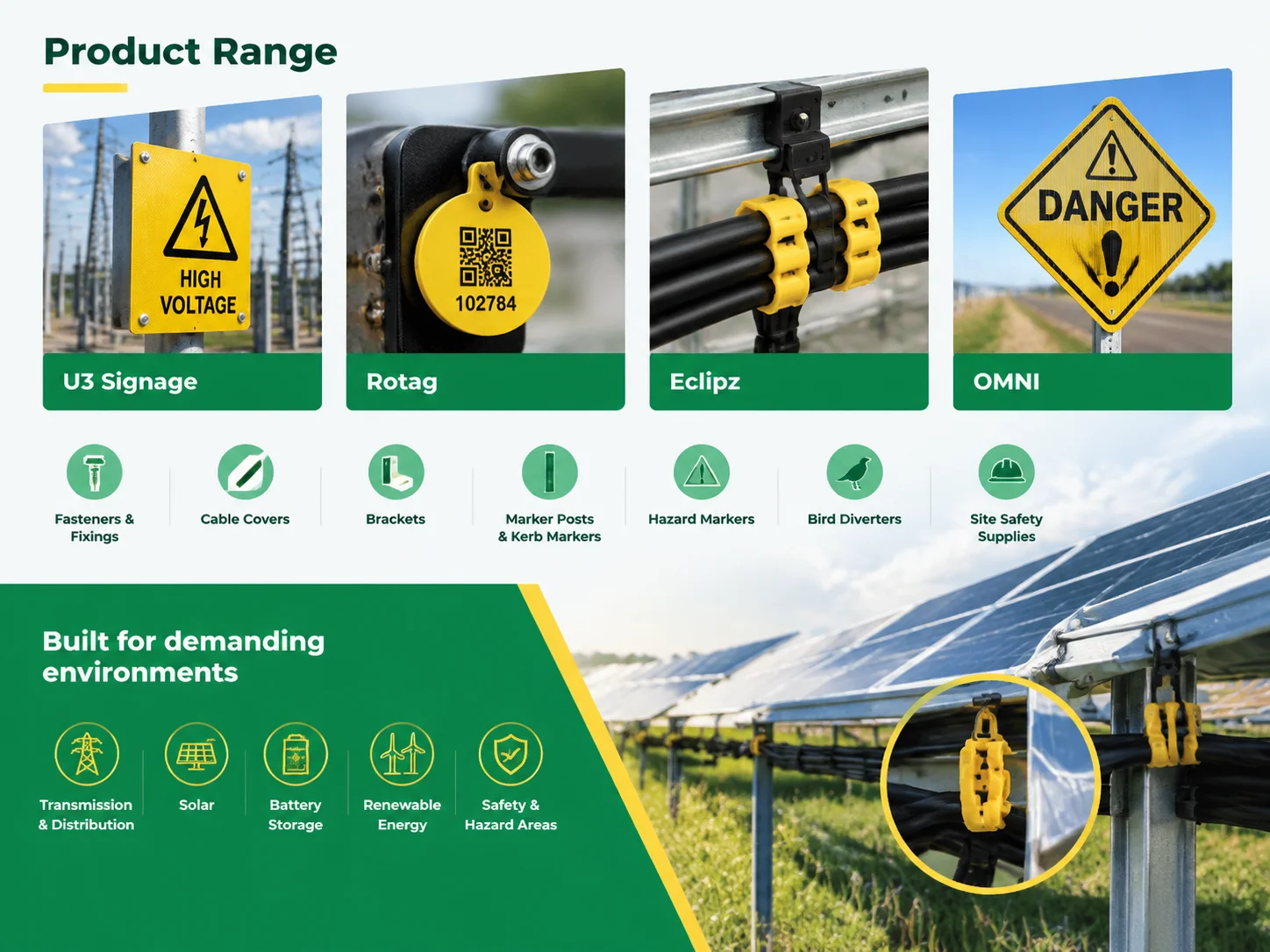
The foundation of the company comprises four different product lines that address distinct problems of identifications.
| Product | What it is | Where it is used |
|---|---|---|
| U3 Signage | Long-life signage system with a claimed 30-plus year track record, lifetime guarantee, fade-free and anti-glare performance, fire-retardant, anti-graffiti | Substation, network, and public safety signage across transmission and distribution assets |
| Rotag | Rotating tag solution for asset identification and tagging, designed for high volumes and harsh conditions | Utility and renewable energy assets requiring durable, traceable identification |
| Eclipz | Snap-on cable labelling clips and cable harness hanger system | Utility-scale solar, battery storage, and cable management on renewable sites |
| OMNI | Lenticular safety signage technology giving visibility from multiple angles | Public-facing hazard warning where approach direction cannot be predicted |
However, the product range expands beyond these four and includes fasteners and fixings, hard and soft cable coverings, brackets, markers, and warning signs, for example. In the Supply Classification of suppliers, the company appears in terms like arc flash mitigation, cable fittings and conductors, connectors and accessories, measuring instruments, and equipment used in extreme weather condition.
The solar industry is where the products produced by the company have gained the largest popularity, because utility-scale solar power plants are characterized by the presence of loads of cables which are connected with a particular engineering solution devised at a particular construction site. For example, one of the projects of the company consisted in several years of co-invention of a cable hanger which was compatible with a leading solar tracking system that can only happen if a supplier is treated as a developer and not an ordinary supplier.
The customers who want to compare the companies that provide specialized supplies are advised to examine the companies in terms of their specification documents, licenses, and the order execution process.That is the same qualification discipline that applies when sourcing an electrical switch and socket manufacturer, and the criteria are not very different in either case.
Where It Operates
The company functions chiefly as an operation in Australia and New Zealand because its operations centre on remote sites rather than a single factory.
The corporation maintains offices in Brisbane, Sydney, and Melbourne in Australia. In New Zealand, it operates offices in Auckland, Tauranga, Blenheim, and Christchurch. The company has emphasized having strategically positioned facilities and a mobile workforce, with the result that its delivery sites are in regions far away from populous areas, such as solar and wind farms, electric power substations, and gas pipelines.
The success of the company has been greatly aided by its New Zealand roots. The company originated in New Zealand as an engraving business more than thirty years ago and has since expanded to Australia to tap into the growing market of renewable energy in the country, which has been flourishing recently.
Clients and Projects
The client roster offers the most credible evidence of expertise because utility companies and transmission network operators do not use signs from inexperienced vendors.
Some of the known customers of the business are ElectraNet, an operator of the transmission network in South Australia; Transgrid, the power supply operator in New South Wales; Ausgrid, which is a major distributor of the electricity in New South Wales; APA Group, which is responsible for managing gas transmission systems; Downer, a big company in the field of infrastructure supply; Powerco representing New Zealand’s electricity transmission market; Meridian Energy, a renewable energy company in Australia; Wellington Electricity; Northpower; and McKay Contracting.
There are three projects, which demonstrate the degree of versatility of the company. In New Zealand, the company’s good cooperation with the health and safety team of Meridian provided the redesign of the public safety signs in such a way that they could be used in all locations and situations. In Australia, it spent two years together with Bouygues developing its own cable-holder system, which can be used in Nextracker, adapting it to the jobs which require speed and safety. In Victoria, the company delivered signs and marking systems to the APA Group as part of the Western Outer Ring Main pipeline project.
In all of the above cases, the customer has specific needs. Identification or protection systems have to be adapted to particular items, environment, and norms for compliance.
Accreditations and Testing
The accreditation evidence for this category of product offers more valuable information than any marketing statement, because the specific failure mode being avoided is deterioration occurring over many years.
- Testing of the signs according to AS 1319, which is the Australian standard for designing and using safety information signs.
- Ultraviolet exposure testing at the Allunga exposure test station known for testing products under the Australian conditions, which is the most relevant test realized in a situation when the main enemy of the product is sunlight.
- Testing for cyclone conditions of the products in the range of this company, which is done to simulate the wind loads that are going to be faced by the infrastructure exposed to unfavorable weather conditions.
- Underground cable coverings being checked according to Australian standards during the supplier’s accreditation process.
- The claimed 32-year history of the U3 signage system is validated by a lifetime guarantee and anti-graffiti characteristics.
It must be mentioned that the Allunga exposure testing seems to be the differentiating factor standing behind recognizing a reliable supplier from an optimistic one. The process of accelerated UV testing was created just because the failure mechanism is impossible to be tested in real-time within the commercial product cycles. The supplier that is ready to perform an exposure test of its products can offer the customer more valuable information than the durability testimonials can suggest.The same logic — demanding evidence rather than asserting performance — governs how any long-life infrastructure component should be specified, and it applies equally to the devices installed by the electricians who work on these sites, which is the context behind our guide to replacing a light switch safely.
Size and Leadership
According to business data, the company is classified within the small-to-medium specialist category, suggesting that it functions within the employee range of 18 to 50, which is squarely away from the classification of being a large multinational organization. For customers, this is an important consideration since organizations of this nature tend to be flexible and provides solutions customized to their client’s needs, but do not possess large amounts of capital in their balance sheets, meaning that customers must be cautious when undertaking any large-scale deals lasting several years.
The managing director of the organization is Charlie Beatson, who has also been identified as the person to contact in the supplier directories within the industry. The company is also comprised of different other roles, including head of sales, operations management, business development, key accounts, marketing management, art production and operation coordination, and client engagement, which is a company structure quite common in any project-led business where the main pillars of the business include the production of artworks, scheduling, and account management.
Customer feedback posted on the company’s site proves to have a common theme worth mentioning in regard to the company’s business model, namely that of flexibility and time taken for delivery use as reputation measures. For instance, one of the customers from New Zealand has been served by the company for seven years while one of the renewable energy engineers from Australia referred to the quick rates of delivery and design alignment features of the company’s products and services, which in the case of this particular market sector show that the company is able to compete on the issue of product simplicity while being good at providing services.
Why This Niche Exists
It is possible to question why identification products need a specialist supplier. However, the answer is that identification, in terms of regulated environments, is, simply put, an obligation of compliance instead of convenience.
When it comes to electrical safety systems, it is required to label assets, indicate hazards, and mark conductors. In terms of arc flash protection systems, it is vital to identify the equipment through proper labeling. Public safety obligations require issuing warnings that can still be easily read after years of operation. When the audit takes place, the operator has to prove that all these requirements are met within the entire system, and it would be a problem if the labels have either faded or missing.
Lifecycle consideration is enough to prove the point. A cheap label that is replaced every second year is more costly in a long run compared to a durable label that is put in place only once in thirty years. Each time the label has to be replaced, a technician is sent to a remote location that may involve an outage or permit.The same reasoning drives specification decisions in modern electrical installations more broadly, including the shift toward devices with better-documented performance such as USB wall outlets with fast-charging capability, where the installed device has to serve an asset life measured in decades.
Evaluating a Specialist Supplier
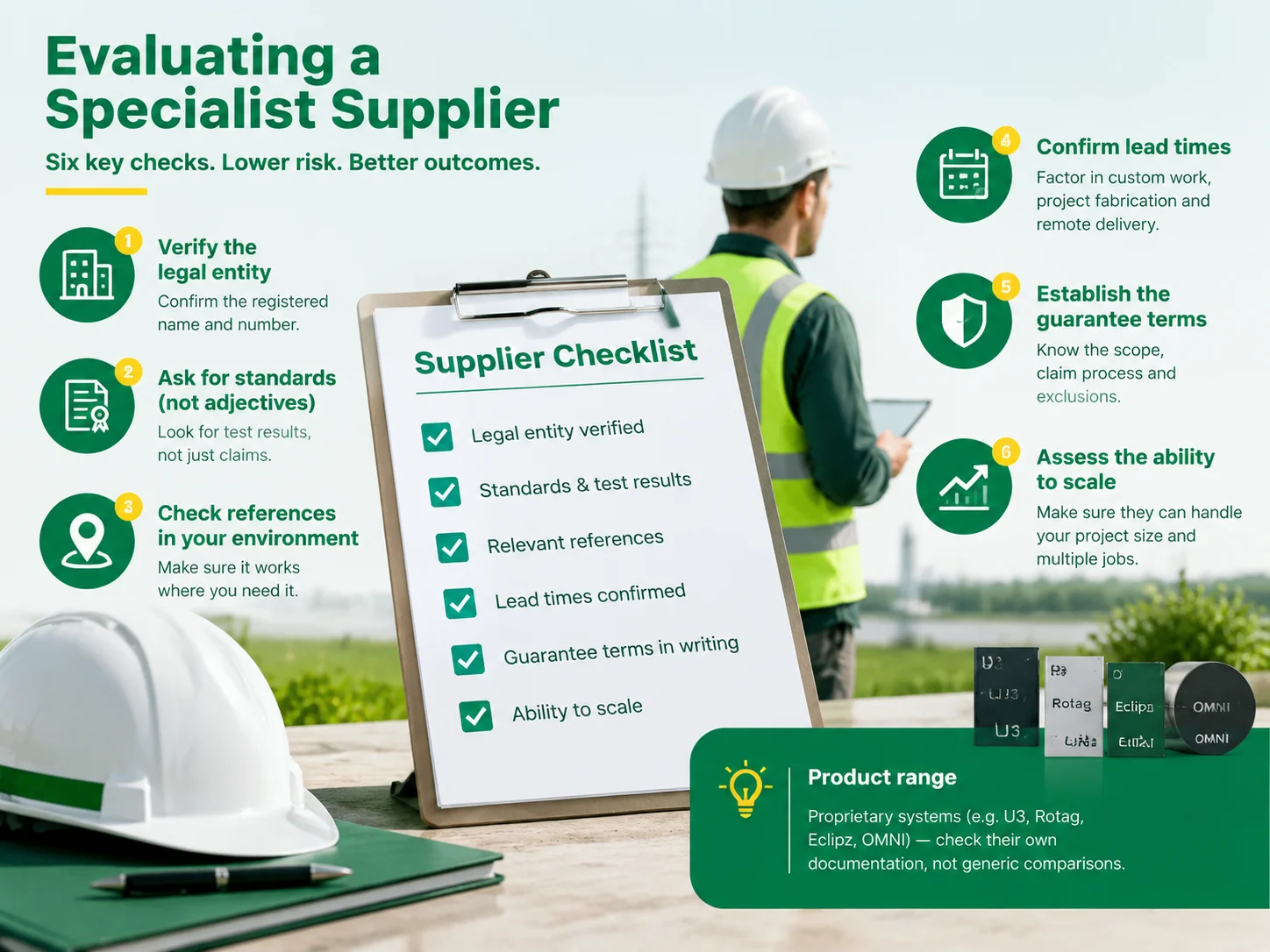
When making a decision about a supplier such as this one – or any vendor that has a similar level of business specialization – six tools can help you limit possible risk.
- Check the legal entity. You have to make sure that the registered name and number match those given in the documents you prepare. The supplier’s name you would see as a brand may differ significantly from the name listed in legal documents, therefore affecting liability.
- Ask for standards, not adjectives. Long-lasting is an adjective. A phrase about the product being certified to AS 1319 and subjected to accelerated UV exposure testing means that it meets certain standards.
- Do not take references at face value. What works well for New Zealand may not work anywhere else, including Queensland.
- Confirm lead time against your program. Items with customized artwork or special production technology would take longer to be delivered, and a supplier who is unable to provide written confirmation of the delivery date presents a serious risk.
- Clarify guarantee terms. A lifetime warranty only makes sense if you have it in writing.
Finally, remember that the listed technologies – U3, Rotag, Eclipz, OMNI – are not generic categories of products; rather, they are proprietary systems, meaning that you should assess them based purely on their own documentation rather than on comparison to products available on the market. The same principle applies when assessing a product portfolio in any specialised category, and it is the reason a manufacturer’s ability to document and support what it sells is a better predictor of satisfaction than the width of its catalogue, as our example of a documented product specification illustrates.
FAQ
What is the company name for Identimark.com?
Identimark is only a trading name. The business registry identifies the legal entity as Novare Global Limited, which operates under names such as Novare Global, Identimark Group, and IdentiMark Solutions. The operating entity in Australia is Identimark Solutions, with ABN 36 477 982 585. As registered details change due to restructuring, make sure to confirm the legal name with ASIC in Australia or the Companies Office of New Zealand before including it in any contract.
What does Identimark make?
It manufactures and designs identification and protection systems for infrastructure in the energy sector: safety signs, tags and labels, cable protection systems and management, cable covers, markers, and fasteners along with other safety products. The target market for products consists of utility companies, renewable energy developers, companies constructing the transmission and distribution networks, and EPC contractors. Some of its successful product lines are products U3 signs, Rotag identification tags, Eclipz cable marking and fitting system, and OMNI optical safety signs.
Where is Identimark located?
The company operates within the territories of New Zealand and Australia. Its offices in Australia are located in various places such as Brisbane, Sydney, and Melbourne. Offices of the company in New Zealand can be found in Auckland, Tauranga, Blenheim, and Christchurch. In Australia, it appears in supplier directories under the address provided of Unit 18b.2 112-118 Talavera Road, North Ryde, New South Wales. The company developed in New Zealand and later expanded in Australia. It serves projects in the most remote regions as well as in big cities.
Is Identimark Australian or New Zealand?
Both, as far as the commercial interests are considered. The company started its journey more than 30 years ago as a small engraving company in New Zealand, and the utility market in New Zealand is an important part of its business that serves clients such as Meridian Energy, Powerco, Wellington Electricity, and Nyong Power. The Australian division has developed significantly due to the success of renewable energy construction and almost all its recent projects have taken place in Australia.
Who are Identimark’s main customers?
Known clients of the company include ElectraNet, Transgrid, Ausgrid, APA Group, Downer, Meridian Energy, Wellington Electricity, Northpower, McKay Contracting. All these clients are engaged in providing services in the areas of energy infrastructure and fulfil the requirements of the law related to regular audits of equipment and public safety.
References
- Identimark — About the Company
- ASIC — Australian Business and Company Register
- Standards Australia — AS 1319 Safety Signs for the Occupational Environment
- WorkSafe New Zealand — Electrical and Hazard Identification Requirements
Conclusion
Identimark.com is a website that is run by Identimark, which is a type of company that has the registered company name of Novate Global Limited, and operates in Australia under the name Identimark Solutions, with offices located in North Ryde, New South Wales. Identimark started over thirty years ago as a relief engraver in New Zealand, and now sells different kinds of safety signs, identification labels, and three-phase cable systems to customers in transmission networks, distribution businesses and renewable energy developers in both countries. Identimark’s clients include ElectraNet, Transgrid, Ausgrid, APA, Downer, and Meridian Energy and its reputation for its product offerings is based on the company’s willingness to provide the customer with a specific and verifiable data stream.