




Are Zip Ties Heat Resistant?
A maintenance technician working in an injection molding facility used a nylon tie to fasten a sensor cable in the vicinity of the heating barrel, and the tie completed less than one shift; by the morning, it had melted, stretching and breaking, which led to the sensor cable being laid on the hot surface. The tie was not faulty, but rather just inappropriate for a place where temperatures regularly reached all 90°C. The question of whether zip ties are heat-resistant is complicated and does not have an unequivocal yes or no answer, as it depends on the material from which the tie is made, the temperature it is exposed to, and for how long. A common nylon tie withstands warm temperatures for a short period, and it is good for usage in an apartment circuit breaker. A cable tie in the engine compartment, in a bakery oven, or in a dryer has to be made of an entirely different material.
The Temperature Limits of Standard Nylon Cable Ties
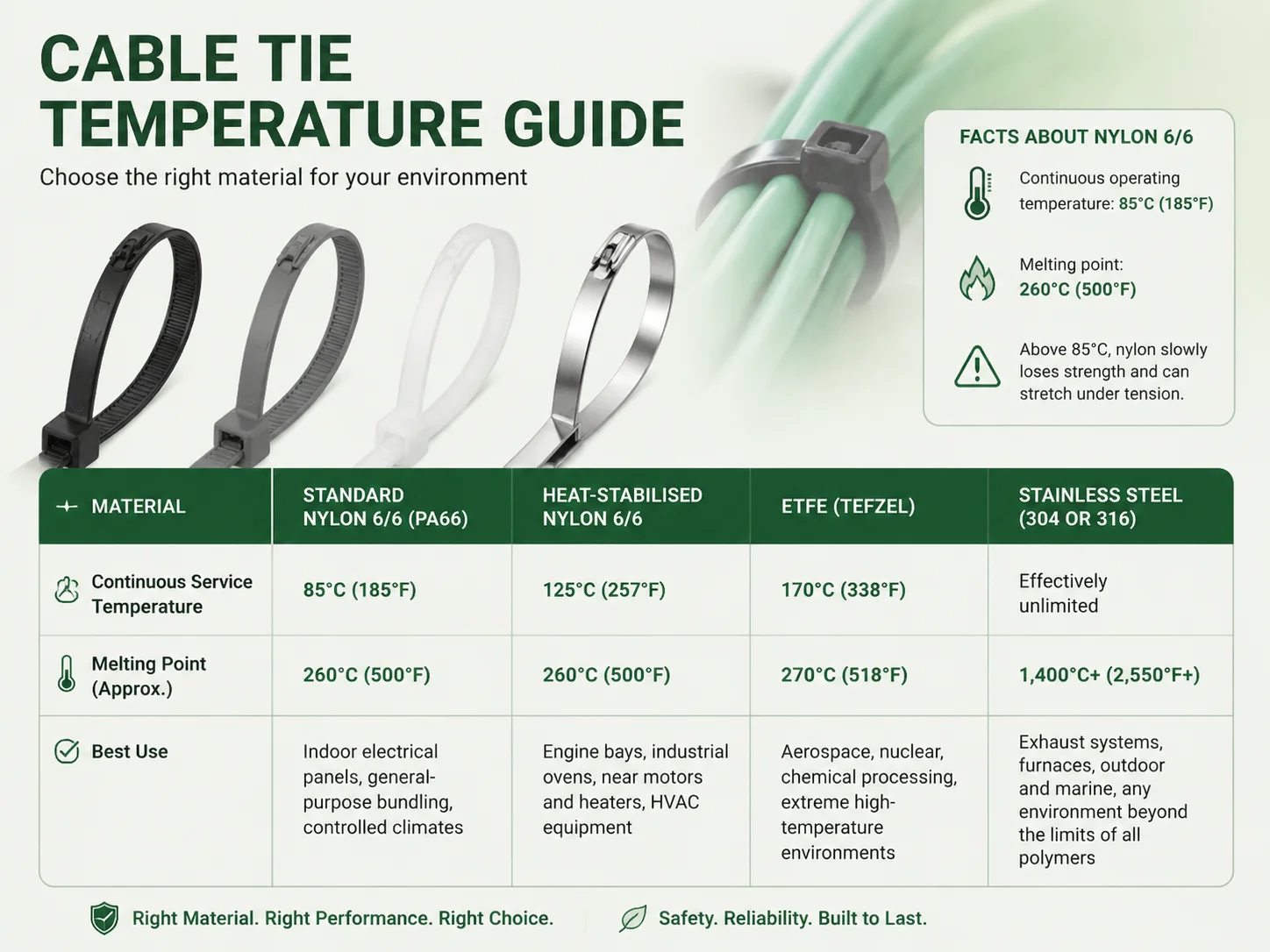
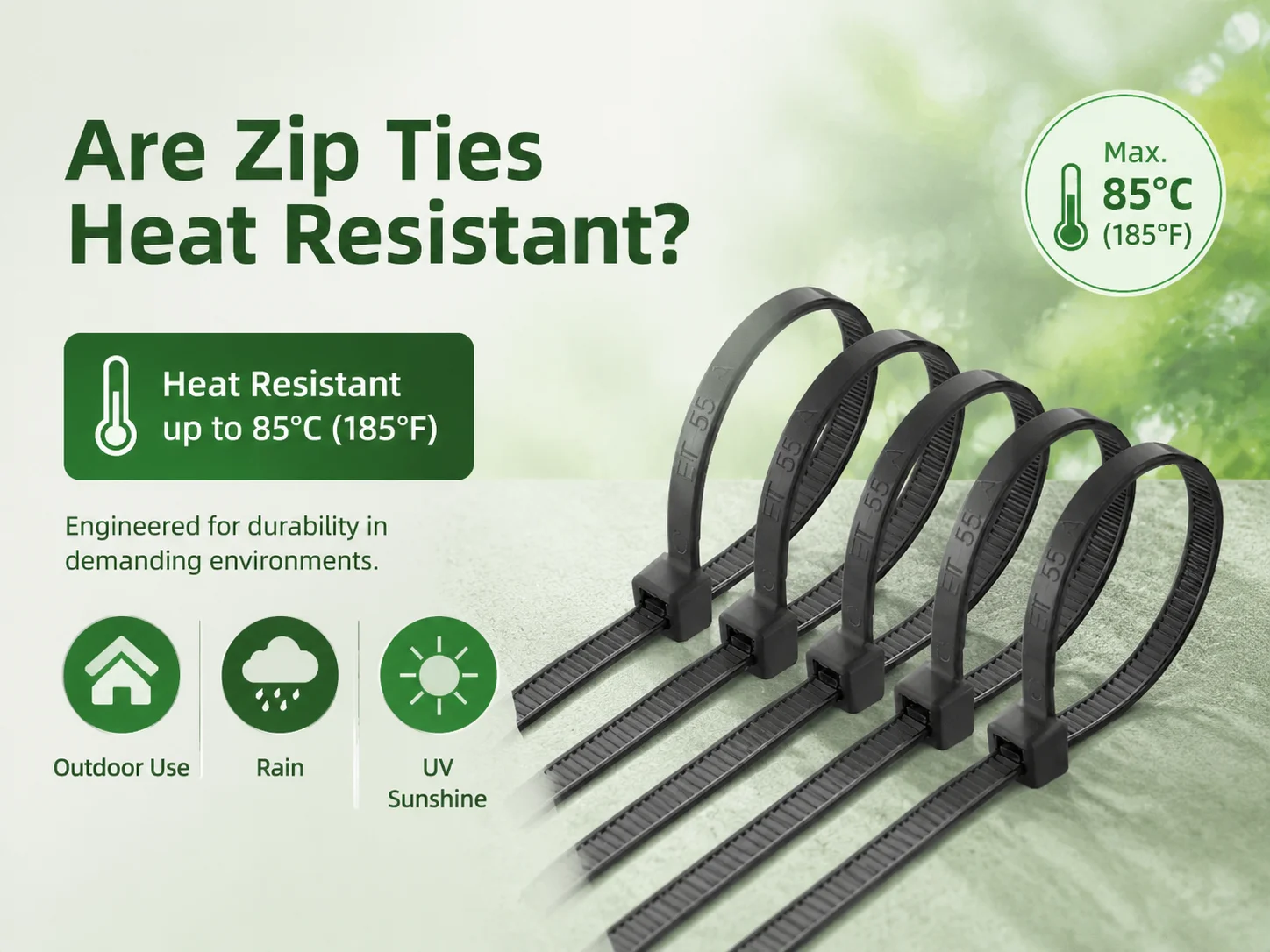
The large number of zip ties available for use are created using nylon 6/6, also known as polyamide 66. This is a semi-crystalline material that is classified as an engineering thermoplastic and can operate effectively at approximately 85°C (185°F). As long as nylon 6/6 is heated up only to this temperature, which is the continuous operating temperature value for the polymer, it can be used without any loss of effectiveness. At temperatures above 85°C, the polymer slowly starts to lose its mechanical qualities. Even though the melting point of nylon 6/6 is about at 260°C (500°F), the cable tie will become ineffective long before this temperature is reached. If the nylon material was subjected to temperatures exceeding the continuous operating temperature, the zip tie has the tendency to stretch under tension, which leads to damage.
| Material | Continuous Service Temperature | Melting Point (Approx.) | Best Use |
|---|---|---|---|
| Standard Nylon 6/6 (PA66) | 85°C (185°F) | 260°C (500°F) | Indoor electrical panels, general‑purpose bundling, controlled climates |
| Heat‑Stabilised Nylon 6/6 | 125°C (257°F) | 260°C (500°F) | Engine bays, industrial ovens, near motors and heaters, HVAC equipment |
| ETFE (Tefzel) | 170°C (338°F) | 270°C (518°F) | Aerospace, nuclear, chemical processing, extreme high‑temperature environments |
| Stainless Steel (304 or 316) | Effectively unlimited (no polymer degradation) | 1,400°C+ (2,550°F+) | Exhaust systems, furnaces, outdoor and marine, any environment beyond the limits of all polymers |
Heat‑Stabilised Nylon: The Standard Upgrade for Warm Environments
Heat-stabilised nylon 6/6 is a very affordable alternative for applications where typical nylon can’t be used due to heat, but applications don’t require the level of performance from ETFE and stainless steel. Heat-stabilised nylon is made from the same type of polymer as standard nylon, however, its structure has some chemical additives like copper compounds and organic stabilisers, which prevent the polymer properties from degrading as a result of thermal oxidation, which makes polymer brittle and weak at elevated temperatures. The introduction of the aforementioned additives increases the operating temperature limit of heat-stabilised nylon, thus allowing it to be used in automotive applications, industrial machinery, and equipment exposed to high temperatures. A good characteristic of heat-stabilised nylon ties is their characteristic green, cyan, or black colour with stripes, which depends on the producer.
ETFE (Tefzel): When the Heat Is Extreme
ETFE (ethylene tetrafluoroethylene) More often than not, referred to by the name of its trademark Tefzel, the fluoropolymer has a maximum service temperature of 170 °C (338 °F). ETFE circuitry ties have excellent properties of flame-retardancy along with good resistance to chemicals and ultraviolet radiation and same mechanical characteristics at the temperatures that would make a nylon tie useless. The applications of ETFE cable ties include aerospace wiring harnesses, nuclear power plants, chemical manufacturing units, and other applications where heat and corrosive media are present. Although ETFE ties are considerably more expensive than nylon ties and the tensile strength of an ETFE tie is lower than that of an equivalent nylon tie, in many cases it is impossible to substitute nylon ties by its alternatives.
Stainless Steel: The Non‑Polymer Answer
Stainless steel is a material that exceeds the limits of any thermoplastic. An example of this is the stainless steel tie used, made from a stainless steel alloy like Type 304 or 316. Since there are no organic polymers to melt with heat, it is safe to say that stainless steel can withstand any conditions of severity that a cable tie can be expected to encounter. Stainless steel ties are therefore used in situations where other less heat-resistant ties fail, such as bundling cables close to exhaust manifolds, in industrial ovens and furnaces. Disadvantages of using a stainless steel tie include the increased cost of materials, a heavier construction, higher conductivity, and the necessity of using a tensioning tool. Our guide on alternatives to cable ties covers stainless steel and other non‑plastic fastening solutions, including their advantages and their specific installation requirements.
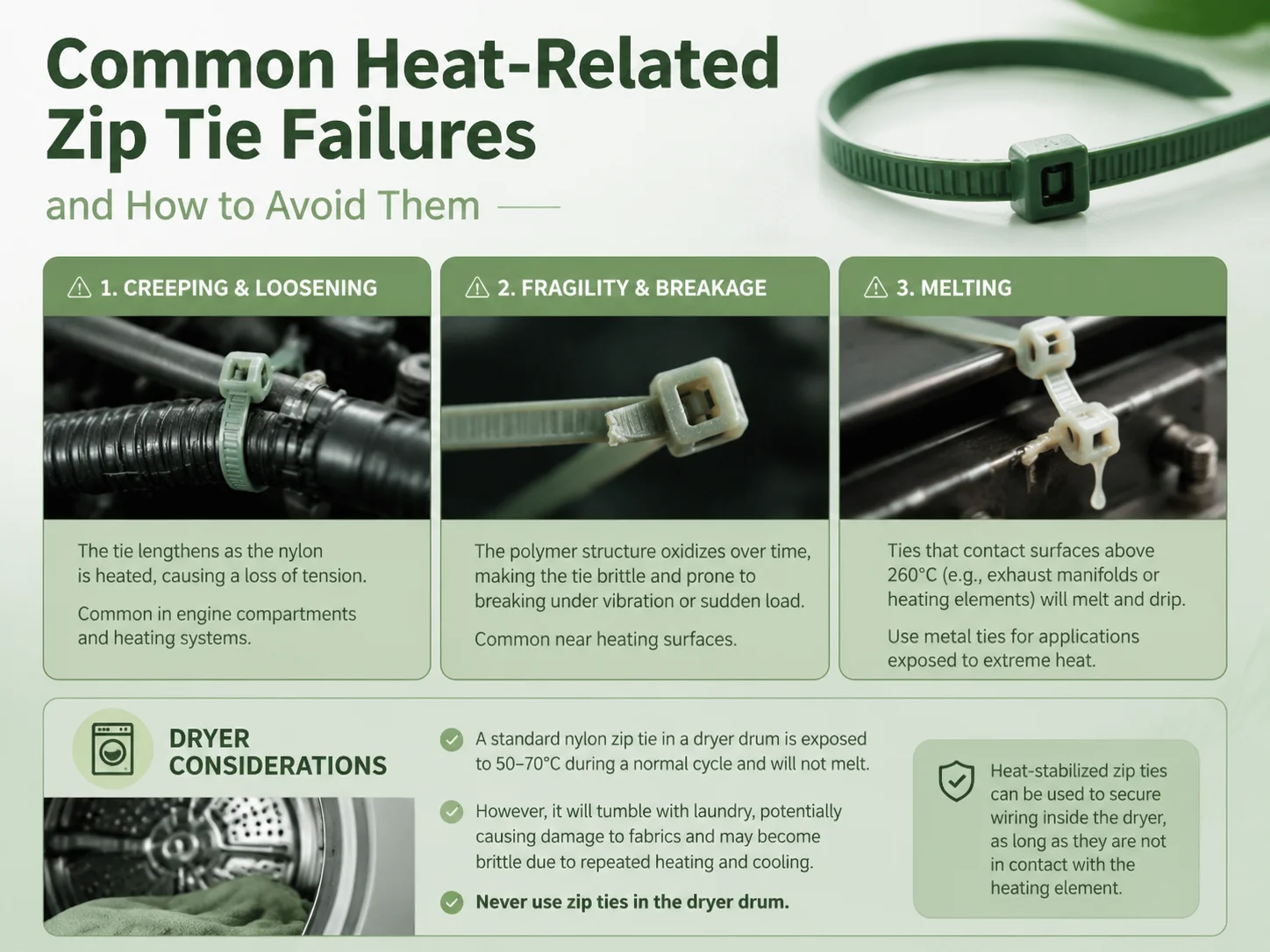
Common Heat‑Related Zip Tie Failures and How to Avoid Them
If you use a zip tie in a warm climate without checking its temperature rating, you can expect specific ways in which failure will occur. The first is creeping and loosening: the tie lengthens as the nylon is heated causing a loss of tension. This is an expected failure found in an engine compartment and heating system where a regular nylon tie was installed. The second way is fragility: the ties are becoming fragile over time when the polymer structure gets oxidized and eventually breaks when vibration or sudden load occurs. This happens in things near a heating surface. The third way is actual melting: a tie which comes in contact with a surface with temperature above 260C – an exhaust manifold or heating element – will melt and drip. A metal tie is the only option for use with such surfaces.
In the case of appliances like a clothes dryer, the concern is, will a zip tie melt in the dryer? A standard nylon tie in a dryer drum would be exposed to temperatures of 50–70°C during a normal cycle and would not melt. However, it will tumble around with the laundry and could get caught and damage fabrics. It could ultimately become brittle as a result of the constant heating and cooling cycles. A zip tie should never be used in a dryer drum; however, heat stabilised ties can be used to secure the wiring inside the dryer, providing the tie is not in contact with the heating element.
How to Choose the Right Cable Tie for a Hot Environment
The process of choosing an appropriate heat-resistant cable tie comes down to answering three questions. First, what is the maximum ambient temperature of the cable tie? Does it include peaks like the temperature of an engine during ignition in summer or the temperature during a heating cycle of a given process? Secondly, is the tie in direct contact with a heated surface or just located in a hot area? Lastly, is the environment chemically aggressive too? The table below will help in making the right decision.
| Environment | Recommended Cable Tie |
|---|---|
| Ambient up to 85°C; indoor, no direct contact with hot surfaces | Standard nylon 6/6 |
| Ambient 85–125°C; engine bays, near motors, industrial equipment | Heat‑stabilised nylon 6/6 |
| Ambient 125–170°C; chemical exposure; aerospace, nuclear | ETFE (Tefzel) |
| Ambient above 170°C; direct contact with hot surfaces; exhaust systems; furnaces | Stainless steel (304 or 316) |
For the majority of industrial and electrical applications where heat is a factor, a heat‑stabilised nylon tie provides the correct balance of temperature resistance, strength, and cost. igoto’s range of cable ties includes both standard and heat‑stabilised nylon, as well as stainless steel, with the material clearly specified on the packaging and the data sheet. For a broader look at how nylon ties are engineered for demanding environments, our article on nylon cable ties and their functions covers the full range of material grades and their specific uses.
Frequently Asked Questions
At what temperature will zip ties melt?
Nylon 6/6 zip ties will begin to melt at a temperature of around 260 degrees Celsius (500 degrees Fahrenheit). Although, they start to lose their strength and get soft at a temperature much below that. The continuous service temperature of nylon zip ties is 85 degrees Celsius (185 degrees Fahrenheit).
What zip ties can withstand heat?
Heat‑stabilised nylon 6/6 zip ties continuously endure high temperatures of up to 125°C (257°F). Higher temperature limits are provided by ETFE (Tefzel) ties that can withstand temperatures of up to 170°C (338°F). Stainless steel ties demonstrate unlimited heat resistance.
Can I zip tie a heat shield?
Polymer ties should never be used to secure heat shields, unless the tie is not in contact with the heated surface. Heat shields are barriers for transferring heat, so the tie used to hold the shield in place will be subjected to either contact or radiated heat. The only fasteners that meet the criteria for this application are steel cable ties.
Will a zip tie melt in the dryer?
A typical nylon zip tie situated within the drum of a clothes dryer will not melt when subjected to the usual drying temperatures of between 50–70°C, however despite that it does not serve any practical purpose in the dryer drum and it might cause damage to the clothes. The zip tie that is used to hold the internal wiring of the dryer must be made from heat-stabilized nylon since the temperature inside near the heating element can be above the nylon’s heat limit.
Will a zip tie melt in the dryer?
A standard nylon zip tie inside a clothes dryer drum will not melt at normal drying temperatures of 50–70°C, but it has no functional purpose inside the drum and could damage fabrics. A zip tie used to secure internal wiring inside a dryer should be heat‑stabilised nylon, as the internal temperature near the heating element can exceed the limit of standard nylon.
References
- Panduit — Cable Tie Material Specifications. Manufacturer technical data on standard, heat‑stabilised, and ETFE cable tie materials, including continuous service temperature ratings.
- HellermannTyton — High‑Temperature Cable Management Products. Global manufacturer with detailed thermal performance data for heat‑stabilised and fluoropolymer cable ties.
- UL — Component Recognition for Cable Ties. Information on the testing and listing requirements for cable ties used in electrical equipment, including thermal performance criteria.
- American Chemistry Council — Plastics Division. Information on the thermal properties and degradation mechanisms of nylon and other engineering plastics.
Are zip ties heat resistant? The response entirely relies on the zip tie being used. A traditional nylon zip cable tie is likely to show signs of failure in the engine bay. Conversely, a heat-stabilized tie will manage to survive in that area. ETFE zip cable ties will withstand extremely high temperatures. Furthermore, a stainless steel zip cable tie will last longer than all of these ties put together. Entering material matches with surroundings is an essential step lasting a short time during installation. The company provides zip cable ties for different variations of temperature effects since the tie that holds a cable close to a heater refers to thermal specification as much as to mechanical znstruction.