




Standard Cable Tie Sizes
Upon making a visit to the supply house to retrieve “a bag of cable ties” for a paneling project, the apprentice electrician brought back 4‑inch ties rated to hold 18 pounds each. The head electrician examined the ties and disapproved. The bundles they were trying to secure measured 2 inches in diameter, which was too big for a 4‑inch tie to hold comfortably, and too weighty to support by an 18‑pound tie. What he actually needed was an 8‑inch cable tie rating 50 pounds — the standard cable tie size in electrical work, long enough for the bundle and strong enough to hold the load. The apprentice found out something that all installers learn: cable ties are not universal and depend on every aspect of usage, including all the measurements.
How Cable Tie Sizes Are Defined and Measured
The most important characteristics of cable ties are the dimensions (length & width) and tensile strength. Length is the distance from the bottom tail to the outer edge of the locking head and indicates the maximum circumference of the items held. Width is measured along the strap, while the combination of width value with the thickness value gives the upper limit for tensile strength. Tensile strength (reported in lbs or N) is defined as the lowest force that the cable tie can withstand when subjected to a tension test, usually done in accordance with UL 62275 or MIL-STD-23190.For a complete breakdown of how these three dimensions interact across the full size range, our guide on cable tie sizes provides detailed dimensional data for every common length and strength class.
It is usually believed that a bigger tie will be able to hold more weight but that is a misconception. The pulling strength of a strap is determined by the cross section of the strap meaning its width and thickness not its length. When comparing a 50-pound tie that measures 8 inches in length to a 50-pound tie that measures 14 inches in length, both will have the same strength. The additional inches are used to carry larger loads. A worker who has to carry heavy loads has to choose a strap that has a higher pulling power rather than just choosing a bigger strap.
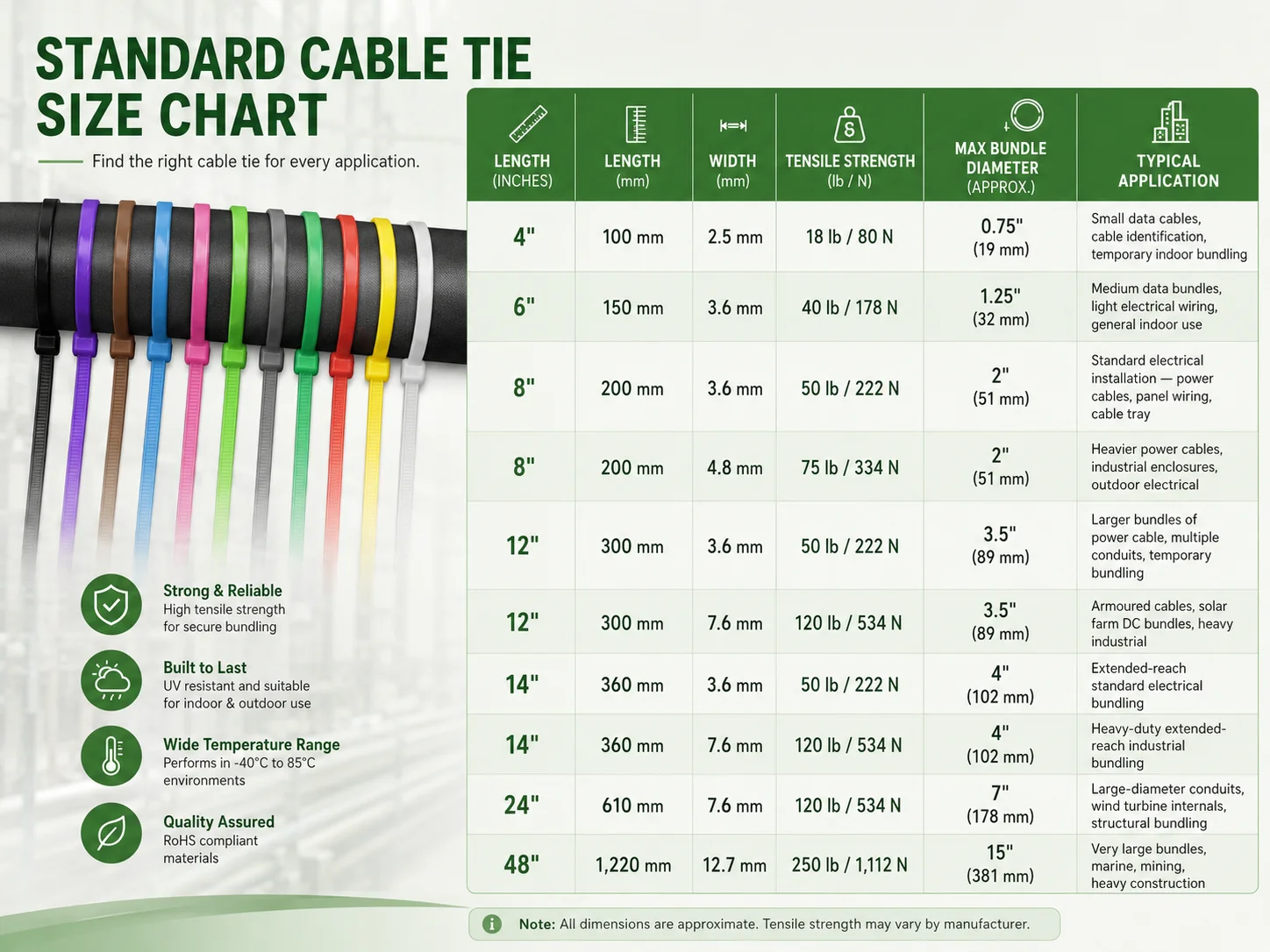
The Standard Cable Tie Size Chart
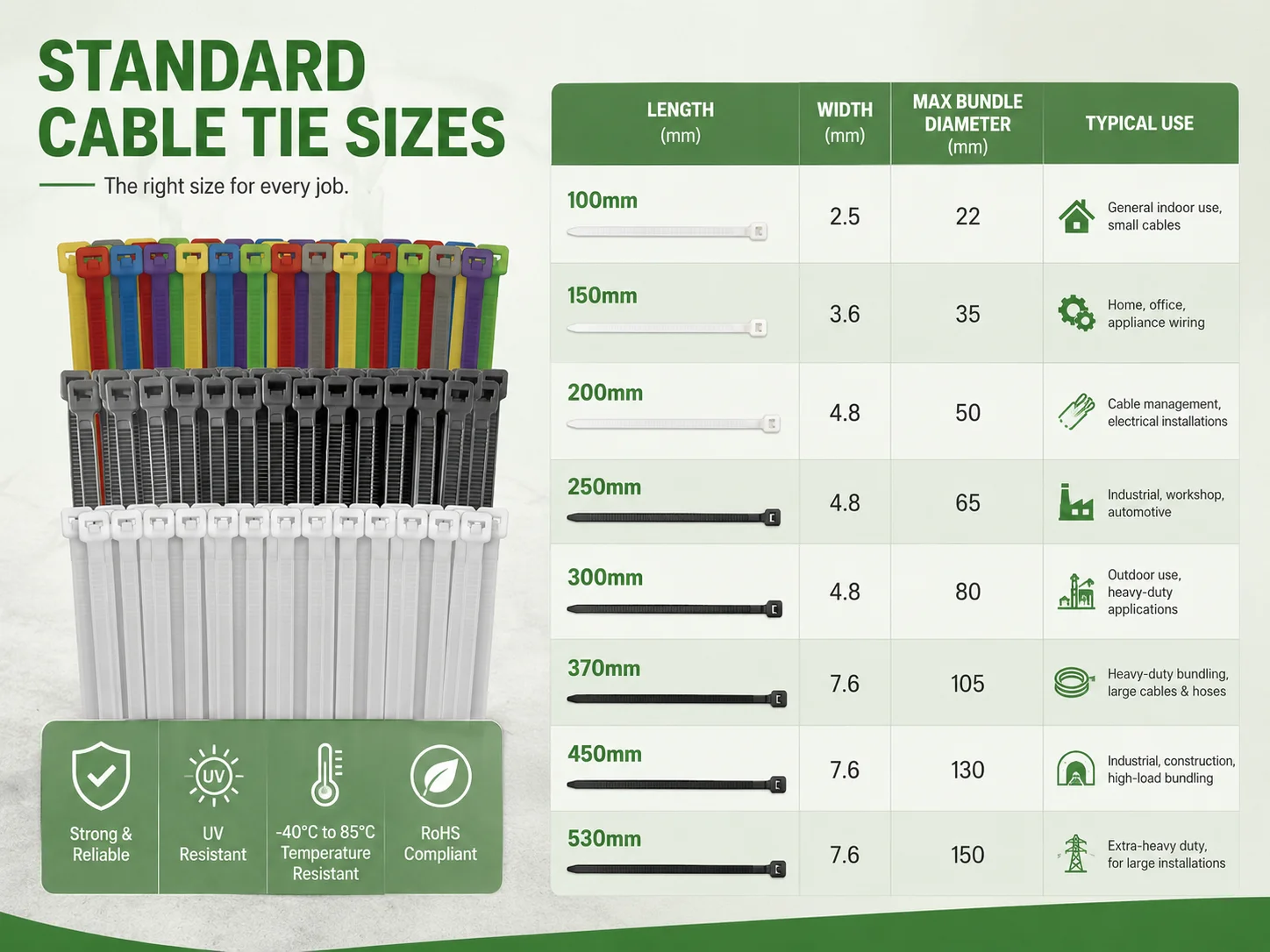
The table presented below describes the standard sizes of cable ties that are available in the electrical equipment stores, as well as by industrial sellers and business-to-business suppliers. These dimensions can satisfy the requirements of a large number of installations ranging from simple cable harnesses to tough industry conduits.
| Length (Inches) | Length (mm) | Width (mm) | Tensile Strength (lb / N) | Max Bundle Diameter (Approx.) | Typical Application |
|---|---|---|---|---|---|
| 4″ | 100 mm | 2.5 mm | 18 lb / 80 N | 0.75″ (19 mm) | Small data cables, cable identification, temporary indoor bundling |
| 6″ | 150 mm | 3.6 mm | 40 lb / 178 N | 1.25″ (32 mm) | Medium data bundles, light electrical wiring, general indoor use |
| 8″ | 200 mm | 3.6 mm | 50 lb / 222 N | 2″ (51 mm) | Standard electrical installation — power cables, panel wiring, cable tray |
| 8″ | 200 mm | 4.8 mm | 75 lb / 334 N | 2″ (51 mm) | Heavier power cables, industrial enclosures, outdoor electrical |
| 12″ | 300 mm | 3.6 mm | 50 lb / 222 N | 3.5″ (89 mm) | Larger bundles of power cable, multiple conduits, temporary bundling |
| 12″ | 300 mm | 7.6 mm | 120 lb / 534 N | 3.5″ (89 mm) | Armoured cables, solar farm DC bundles, heavy industrial |
| 14″ | 360 mm | 3.6 mm | 50 lb / 222 N | 4″ (102 mm) | Extended‑reach standard electrical bundling |
| 14″ | 360 mm | 7.6 mm | 120 lb / 534 N | 4″ (102 mm) | Heavy‑duty extended‑reach industrial bundling |
| 24″ | 610 mm | 7.6 mm | 120 lb / 534 N | 7″ (178 mm) | Large‑diameter conduits, wind turbine internals, structural bundling |
| 48″ | 1,220 mm | 12.7 mm | 250 lb / 1,112 N | 15″ (381 mm) | Very large bundles, marine, mining, heavy construction |
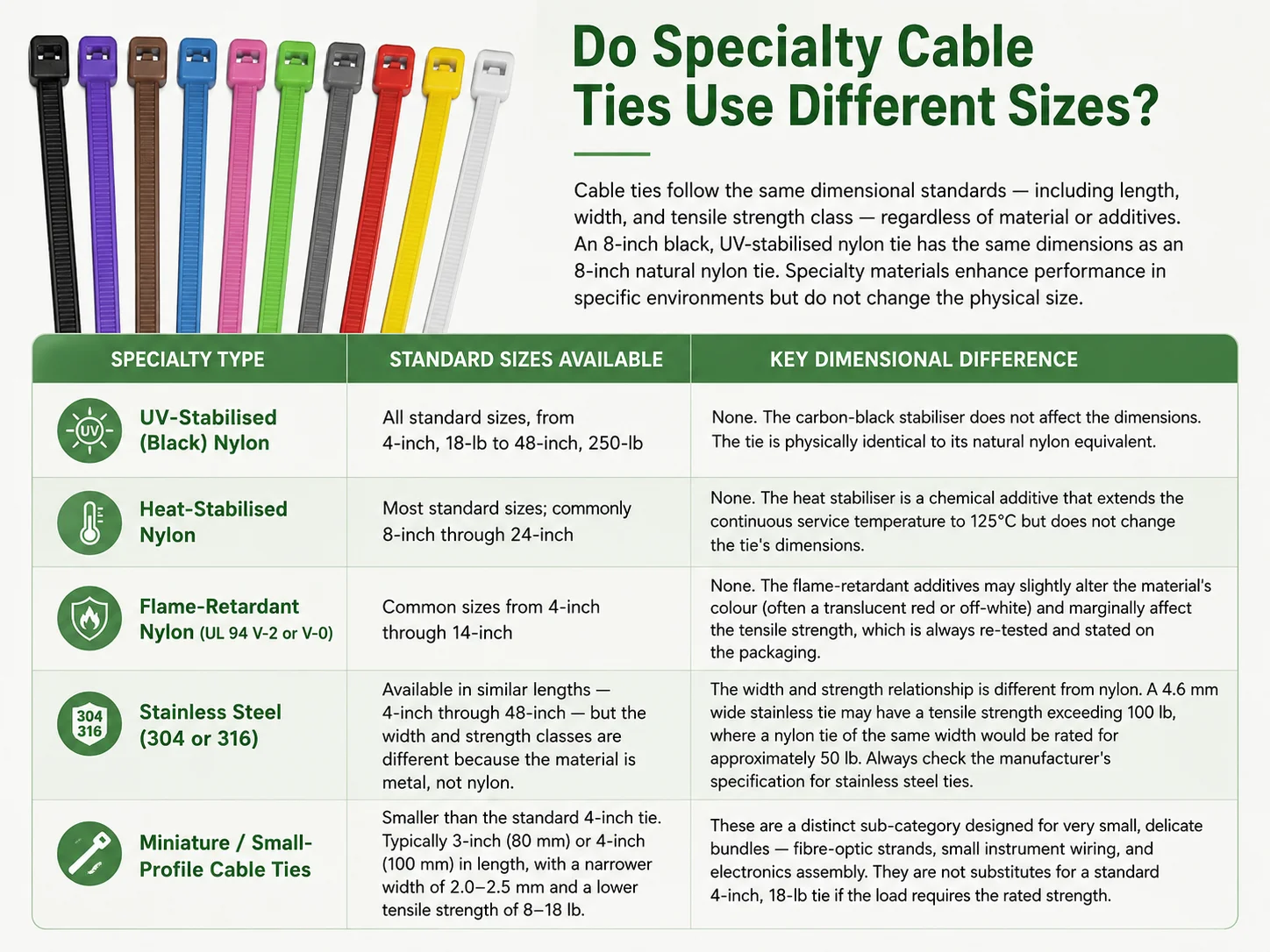
Do Specialty Cable Ties Use Different Sizes?
Cable ties have the same dimensional standards, including the tensile strength class and the size of cable ties produced from any material. An 8-inch cable tie made from black, UV-stabilised nylon will have the same dimensions as an 8-inch natural nylon cable tie. Different material and additives influence environmental properties of the cable tie, such as UV stability and flame resistance, but not the physical size of cable ties as it can be seen in the table below.
| Specialty Type | Standard Sizes Available | Key Dimensional Difference |
|---|---|---|
| UV‑Stabilised (Black) Nylon | All standard sizes, from 4‑inch, 18‑lb to 48‑inch, 250‑lb | None. The carbon‑black stabiliser does not affect the dimensions. The tie is physically identical to its natural nylon equivalent. |
| Heat‑Stabilised Nylon | Most standard sizes; commonly 8‑inch through 24‑inch | None. The heat stabiliser is a chemical additive that extends the continuous service temperature to 125°C but does not change the tie’s dimensions. |
| Flame‑Retardant Nylon (UL 94 V‑2 or V‑0) | Common sizes from 4‑inch through 14‑inch | None. The flame‑retardant additives may slightly alter the material’s colour (often a translucent red or off‑white) and marginally affect the tensile strength, which is always re‑tested and stated on the packaging. |
| Stainless Steel (304 or 316) | Available in similar lengths — 4‑inch through 48‑inch — but the width and strength classes are different because the material is metal, not nylon. A stainless tie of a given width is far stronger than a nylon tie of the same width. | The width and strength relationship is different from nylon. A 4.6 mm wide stainless tie may have a tensile strength exceeding 100 lb, where a nylon tie of the same width would be rated for approximately 50 lb. Always check the manufacturer’s specification for stainless steel ties. |
| Miniature / Small‑Profile Cable Ties | Smaller than the standard 4‑inch tie. Typically 3‑inch (80 mm) or 4‑inch (100 mm) in length, with a narrower width of 2.0–2.5 mm and a lower tensile strength of 8–18 lb. | These are a distinct sub‑category designed for very small, delicate bundles — fibre‑optic strands, small instrument wiring, and electronics assembly. They are not substitutes for a standard 4‑inch, 18‑lb tie if the load requires the rated strength. |
What Are the Industry Standards That Govern Cable Tie Sizes?
Cable ties’ dimensions and performance are determined by many national and international standards that ensure consistency among different manufacturers. The following standards are the most frequently mentioned:
- UL 62275 — Cable Management Systems. This is the main North American and international standard for cable ties. It describes how to test for tensile strength in loop formation, the environmental conditions needed, and the required marking and branding of a sufficiently passed cable tie. If a cable tie is listed by the UL under this standard, it has been assessed to prove its tensile strength and performance.
- MIL‑STD‑23190 — Military Specification for Cable Ties. The define MIL-STD-23190 is a standard from the U.S. Department of Defense and which specifies stricter dimensional tolerances, more stringent environmental tests, and complete traceability for cable ties used for military and aerospace purposes. A cable tie compliant with the above-mentioned standard is identified by a military part number, and the control of the quality of those ties is much stricter than for conventional commercial ties.
- IEC 62275 – This standard serves the same function as UL 62275 on the international level. Essentially, the requirements for testing in both documents are harmonized, and any product which has been tested in compliance with one of the standards will automatically pass the other standard as well.
The reason why an 8-inch 50-pound tie from a particular manufacturer is identical in its fundamental dimensions and strength to an 8-inch 50-pound tie from another manufacturer lies in these standards. The standard itself identifies the performance class that the manufacturer uses in their own quality system so that all the ties in the bag comply with the standards. As for igoto’s cable ties, they comply with these standards thanks to the UL listing and the essential specifications required for professional installations.
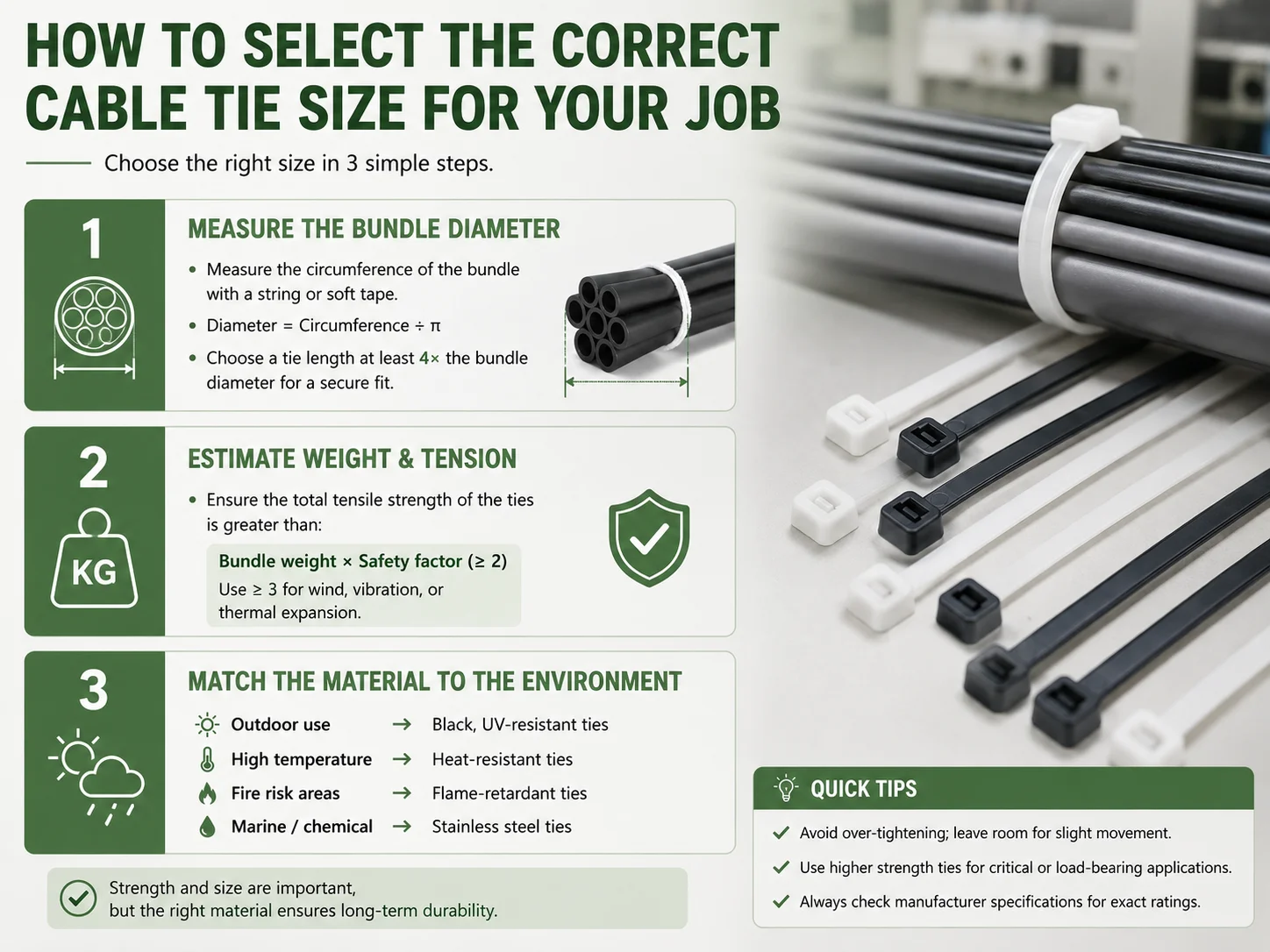
How to Select the Correct Cable Tie Size for Your Job
Selecting the appropriate size of standard cable ties consists of three steps and it takes a minute or less once you know how it works.
- Measure the bundle diameter. Take a length of string or a soft tape to surround the bundle and measure its circumference. To obtain the diameter of the bundle, divide the circumference measured by π or measure directly across the widest diameter of the bundle. The length must be long enough so as to take the surface of this diameter and still have enough string to use for the mechanism. Experiences show that it is best to use a tie that measures as long as four diameters of the bundle.
- Estimate the weight and tension the tie must hold. A suspended bundle that depends on its ties for support requires ties made of a material that will provide sufficient strength to support the bundle; the combined tensile strength of the ties must be greater than the weight of the bundle multiplied by the required safety factor, which is equal to or greater than two. A bundle subject to wind, vibration, or thermal expansion requires a safety factor that is greater than three.
- Match the material to the environment. If you are working outside, choose a black tie made of UV-resistant material. If you are in a hot environment, choose a heat-resistant tie. If you are working in a place where air is circulated, use a flame-resistant tie. You should also use a steel tie in a marine or chemical environment. Strength and size are important, but the making of a material also affects its overall durability.For more on how material choice affects performance in demanding conditions, our guides on whether zip ties are heat resistant and why UV‑protected cable ties matter outdoors cover the specific temperature and sunlight degradation mechanisms.
Frequently Asked Questions
What is the standard size of a cable tie?
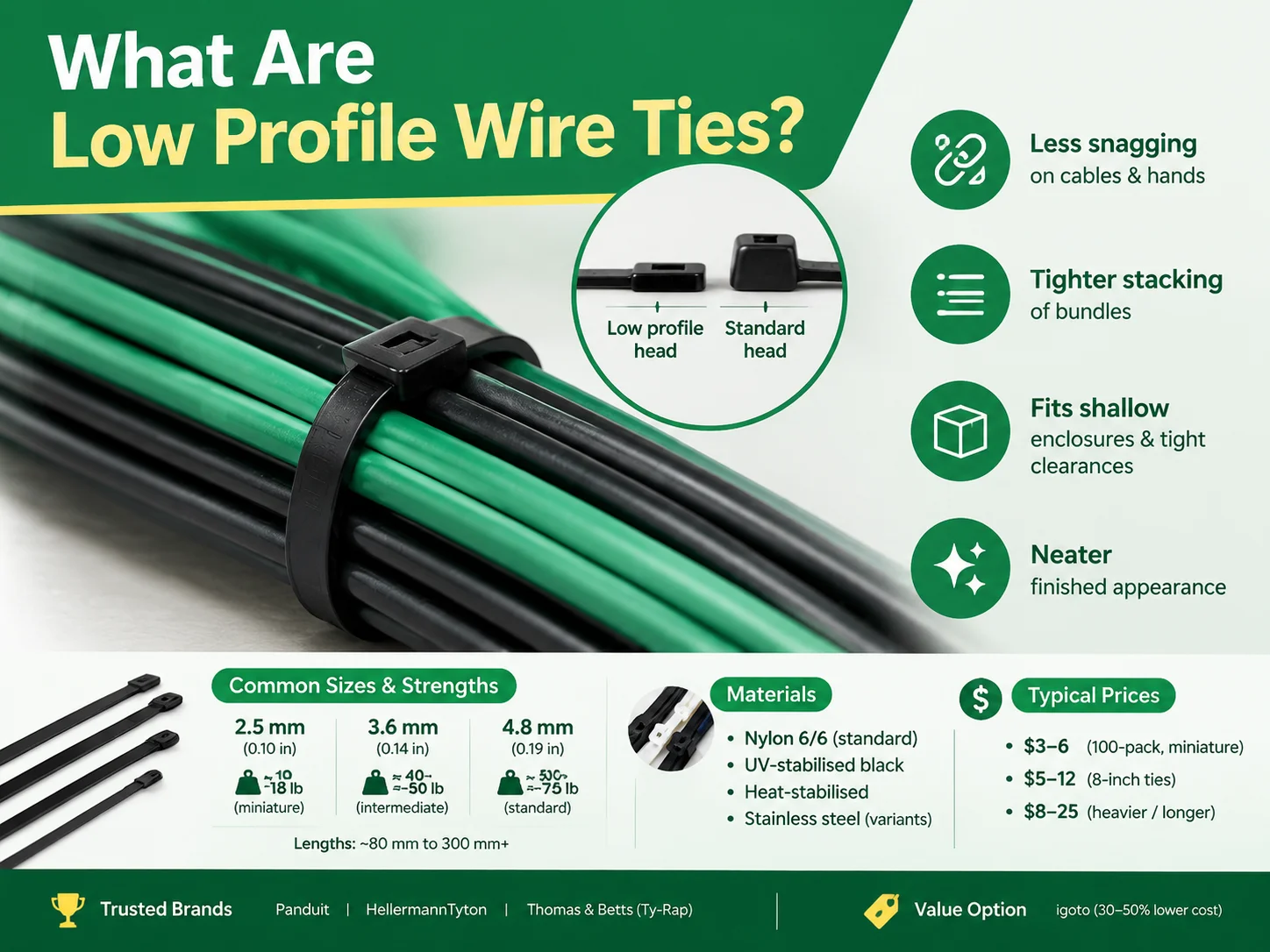
The 8-inch (50 pounds), or 200 x 3.6 mm (222 N), cable tie is the most common in size. It is used by the electrical industry for securing electric cables, bundling panel wire, and fastening cables to trays. The 4-inch (18 pounds) cable tie is used for light-duty bundling, whereas the 12-inch (120 pounds) cable tie is used in heavy-duty applications.
What is a standard zip tie size?
A commonly used zip tie in electrical and general industry is a 200 mm (8 inch) zip tie with 50 lb (222 N) load-carrying capacity. It has about 3.6 mm (0.14 inch) width. This size is suitable for most tasks involving bundling and securing in the field of panel construction, cable tray installation, and electrical work in general.
What are the standards for cable ties?
The standards governing various cable ties consist of the following: the UL 62275 (the U.S. and international standard of cable management systems), the MIL-ST 23190 (the U.S. military standard for higher performance cable ties), and the IEC 62275 (the international equivalent of the UL 62275 standard). These standards specify the requirements concerning testing, rating, and marking of cable ties that are expected to be listed.
What are the common lengths for cable ties?
Some of the most popular dimensions of cable ties are 4 inches (100 mm), 6 inches (150 mm), 8 inches (200 mm), 12 inches (300 mm), 14 inches (360 mm), 24 inches (610 mm) and 48 inches (1,220 mm). The most popular cable tie length among the electrical installers is the 8-inch length, while the 4-inch length suits the light and data cable applications. The industrial and outdoor applications usually prefer the 12-inch and longer ties.
References
- Panduit — Cable Tie Size and Material Specifications. Manufacturer of a full range of standard, UV‑stabilised, heat‑stabilised, and stainless steel cable ties with published dimensional and strength data.
- HellermannTyton — Cable Tie Product Data and Standards. Global manufacturer providing detailed technical specifications for every cable tie size and material.
- UL 62275 — Cable Management Systems. The defining standard for cable tie testing, rating, and listing in North America and internationally.
- MIL‑STD‑23190 — Military Specification for Cable Ties. The U.S. Department of Defense standard for higher‑performance, fully traceable cable ties used in military and aerospace applications.
Standard cable tie sizes are a language of three numbers — length, width, and tensile strength — and once you know the translation, selecting the right tie becomes automatic. The 50-pound 8-inch cable tie is suitable for almost all electrical jobs. The bigger industrial tie is the 120-pound, 12-inch cable tie. Both types are also available in black UV-stabilised versions. The standard is used so that the installers in Manchester and Melbourne can understand the codes and find out what cable ties are inside the packages with the same coded information. Igoto offers the entire range of cable tie sizes in all types of materials and strength classes.