

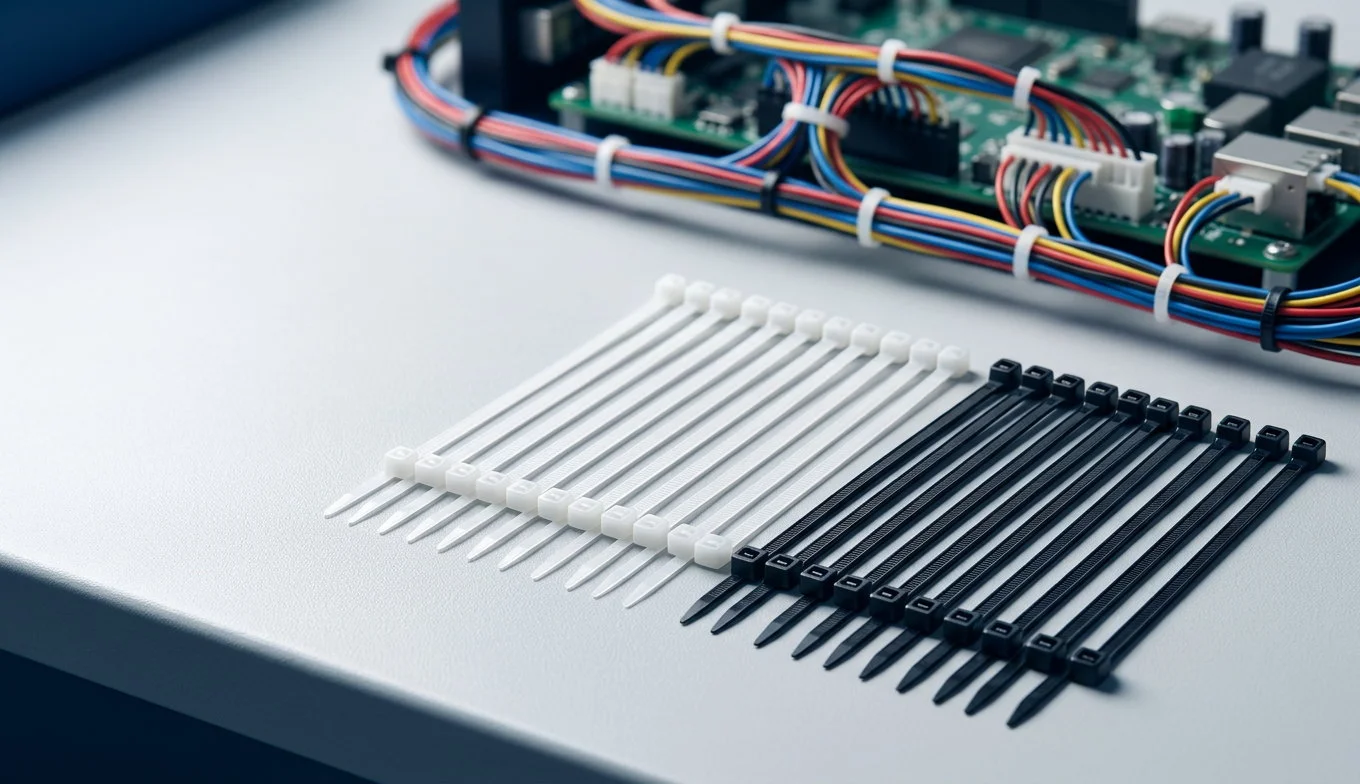



Are Nylon Zip Ties Better Than Plastic?
When the maintenance manager based at a food processing facility was in need of zip ties for a cable management job that was to be executed outside, the supplier offered him two different types with different prices. The first type was called “Nylon 6/6 Cable Ties – Black UV-Stabilized” while the second option was termed as simply, “Plastic Zip Ties.” The prices differed by roughly 30%. Hence the manager preferred to buy the cheaper option. Eight months later the zip ties were brittle, faded and broke mere when finger pressure applied upon them. Although both were black in color, the nylon cable ties were not the right match. Despite being black, they were made from polypropylene plastic which is cheaper and has lost strength over time. The difference between nylon and plastic prompt many buyers to lose sight of better buying options. Nylon as already mentioned, is still a type of plastic. The better question is how nylon cable ties are superior compared to other plastic types which are less expensive. The answer is yes in practically all areas where nylon ties are used. One must be able to differentiate between varieties of material used to manufacture ties if they want them to work efficiently for long time around.
Summary: Nylon zip ties — specifically those made from nylon 6/6 (polyamide 66) — are better than zip ties made from other common plastics, such as polypropylene (PP), in terms of tensile strength, temperature resistance, UV resistance (when carbon‑black stabilised), and overall durability. Nylon is itself a plastic — an engineering thermoplastic with a unique combination of strength, stiffness, creep resistance, and heat tolerance that makes it the standard material for cable ties in electrical, industrial, and outdoor applications.
The Terminology Trap: Why “Plastic vs. Nylon” Is the Wrong Question
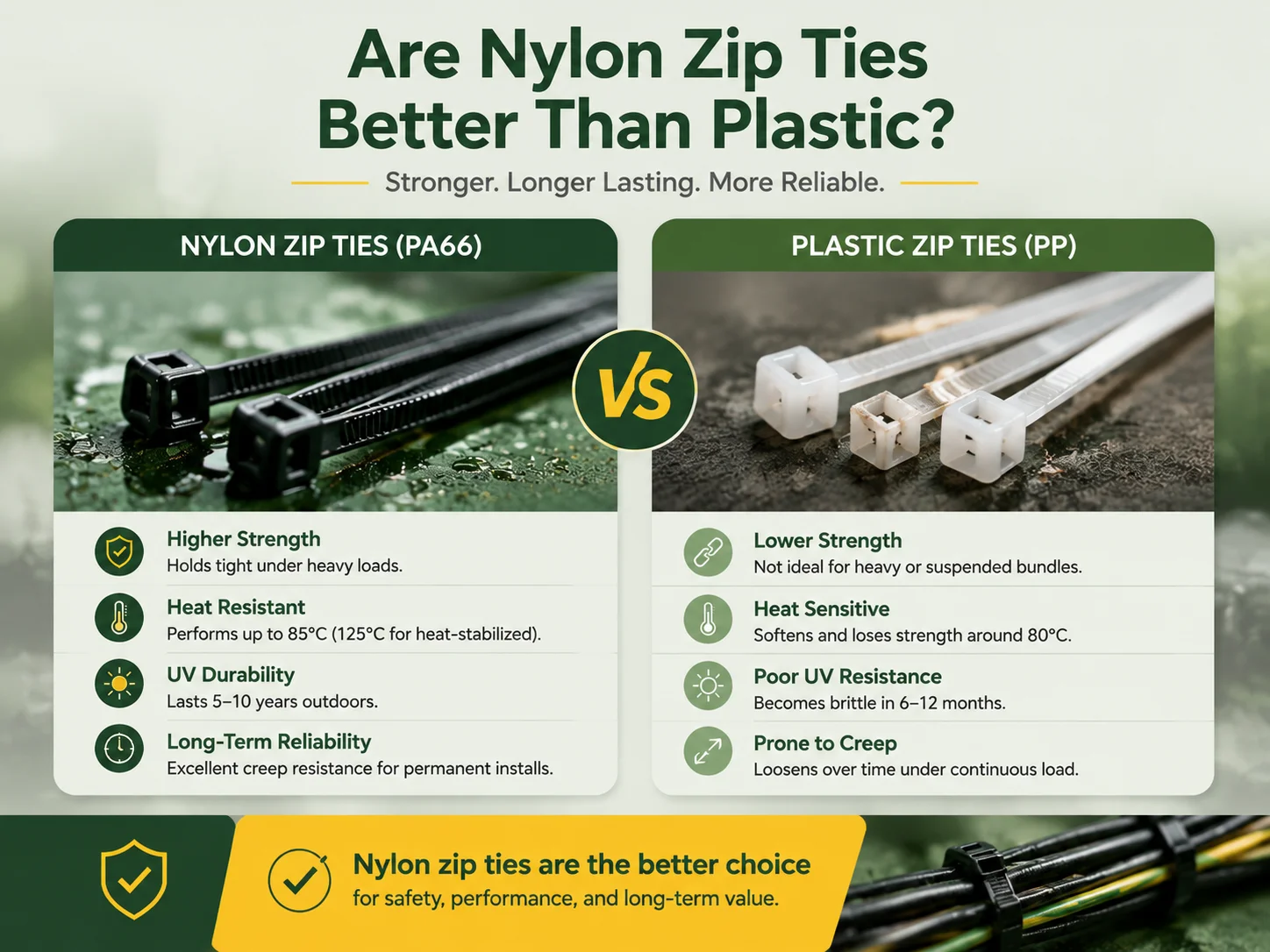
The phrase “Is nylon zip tie better than plastic?” indicates a misconception about the different types of materials. Nylon belongs to a category of materials known as plastics — specifically, polyamides, which fall under a class of materials called engineering thermoplastics. The type of nylon that is normally utilized for making nylon cable ties is nylon 6/6 (polyamide 66), which is a thermoplastic. It was selected for the first Ty-Rap cable tie manufactured in 1958 because it combines several important properties, such as high strength, good rigidity, excellent creep resistance, and fairly high service temperature (up to 85 degrees)(185 degrees). In other words, those who ask the question about “nylon versus plastic” are usually comparing nylon to a cheaper type of plastic, such as polypropylene which is sometimes used in making cheap cable ties. Therefore, the comparison is not between nylon and something called simply “plastic.” The comparison is between nylon 6/6 and polypropylene, which have different characteristics.
The issue of terminology confusion is further complicated by the fact that many products are labeled simply as “plastic” on retail packs; there is no indication of the actual material being used to make a product. “Plastic zip ties — black” could be made of nylon, or it could be made of polypropylene, and since there is no mention of the material on the packaging, the consumer cannot determine what type of product is offered for sale. This is why industry professionals and electrical specification specialists prefer to use “nylon cable ties” instead of the term “plastic cable ties” or simply “zip ties.” For a complete explanation of every material used to manufacture cable ties and how to identify them, our guide on what zip ties are made of covers nylon, polypropylene, ETFE, and stainless steel in detail.
Nylon 6/6 vs. Polypropylene: A Direct Material Comparison
The table below provides a direct comparison of the two materials across the criteria that matter most in real‑world cable tie applications.
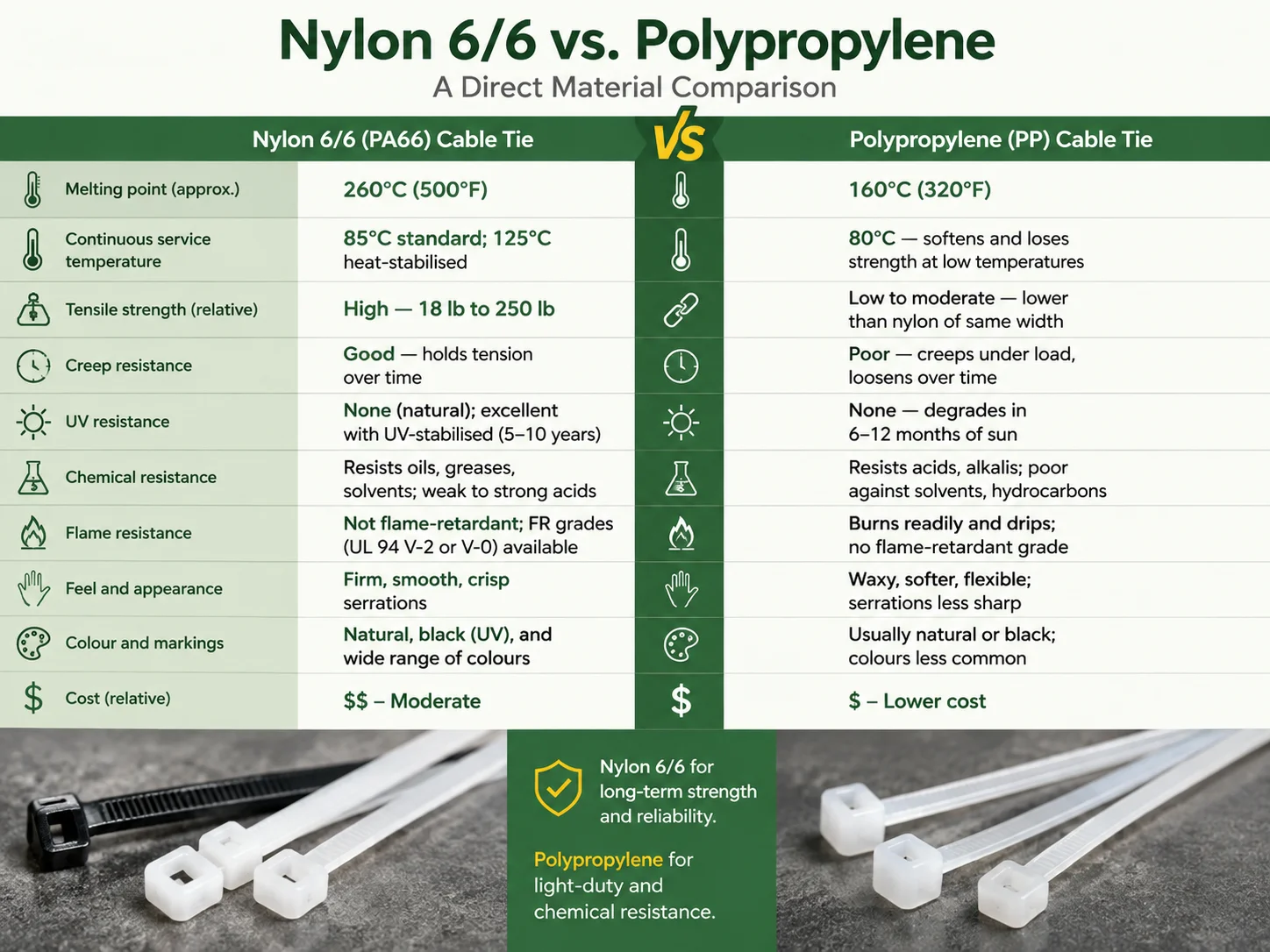
| Property | Nylon 6/6 (PA66) Cable Tie | Polypropylene (PP) Cable Tie |
|---|---|---|
| Melting point (approx.) | 260°C (500°F) | 160°C (320°F) |
| Continuous service temperature | 85°C (185°F) standard; 125°C (257°F) heat‑stabilised | 80°C (176°F) — softens and loses strength at relatively low temperatures |
| Tensile strength (relative) | High — standard ratings from 18 lb to 250 lb. Nylon 6/6 has a tensile strength of 10,000–12,000 psi for the base resin, which translates into the published loop strength of the finished tie. | Low to moderate — a polypropylene tie of the same width as a nylon tie will have a significantly lower tensile strength. Polypropylene is not suitable for heavy or suspended bundles. |
| Creep resistance | Good — nylon holds its tension over time under continuous load, which is critical for a permanent fastening. | Poor — polypropylene creeps (stretches) under continuous load, and a bundle that was tight at installation will loosen over time. |
| UV resistance | None in natural form; excellent when carbon‑black UV‑stabilised (5–10 years outdoors in temperate climates). Our guide on whether zip ties are UV resistant explains the chemistry in detail. | None — degrades rapidly outdoors, becoming brittle and losing strength within 6–12 months of direct sun exposure. |
| Chemical resistance | Good resistance to oils, greases, and common solvents; attacked by strong acids and phenols. | Excellent resistance to acids and alkalis; poor resistance to organic solvents and hydrocarbons. Polypropylene is sometimes chosen specifically for its acid resistance in chemical environments. |
| Flame resistance | Standard nylon is not flame‑retardant; flame‑retardant grades (UL 94 V‑2 or V‑0) are available for electrical enclosures and public buildings. | Polypropylene burns readily and drips burning material; it is not available in a flame‑retardant cable tie grade. |
| Feel and appearance | Firm, slightly flexible at room temperature; smooth, uniform surface; crisp, well‑defined serrations. | Waxy, softer, more flexible; may feel greasy; serrations are often less sharply defined than on nylon ties. |
| Colour and markings | Available in natural (translucent off‑white), black (UV‑stabilised), and a wide range of colours for identification. The colour is uniform and consistent. | Usually natural (translucent) or black; coloured polypropylene ties are less common. The surface may appear streaky or mottled. |
| Cost (relative, same size) | $$ – Moderate; the industry standard for quality fastening. Nylon costs more than polypropylene per kilogram, and the finished tie costs more per unit. | $ – Less expensive than nylon. The lower material cost is the primary reason polypropylene ties exist in the market. |
When a Polypropylene Zip Tie Is Acceptable — and When It Is Not
Polypropylene cable ties cannot be classified as defective products by no stretch of the imagination. This is because they are purpose-built products that have a set of specific applications, which include the need to be used indoors, to have a low load requirement, have a temporary usage and to be non-critical. In those applications, the polypropylene cable ties work satisfactorily while at the same time being cheaper than nylon cable ties. For example, they can be used in securing low load requirements such as gathering loose cords in the garage, organizing cords under the desk of a desktop computer, suspending temporary decorations in a party, tying plants to a garden stake for a season, etc.
The polypropylene ties should not be used in any electrical application as they are not able to satisfy the safety requirements of all installations in which they are applied and cause a safety hazard. Plastics, including polypropylene do not suit any outdoor application as polypropylene breaks down under UV rays and becomes useless within a few months. All indoor applications also do not fall under the category of the applications where polypropylene ties are applicable because they fail due to low strength and stretch under load. Lastly, polypropylene ties cannot be used in cases when the certification of material is required by the law, the manufacturer, or customer specifications because polypropylene is seldom tested and certified as required. For professional buyers, the needed material during the purchase will be nylon 6-6. It is the only suitable material for the buyer when the application calls for it.
How Long Do Nylon Zip Ties Last Compared with Polypropylene?
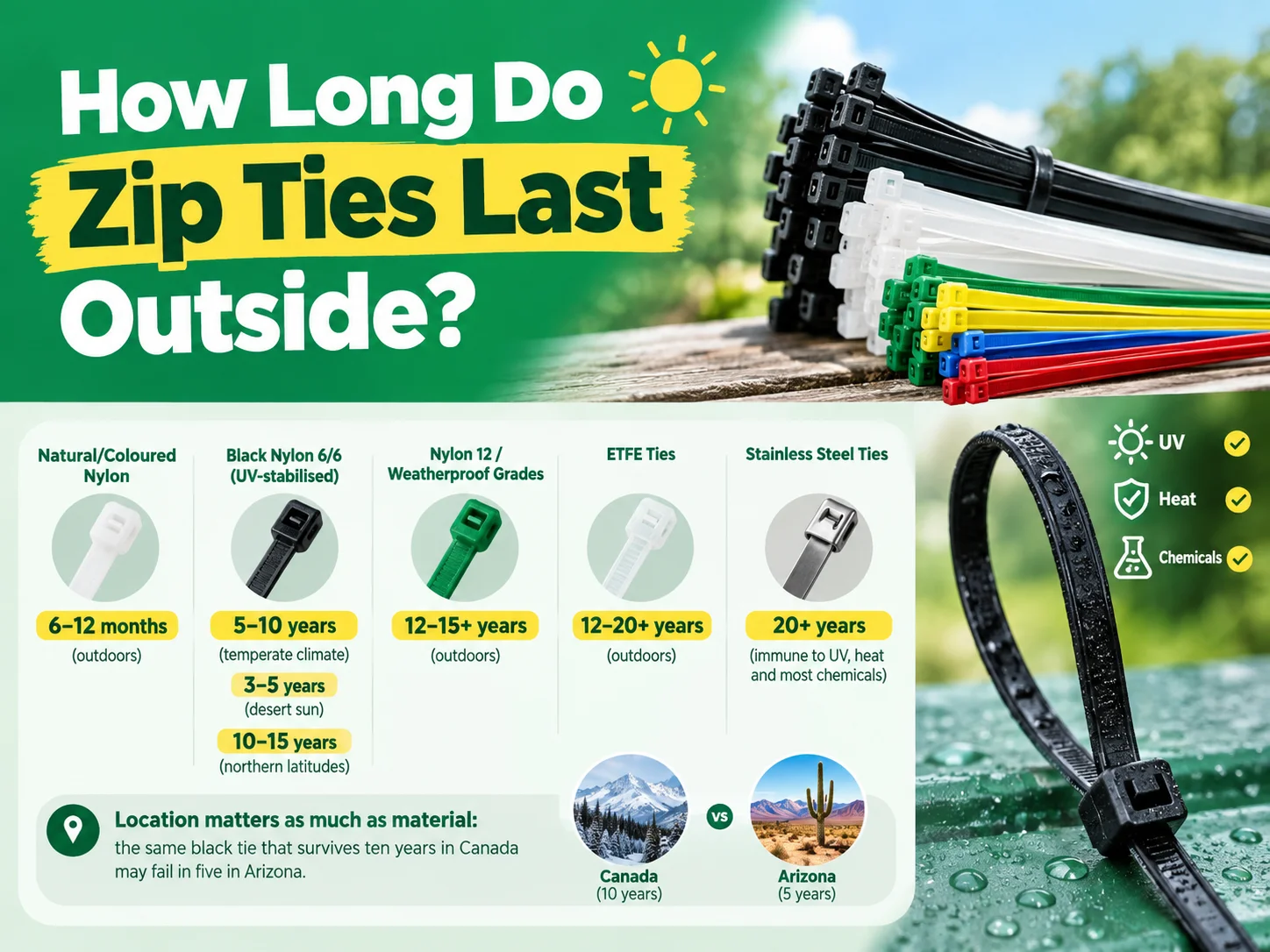
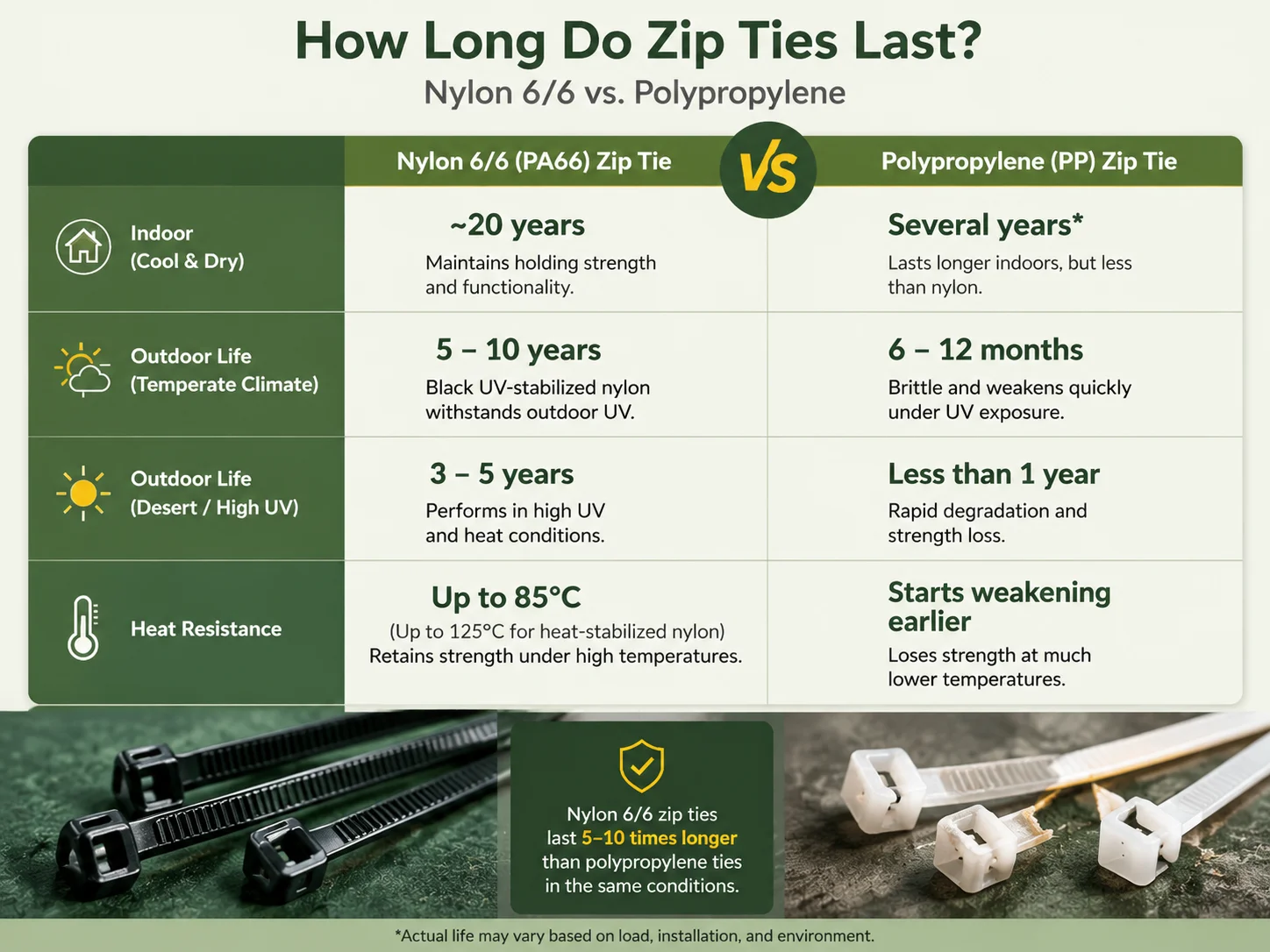
A cable tie’s longevity depends on its type of material, environmental conditions, and working load. A nylon 6/6 tie is expected to last five to ten times as long as a polypropylene tie of comparable size and weight. In a cool and dry indoor environment, nylon cable ties last about 20 years, maintaining their holding ability and functionality throughout the lifetime of the installation. Polypropylene ties in the same environment should also last longer than they would in an outdoor environment since their main degrading forces—heat and UV light—are absent. In fact, the difference between the two becomes evident in more extreme conditions. A black UV-stabilized nylon tie should survive outside for 5 to 10 years in temperate climate and for 3 to 5 years in desert conditions. A black polypropylene tie is going to become brittle in 6 to 12 months and lose its strength long before that because the black color additive used in a polypropylene tie is not a UV stabilizer. Nylon does not lose its strength till 85 degrees Celsius (or even till 125 °C for heat treated nylon) and keeps its ability to hold under various conditions. Polypropylene membrane will start losing its strength much earlier due to the heat. For a detailed look at the temperature limits of every cable tie material, our article on whether zip ties are heat resistant provides the continuous‑service and melting‑point data for nylon, polypropylene, ETFE, and stainless steel.
What Is the Strongest Type of Zip Tie — and Where Does Nylon Rank?
A stainless steel cable tie ranks as the strongest kind of zip tie, being able to withstand weight loads as low as 100 pounds for smaller zip ties and up to 600 pounds and beyond for industrial strength zip ties. Stainless steel ties are indeed much stronger than other types of ties made out of polymers. This is also the material you should be turning to when you need to carry more load than nylon is able to bear. In the polymer zip ties category, the strongest type of zip tie is nylon 6/6 tie. The strength of the zip ties will range from 18 pounds for the low end of the spectrum to 250 pounds for the heavy-duty type of nylon ties. For instance, similar to the width of the nylon tie increases the difference in load versus width characteristics of the polypropylene tie. This means that nylon 6/6 ties are more suitable for different electric, industrial, or outdoor applications as compared to other types of zip ties. For a complete comparison of nylon and stainless steel across every dimension, our guide on stainless steel zip ties vs nylon cable ties covers the trade‑offs in detail.
Frequently Asked Questions
What material is best for zip ties?
The best zip tie material is one suited to the environment and load. Nylon 6/6 is the common material for indoor electrical and general uses. For outside conditions, black UV-stabilised nylon 6/6 is generally used. For high-temperature applications, one should choose heat-stabilised nylon or stainless steel. For maximum strength, stainless steel is needed. Simple polypropylene is only good for small light-duty and temporary conditions; therefore, it shouldn’t be used whenever one needs durable or strong materials.
Which is better nylon or plastic zip ties?
Nylon zip ties are better than other plastic zip ties, especially polypropylene, as they provide better mechanical strength, heat resistance, outdoor durability, and more efficient long-term application. The term nylon describes certain types of plastics, as the comparison being made is between nylon and cheaper plastics like polypropylene. Although nylon 6/6 is stronger than polypropylene regarding heat and UV resistance, it has to be used in those applications requiring either professionalism or long-term use.
How durable are nylon zip ties?
Longevity of nylon zip ties is probably 20 years in cooler and dry indoor conditions. Outdoors, black UV-stabilised nylon 6/6 will last between 5 and 10 years in temperate climates and 3 to 5 years in the desert, while in the end, the durability depends on the climate and material used.
What is the strongest zip tie?
Stainless steel cable ties have been proved to be the strongest zip ties with tensile strengths greater than 600 pounds. Nylon 6/6 is the next strongest zip tie material with tensile strength rating of up to 250 pounds for heavy-duty ties. Moreover, polypropylene ties can be characterized by being weak and applicable under lightweight conditions only.
References
- Panduit — Cable Tie Material Specifications and Technical Data. Manufacturer of nylon 6/6, polypropylene, ETFE, and stainless steel cable ties with published tensile strength, temperature, and weathering data.
- HellermannTyton — Material Properties and Selection Guide for Cable Ties. Global manufacturer providing detailed material performance data for every cable tie material, including nylon and polypropylene.
- American Chemistry Council — Plastics Division. Information on the properties, additives, and environmental performance of nylon (polyamide) and polypropylene, including the mechanisms of UV and thermal degradation.
- UL 62275 — Cable Management Systems. The defining standard for cable tie testing, rating, and listing, including the tensile loop strength test and the material conditioning requirements that apply to both nylon and polypropylene ties.
Are nylon zip ties better than plastic? Nylon is a plastic — an engineering thermoplastic that was chosen for the original cable tie in 1958 because it was the best material for the job, and that remains the best material for the job today. When comparing nylon cable ties and ties made from cheaper plastic like polypropylene or low-quality regrind blends, nylon emerges the winner clearly. Nylon is stronger and has higher heat tolerance. Nylon offers prolonged tension. Nylon can be treated with UV stabilization for outdoor uses. Flame retardation is another possibility for nylon for making electrical enclosures. Nylon offers a number of certificates, including UL listing and material test report, that professional installations might require. On the contrary, the cheaper plastic ties can only fit some temporary and easy jobs in the home office or garden. In all other cases of application where cable tie failure can act as an obstacle, you need to use nylon 6/6 material, which is of high quality and can be proved by necessary documentation. igoto offers a full range of nylon cable ties, including different sizes, colors, and material grades – find the right tie for any job that requires nylon.