

Are White Zip Ties UV Resistant?
A solar installer in Queensland thought that a batch of DC cables secured to an aluminium mounting with some white zip ties would remain intact, just like those he had previously used — they looked the same, felt similar and had the same 50-pound-rated tensile strength written on the package. However, 18 months later, all the white ties became brittle and would crack and break at the slightest touch, while the black ties installed on the same day on the same unit remained intact. This incident reflects the installer learning the hard lesson that materials engineers have known for many years: the standard white zip ties are not UV resistant. The thing here is that the color of a tie is more than just a design detail; given that it is the only reliable visual indicator of the cable ties’ UV resistance outdoors. Understanding how and why white ties fail outdoors, which colors provide real UV resistance and what are the alternatives for white and light-colored ties is the key to knowing whether fastening would last until the impending inspection or fail immediately.
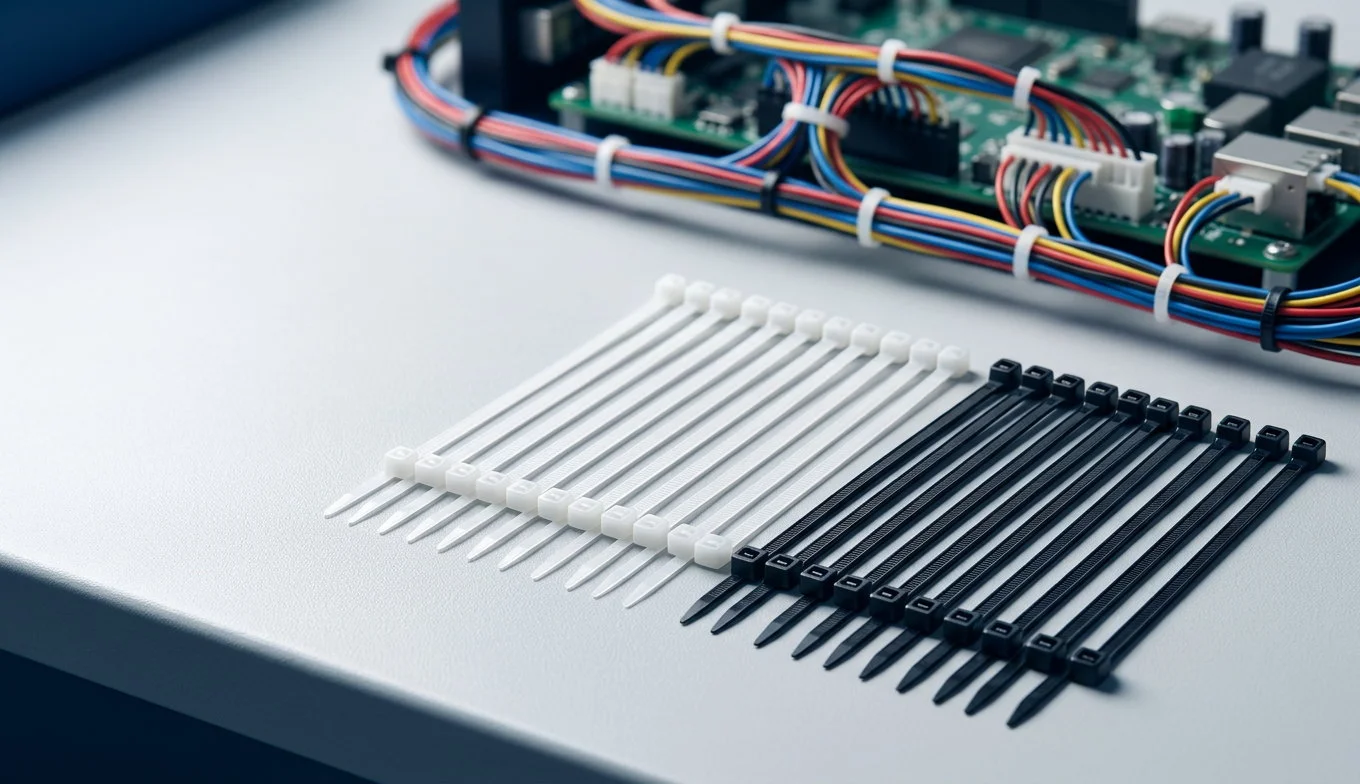
Summary: Regular white nylon cable ties, which are also referred to as ‘natural’ cable ties, are those which contain no UV stabilisers. The natural colour of nylon 6/6 is translucent off‑white and a white pigmented tie simply means that natural nylon is added with a white pigment to give it a white colour — neither the natural one nor the pigmented version are UV resistant. If left outdoors under sunlight, a white cable tie made of nylon will start losing tensile strength in a few weeks and will quickly break after about 6–18 months according to the component of the weather. The only colour of nylon cable tie that is resistant to UV rays is black which is known as a colour that is UV-stabilised or weather-resistand owing to its carbon black content.
The Chemistry of UV Degradation: Why White Nylon Dies in the Sun
To know why white zip ties fail outdoors, it is important to find out how ultraviolet light affects nylon. In a scientific sense, nylon 6/6, or polyamide 66, is a polymer or a long chain of repeating units. When the UV light strikes the polymer chain (especially in the UV−B and UV−A spectrum), the energy breaks chemical bonds that hold the chain together. This process is called photo-oxidation; it causes the polymer chain to shorten. Shorter chains lead to the loss of flexibility of the material and micro-cracks on the surface. Water gets into the cracks, and temperature changes (the daily extension and shrinking of the zip tie on a solar surface) cause further opening of the cracks into the material. The problem is that, at some point, the tie will lose its tensile strength, and break. This process of degradation will take place for any nylon material that does not receive protection from UV rays, regardless of the color. The difference between the zip tie that works for years outdoors and one that fails within a couple of months is that the former tie uses a UV stabilizer, the chemical that either absorbs the energy from UV rays before they destroy the polymer chain or that absorbs free radicals created by the UV. The best and the cheapest UV stabilizer is carbon black — a tiny powder that is mixed with the nylon resin before producing the zip tie. The American Chemistry Council provides extensive technical literature on the mechanisms of UV degradation and the role of stabilisers in extending the outdoor service life of engineering plastics, and the data is consistent: carbon black is the reference standard for UV protection in polyamides.
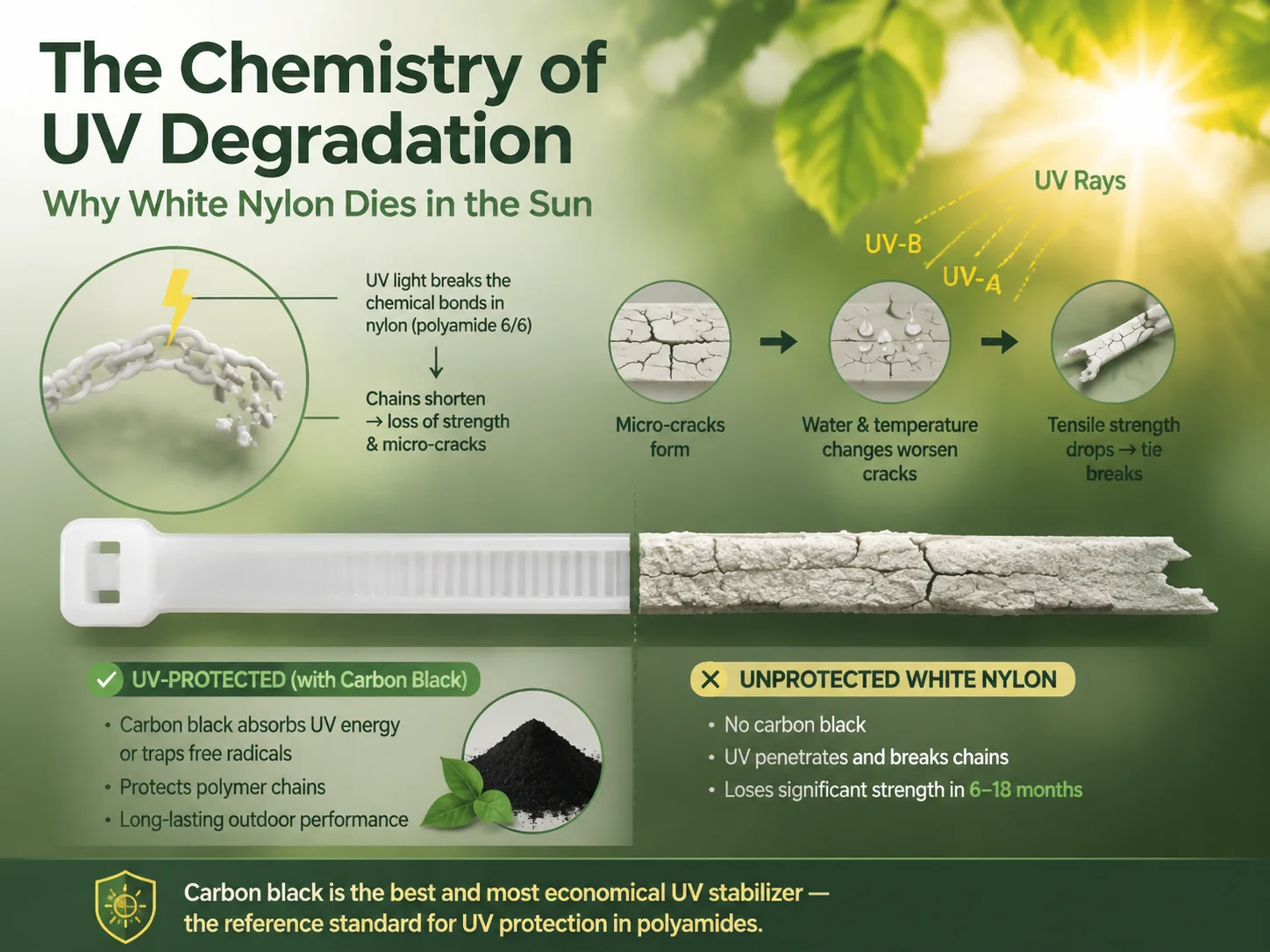
A white nylon cable tie is devoid of carbon black. In case it is a natural tie, it appears as an opaque off-white shade of nylon 6/6. The white coloration may come in some naturally pigmented tie made by means of using the white pigment, which is used in the manufacturing of the cable ties. There is no meaningful UV protection with a white cable tie. The white nylon cable tie might even deteriorate faster than its natural counterpart. The reason is that even though the pigment in a white cable tie is responsible for reflecting light, its impact will not affect UV rays. It is clear that a white nylon cable tie left by itself outside in direct sunlight would lose a substantial proportion of its strength in 6-18 months. For a deeper dive into the UV stabilisation chemistry and the testing standards that verify it, our guide on why UV‑protected cable ties matter outdoors covers the science and the accelerated‑weathering tests that every reputable manufacturer uses to validate their outdoor‑rated products.
What Colour Zip Ties Are UV Resistant? The Simple Answer and the Nuances
The answer to the inquiry, “What colour zip ties can be used outdoors?” is that the answer is simply, black. Any black nylon cable tie that has “UV resistant”, “weather resistant”, or “outdoor rated” marked on it will be totally dependable for any outdoor usage purposes. The black color arrives from carbon black pigment that is responsible for the durability of the cable tie outdoors. Nevertheless, not all black ties can protect from UV rays. Some black cable ties are capable of providing the color black without the use of the UV stabilizing pigment, dye, or cheap colorant that gives energetic black color but does not protect from UV rays. This happens with affordable non-branded or retail-пackaged zip ties when the maker reduced out the price of the UV stabilizer. The only thing that will assure the customer that the black cable tie actually has UV resistance is the manufacturer’s specification, while the language of the specification will say either “UV resistant”, “weather resistant”, or “outdoor rated”, also indicating that the material is “UV-stabilized nylon 6/6.” For a complete explanation of how to identify a genuinely UV‑resistant tie through physical tests and documentation verification, our guide on whether zip ties are UV resistant covers the visual, tactile, and certification checks that separate a quality outdoor tie from an indoor one.
What can be said about these other colours? In order to make the standard coloured nylon cable ties, the manufacturer uses the basic colours like red, blue, green, yellow, orange, grey and white dyed with non-stabilizing pigments. These cable ties are not UV resistant. Their degradation outdoors will be similar to natural (non-coloured) nylon. A standard coloured cable tie breaks down after some time and starts crumbling after six to eighteen months of being in the sun. A unique tie exists, which is manufactured directly with a UV stabilizer that is not made of carbon black. Its manufacturing includes hindered amine light stabiliser (HALS) or benzotriazole UV absorber as an additive. Such ties are hard to find and cost more than the usual black UV-stabilised ties. Manufacturers have to indicate that these UV-resistant cord ties exist and be ready to label the product in case of need. Clients use such ties in the places where colour coding is necessary, and black ties are unacceptable. For instance, it is needed in a pharmaceutical production facility where various pipes and container tubes have to be coloured differently. When choosing the outdoor cable ties, it is essential to check the specifications and the results of the weathering tests that guarantee the desired colour is UV resistant. The Panduit catalogue presents some UV resistant ties. However, one should refer to the technical data sheet for each colour with the weathering tests results available.
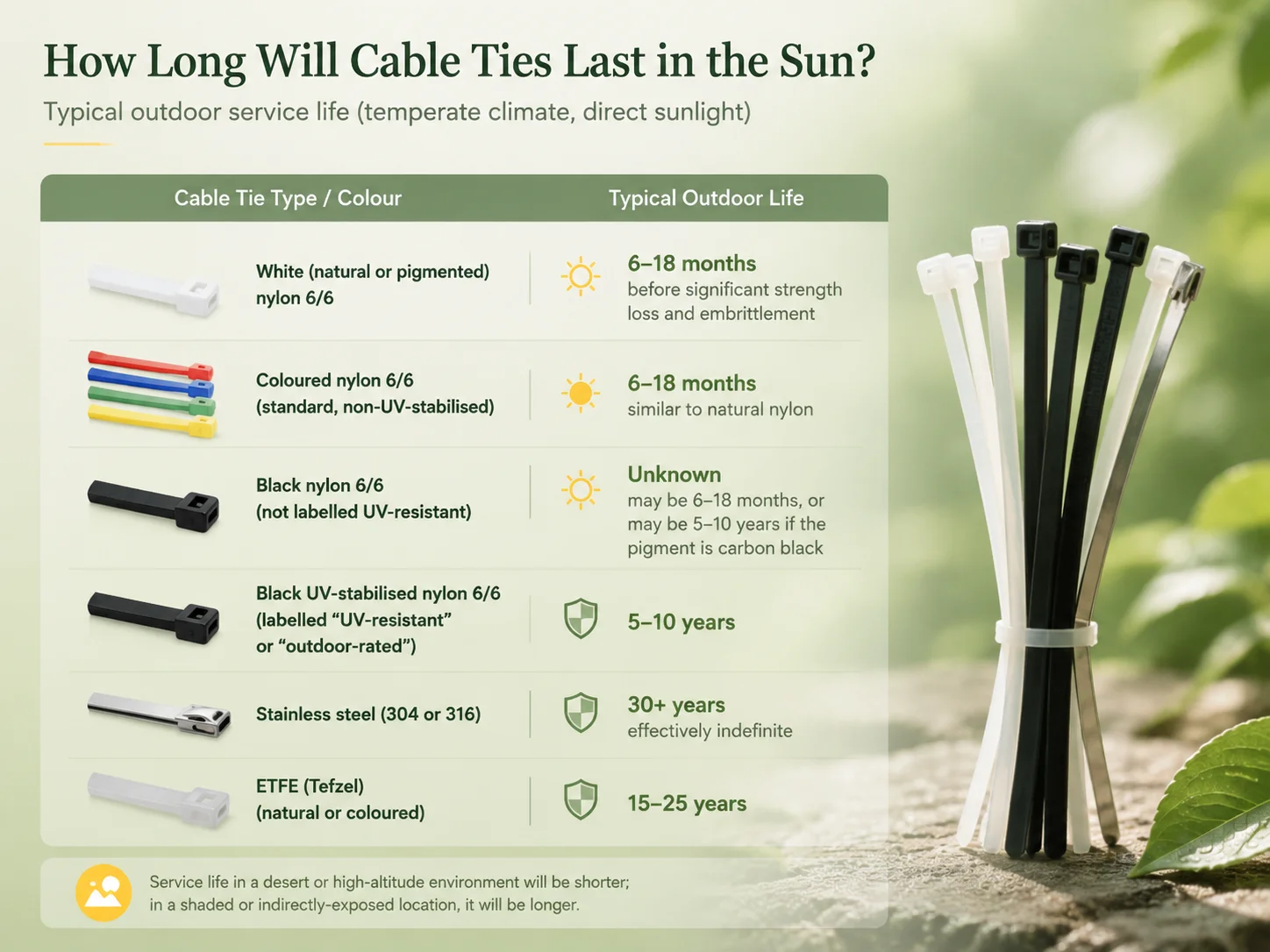
How Long Will White Zip Ties Last in the Sun Compared with Black?
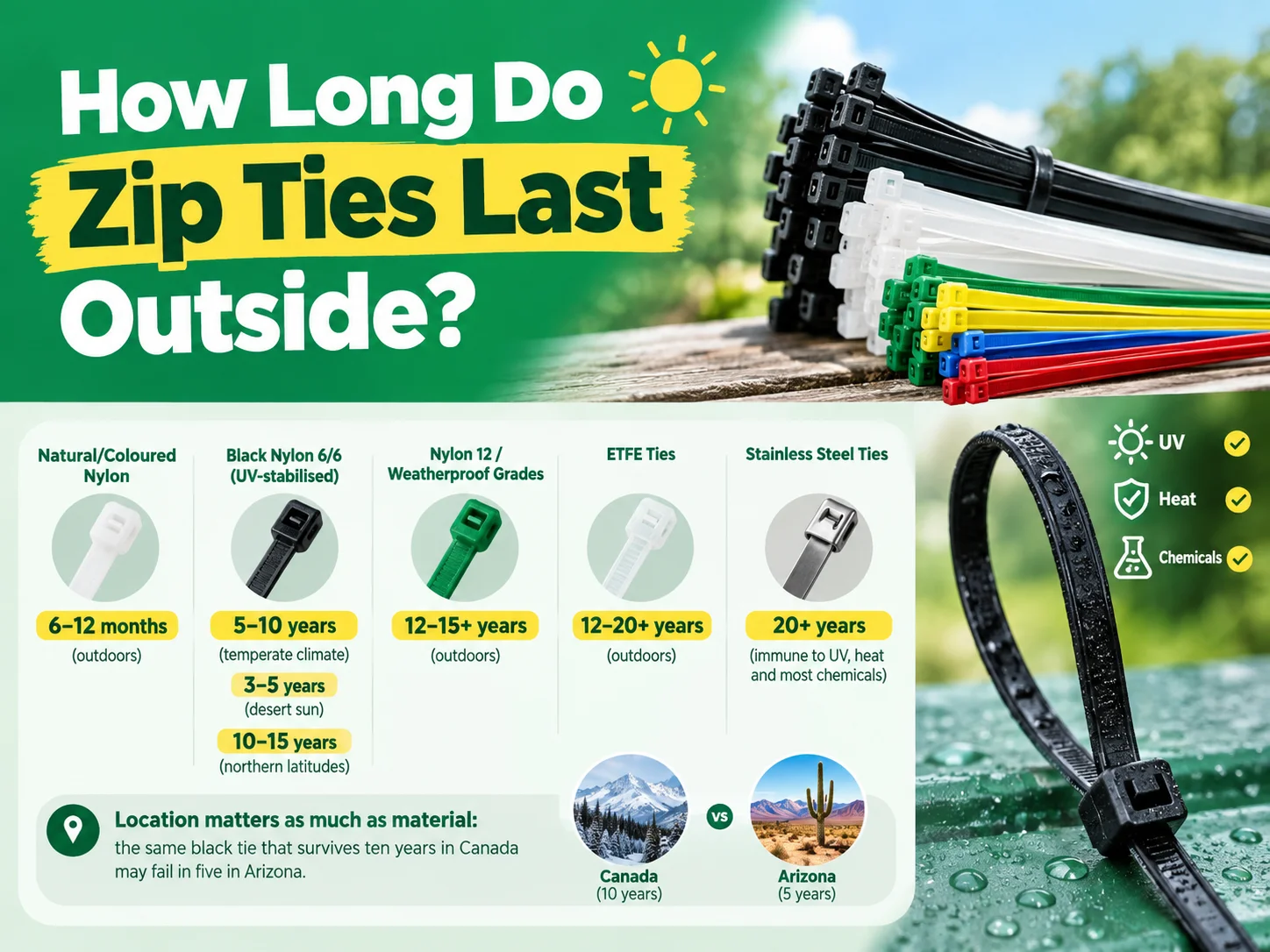
The table below summarises the typical outdoor service life of different cable tie colours and materials, based on temperate‑climate exposure to direct sunlight. The service life in a desert or a high‑altitude environment — where UV intensity is higher — will be shorter; in a shaded or indirectly‑exposed outdoor location, it will be longer.
| Cable Tie Type / Colour | UV Resistant? | Typical Outdoor Life (Temperate Climate, Direct Sun) |
|---|---|---|
| White (natural or pigmented) nylon 6/6 | No | 6–18 months before significant strength loss and embrittlement |
| Coloured nylon 6/6 (red, blue, green, yellow, etc.) — standard, non‑UV‑stabilised | No | 6–18 months — similar to natural nylon |
| Black nylon 6/6 — not labelled as UV‑resistant | Uncertain — may or may not contain a stabiliser; assume no UV resistance unless the manufacturer states it | Unknown — may be 6–18 months, or may be 5–10 years if the pigment is carbon black. Do not rely on it without documentation. |
| Black UV‑stabilised nylon 6/6 — labelled “UV‑resistant” or “outdoor‑rated” | Yes — carbon‑black stabiliser | 5–10 years |
| Stainless steel (304 or 316) | Immune — no polymer to degrade | 30+ years; effectively indefinite in most outdoor environments |
| ETFE (Tefzel) — natural or coloured | Yes — inherently UV‑resistant, regardless of colour | 15–25 years |
What Are the Best Zip Ties for Outdoor Use When You Cannot Use Black?
In the event the purpose of the cable tie is to identify colors or blend aesthetically with equipment, a typical white nylon cable does not work. There are not many substitutes, but those that are available come with specific drawbacks. The best alternative to nylon is the steel cable tie, which has the advantage of being UV-resistant, as it consists of no polymer, which would break down. Also, the steel cable tie has a silver color making it easier to blend with aluminum, galvanized steel, and white-painted equipment. Aster appears to be appropriate for outdoor usage; however, if you operate in a marine or coastal area, you will have to use type 316 tie. The drawbacks include a higher price than nylon, higher weight of the product, electrical conductivity, etc. For a complete comparison of nylon and stainless steel across all performance dimensions, including strength, temperature resistance, and installation requirements, our guide on stainless steel zip ties vs nylon cable ties covers the trade‑offs in detail.
The alternative is that of coloured nylon ties stabilised by ultraviolet rays, which has been manufactured since uses a package that does not use carbon black. A few suppliers can supply coloured nylon ties and they are almost always custom orders that cost more than black UV ties. The colours available are few and often they are mostly white or light grey with limited other colours that vary with a supplier. Always ask the supplier to see the accelerated weathering data for the particular colour and confirm that the tie has passed testing standards. A tie that is simply marked “UV resistant” cannot be relied and trusted for outdoor use. Igoto can provide coloured cable ties that have been UV stabilised with appropriate material certificates.
Indoor Use: Where White and Coloured Zip Ties Belong
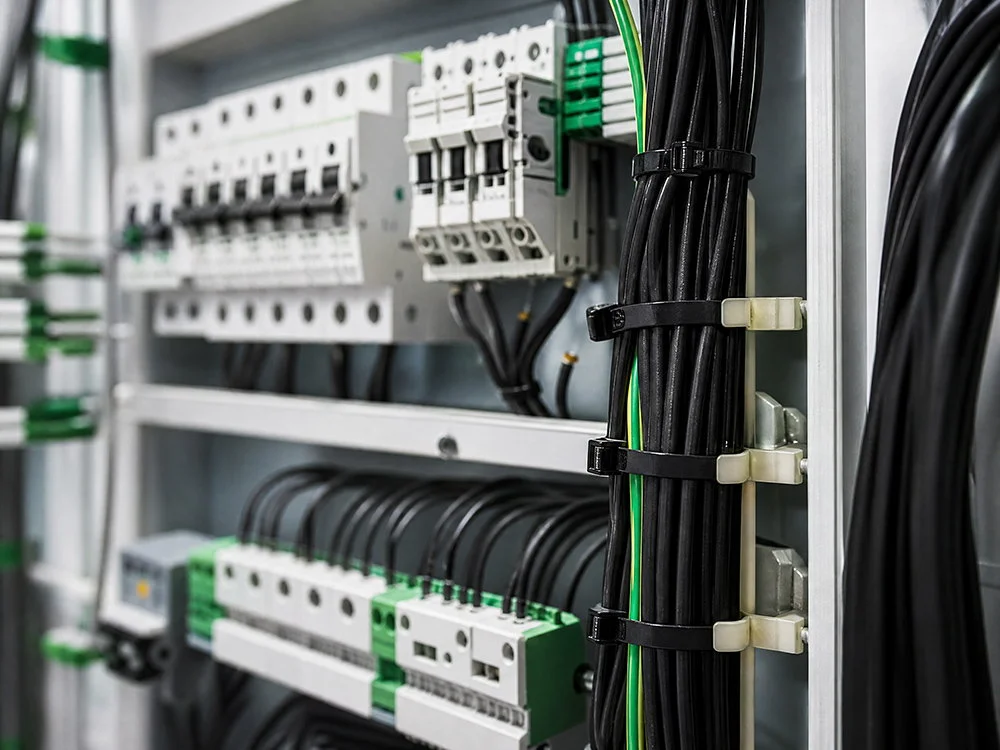
White and colored nylon cable ties are wonderful products, provided that they are used indoors, in a controlled environment without direct sunlight. If white nylon ties are used in a dry climate indoors, they will last for decades. White ties retain their tensile strength, locking integrity, and appearance. The color of the tie gives an elegant look to installations made in white-paneled electric panels, medical devices, and consumer electronics. Colored ties allow for a swift visual coding of different circuits, voltage levels, or types of cables, which is the standard method in data centers, control panels, and structured cabling installations. For such indoor applications, using white or colored nylon ties is the right choice since they are cheap, available, and very durable in the absence of UV light. For a comprehensive look at how to use colour coding effectively in cable management, our guide on the versatile uses of coloured nylon cable ties explains the common colour conventions and their practical applications across different industries.
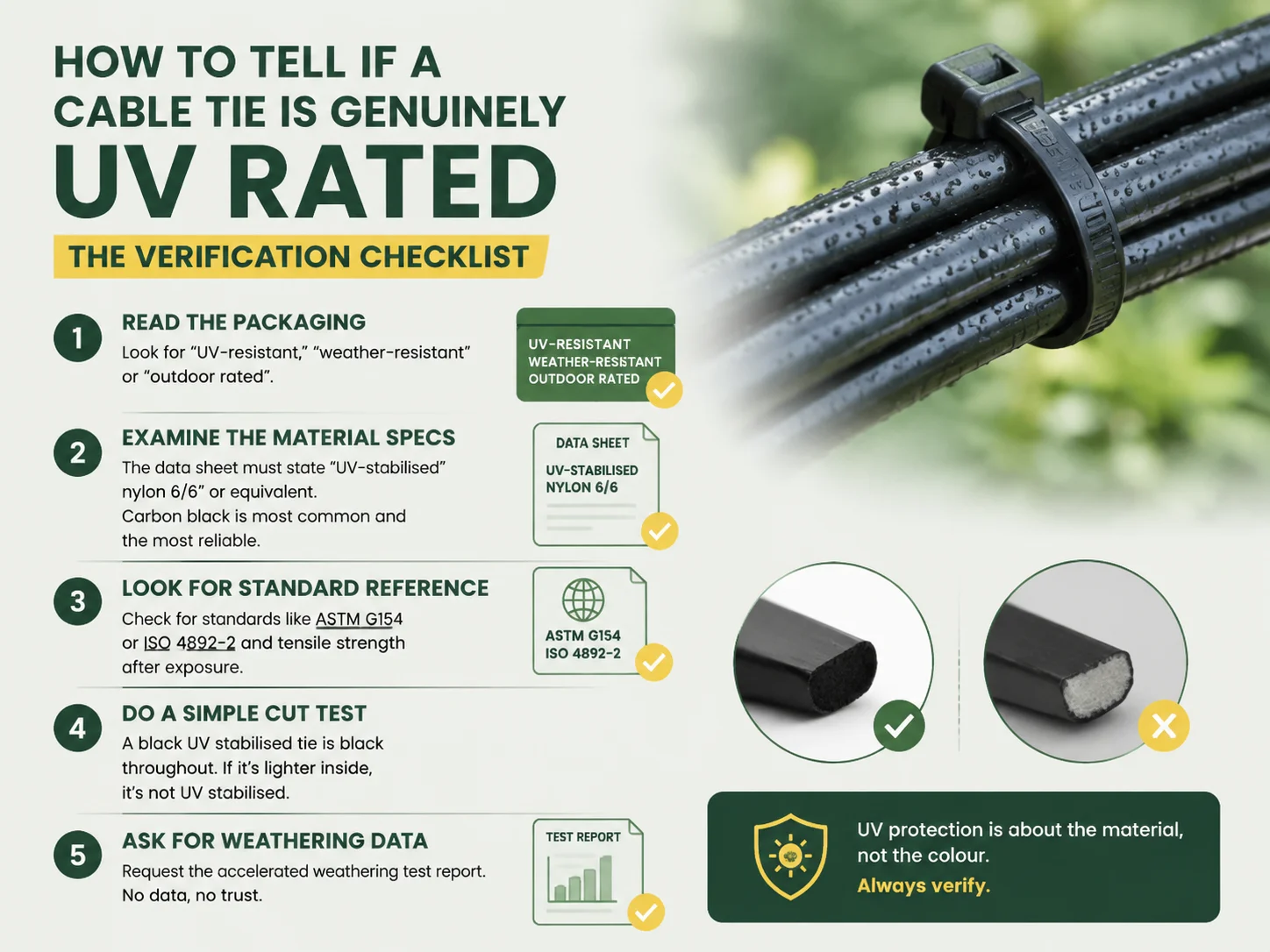
How to Tell If a Cable Tie Is Genuinely UV Rated: The Verification Checklist
Verifying that a cable tie is UV rated requires checking the manufacturer’s documentation, not just looking at the colour. The following checklist provides a practical verification sequence that works for any brand and any colour.
- Read the packaging. The packaging must have the words “UV‑resistant,” “weather‑resistant” or “outdoor rated”. If it does not, then consider a tie for indoor use only, irrespective of its colour.
Examine the material specs. The data sheet must have “UV‑stabilised nylon 6/6” or equivalent. The type of stabiliser (carbon black, HALS or benzotriazole) may be names too, however, Carbon black is most common and the most reliable.
Look for certification or standard reference. A reliable manufacturer will mention the accelerated weathering standard like the ASTM G154 or ISO 4892‑2 and will give the relevant test conditions and result in tensile strength after exposure. A tie with no certification and no standard reference is a tie with no UV resistance.
Do a simple cut test on a sample. Cut through the cross-section of the tie. A black UV stabilised tie should be consistently black throughout the entire thickness; the carbon black is compounded into the resin and not just painted. If a tie is black on the surface but lighter inside, then that tie is not UV stabilised. The test will not work for a white or a coloured tie because, in this case, the UV stabiliser, if present, is not visible.
Ask for the manufacturer’s weathering data. In case of crucial installation outdoors, ask for the accelerated weathering test report for the specified product. In case the manufacturer is not in a position to provide the data, the manufacturer should not be trusted.
Frequently Asked Questions
What color zip ties are UV resistant?
When it comes to black zip ties, they can only be considered UV resistant if the packaging clearly states “UV-resistant” or “outdoor-rated”. The use of carbon black allows these ties to block out the harmful rays of the sun. The same cannot be said for regular black or natural nylon cable ties in addition to those in the colours red, blue, green, yellow, and any others. Unless the manufacturer produces non‑carbon black zip ties, these regular ties won’t be UV resistant either. On the other hand, stainless steel cables ties are naturally protected from UV rays regardless of their colour.
How long will zip ties last in the sun?
A black nylon tie with UV stabilization would last 5 to 10 years in temperate areas exposed to direct sunlight, and short of about 3 to 5 years in deserts. A white or colored nylon tie that is not UV stabilized will only last from 6 to 18 months until it becomes weak and brittle. Both types of ties made of stainless steel would last 30 years or more when installed outside.
What are the best zip ties for outdoor use?
The best zip ties for outdoor use are black UV‑stabilised nylon 6/6 ties for general electrical, solar, and industrial applications — they provide 5–10 years of service at an economical price. For extreme environments, for applications that must last 20+ years, or for applications where a non‑black colour is required, stainless steel cable ties are the best choice. igoto’s UV‑resistant cable tie range covers the full size and strength spectrum for outdoor nylon applications, and our stainless steel ties are available in 304 and 316 grades.
How to tell if a cable is UV rated?
In order to confirm whether or not a cable tie has a UV rating, one must ensure that certain terms are present in the packaging. Specifically, it should be labeled “UV-resistant,” “weather-resistant,” or “outdoor-rated.” One should also look in the material specifications for the term “UV-stabilised nylon 6/6.” Additionally, a reference to a standard, such as ASTM G154 or ISO 4892-2 can also validate UV resistance. For an additional confirmation, one can make a cut in the tie across the cross-section to ensure that the entire thickness is uniformly black in color. Perhaps the best idea is to ask the manufacturer for a weathering test report in case of a critical installation.
References
- American Chemistry Council — Plastics Division. Information on UV stabilisation of engineering plastics, the mechanisms of photo‑oxidation, and the role of carbon black and HALS in extending outdoor service life.
- Panduit — Outdoor Cable Ties and Weathering Data. Manufacturer of UV‑stabilised nylon, coloured, and stainless steel cable ties, with published accelerated‑weathering results and material specifications for every colour and grade.
- HellermannTyton — Cable Tie Material Properties and Outdoor Performance. Global manufacturer providing technical data on UV resistance, temperature ratings, and outdoor service life for every cable tie material and colour.
- ASTM G154 — Standard Practice for Operating Fluorescent Ultraviolet (UV) Lamp Apparatus for Exposure of Materials. The standard test method used to evaluate the UV resistance of plastics, including cable ties, and to validate the claims of UV‑stabilised products.
Are white zip ties UV resistant? No — and they never have been. The white nylon cable tie is an indoor product, engineered for clean, dry, sun‑free environments where it will serve reliably for decades. It is temporary, at best, to use outdoors and in the sunlight. The carbon black stabiliser has made nylon ties black, and those outdoor cable ties that are not black (unless they are made of stainless steel or are certified by a manufacturer as being UV stabilised without the usage of carbon black) are ties that do not stand the test of sunlight. If one is an installer of solar systems, electrical contractor, or a facility management expert, then one will follow the simple rule of using the black outdoors, any colour indoors, and stainless steel in cases where neither nylon nor colour is suitable. igoto provides all options from black UV-steel cable ties to be used outdoors to white and coloured nylon ties for indoor usage to stainless steel ties for environments where nothing else is durable enough.