



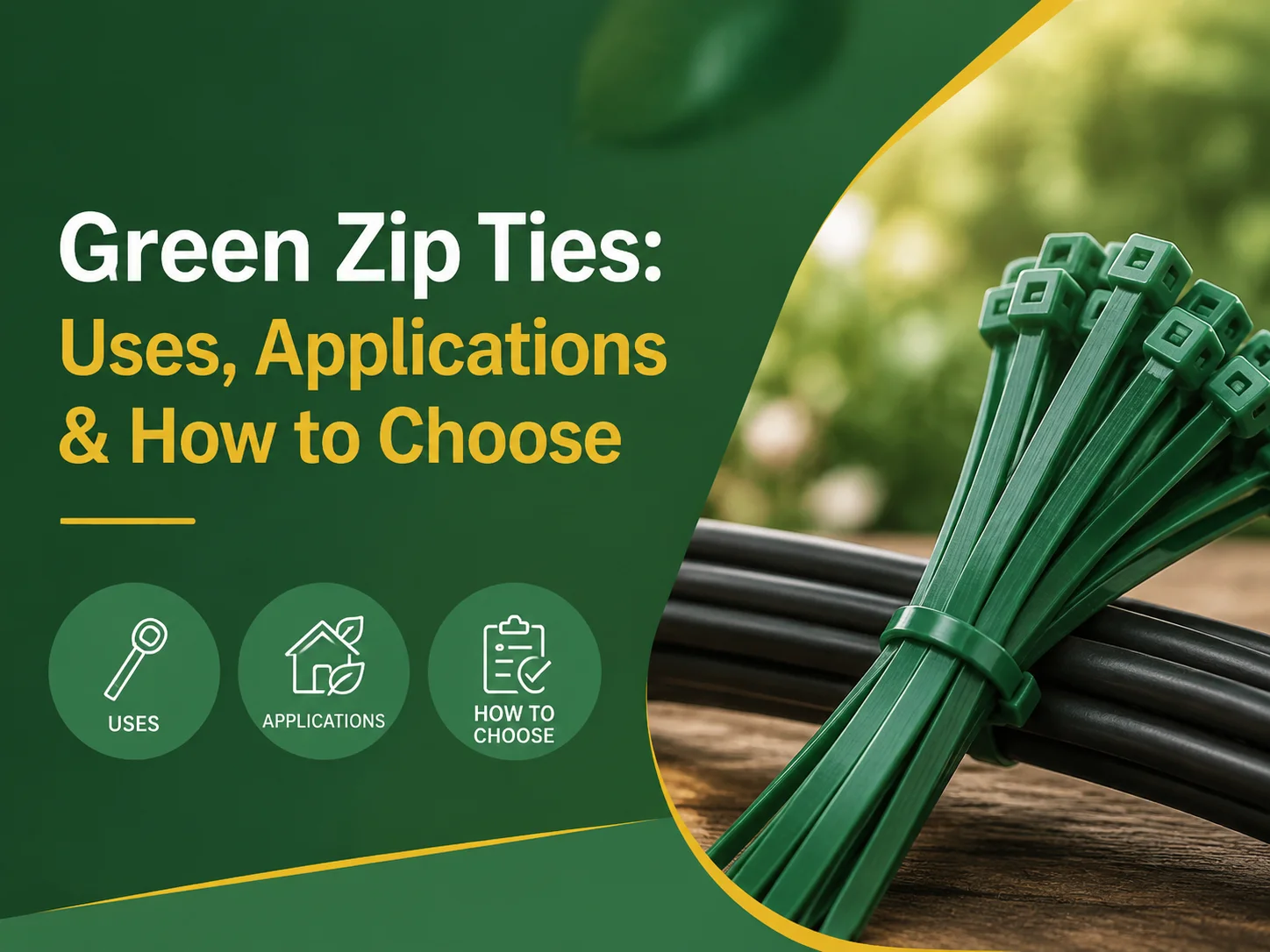
Green Zip Ties: Uses, Applications & How to Choose
If you walk through a properly looked after garden in July, you will most likely see ties connecting the young tomato plant with the stake, directing a climbing rose on the trellis, and anchoring wiring for path lights in the ground. But these will be difficult to spot. The whole point of the green zip ties is not to be seen. The color is not only for decoration; rather it is meant to blend in. The article will explain the usage of green zip ties, the required strength necessary for outdoor use of the ties, as well as how to determine the size and strength of zip ties required for the task.
Summary: Green zip ties, due to their shade, are simply just nylon cable ties, yet they are special because they are useful in blending into plant life in horticultural and concealment operations. Green zip ties can be used for horticultural or decorative illumination purposes, as well as for camouflage. However, one aspect alone cannot stop sun rays from affecting material over time, thus any job that is performed outdoors for a long time should be done by means of a UV resistant green zip tie or a black UV or stainless zip tie, if it is a permanent installation.
What Are Green Zip Ties?
Green plastic ties can be defined as traditional self-locking cable ties as they include a nylon strap that is equipped with a head, which contains a ratcheting mechanism. The only distinction is that their color may be green instead of black or white, which is how these ties received their name. The manufacturers of green cable ties create them using nylon 6/6, which is known for its durability and thermal resistance. The color itself is not just a combination of pigment and resin but rather spreads throughout the entire strap, which is a distinguishing feature.
The lengths of green zip ties vary between 4 inches and 20 inches, while their thickness differs from 2.5 mm to 7.6 mm and more. Moreover, the tensile strength of the ties can reach the level of 100 lbs and more. In such a way, it can be said that green zip ties do not have an impact on the performance of any equipment the users may use it for, but gives them the opportunity to obtain the needed color.
There is one question of potential confusion which should be cleared up first. One term may have two meanings. Most of the customers request green cable ties of the green color, while others require environment-friendly cable ties. In this paper we will focus on the color instead of the eco-friendliness of the product.
The Main Advantage of Green: Camouflage
The reason for opting for green instead of white or black straps is that it can obscure the eye of the observer. The green straps will merge with whatever it is fixed to, whether it is grass, leaves, hedges, or a trellis. Some companies even suggest that garden designers utilize green parts of the earrings for their work to obtain better effects, as they are more suitable for blending in with nature.
The importance of this visual invisibility is that it is not only beautiful but also practical when applying green cable ties in landscaping and outdoor organizing of wires. The presence of so many green cable ties in this case is important because it will save the designer from unnecessary attention when working on the project, and that’s it.
It has to be mentioned that shades are important too. The green ties are most believable against the background of branches or tree trunks; however, they can be seen against dark bark, dead winter branches, or light wall. Choosing the right shade of the tie is thus one of the nuances that distinguish the master from the novice.
Special Uses and Application Scenarios
Green is a niche colour, and niches are where it dominates. Here are the scenarios where green cable ties are the obvious first choice rather than a compromise.
| Scenario | Why green wins | Typical tie |
|---|---|---|
| Gardening & horticulture | Disappears against stems and leaves | Light, 4–8 in, low tensile |
| Landscaping & cable concealment | Hides wiring along fences and hedges | Standard, 8–14 in |
| Vineyards, greenhouses & agriculture | Blends into rows and canopy, weather-facing | UV-stabilised, 8–12 in |
| Holiday & decorative lighting | Vanishes into tree branches and garland | Light, reusable, 4–8 in |
| Tactical & outdoor concealment | Camouflage against vegetation | Standard to heavy, olive/green |
| Colour-coded cable management | Fast visual sorting of circuits or systems | Any size, by system |
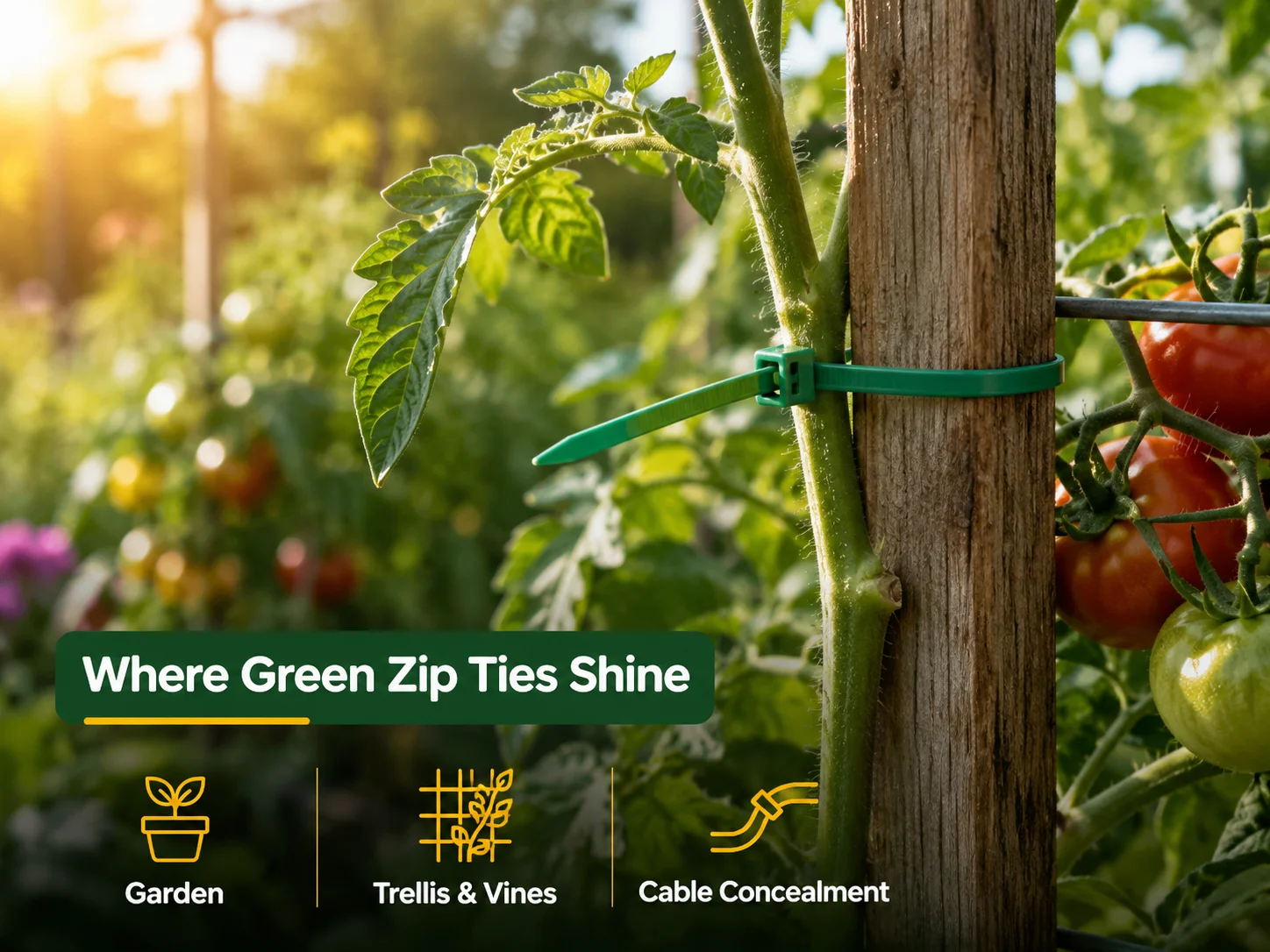
Gardening and horticulture is the main purpose. Gardeners attach plants to stakes, raise climbing roses and grapevines on wires, as well as train tomatoes, peas, and beans on supports. When doing all this, the green garden zip tie is working in an undercover manner since its ratcheting head is quicker and more effective than knotting the twine manually, which is especially advantageous when there are many stems to tie up during the day. The reusability of the ties is a great advantage for climbing plants as the same tie can be released and retied at a higher position in the growing season. The only thing that should be noted is described in the sizing section – one should never crush a growing stem.
Landscaping and outdoor cable concealment let green to serve not only for plants but also for cables. Low-voltage garden lights, ways of drip irrigation installation, and wires or audio wires along fences, entrance-ways, or hedges look far more stylish with green zip ties than whitish ones.
Vineyards, greenhouses, and agriculture rely on its great properties. Here green serves double purposes: on the one hand, it helps the plants grow successfully, and on the other hand, it provides the agricultural facilities with an amazing visual appearance to attract potential visitors. The only thing to worry about is the fact that ties will withstand the weather conditions through seasons.
Decorative lighting is one of seasonal applications of the new material. Green ties can be used to fasten string lights to branches of the conifer trees and railings without making them look untidy.
The field of tactical and outdoor concealment applies green and dark green ties to attach camouflage nets, install cameras, and hide equipment among trees. In cable management green can be simply used to sort out circuits, zones, and types of machines.
Are Green Zip Ties UV Resistant? The Outdoor Reality
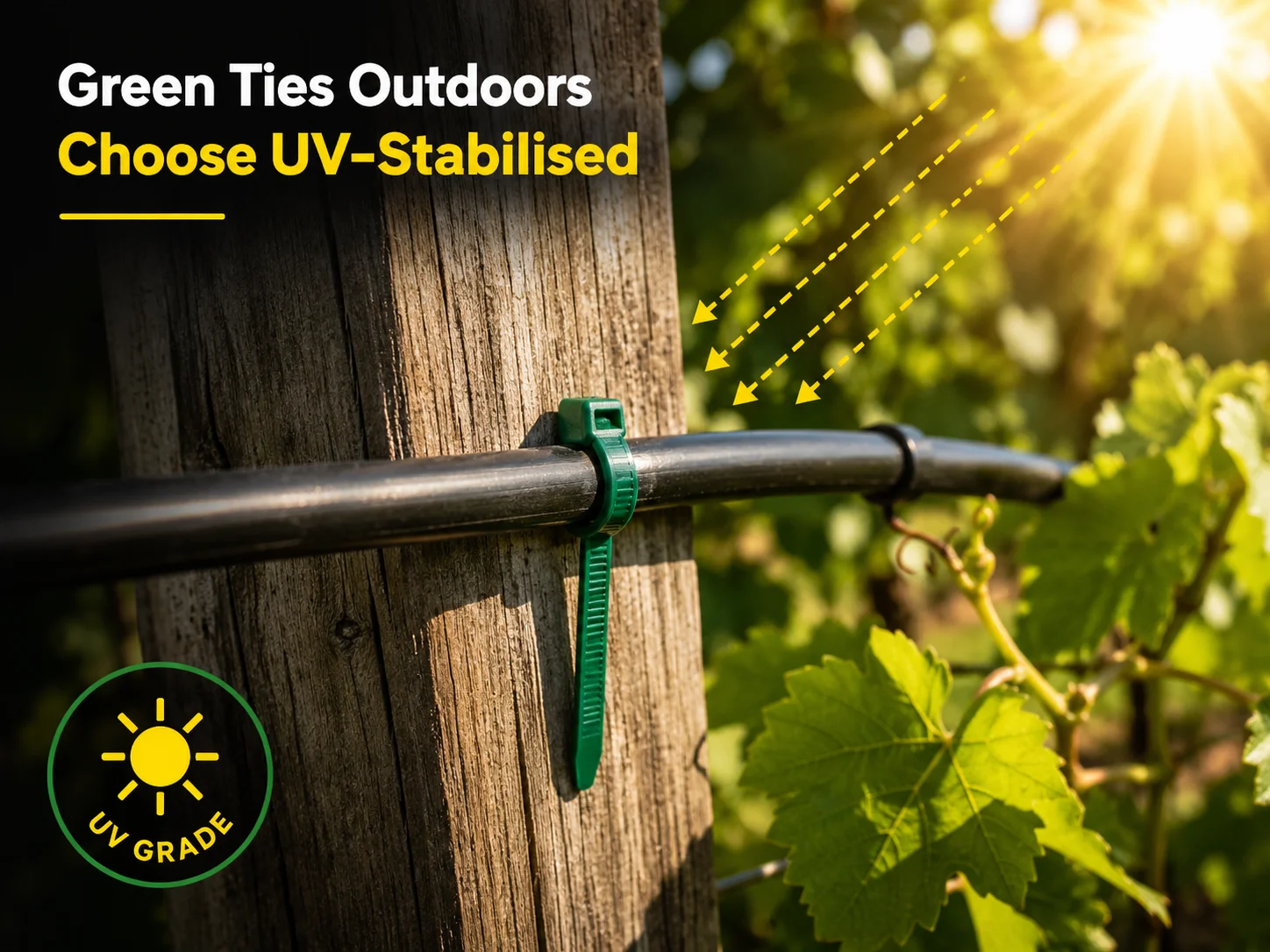
This is the type of question that perplexes many, and therefore it should be answered in an appropriate way. The mere fact of being green does not tell us anything about the resistance of a tie to sunlight. Ties of different colours are dyed with organic dyes and pigments, which are selected for their aesthetic qualities but not for their protective features, which means that the colourful ties and ties with natural colours can get brittle and cracked after only a few months of being exposed to sunlight. The most reliable UV protector available in the market is carbon black, and as a result, you will have a black tie.
The fact that something is green does not mean it cannot be used outdoors. UV-proof green zip ties are available, but manufacturers add haloes and absorbers to the green mixture to make it resistant to real-life weathering. These ties are pricier than the regular ties of different colours and though their lifespan is not as long as that of carbon black ones, they are the right choice if you want to have both the colour and the durability of the outdoor application.
If you are weighing this up, our guide on whether zip ties are UV resistant walks through the chemistry in full, and what plastic zip ties last the longest compares real-world outdoor lifespans.
| Tie type | UV protection | Rough outdoor life in full sun |
|---|---|---|
| Standard green nylon | None (dye only) | Months |
| UV-stabilised green nylon | HALS + UV absorbers | Several years |
| Black UV-stabilised nylon | Carbon black | Many years |
| Stainless steel | Immune to UV | Decades / permanent |
If your green ties will sit in direct, year-round sunlight, insist on a UV-stabilised grade — a standard coloured nylon tie is an indoor-to-seasonal product and will grow brittle within months of hard sun. For a fastening that must outlast the structure itself, step up to stainless steel versus nylon and accept the loss of camouflage.
“Green” the Other Way: Eco-Friendly Options
Readers who actually think of eco-friendly as opposed to just colour should get to know these two type of zip ties. Biodegradable green zip ties will usually be made out of plant materials or compostable polymers that disintegrate under suitable conditions, which allows for their use in one-season gardening where otherwise thousands of them are thrown away. In turn, reusable green zip ties feature a release tab on their head that contributes to another type of sustainability since the same tie is good for years of festive decorations and plant manipulation. Both things, however, cannot substitute a proper load-bearing structural tie, so they both must be regarded as a more reasonable solution only when one needs both colour green and lightness.
How to Choose the Right Green Zip Ties
Colour aside, a green tie is chosen the same way as any other: match the strap to the bundle and the environment. Start with length — the tie must wrap the bundle with a little to spare — then check width and tensile rating, because width is the most reliable indicator of strength. Our breakdown of zip tie width and strength and the guide to how much weight zip ties can hold cover the numbers in detail.
Then you can make your choice on the type of grade based on the environment in which you’re working: if surroundings include interiors or shaded work surfaces, you need to go for the standard nylon zippers; if you have a pole that is exposed to the sky, you have to use the UV-stabilizing variety of the grade and wherever zippers are being used that can be taken off and put back in place.
When using the zippers to bind living stems, it is important to remember to leave both the zippers and the stem of the plant flexible enough for their growth; thus, a tightly fastened green zipper will cut through that very tree to which it was attached.
Frequently Asked Questions
Are green zip ties UV resistant?
Not automatically. The green hue is a result of the dyes that provide no useful sun safety, making an ordinary green colored zip tie suitable for indoor/temporary outdoor use only. For effective outdoor application, one should opt for the UV-stabilized green zip tie with HALS and UV materials incorporated, or for a black carbon colored tie if the color is not relevant.
What are green zip ties used for?
The remarkable application is indeed that of requirement of the fastener wherein applications may see its use in staking and guiding plants, supporting their vines, concealing low voltage electric cables along fences, and hanging lights on the Christmas tree among others. Other color-coding uses are done where the green signifies one of the categories present in the system.
Do green zip ties come in different sizes?
The green cable ties are available in standard sizes anywhere from 4 inches to 20 inches. They come in light, medium and heavy duty capacities. They also have a tensile strength of between 18 pounds to over 100 pounds depending on the widths chosen.
Are there biodegradable green zip ties?
Biodegradable green zip ties, made of materials derived from plants or those that can compost, are available and work fine for gardening or one-time-use purposes. Reusable green ties can eliminate waste as they can be used for many cycles and can be more useful for low-strength jobs rather than heavy-duty applications.
References
- Penn State Extension — Supporting Herbaceous Plants in a Flower Garden. University guidance noting that green ties blend into foliage better than other colours.
- Iowa State University Extension — Staking Perennials. Materials and figure-eight technique for tying plants without damaging stems.
- University of Minnesota Extension — Staking and Guying Trees. Use of ties and splints in tree support, including cautions on girdling.
- American Chemistry Council — Plastics. Background on nylon polymers and UV stabilisation of engineering plastics.
- Wikipedia — Cable Tie. General reference on cable tie construction, materials and applications.
At igoto, we produce nylon cable ties suitable for any application – this includes average zip ties to UV-stabilized varieties that can withstand the elements – in whatever size and tensile strength you may require. Should you need green zip ties for your landscaping project, agricultural work, or outdoor installation, please contact us so we can advise you on the suitable color, type, and quantity.