



World’s Biggest Zip Tie: From Record-Breaking Giants to Everyday Heavy-Duty Workhorses
When a technician from a wind farm stood at the foot of a turbine tower with a height of 260 feet, he was met with a difficult but familiar job of fastening the huge bundle of armoured cables around the structure. Simple cable ties would have no effect on the job. He required something that was much greater in scale. What he held in his hand was a 48-inch long nylon zip tie which had a weight of 250 pounds with an unparalleled tensile strength. This tool was able to fasten the huge bundle successfully and provide reliability against any vibrations, changing temperature and any changes in the weather. Even though there have been some novelty and promotional samples created to impress the public, real giants in the industry have made it possible to use their creations in reality. This essay will provide a detailed explanation of both aspects.
Summary: The longest nylon cable tie available for commercial use is 48 inches (1,220 mm) long and can withstand a load of 250 pounds. However, to work with even longer ties one should use stainless steel cable ties created by some manufacturers in lengths exceeding 100 feet. The commonest tie in industrial applications is the nylon cable tie that is 48 inches long and can resist a weight of 250 pounds. For users that need a tie that is able to fasten packages that have a diameter of 15 inches or more or can hold more than 250 pounds, stainless-steel ones should be used because their tensile strength can be over 600 pounds, and they can tolerate UV-rays, chemicals, temperature. The words the biggest should always be regarded according to a context.
The Record Holders: Monster Cable Ties Built for Spectacle and Marketing
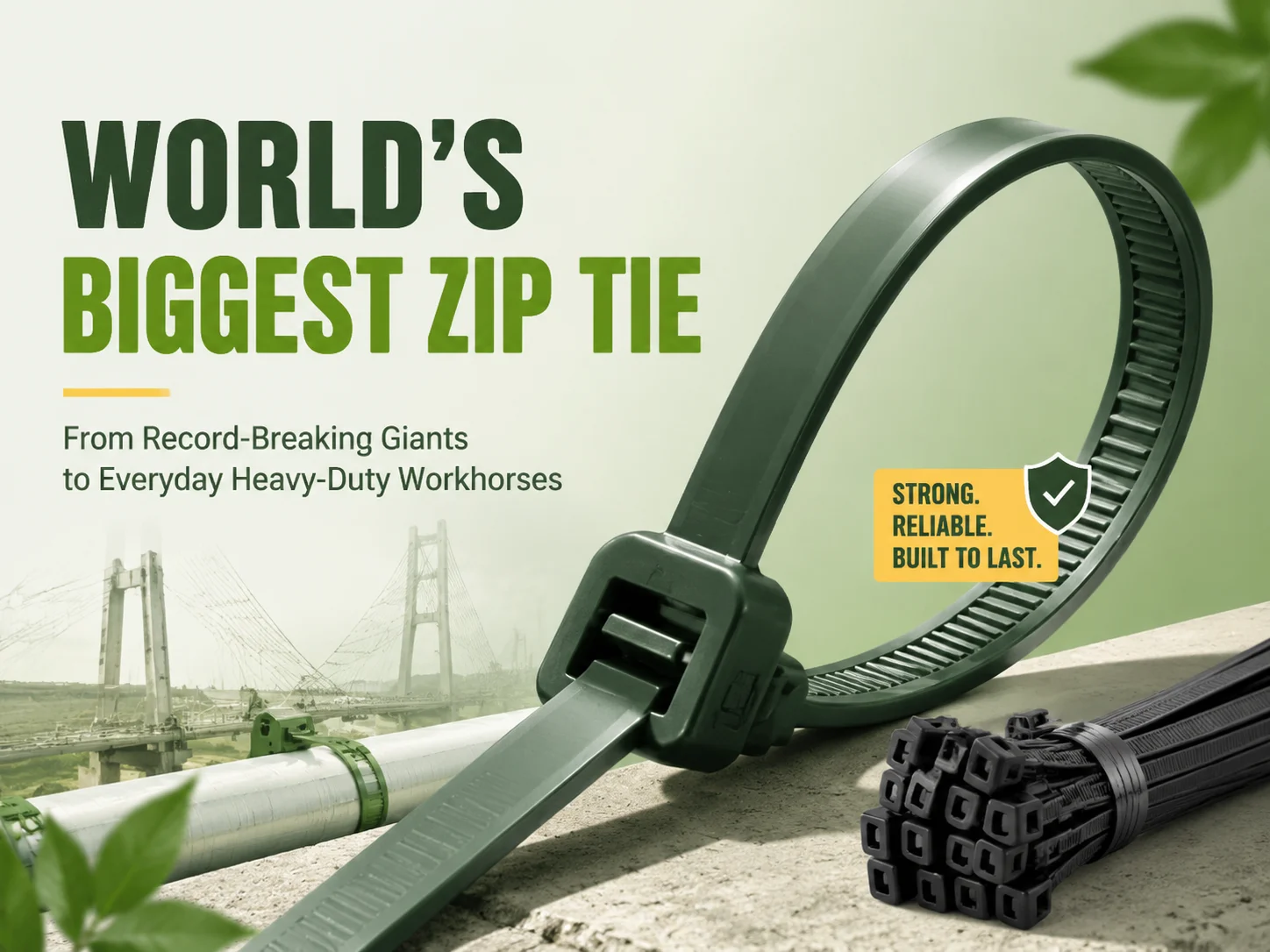
Many companies have succeeded in creating extra-large zip ties through the years with the aim of obtaining a Guinness world record or demonstrating their capacity to the public at various exhibitions. Such products are not available for sale, each of them being created by hand by craftsmen. For instance, a Czech firm created the world’s longest zip tie of over 30 meters in 2019, which required the participation of several people in the process of making it. In the same way, companies engaged in custom fabrications such as ThomasNet have produced such oversized zip ties for their customers. Although such oversized zip ties are not designed for practical applications in industry, they show that thereneral design of a zip tie can be presented in many different sizes.
The Real Heavyweights: 48-Inch Nylon Ties and Continuous-Length Steel Systems
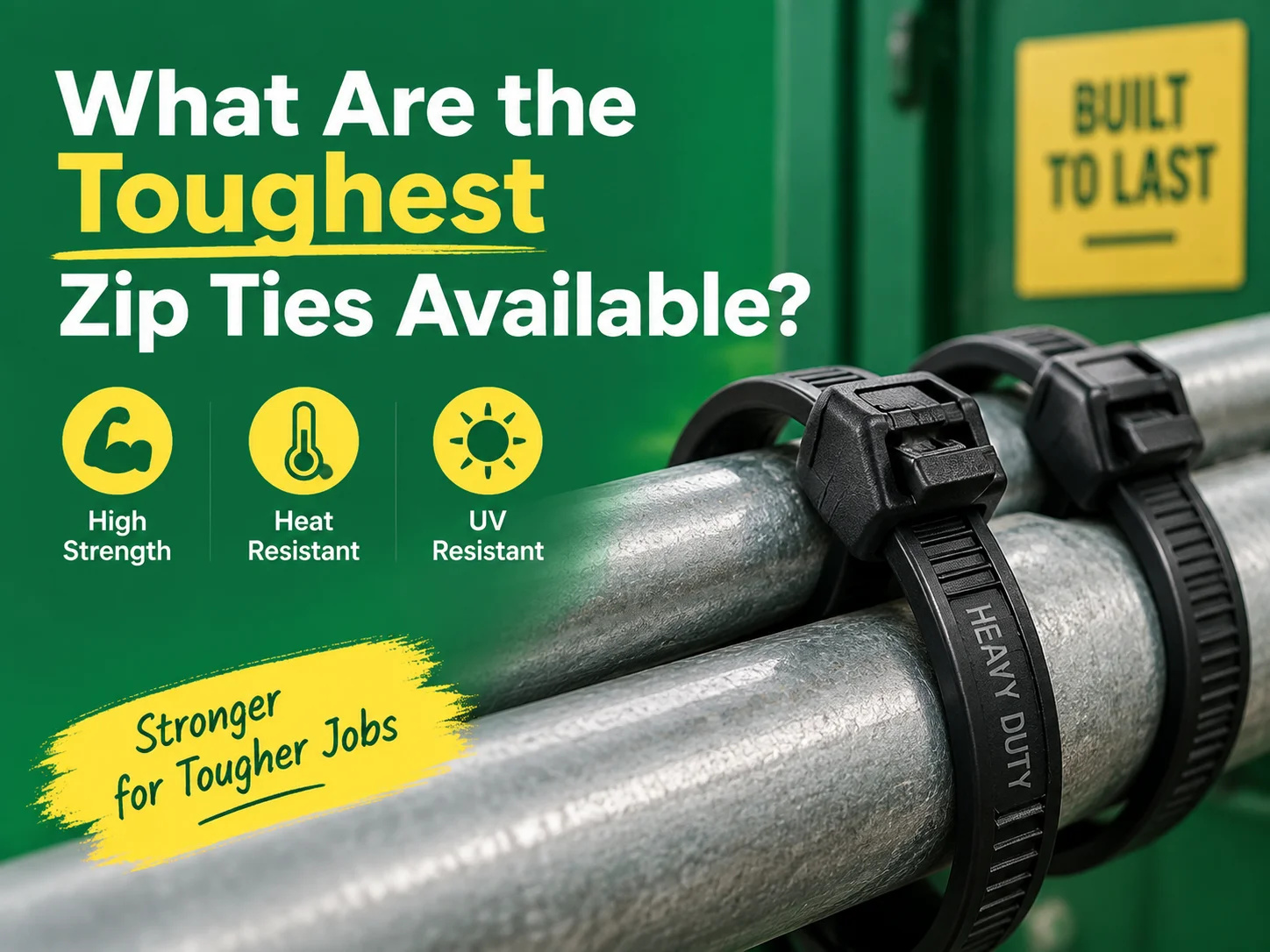
When it comes to fastening, engineers and installers prefer the biggest tie. A giant cable tie measuring 48 inches long and 250 pounds in tensile strength would meet their fastening requirements. The standard cable tie comes with a width of 0.5 inch (12.7 mm) and it allows for the bundling of items with the diameter of 15 inches. It is mostly useful for fastening heavy conduits, industrial cable trays, and turbine wires. Beyond 48 inches’ length and 250 pounds’ tensile strength, nylon’s performance characteristics are no longer as effective and metal must be used instead.
If there’s a contest for the strongest type of cable tie, it would be the stainless steel one. These cable ties are available in 304 grade and 316 grade and they gain tensile strength greater than 600 pounds. The cable ties can be also manufactured in custom lengths. Some manufacturers provide a stainless steel banding system which can be cut to any desired length on site. Such systems are generally used for fastening heavy pipe bundles, mining cables, and ship systems with no chance for failure.
Specifications of the Biggest Standard Cable Ties
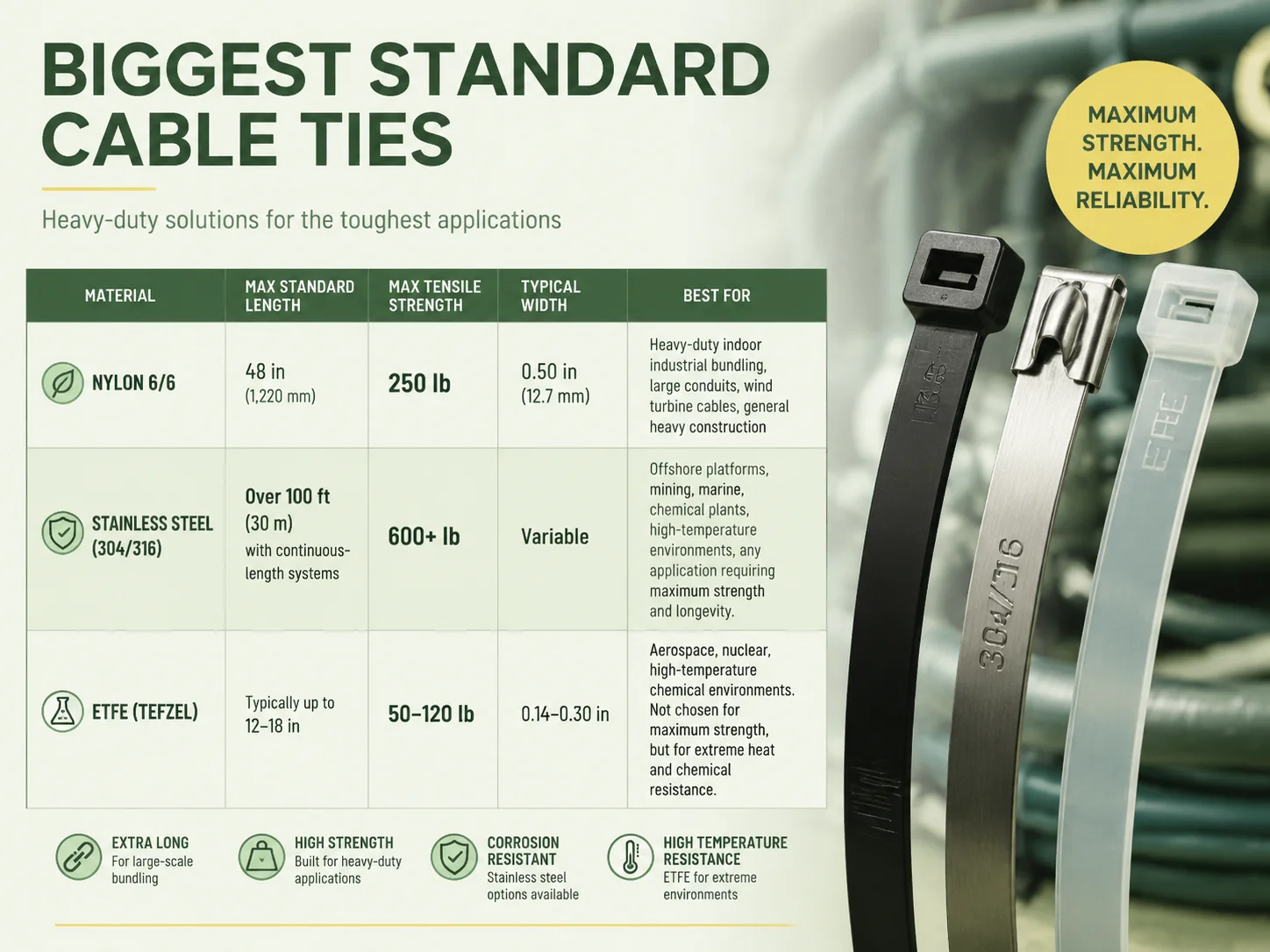
The table below compares the largest commonly available cable ties across different materials, providing a direct reference for the professional buyer who needs a “giant” tie for a real job.
| Material | Max Standard Length | Max Tensile Strength | Typical Width | Best For |
|---|---|---|---|---|
| Nylon 6/6 | 48 in (1,220 mm) | 250 lb | 0.50 in (12.7 mm) | Heavy-duty indoor industrial bundling, large conduits, wind turbine cables, general heavy construction |
| Stainless Steel (304/316) | Over 100 ft (30 m) with continuous-length systems | 600+ lb | Variable | Offshore platforms, mining, marine, chemical plants, high-temperature environments, any application requiring maximum strength and longevity. Our guide on stainless steel zip ties vs nylon cable ties covers the trade-offs in detail. |
| ETFE (Tefzel) | Typically up to 12–18 in | 50–120 lb | 0.14–0.30 in | Aerospace, nuclear, high-temperature chemical environments. Not chosen for maximum strength, but for extreme heat and chemical resistance. |
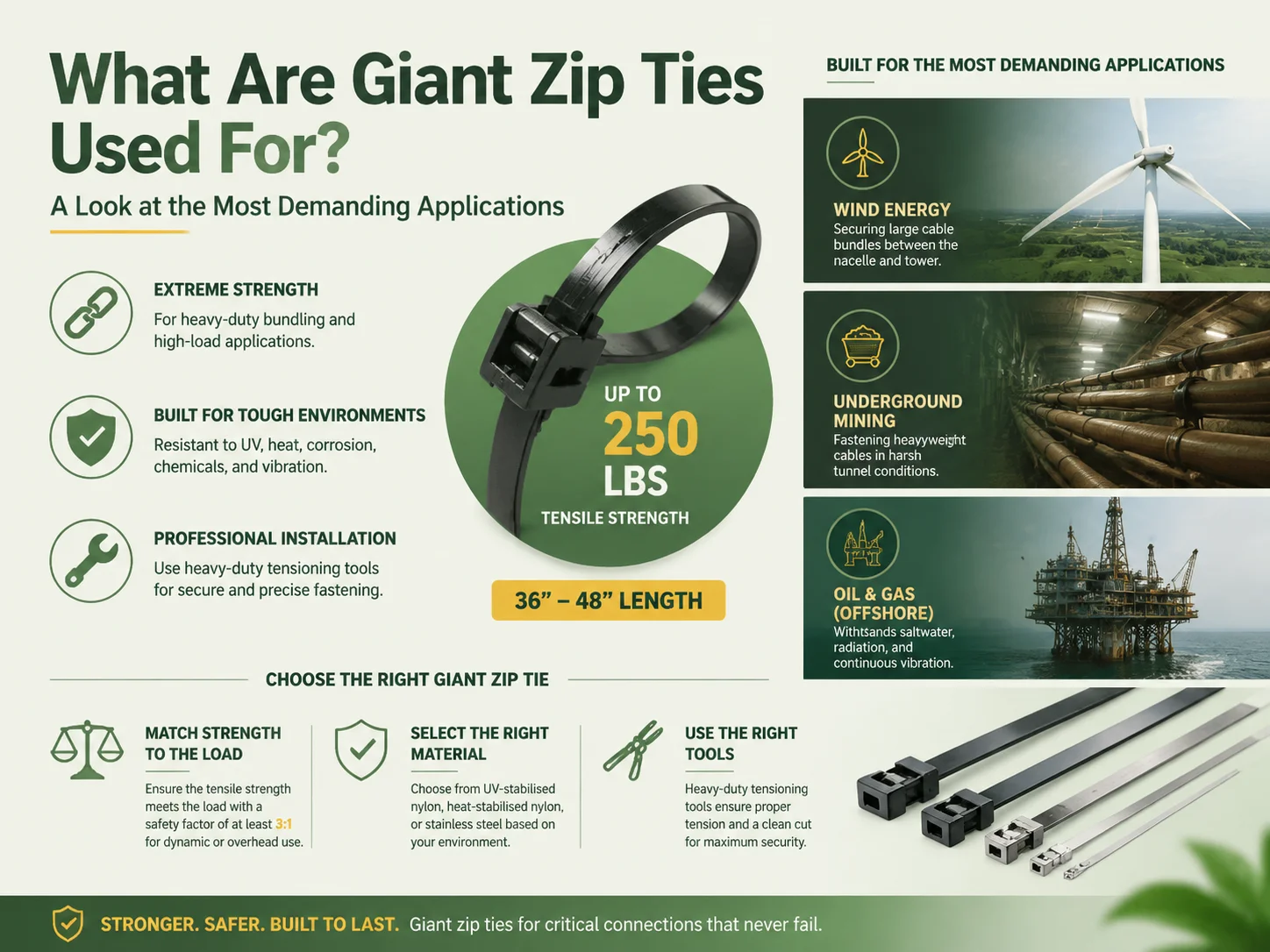
What Are Giant Zip Ties Used For? A Look at the Most Demanding Applications
The requirement for a larger or sturdier zip tie stems from either the proportion of the bundle itself or its carrying capacity. For instance, in a wind turbine, the cable bundle between the nacelle and the base of the tower can reach over 10 inches in diameter and weighs a few hundred pounds. Thus, a regular 8-inch, 50-pound tie would quickly snap and fail to work. Hence, technicians use the more suitable 36-inch and 48-inch ties with a robustness of 175 or 250 pounds. When it comes to underground mining, it is also important to secure heavyweight cables to the side of tunnels to avoid damage caused by heavy machinery, which can only be accomplished with wires of sufficient strength and heat resistance made of stainless steel. In the seashore oil industry, there are similar challenges, where standard nylon ties can’t withstand saltwater, radiation, and vibration.
Choosing the suitable type of “giant” tie for one’s needs does not only imply finding the longest one. Proper match of tensile strength of the wire and the load with the safety factor of at least 3:1 must be ensured in the case of dynamic use or overhead purposes. The matter of finding the suitable material is of utmost importance as well; UV-stabilised nylon, heat-stabilised nylon, or stainless steel may be required depending on the place of use. Finally, appropriate tools have to be available; heavy and large format ties will need heavy-duty tensioning tools in order for the tension to be calibrated and the tail to be cut.For a broader look at fastening options that go beyond traditional zip ties, our guide on alternatives to cable ties covers metal clamps, lacing cord, and other heavy-duty solutions.
Frequently Asked Questions
What is the largest size of zip ties?
The long-standard nylon zip ties measure 48 inches long, and they have the tensile strength of 250 pounds. Although some producers offer custom-made ties in lengths greater than 48 inches, this is the longest length stock zip tie offered by most suppliers.
What’s the longest cable tie you can buy?
In the market, the 48-inch nylon cable tie is usually the longest to be obtained. Anything longer than that belongs to the stainless steel cable tie category, which may be manufactured to any length as per one’s choice. There are even some systems that manufacture stainless cable ties in an endless format so that they can be cut to lengths longer than 100 feet.
What are giant zip ties used for?
Large-sized zip ties are commonly used to bundle large diameter wires, conduits, or tubes. They are widely used in applications such as securing electrical cables in wind turbine towers, bundling cables in mines, and tying down industrial ducts. Marine areas and extreme applications use giant ties made of stainless steel material.
What is the price of cable tie 500mm?
When bought in big sizes (around 1,000 units), a 500mm cable tie (around 20 inches) in black and UV stabilised nylon usually costs about $0.03-$0.08. More durable forms come in a higher price range since they are made with a tougher material. Much higher prices are asked for stainless steel ties of this length.
References
- Panduit — Extra-Heavy-Duty and Long-Length Cable Ties. Manufacturer of nylon and stainless steel cable ties with published dimensional and strength data for large-format and high-strength products.
- HellermannTyton — Heavy-Duty Cable Management Solutions. Global manufacturer providing large-format nylon and stainless steel cable ties for wind energy, mining, and industrial applications.
- UL 62275 — Cable Management Systems. The defining standard for cable tie testing, rating, and listing, including the tensile loop strength test and the material conditioning requirements.
- MIL‑STD‑23190 — Military Specification for Cable Ties. The U.S. Department of Defense standard defining dimensional tolerances and minimum strength requirements for military-grade ties, including large-format and high-strength designs.
The largest zip ties are not merely items for publicity purposes. They are solutions to engineering issues. The 48-inch zip tie made of nylon securing a group of cable wires in a wind turbine and customized zip tie made of stainless steel used to secure a pipe on the oil platform represent that these giant zip ties can be used when there is a job requiring a specific size and strength which cannot be offered by regular zip ties. The contractor, the wind farm staff, and the offshore engineer will need the suitable zip tie according to the length, size, and material used and this is where igoto company comes into the play as it can provide any zip tie from the biggest regular nylon zip tie to the customized zip ties.