



Button Head Cable Ties: A Complete Guide to Chassis
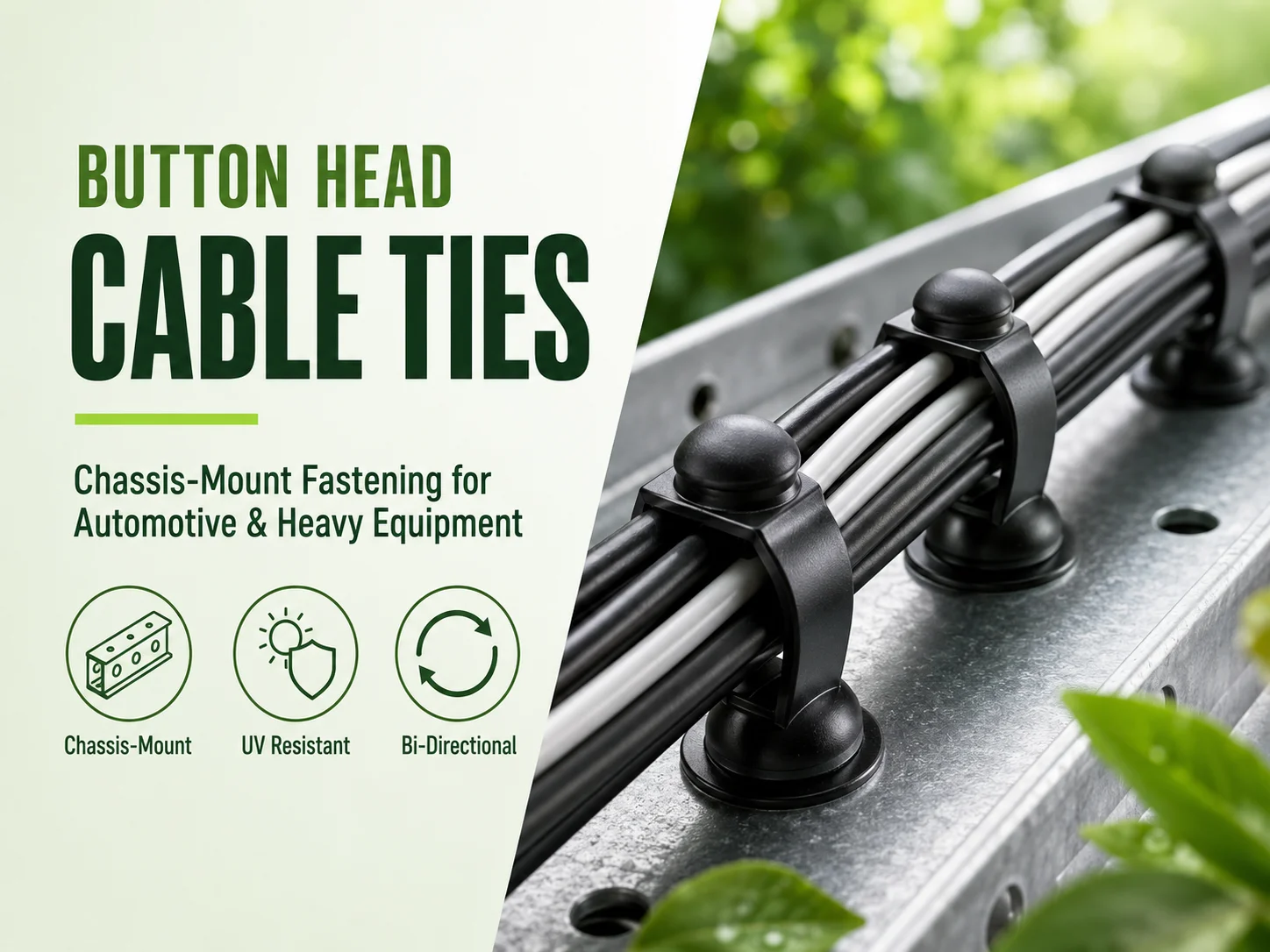
In case you are one of those who have opened a car chassis, a truck frame, or any other piece of heavy machinery and wondered about how the wiring loom is held firmly against the metal, button head cable ties could be your answer. A button head cable tie is a unique form of a zip tie that has a very peculiar round head which is placed flat on the pre-drilled hole. Hence, after stopping the wire, it also ensures its guiding through one operation.
A button-head cable tie is a round head fastener that is designed for cable management in the automotive industry, transportation, and special machinery. The tie has a two-piece construction with the ability to enter through its dome head without any problems. The nylon material used for production of the ties is sturdy and can withstand high temperatures and external environment conditions. In this article, you will find out how to use button-head cable ties, what makes them different from regular cable ties, how to choose the right size and how to install the tie properly, what kind of material and color should be used for this kind of cable ties.
What Is a Button Head Cable Tie?
A button head cable tie is a self-locking device that mixes a standard zip tie effect combined with a built-in mounting feature. It gets the name from the dome-shaped ‘button’ head that contains a locking mechanism. A regular cable tie looks flat and rectangular, while a button head zip tie resembles a round head with a smooth surface that fits in the panel/frame.
These cable ties belong to a large family of self-attaching fasteners and are crucial in automotive and heavy equipment industries because they let a technician mount a cable track by only drilling one hole in the chassis with no need to use a separate clip or clamp. The tail of the cable tie is put through the hole, turned back, and locked in the head, which means the round head is pressed against the metal and a tail is forming a neat loop on the opposite side of the frame.
Therefore, button head cable ties are not very popular among consumers but are widely used in industries where electrical cable needs to be mounted along the frame, firewall, or panel.
Anatomy of a Button Head Cable Tie
The fundamental idea of making a button-head cable tie is quite distinct from the common ratchet mechanism. While the latter uses a one-piece tie, the button-head concept implies that there are two elements in the construction of such tie, creating some additional advantages:
First, it is the button-head itself, which is used to house the locking mechanism inside. It has a low profile, while the end product looks very neat and rivet-like.
Second, it is the presence of two locking processes, which are operated from inside the button-head. Thanks to this system, this type of ties is very strong and can prevent the occurrence of significant vibrations.Another important advantage of the ties construction is that the two sides of the strap feature serration, allowing the tie to lock regardless of which way the strap is turned.
Finally, the last important benefit of the button-head ties is the tail aspect, as the tail comes in and out of the button-head parallel to the strap thus allowing it to go through the hole at the same time as locking.
Button Head vs. Standard Cable Ties
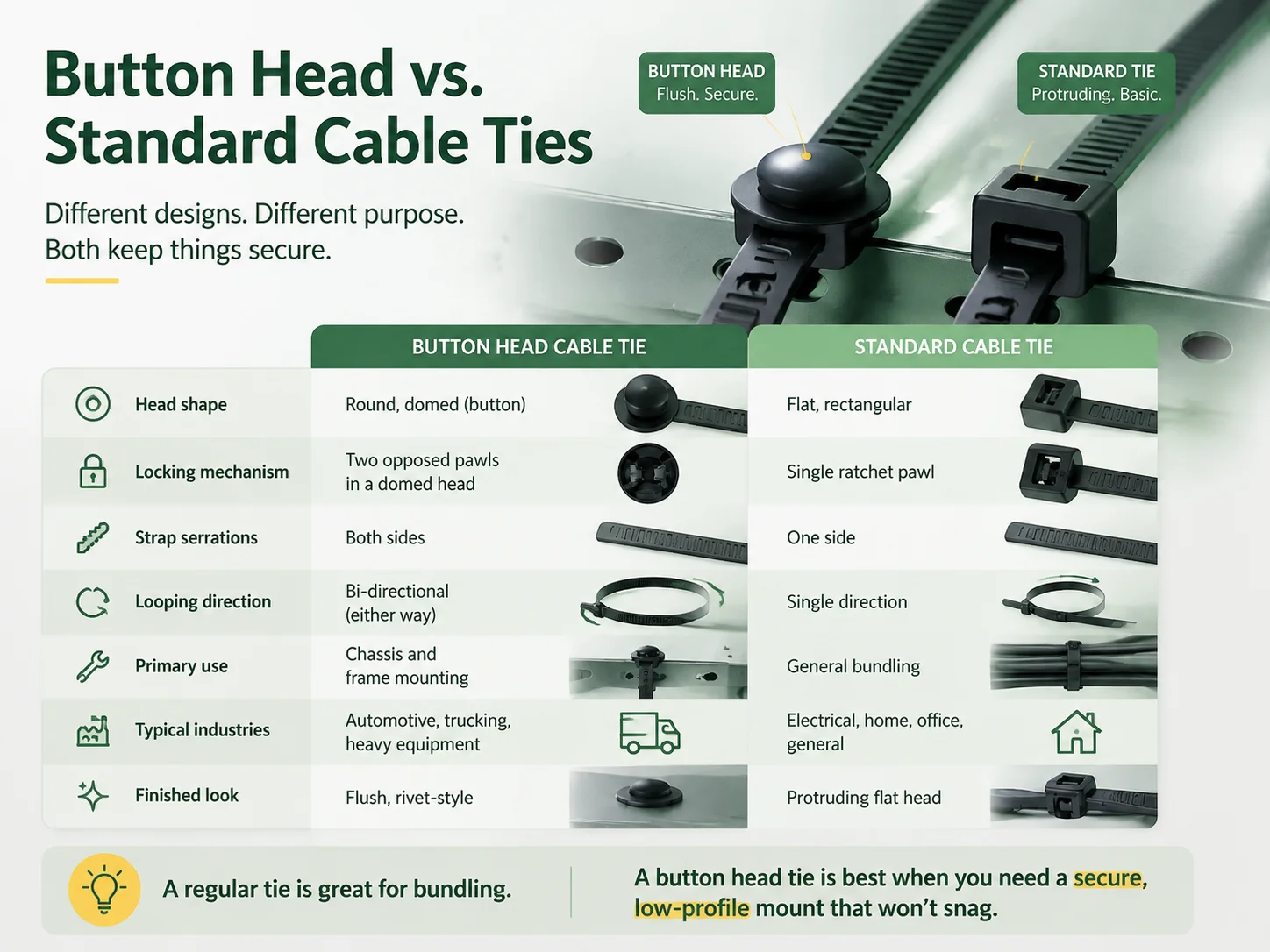
The simplest method for understanding what a button head cable tie is would be to examine it next to a standard ratchet-type cable tie that you might already own. Both cable ties work to keep cables together, but they are used for different purposes.
| Feature | Button Head Cable Tie | Standard Cable Tie |
|---|---|---|
| Head shape | Round, domed (button) | Flat, rectangular |
| Locking mechanism | Two opposed pawls in a domed head | Single ratchet pawl |
| Strap serrations | Both sides | One side |
| Looping direction | Bi-directional (either way) | Single direction |
| Primary use | Chassis and frame mounting | General bundling |
| Typical industries | Automotive, trucking, heavy equipment | Electrical, home, office, general |
| Finished look | Flush, rivet-style | Protruding flat head |
In summary, a regular tie is the right option for simply tying wires. A button head zip tie is the best choice when you also need to keep the connection secured in a metal frame and make it as flat as possible so that it won’t get caught on anything.
Key Benefits of Button Head Cable Ties
The unique button head construction of the cable tie offers several functional benefits for experts.
- Integrated mount: The cable tie allows to fasten and position in place with a single trend through the hole in the chassis, therefore, no further clips, saddles or adhesives are required.
- Professional look: The round cap looks as if it is buttoned, creating a riveted look.
- Snag-proof: With its small size, it can’t easily get stuck or catch on other objects.
- Strong grip: Thanks to two locking arms, this cable tie is not afraid of vibrations that are common for automotive applications.
- Easier installation: The bi-directional looping makes the installation easier even if the hole is hard to reach.
Manufactured of high-quality plastic, the cable tie will work even in oil or grease environment.When choosing a cable tie for outdoor or exposed automotive applications, you must use the UV-resistant black Nylon 6/6 cable tie because the white one will break down under UV exposure.
Where Button Head Cable Ties Are Used
Since they integrate the features of bundling and mounting, button head cable ties are found in a wide range of applications in the wiring world. Following are some of the major uses:
- Automobile chassis: They play a key role in organizing all the cables and harnesses in the automobile frame.
- Trucks and trailers: Button head ties are recommended for mounting cables, hydraulic pipes, and airline pipes inside the truck body where vibrations are normal.
- Heavy machinery: These metal ties are useful in industrial vehicles, agricultural systems, construction equipment, etc. in order to manage all the wiring that can experience shocks, dust, and extreme temperature fluctuations.
- Marine and outdoor uses: These cable ties allow you to avoid the effects of UV light and dampness in your wiring system.
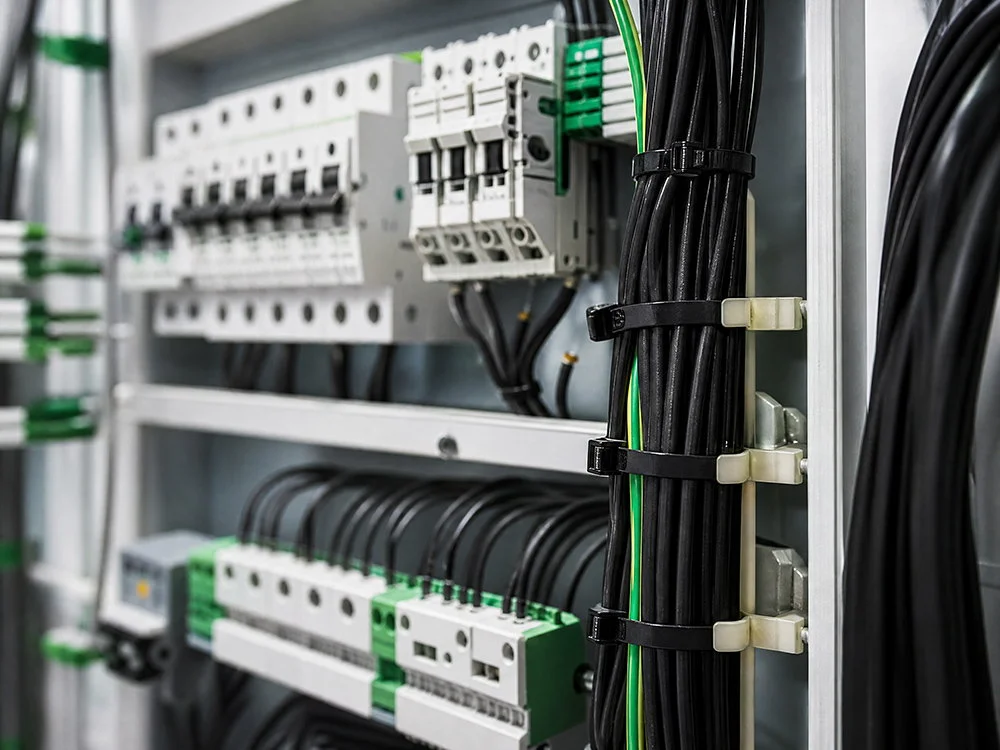
- Industrial equipment: They work very well both in panel routing and enclosures because due to their design they do not slow down the maintenance process.
If your project is more general-purpose, you may find a broader selection useful in our guide to how to choose cable ties, or you can compare load ratings in our overview of heavy duty zip ties.
How to Install a Button Head Cable Tie on a Chassis
The use of button head cable ties is simple if one knows how to use them correctly. To use a button head cable tie in a chassis you need to follow these steps to use a button head cable tie in a chassis:
- Pass the tail through the opening. The strap end of the button head cable tie will go through the hole already present in the chassis. At this point, the round head should touch the metal on the near side.
- Create a loop. Once the tail is back around the cables, it should head towards the head. Thanks to the design, one can wrap clockwise or counter-clockwise.
- Insert into the head. The tail must be inserted into the domed head and the functions of the internal latch can be activated.
- Tighten the tie. The ideal outcome involves pulling the tail till the cable wires are tight against the chassis without damaging it in any way.
- Complete the procedure. After the button head cable tie has been installed, one should cut the surplus tail in a way that no additional pieces stick out.
For guidance on a safe, burr-free cut, see our tutorial on how to cut cable ties.Ensure that the mounting hole diameter matches your cable tie head before making a purchase. If the hole is too large, the head will pull through when under stress; while if it is too small, the head will not fit in properly thus, checking the hole size is the key element for successful and secure mounting.
Choosing the Right Button Head Cable Tie
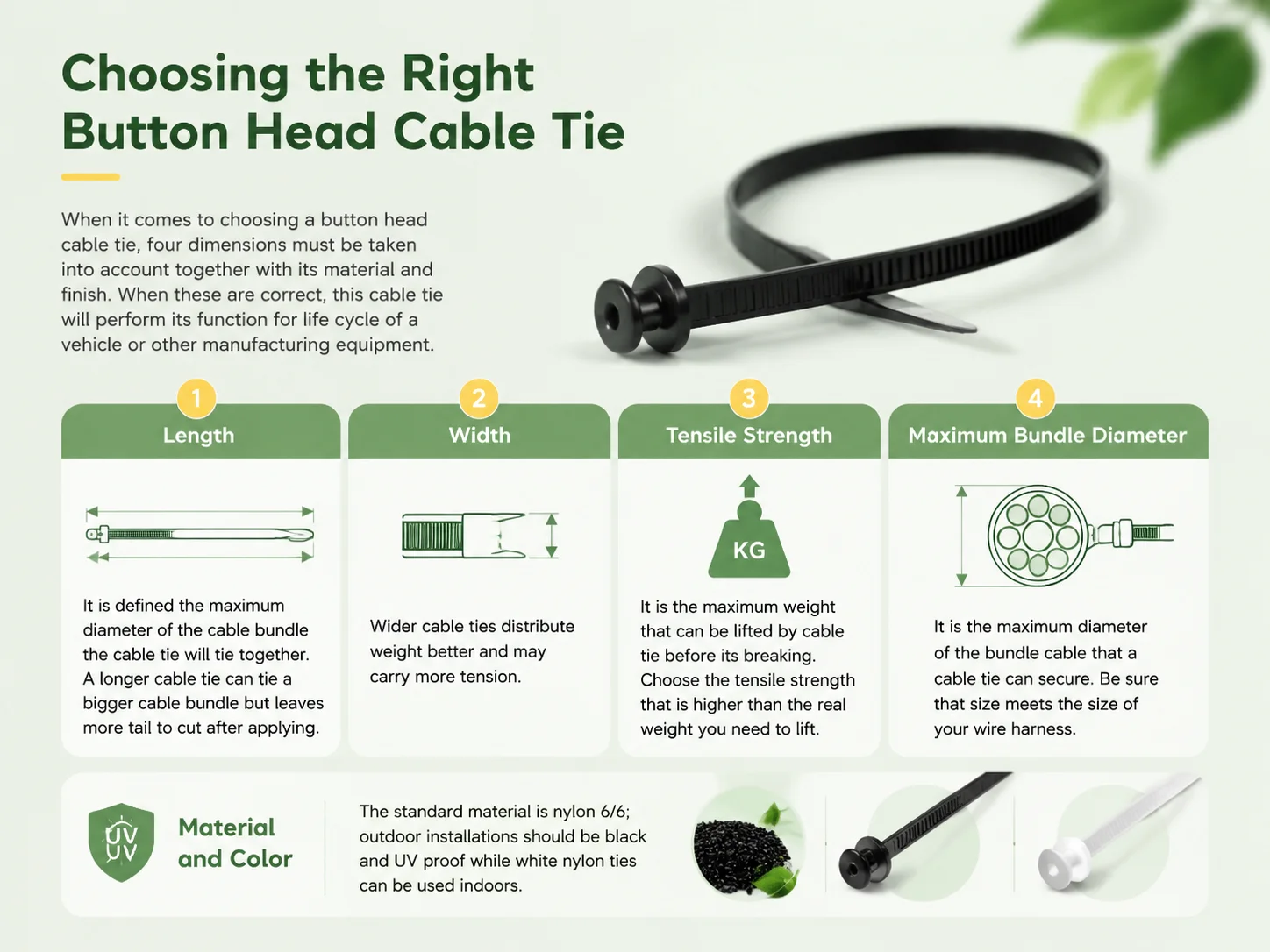
When it comes to choosing a button head cable tie, four dimensions must be taken into account together with its material and finish. When these are correct, this cable tie will perform its function for life cycle of a vehicle or other manufacturing equipment.
Length: It is defined the maximum diameter of the cable bundle the cable tie will tie together. A longer cable tie can tie a bigger cable bundle but leaves more tail to cut after applying.
- Width: Wider cable ties distribute weight better and may carry more tension.
- Tensile strength: It is the maximum weight that can be lifted by cable tie before its breaking. Choose the tensile strength that is higher than the real weight you need to lift.
- Maximum bundle diameter: It is the maximum diameter of the bundle cable that a cable tie can secure. Be sure that size meets the size of your wire harness.
- Material and color: The standard material is nylon 6/6; outdoor installations should be black and UV proof while white nylon ties can be used indoors.
Button Head Cable Tie Sizes and Specifications
The table presented below outlines the most commonly seen specifications when purchasing button head cables, although the exact numbers may vary from manufacturer to manufacturer. Use this as a guide and check your chosen component’s datasheet.
| Specification | Typical Range | Notes |
|---|---|---|
| Length | 9.6″ to 15″ (approx. 245–370 mm) | Longer for larger looms |
| Width | Around 0.2″–0.3″ (5–7.6 mm) | Wider = higher load capacity |
| Tensile strength | 50–120 lbs (approx. 22–55 kg) | Choose with load headroom |
| Max bundle diameter | 2.6″ to 4.3″ (approx. 65–110 mm) | Confirm fit to your harness |
| Material | Polyamide 6.6 (Nylon 6/6) | Oil, grease, and base resistant |
| Colors | Black (UV) and natural | Black for outdoor/UV exposure |
| Temperature range | -40°C to +85°C (-40°F to 185°F) | Heat-stabilized grades available |
| Flammability | UL 94 V-2 | Halogen-free, silicone-free |
Materials, UV Resistance, and Temperature Performance
Almost all high-grade button head cable ties are made using polyamide 6.6 (also known as nylon 6/6), meant for its outstanding properties of tensile strength, flexibility as well as resistance to chemicals, which is why it is widely used in the market of cable ties.Two criteria stand out:
- First of all, UV resistance: black button head cable ties are black due to the presence of a carbon black filler that serves the purpose of blocking UV light and prolonging their servitude for many years in an open air wheel compartment. Natural nylon suffers degradation with too much exposure to sun.
- The second heating-related point has to do with heat management. The usual grades can perform from around -40 degrees Celsius up to +85 degrees Celsius, which will suffice in most automotive and outdoor conditions. For continuous high-temperature exposure, such as near an exhaust or engine block, special heat-stabilized grades will perform better. Most button head ties are UL 94 V-2 classified as to fire resistance, which is important for automotive and electronics production.
Best Practices and Common Mistakes to Avoid
A button head cable tie will not perform as intended if it has been misused during the installation process. Using a few tried and tested tactics will ensure that your cables are correctly installed and remain undamaged for years, regardless of how much vibration or outdoor elements they may be subjected to.
- Do not overtighten. Pulling the strap too tightly may damage the insulation of the wires and will eventually result in fraying and perhaps cutting through. Properly tighten the bundle to the frame but do not overdo it as it is not an issue of maximum strength but of secure fastening.
- Keep the head straight. If the rounded part is tilted at an awkward angle, it will move under vibrations and may lose its grip eventually. Ensure that the round head lays flat against the mounting frame before trimming it.
- Trim appropriately. Make sure that the head of the button cable tie has not been trimmed off closely so that it has no sharp end which may injure fingers during maintenance work.
- Use only suitable types of cable ties. The black cable ties that have been specially treated against UV radiation should only be used outdoors while natural nylon cable ties should be used indoors. This is one of the most frequent causes of cable failure.
- Always respect the maximum load of the cable ties. Always ensure that their stress bearing capacity far exceeds the weight of the wires according to the road and machinery vibrations to which they will be subjected.
Frequently Asked Questions
What is a button head cable tie used for?
The device known as a button head cable tie helps to guide and fasten the entire bundle of cables attached to a frame, chassis, or panel through drilled holes specifically for this purpose. The round head presses against the metal, while the strap encircles the wires, thus making it ideal for use in the electrical circuits located in automobiles, trucking vehicles, and heavy machines.
Why is it called a button head cable tie?
This name is derived from the name used for the round dome like head of the lock. It is shaped in a smooth dome with a round button like shape of surface appearance and is not flat like the head of standard tie.
Are button head cable ties reusable?
The majority of head-button cable ties are made for permanent fastening and not for re-usability like releasable connections. However, in some instances, it is possible to relieve the tension and remove it after that.If reusability is your priority, a dedicated releasable tie is a better fit, and you can explore options in our guide to reusable zip ties.
What material are button head cable ties made of?
Mostly, they are made from most Polyamide 6.6 (Nylon 6/6) material, which provides a good resistance to oils, grease, and most bases. Black versions come with a carbon black additive to make them UV-resistant when used outside and under the hood.
What size hole do I need for a button head cable tie?
The hole for mounting should match the diameter of the tie head, so it is properly secured and it doesn’t pull out during loading. Always consult the manufacturer’s datasheet for the correct size hole before drilling or ordering.
Can button head cable ties be used outdoors?
Yes, as long as you go with a black, UV-stabilized button head cable tie manufactured from Nylon 6/6. These kinds of cable ties are designed for use in automotive, marine, and heavy-duty industrial environments and are extremely resistant to high or low temperatures as well as prolonged exposure to sunlight.
Get the Right Button Head Cable Ties for Your Project
Wiring a vehicle’s chassis, constructing heavy machinery, or wiring through a tough industrial loom, the proper button-head cable tie will offer you a clean, secure, and snag-free installation that will be good for decades. With iGoToCableTies, you can choose the length, width, tensile strength, and material of the cable tie according to your application so that it does not come loose in the future. Check out our extensive range of cable ties and specialty fasteners and contact us for bulk orders and specifications. Whenever you want cable management that is trusted in practice, you will find button head cable ties that will do your job perfectly at iGoToCableTies.