


Are There Biodegradable Zip Ties?
You have just completed an extensive garden stake binding project—200 zip ties are used to keep tomato plants attached to the posts, attaching mesh to frames, and connecting drip irrigation pipes to the posts. Though the project is complete and appears tidy and professional, a nagging thought lingers in your mind: all those ties will remain in the soil as they were left for many years ahead. Pulling one out from the previous season’s plot, you see that it remains intact, unblemished, and unchanged. You begin to wonder whether any biodegradable zip tie can replace the existing zip ties in your project while returning to nature once their task is done.
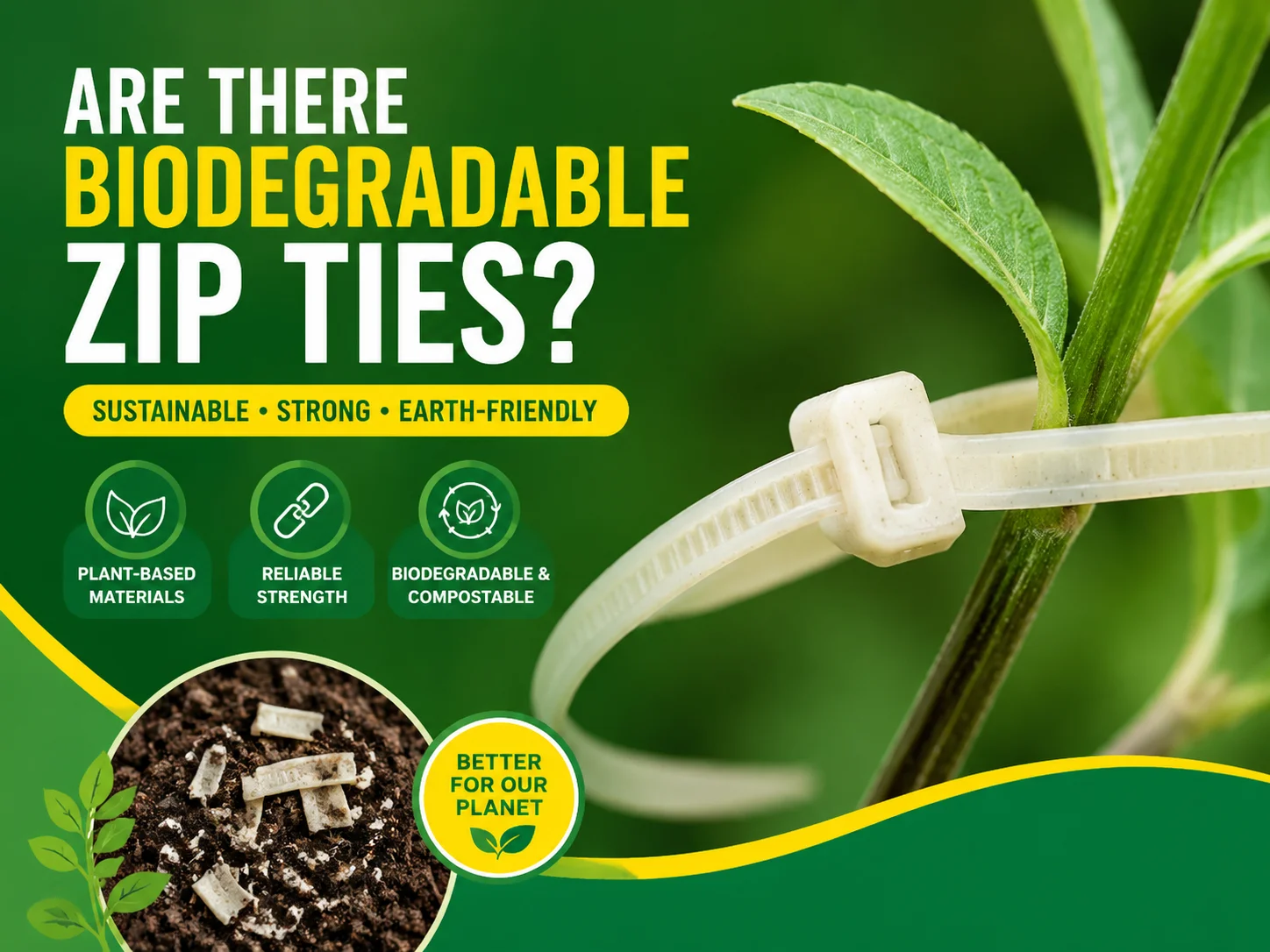
Indeed, biodegradable zip ties are available. Made from plant-based polymers (mostly PLA, which is made of corn starch, PHA made through bacterial fermentation, or starch composite), they biodegrade within the timeframe of 6 to 24 months when composted. In terms of price, they are typically 15–40% more expensive than classic nylon ties; nevertheless, biodegradable zip ties can be used in conditions of indoor, temporary, agricultural, and eco-certified applications.
Do Biodegradable Zip Ties Actually Exist?
Yes, but they are becoming more and more accessible. Biodegradable zip ties are cable ties produced from plant-based materials instead of oil-based materials such as nylon 6/6. Biodegradable zip ties do not stay in landfills or soil for more than 50 years, but they have been manufactured so that they decompose into natural materials through some natural processes like industrial composting, soil burial, or marine exposure depending on the production method.
There are currently three main categories of biodegradable cable ties on the market:
| Type | Base Material | Decomposition Time | Best Environment |
|---|---|---|---|
| PLA ties | Corn starch / sugarcane fermentation | 3–6 months (industrial compost) | Indoor, dry, temporary |
| PHA ties | Bacterial fermentation of sugars/oils | 6–18 months (soil, freshwater, marine) | Agricultural, outdoor temporary |
| Starch-based composites | TPS (thermoplastic starch) + biodegradable polyester | 3–12 months (compost or soil) | Horticulture, agriculture, packaging |
| Fiber-based ties | Wood fiber from sustainably managed forests | Compostable / recyclable in paper stream | Retail bundling, events, packaging |
For a broader look at what conventional ties are made from and why material choice matters, our guide on what zip ties are made of covers PA66, nylon 6, and other common polymers in detail.
Biodegradable vs. Standard Nylon Ties: Key Differences
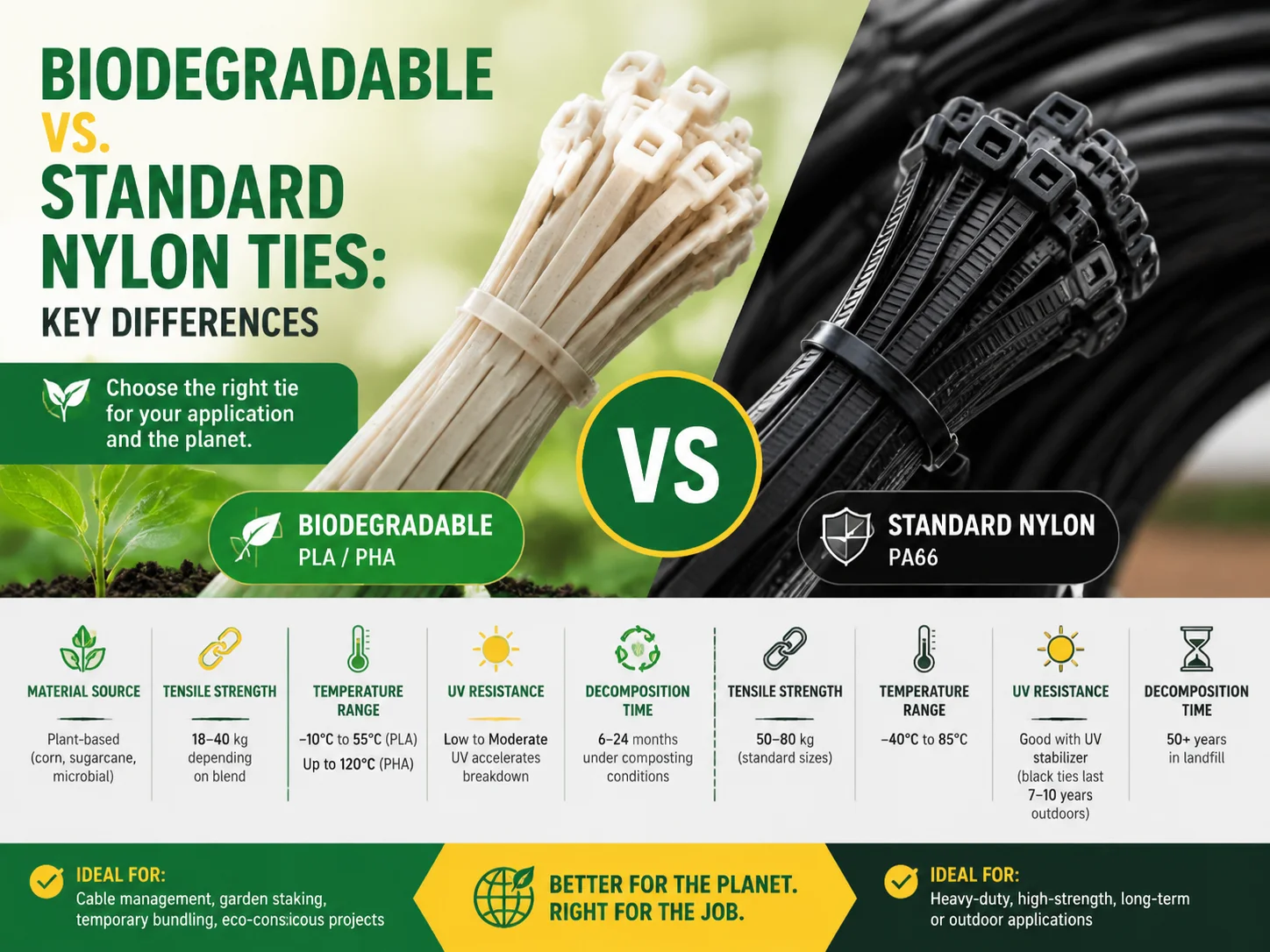
Buyers primarily ask: “By switching to biodegradable products what am I sacrificing?” The truthful answer is that it means losing some tensile strength, UV resistance, and having greater expense per unit, but the upside of the switch is being able to compost and the overall footprint being reduced on the environment.
| Property | Standard Nylon (PA66) | Biodegradable (PLA/PHA) |
|---|---|---|
| Material source | Petroleum-based | Plant-based (corn, sugarcane, microbial) |
| Tensile strength | 50–80 kg (standard sizes) | 18–40 kg depending on blend |
| Temperature range | −40°C to 85°C | −10°C to 55°C (PLA); up to 120°C (PHA) |
| UV resistance | Good with UV stabilizer (black ties last 7–10 years outdoors) | Low to moderate—UV accelerates breakdown |
| Moisture behavior | Absorbs moisture but retains strength | Moisture accelerates decomposition (PLA sensitive) |
| Decomposition time | 50+ years in landfill | 6–24 months under composting conditions |
| Cost per 100-pack | $3–$15 (standard sizes) | $5–$22 (estimated, varies by material) |
| Reusable | No (one-piece ratchet lock) | Limited—some designs offer releasable tabs |
| Certifications | UL 94V-2, CE, RoHS | ASTM D6400, EN 13432, OK Compost |
The main operational distinction lies in the difference in tensile strength. A normal nylon tie of 4.8mm with a load capacity of 50kg will hold tightly under pressure while its ecological alternative guarantees only 18-22kg. This is sufficient for cable management, gardening and temporary bundling, but when it comes to the heavy use of conduits, car wiring and high-load applications thereby nylon is the best possible option.If you’re weighing nylon against other conventional materials, our comparison of stainless steel vs. nylon cable ties breaks down strength, cost, and use-case trade-offs.
What Materials Are Used?
Biodegradable zip ties are not all the same. The material determines everything from decomposition environment to mechanical performance:
PLA (Polylactic Acid)
PLA, which is sourced from fermented plant starch such as corn or sugarcane, is one of the most widely used biodegradable tie material. It provides decent clarity in appearance and sufficient rigidity; however, it has low thermal stability since it starts to soften at above 55-65 degree Celsius and releases harmful waste unless decomposed under controlled conditions of industrial composting facilities.
PHA (Polyhydroxyalkanoates)
PHA is produced by fermentation of sugars or oils with the help of microbes. PHA has broadest biocompatibility profile, as it can decompose in soil even without being composted under industrial conditions. PHA tolerates heat (up to 120°C) and moisture better than PLA. On the other hand, PHA is more costly than PLA (about $4–6/kg without accounting for conversion process versus $2-3 for PLA).
Starch-Based Composites (TPS)
The most inexpensive biodegradable tie has been produced from thermoplastic starch combined with biodegradable polyesters (for instance, PBAT). This type of tie decomposes within a period of 3 to 12 months in soil or compost but has the lowest tensile strength (10–30 MPa) and insufficient moisture resistance. The tie is mainly used in horticulture, agriculture, and single-use packaging where there are no high requirements for strength and where the goal of decomposition in soil comes first.
Fiber-Based Ties
FibreStrap is an example of a new type of tie that is made of long fibers of Scandinavian woods obtained from sustainably managed forests. This tie is not made of polymers. It works like traditional zip ties but is recyclable in paper waste or compostable. It has a maximum tensile strength of 12 kg and is produced using fossil-free sources thereby saving at least 80% in carbon emissions and water compared to nylon production.
How Much Do Biodegradable Zip Ties Cost?
The cost of biodegradable cable ties is on average 15-40% higher than traditional nylon ties, which is largely due to the expense of raw materials, less manufacturing capacity, and certification costs. Below is a summary of pricing by type and quantity.
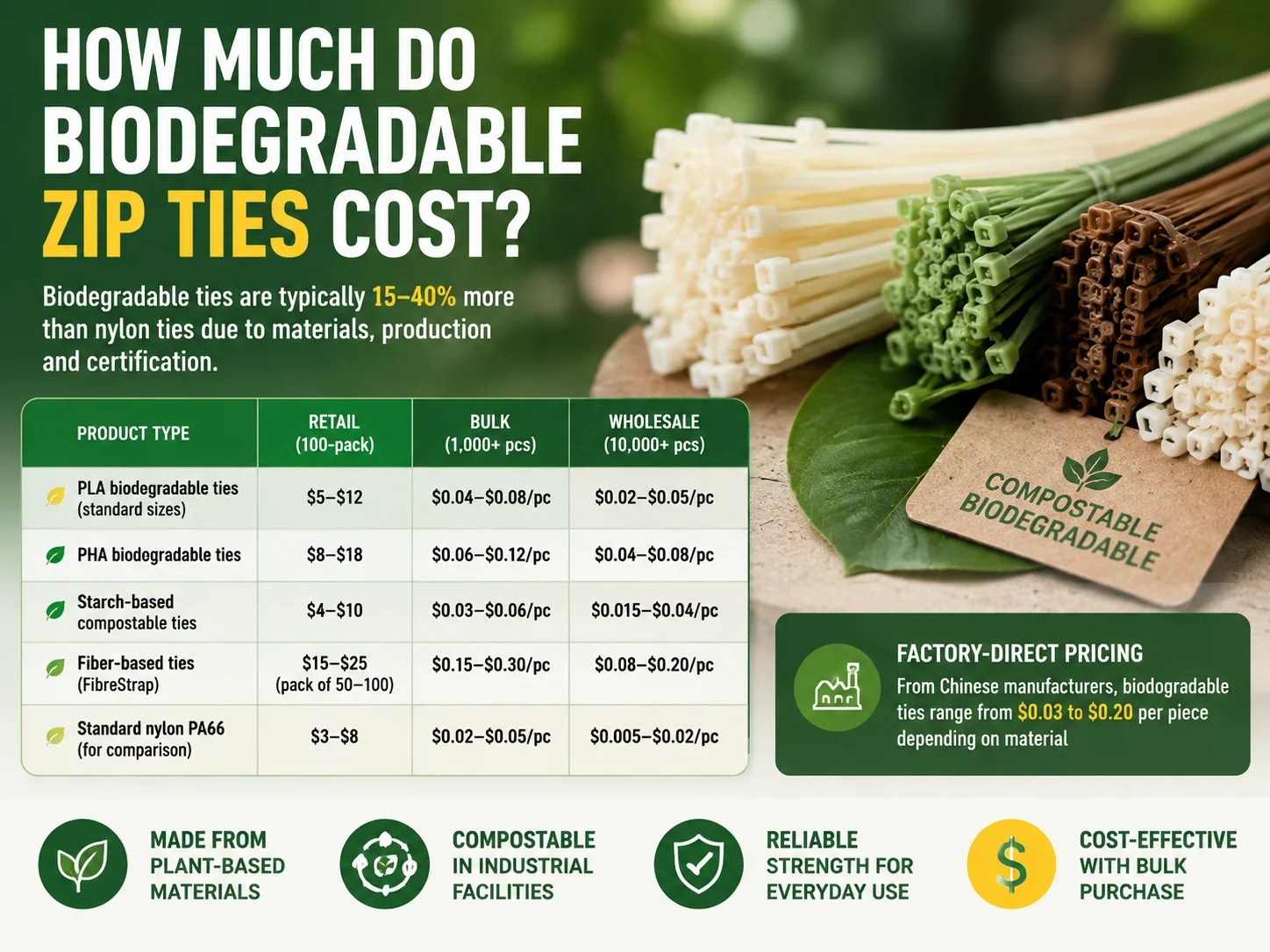
| Product Type | Retail (100-pack) | Bulk (1,000+ pcs) | Wholesale (10,000+ pcs) |
|---|---|---|---|
| PLA biodegradable ties (standard sizes) | $5–$12 | $0.04–$0.08/pc | $0.02–$0.05/pc |
| PHA biodegradable ties | $8–$18 | $0.06–$0.12/pc | $0.04–$0.08/pc |
| Starch-based compostable ties | $4–$10 | $0.03–$0.06/pc | $0.015–$0.04/pc |
| Fiber-based ties (FibreStrap) | $15–$25 (pack of 50–100) | $0.15–$0.30/pc | $0.08&nd;$0.20/pc |
| Standard nylon PA66 (for comparison) | $3–$8 | $0.02–$0.05/pc | $0.005–$0.02/pc |
As evidenced by the factory direct prices charged by the Chinese manufacturers whose products are registered with various B2B platforms, biodegradable ties go from $0.03 a piece for PLA blends to $0.20 for PHA ones.For context on conventional tie pricing, see our complete guide on nylon plastic tie prices which covers cost by size, brand, and quantity.
The final price is impacted by several influences:
- Material type – PHA is about 2–3 multiplicator more pricey compared to PLA on material cost level.
- Certifications – costs of completion of ASTM D6400/EN 13432 tests results in $0.005 to $0.02 of costs per certificate.
- Order volume – bioplastics price differ mostly compared to nylon price only for 10,000+ volumes.
- Additives – biodegradables including UV stabilizers or colorants are usually more expensive but not correspond to the biodegradability goal.
Brands and Manufacturers
The biodegradable cable tie market is still developing, with a mix of established manufacturers and innovative startups. Key suppliers include:
| Brand / Manufacturer | Material | Notes |
|---|---|---|
| FibreStrap (Scandinavia) | Wood fiber | World’s first fiber-based cable tie; 80%+ CO2/water reduction vs. nylon; up to 26.5 lbs tensile; paper-recyclable |
| Rapstrap (UK) | Starch-based / water-soluble | Biodegradable and reusable designs; waste-reducing strip geometry yields more ties per strip; featured on Dragons’ Den |
| Ningbo Sanzheng (China) | PLA / bio-based blends | Manufacturer of eco-friendly industrial cable ties; 9+ years experience; supplies recyclable and biodegradable options |
| IGOTO (China) | PLA / bio-based PA66 blends | Offers biodegradable cable tie product line alongside conventional nylon; 21+ years in cable tie manufacturing |
| Anhui Angke New Materials (China) | Double-lock biodegradable | Specializes in degradable ties for horticulture and agricultural planting applications |
| Difvan | PLA / PHA blends | R&D-focused; developing reusable + biodegradable hybrid designs for electrical and industrial sectors |
Big, established companies such as Panduit, HellermannTyton, and Thomas & Betts still do not have distinct biodegradable tie lines, but of course, some of them have recyclable or reduced material designs. Innovation comes now from niche manufacturers and material sci-pioneers and not from traditional cable tie leaders.
When Should You Choose Biodegradable Ties?
Biodegradable zip ties are not a universal replacement for nylon—they are a purpose-specific solution. Choose biodegradable ties when these conditions apply:
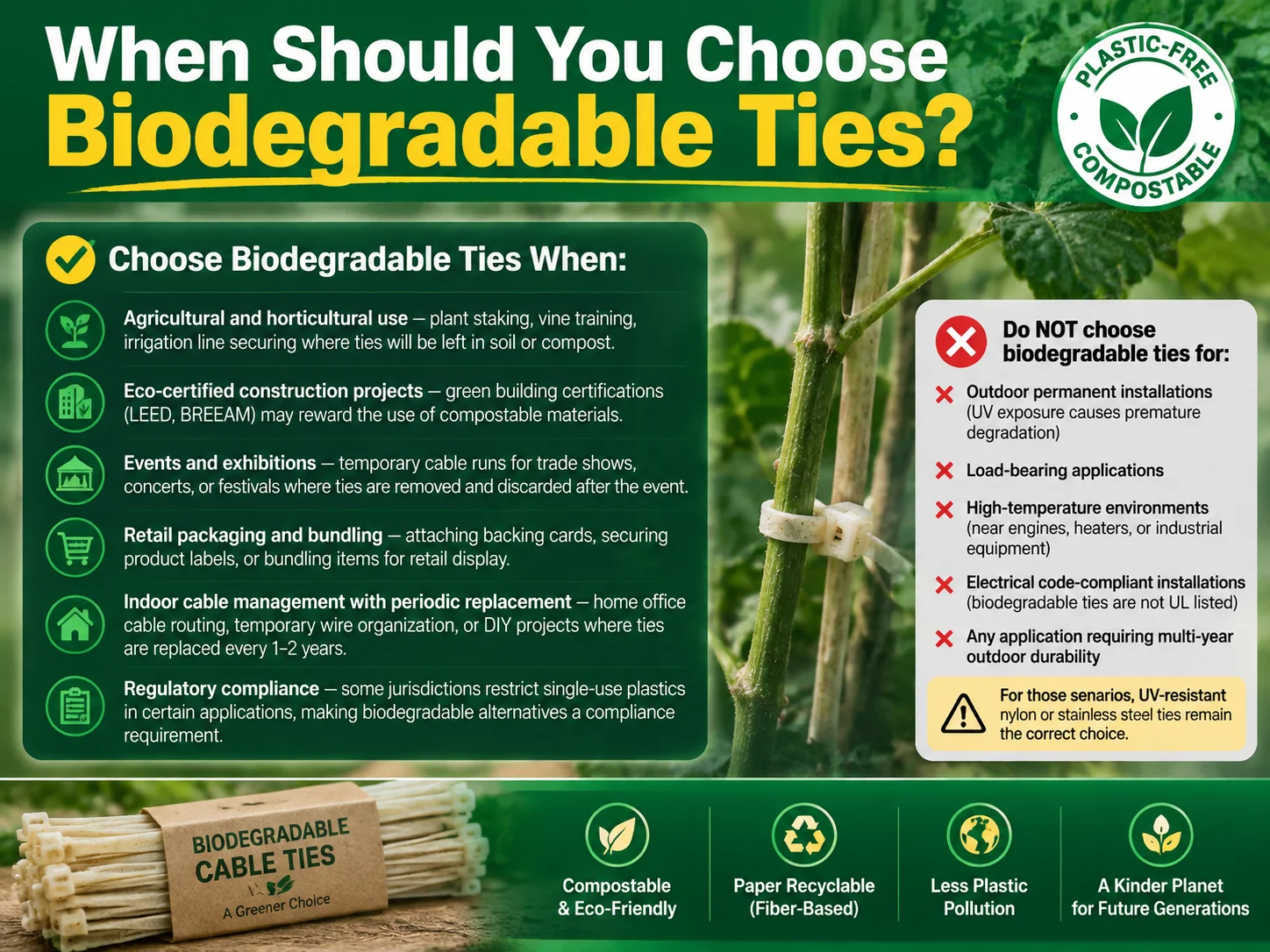
The use of agricultural and horticultural materials — plant staking, vine training, irrigation line fastening where ties will remain on the ground or compost at the end of the season. The nylon ties in the soil are classified as microplastic pollution.
- Eco-certified constructions — green certification of buildings (LEED, BREEAM) may approve of the use of biodegradable materials in installations.
- Events and exhibitions — temporary cable runs required during trade shows, concerts, or festivals in which the ties can be removed and disposed of. Fiber-based ties can go to the paper recycling.
- Retail packaging and bundling — using ties to attach backing cards, hold product labels, or bundle materials for retail display purposes makes the ties part of consumer waste.
- Cable management applications — home office cable installation and temporary wiring organization applications require replacing ties every 1-2 years as part of the system.
- Regulatory compliance — some jurisdictions do not allow single-use plastics in certain applications so using biodegradable materials may become a compliance demand instead of an option.
Don’t opt for biodegradable cable ties in the case of outdoor permanent installation (the sun quickly destroys them), load-lifting applications, environments with too high temperatures (such as near engines, heaters, or industrial machinery), for the installations that meet electrical codes (biodegradable cable ties have not been approved by UL for that), and for any use demanding outdoor durability for a time period of several years. In those cases, use either UV-resistant nylon or stainless-steel cable ties instead.
Nylon vs. Plastic vs. Stainless Steel vs. UV vs. Biodegradable: How to Choose
Choosing the appropriate tie material from five well known options is an outcome of matching the properties of the tie material with the application requirements. In the following, a practical choice matrix is being preented
| Material | Best For | Strength | Outdoor Life | Cost (100-pack) | Eco-Impact |
|---|---|---|---|---|---|
| Standard Nylon (PA66) | General-purpose indoor bundling, electrical work, automotive | 50–80 kg | 2–3 years (degrades without UV stabilizer) | $3–$8 | Persists 50+ years |
| UV-Resistant Nylon | Outdoor permanent installations, solar, fencing | 50–80 kg | 7–10+ years | $5–$15 | Persists 50+ years |
| Stainless Steel (304/316) | Extreme heat, chemical exposure, food grade, marine | 90–160 kg | 20+ years | $15–$50 | Recyclable but energy-intensive |
| Biodegradable (PLA/PHA) | Agriculture, temporary bundling, eco-certified projects | 18–40 kg | 6–18 months (by design) | $5–$18 | Composts in 6–24 months |
| Fiber-Based | Retail, events, packaging, light indoor bundling | Up to 12 kg | Not recommended for outdoor | $15–$25 | Paper-recyclable / compostable |
A practical selection approach:
- Indoor, multipurpose → Standard nylon PA66. This is the most cost-effective type and has great flexibility in applications.
- Outdoor, permanent → UV-resistant nylon. The use of carbon black helps in making this nylon resistant to UV rays for years of outdoor use.
- High heat or chemical exposure → Stainless steel 316. In fact, no plastic tie materials can be used at temperatures over 85°C for prolonged time.
- Agricultural or eco-certified → Biodegradable PHA or starch. This is the only type of tie that is designed to decay in soil.
- Temporary, retail or events → Fiber or PLA biodegradable. A better option when it comes to short life applications.
Certifications to Look For
Not every product claiming to be “biodegradable” actually breaks down properly. Look for these stamps to prove environmental claims:
- ASTM D6400 — U.S. standard for compostable materials. Requires elements to completely break down within 180 days in industrial settings with no toxic byproducts left.
- EN 13432 — European standard for compostable and biodegradable packaging. Equivalent to ASTM D6400, it is nonetheless more popular in the EU.
- OK Compost and OK Compost Home — TÜV Austria certification. Home certification means elements can break down in lower-temperatures that are typical for home composting bins (20-30°C). It is more challenging than industrial composting.
- ISO 17088 — International standard for plastics that may be recovered through composting.
- OK Marine — Young certification that confirms that something can break down in the ocean. As of now, only PHA-based ties have this feature.
Products labeled as “biodegradable” without any of these certifications may be made with oxo-degradable materials – conventional plastic materials that break into microplastics instead of decomposing. Always ask the manufacturer for certification documents when ordering items in bulk.
Limitations and Honest Caveats
Biodegradable cable ties represent an emerging technology which comes with specific limitations that customers need to be cognizant of before making specifications.
- Lower strength level — The strongest biodegradable ties (PHA) only achieve the strength level of 60% to 80% of the strength of nylon PA66. Biodegradable ties cannot be used in any application where nylon ties are used for supporting loads or where adherence to the applicable code is needed.
- Sensitivity to wetness — PLA and starch cable ties readily absorb moisture which hastens degradation but also diminishes the properties of strength during operation, and should not be employed in a humid environment unless the connection is temporary.
- Sensitivity to UV rays — Unlike nylon ties which have UV stabilizers to increase their outdoor durability, exposure to UV rays in the case of biodegradable ties speeds up the process of breakdown. This is a good quality when ties reach the end of their useful life; however, it limits their usage in the applications where exposure to sunlight is frequent.
- Shorter shelf life — Biodegradable ties cannot be stored for as long as nylon ties (1-3 years as opposed to 10 years+). It is still better to keep biodegradable ties in cool and dry places as their usability is increased this way but there is no point in purchasing them in large quantities before the planned usage.
- Limited range of dimensions — At the moment biodegradable ties can be used only in limited sizes (100-300mm) as opposed to nylon ties (from 50mm to over 1000mm). Heavy-duty biodegradable solutions are rare.
- Higher cost — 15-40% price increase is a reality which creates serious constraints for bulk orders as they will not affect the price difference very much.
As a conclusion, for many applications it is better to use biodegradable ties where their property of decomposing brings some benefits (e.g. agriculture, temporary constructions, eco-approved projects) and continue using conventional nylon ties or UV-stabilized ties in applications where strength is important.Our comparison of green zip ties explores additional eco-friendly options and alternatives if biodegradable ties don’t fit your specific application.
FAQ
Are there biodegradable zip ties?
Indeed. The biodegradable zip ties are formed from biodegradable polymers which are derived from plants which mainly include PLA (produced from corn starch), PHA (made from bacterial fermentation) and starch based composites and can decompose completely in 6 to 24 months under composting conditions. Companies like FibreStrap, Rapstrap, Ningbo Sanzheng and IGOTO are some of the manufacturers who produce biodegradable zip ties. The costs of zip ties would vary from 5 to 18 dollars for 100 packs which makes it about 15-40% more expensive than standard nylon ties. Biodegradable zip ties are most suited for use in agricultural, temporary and environmentally friendly applications.
What is the eco friendly alternative to cable ties?
There are a number of different biodegradable tie options available today that are a little less harmful to the planet, these options include: (1) Biodegradable ties that break down within six months to two years such as PLA, PHA, starch etc.; (2) FibreStrap tie options that are made from fibers of wood in compliance with paper recycling initiatives; (3) Ties that can be reused multiple times with releases that help to limit consumption; (5) Ties made out of sustainable crops like bamboo jute or cotton and are suitable for lighter use purposes.
Are cable ties made of ABS plastic?
Standard cable ties are not made from ABS material. The material used in the production of most cable ties is nylon 6/6 (PA66) which is a type of polyamide. It is the best material in terms of tensile strength, flexibility, temperature resistance, and affordability when compared to other materials. However, nylon 6 and PP(because they are economical) are used in the making of some economy cable ties because they are inexpensive but are not as strong or durable. ABS which stands for acrylonitrile butadiene styrene is used in making inflexible molded items such as electronic enclosure and plumbing fittings instead of making cable ties as it is too rigid and the self-locking design needs flexibility due to the use of ratchet teeth. Compostable ties, on the contrary, may use PLA, PHA, starch-based polymers, or other materials instead of ABS or nylon.
What kind of plastic is in zip ties?
Zip ties are generally made of nylon 66 (polyamide 66 or PA66) semi crystalline thermoplastic (nylon). This compound is derived from hexamethylenediamine and adipic acid (derived from petroleum) with a tensile strength ranging from 50-80 kg, operating temperature ranging from -40 C to 85 C along with wide range of chemical and oil resistance. Some ties use nylon 6 (PA6) with lower price and melting point and strength than PA66. Special ties are made with UV stabilized PA66 (for outdoor use), heat stabilized PA66 (heat stabilized for 105 C), flame-retardant PA66 (with UL 94V-0 additives) or with 316/304 stainless steel in case of extreme environment.
References
- ASTM D6400 — Standard Specification for Compostable Plastics
- EN 13432 — European Standard for Compostable Packaging
- FibreStrap — Sustainable Fiber-Based Cable Ties
- Rapstrap — Biodegradable and Waste-Reducing Cable Ties
- Biodegradable Plant-Based Cable Ties: Performance and Materials Guide
- Reusable and Biodegradable Cable Ties: Meeting Environmental Demands
- NatureWorks — What is PLA (Polylactic Acid)?
Biodegradable zip ties do exist and they are practical in the right circumstances. They are made out of PLA, PHA, starch composites, or wood fiber and they decompose within a time period of 6-24 months instead of 50+ years of maintaining their form like the regular nylon PA66 ties do. Although such ties cost approximately 15-40% more, they have 30-60% less tensile strength, shorter shelf lives, and smaller range of sizes compared to their nylon analogues.
The decision-making process is simple: biodegradable ties should be used when working in agriculture, temporary indoors, or environmentally-friendly projects while traditional nylon ties should be exploited when working outdoors or in other extreme conditions. In the near future biodegradable technologies will develop further with more and cheaper ties becoming available in the market, however, one should go for the right type of ties to make the appropriate grade.
When ordering biodegradable ties in mass production, do not forget to confirm the certificates of the ties (ASTM D6400, EN 13432, or OK Compost) and receive tensile strength sheets from the producer in order to make sure that the method of disposing the ties correspond with its decomposition conditions. The most sustainable tie is the one that does its job well and returns back to the earth afterward.