


How to Choose Heat Stabilized Nylon Zip Ties
If you check out the engine of an automobile that has been used extensively or the interior of an oven, you will see some common-looking cable ties being used to hold wires in position despite extreme temperatures which would normally cause the plastic ties to explode in matters of months. The cable ties found in such situations are called heat-stabilized nylon zip ties. In case your application requires the use of such ties, you will get to know exactly what these ties are, the maximum temperatures they can withstand, how you can differentiate them from ordinary ties, and how you can order for them.
Summary: Heat stabilized zip ties are constructed from nylon 6/6 (PA66) and have the addition of heat stabilizers that make the resin resistant to thermal oxidation. Standard PA66 ties can be used continuously at temperatures up to 85°C (185°F); whereas heat stabilized varieties allow temperatures of 105°–130°C (221°F–266°F) so that they can be used continuously, with UL RTI ratings of up to 140°C. They are characterized by their natural light green or black color, printed heat ratings, and listings in UL 94V-2. Their cost is around 20-40% more than conventional zips.
What Is a Heat Stabilized Cable Tie?
A heat-stabilized cable tie refers to a cable tie made from nylon 6/6 (PA66). The resin for the cable tie is treated with heat stabilizers. These stabilizers include copper-based additives and antioxidants. The melting point of nylon is still 255-260 degrees Celsius, but by the use of heat stabilizers the process of damaging nylon due to the effects of heat and oxygen degrades is slowed down.
If heat stabilizers are not used then, due to prolonged exposure to temperature, the nylon chain oxidizes and starts to break down. Eventually, this results in the cable tie breaking or snapping due to weakness of the cable tie. By using heat stabilizers the tie can be used at very high temperatures for much longer time and hence many manufacturers provide a certificate for their stabilizers for constant usage of cable ties at -40 degrees Celsius to 105-120 degrees Celsius or even up to 130 degrees Celsius, which is depending on what kind of nylon is used for the cable tie.
Why Standard Nylon Fails in Heat: Thermal Oxidation
It is important to understand why a special grade of nylon is required by looking into why regular nylon is notably weak. Nylon 6/6 has the chemical class of polyamide and the long-length molecular compounds are consolidated by means of the hydrogen bonds. However, due to the high temperature in presence of the oxygen, the thermal oxidation process, which is shown in the following stages, starts:
- First, the heat gives energy to destroy the carbon-hydrogen bonds in the molecular chain.
- Secondly, the oxygen reacts with the released bonds to form the peroxides and the free radicals.
- Thirdly, the radicals attack the nearby molecular chains, making them break into smaller chains.
- The shorter length of the polymers reduces the tensile capacity of nylon. Thus, the product becomes brittle, yellow-colored and can eventually break down or crack.
The heat stabilizing agents are responsible for breaking this process. The copper salts, for example, work as the anti-oxidants that do not allow the peroxides to pass through. Hence, heat stabilization does not mean that the material can endure some temperature spikes; it only means that this material can endure the high temperatures for much longer period of time. A standard tie is supposed to be able to endure 90 degrees Celsius for some hundreds of hours, while the heat stabilized tie can survive this temperature for many years.
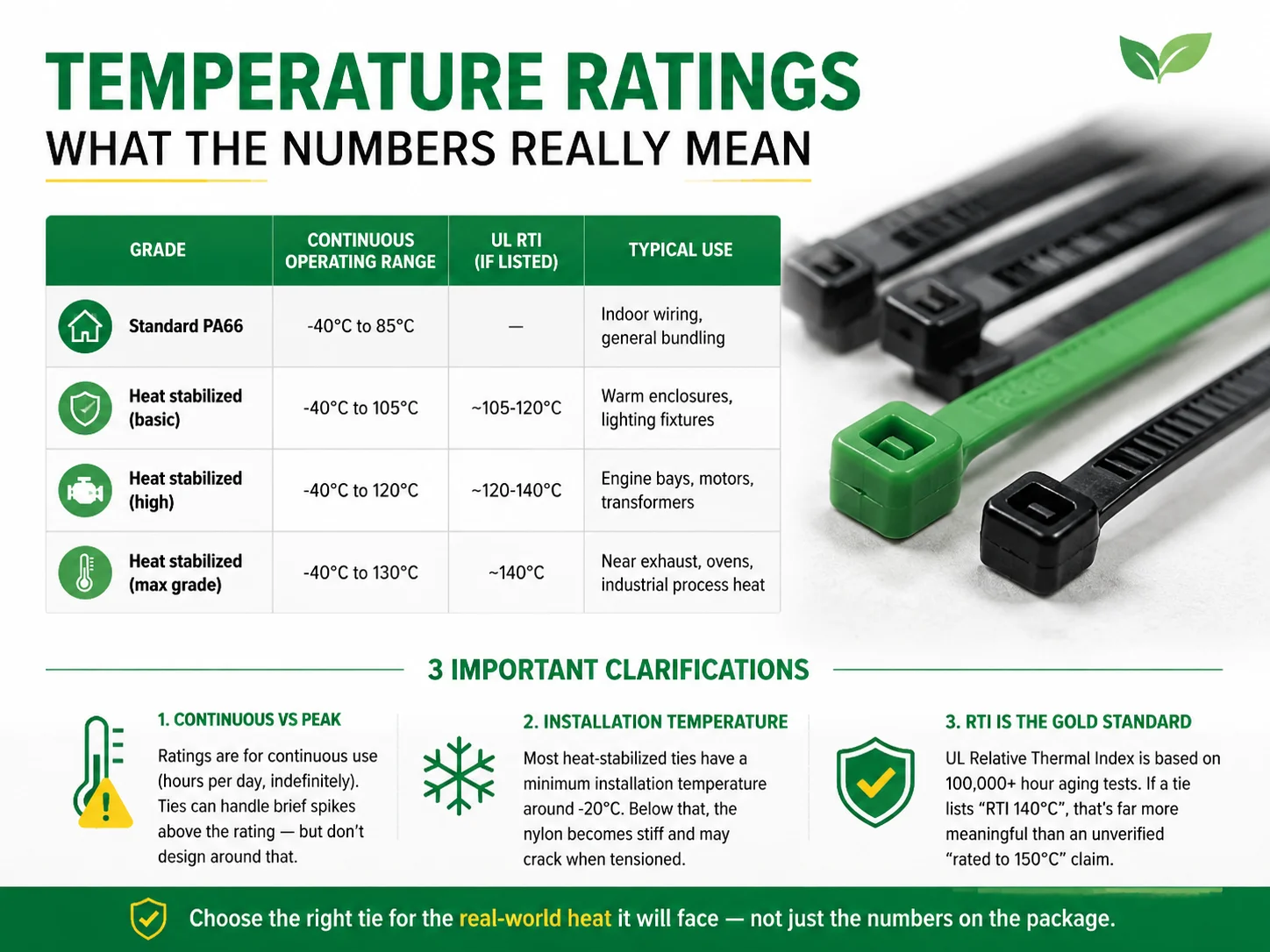
Temperature Ratings: What the Numbers Really Mean
By obtaining the correct temperature specs, you will avoid making two widespread errors: buying a product that it is not meant to last through and wasting money on a higher grade than necessary. Here’s how the ratings system functions:
| Grade | Continuous Operating Range | UL RTI (if listed) | Typical Use |
|---|---|---|---|
| Standard PA66 | -40°C to 85°C | — | Indoor wiring, general bundling |
| Heat stabilized (basic) | -40°C to 105°C | ~105-120°C | Warm enclosures, lighting fixtures |
| Heat stabilized (high) | -40°C to 120°C | ~120-140°C | Engine bays, motors, transformers |
| Heat stabilized (max grade) | -40°C to 130°C | ~140°C | Near exhaust, ovens, industrial process heat |
Three significant points to note:
- Continuous vs peak: the ratings stated are continuous (hours per day, eternally). A tie may withstand brief periods above its rating — but do not base design on this premise.
- Installation temperature: most heat-stabilized ties have a minimum installation temperature of about -20 degrees Celsius. Below this temperature, the nylon will not be pliable and may break while being used.
- RTI is the definitive reference: the UL Relative Thermal Index is a measurement of long-term aging temperature (based on tests extending over 100,000 hours). Hence, a tie with an “RTI 140 degrees” will be much more reliable compared to “rated at 150 degrees.”
Key Specifications of Heat Stabilized Ties
The size of heat stabilized ties is similar to that of standard ties, so the strength of a heat stabilized tie is hardly compromised. Some typical specifications include:
| Property | Typical Value |
|---|---|
| Material | Nylon 6/6 (PA66), heat stabilized |
| Flammability | UL 94V-2 |
| Continuous temperature | -40°C to 105/120/130°C depending on grade |
| UL RTI | Up to 140°C |
| Minimum installation temp | Approx. -20°C |
| Tensile strength | 18 lb (80 N) mini / 40 lb (180 N) standard / 50-120 lb heavy |
| Widths | 2.5 mm (mini) / 3.6 mm / 4.8 mm / 7.6 mm (heavy) |
| Lengths | 80 mm (3.1″) up to 380 mm (15″)+ |
| Typical colors | Natural light green, black (UV + heat combo) |
| Standards | UL 62275, UL 94V-2, RoHS, some grades CSA/ABS |
The color of heat-stabilized ties is worth noting: they are almost always naturally light green rather than the milky white of regular nylon. Some distributors provide black heat-stabilized ties, which offer both UV protection and heat protection, making them ideal for hot outdoor environments in which equipment is positioned on roofs. The size dimensions themselves follow the same standard ranges as regular ties, so our standard cable tie sizes reference applies to heat-stabilized grades too.
Heat Stabilized vs Standard Nylon Ties
If you hold a heat-stabilized tie next to a standard one, they look similar. The differences show up in performance and price:
| Factor | Standard PA66 Tie | Heat Stabilized Tie |
|---|---|---|
| Continuous temperature rating | Up to 85°C | 105°C to 130°C |
| Color | Milky white / black | Light green / black |
| Heat aging resistance | Good (short-term) | Excellent (long-term, tested to RTI) |
| Cold rating | -40°C | -40°C (install min ~ -20°C) |
| UV resistance | Poor (unless UV-stabilized) | Same as standard (choose black for UV) |
| Tensile strength | Same per size | Same per size |
| Relative price | Baseline | +20-40% |
| Certifications | UL 62275, UL 94V-2 | UL 62275, UL 94V-2, RTI listing |
The practical rule states that continuous standard PA66 works up to a temperature of about 85°C. Beyond that area — or anywhere vibration is combined with heat (for instance, an engine, a pump, a compressor) — the heat stabilized option must be used. A tie you replace once differs from the one that must be replaced eternally.
Automotive Applications: The Engine Bay Test
Car engine bays are the traditional testing site for heat-resistant ties, and it’s probably the most significant reason why they are so often searched for. Under the hood, temperatures fluctuate greatly:
- Near the radiator inlet temperatures can reach 80 to 100C even in normal driving.
- On the engine block and around the exhaust, temperatures can range from 120 to 150C.
- Right next to the exhaust manifold or the turbocharger the temperature can exceed 200C (no plastic tie can withstand such temperature so be sure to use stainless steel or metal clamps in that place).
For most of the wiring that comes under the hood, like harnesses along the frame, by the battery, and on the firewall, the suitable option is a heat-stabilized tie for temperatures up to 105°C to 120°C. For work adjacent to exhaust, no nylon can hold up there, so stainless steel ties or clamps are your best choice. If the area also comes into sunlight (like harnesses near the underside of the windshield), black heat-stabilized ties should be used for UV protection too.
Other uses of this kind include wiring for motorcycles, ATVs, marine engines, and radiator fans, and aftermarket additions (lights, compressors, etc.) that share original ties’ features.
Other High-Temperature Applications
In addition to automobiles, heat-resistant cables are valuable for a number of industrial and construction applications:
- HVAC and refrigeration: It can be found in compressor wiring, heating elements in air handlers, etc.
- Lighting: heat stabilization can also be found in LED driver assemblies, ballast boxes, heat traps in high bay lights and recessed fixtures.
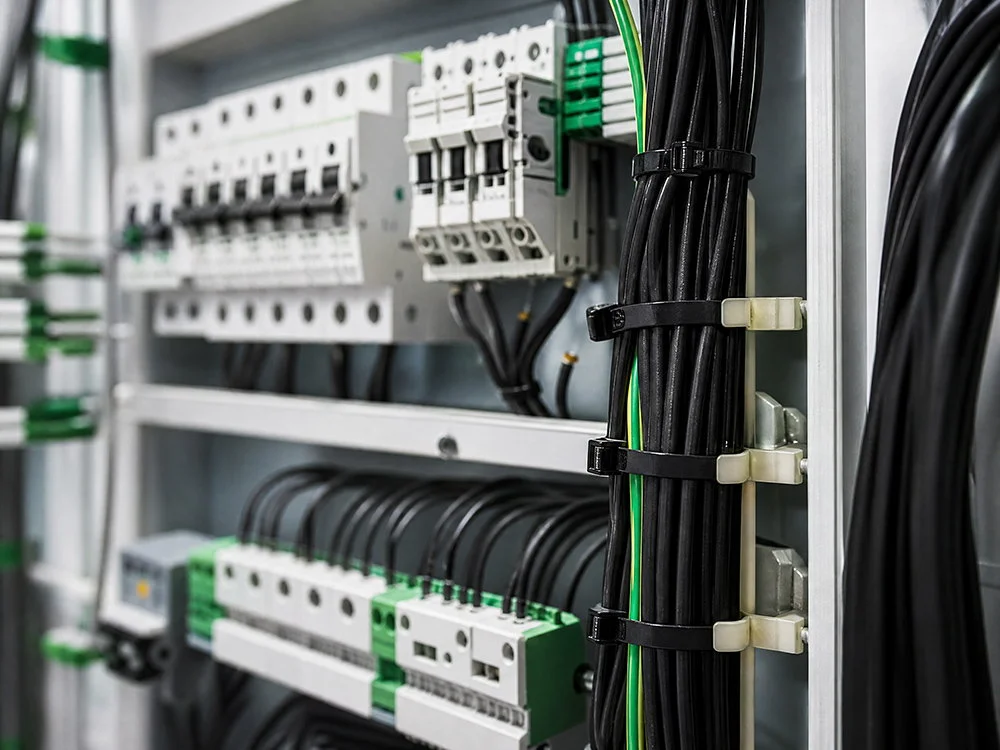
- Electrical enclosures: It can be found in wiring of motor controllers, switchgears, and transformers.
- Industrial stoves and process equipment : It is often used in bundling applications surrounding heaters, steam pipes and dryers.
- Home appliances: It is also found in ovens, dryers, dishwashers, and water heaters used in homes.
- Solar and telecom: used for cable installations on rooftops of homes and buildings.
How to Identify Heat Stabilized Ties
When you are left with a pile of unnamed ties and looking for heat stabilization identification follow the steps listed:
- Color: natural color of light green means heat stabilized nylon usually used. Color of white signifies that it will be regular nylon. Black ties can be the normal or heat stabilized. You need to check what they have written on their packages.
- Printing on the packaging: good quality ties must have temperature on the package or a data sheet mentioning this very temperature with description like “105C” or “RTI 140C.” Without any temperature mentioned on the package it is impossible to check.
- UL Listing: good quality ties must be listed with UL 62275 and must be provided with UL flame classification rated UL 94V-2. Listing provides the strongest evidence of RTI temperature being present there.
- Data sheet: please contact the supplier and ask for the data sheet. It must specify the heat stabilized grade and continuous temperature range.
Never test this “oven test” on any working ties. The usage of sample ties and their being put in the oven at 150C will not provide you with the result.
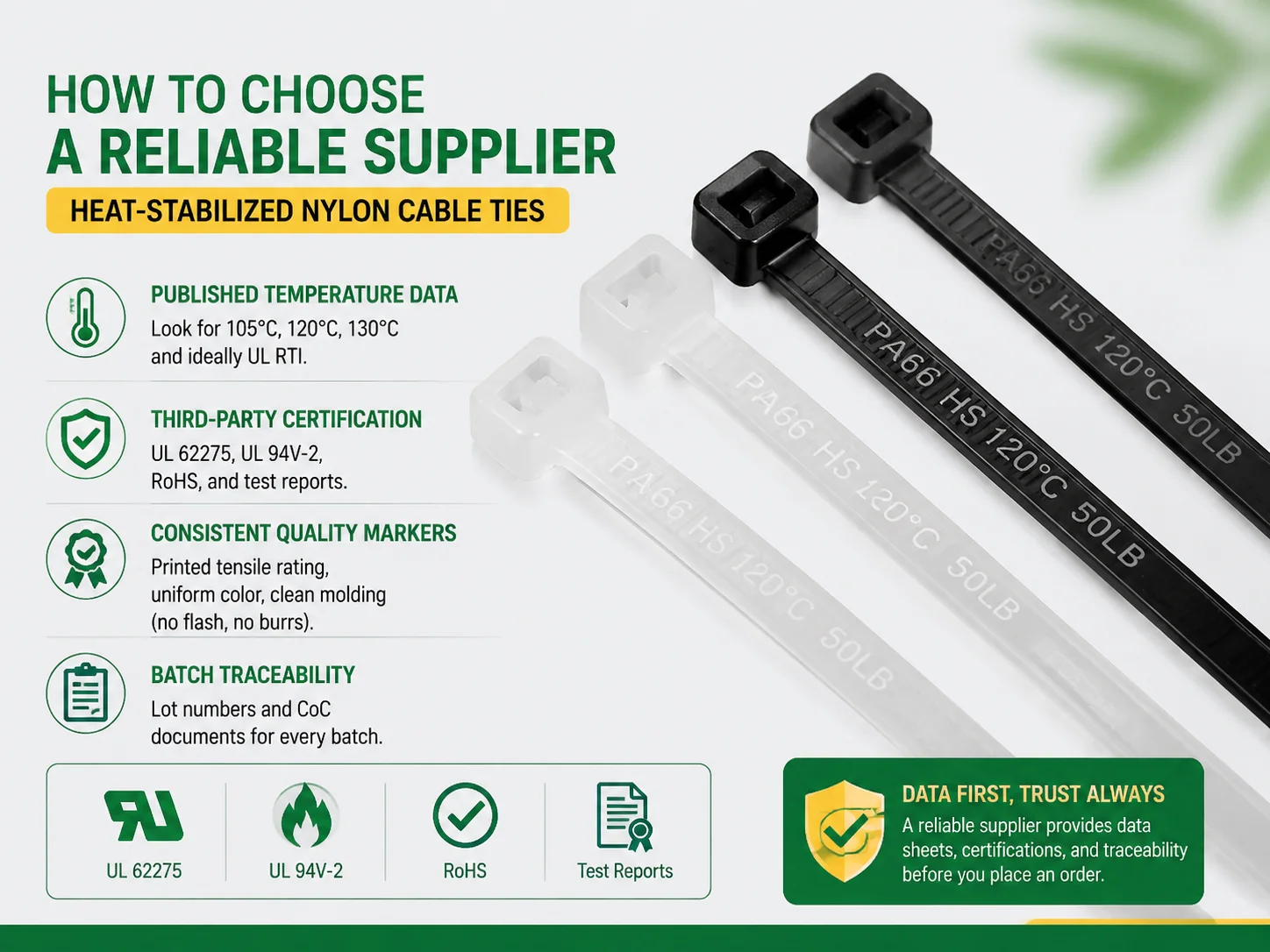
Brands & How to Choose a Reliable Supplier
Prominent brands in heat-stabilized ties are Panduit (“heat-stabilized” PA66 series), HellermannTyton (T-Series heat-stabilized), Thomas & Betts, ABB, and KSS (Kingsun). Asian manufacturers like Wahhlee/Huihua and IGOTO provide heat-stabilized grades to global OEMs. When selecting a supplier, take care to consider:
- Availability of temperature information — look for numbers, not just “high temperature” marketing slogans.
- Authentication — choose products certified by independent organizations.
- Consistency — ask what tensile specification has been established for each size, and how consistent the coloring and production process are.
- Ability to trace batches — for automotive and industrial buyers, lot numbers and CoC (certificate of conformance) of each batch are important.
A dependable supplier will provide you with the catalog prior to taking your order; if a manufacturer is unable to provide thermograph and UL classification, it is a warning sign no matter the price. Whenever you compare suppliers or collect samples, the same factors that differentiate high-quality nylon from low-grade ones are valid in this case — the fabric must be indicated as PA66, the tensile strength must be stated, and the UL classification must be obtained.Our guide on how to distinguish the quality of nylon cable ties walks through the visual and documentation checks.
Prices & Buying Considerations
Heat-stabilized ties cost more than standard nylon, but the premium is modest relative to the reliability gain:
| Size | Standard PA66 (per 100 pcs) | Heat Stabilized (per 100 pcs) |
|---|---|---|
| Mini 100 mm (4″) 18 lb | $1-$3 | $2-$5 |
| Standard 200 mm (8″) 40 lb | $2-$5 | $3-$8 |
| Heavy 300 mm (12″) 50-80 lb | $4-$10 | $6-$15 |
| Brand-name certified (Panduit/HT) 100 pcs | $8-$20 | $12-$30 |
Bulk acquisition considerably reduces the prices of tie products. For example, when buying over 1,000 tie products, one could expect to pay about 20-40% more for a heat-stabilized tie product than for a standard tie product. However, for a manufacturer of car parts or household appliances, the price difference is negligible, considering that the price of a melted tie product can be much higher than that of a heat-stabilized one.When buying tie products, make sure to:
- Look for a tie type with a minimum temperature rating that would still fit your location — for example, the 105°C tie is more economical than the 130°C one and will suit most applications.
- If using the tie within the engine of a car, verify the temperature of your specific location — do not just rely on saying that it is hot.
- Check the minimum quantity of tie products that need to be ordered, since specialty grades usually have minimum order quantities.
Installation & Removal Notes
Heat-stabilized ties can be installed in the same way as standard ties but requires some considerations:
- Installation must not occur at temperature lower than -20ºC as the cold nylon becomes brittle thus warming up the area before installing is recommended.
- After tensioning, cut off the tail flush since it can create sharp edges prone to damaging harnesses.
- Use a tensioning tool while doing production work to maintain the same tension, thus avoiding loose bundles or ties that are overstressed.
- Avoid turning the tie sharply around its head to prevent creating stress zones in the nylon material.
- Disposal: heat-stabilized ties are single-use ones and installation can be done using regular diagonal cutters but caution must be exercised since nylon is stronger than cheap alternatives thus a good cutting tool is recommended too.
- UV warning: heat stabilization does not mean UV resistance so if you plan to use these cables in places with a lot of sunlight make sure you choose either black heat-stabilized ties or specifically designed UV-stabilized cables.
Frequently Asked Questions
What are the best heat-resistant zip ties for cars?
When it comes to automobile applications, you should choose heat-stabilized nylon 6/6 ties rated to approximately 105°C or higher. The best possible rating would be 120°C. Ideally, the tie should also have a UL94V-2 flame rating. Panduit, HellermannTyton, and Thomas & Betts produce automotive heat-stabilized series of ties. The black versions of the ties are used in areas subjected to UV light, for example, around the edges of the hood. In locations near the exhaust manifold or turbo (with temperatures above 200°C), you can use either stainless steel ties or clamps. No plastic ties survive extreme conditions of that area.
What is a heat stabilized cable tie?
A heat stabilized cable tie is a type of cable tie made of nylon 6/6 (PA66) thermoplastic which is compounded with other chemicals such as copper-based heat stabilizers in order to slow the process of thermal oxidation. Ordinary PA66 ties are available in the temperature range of 85°C while heat stabilized cable ties work in the range of 105°C-130°C , with the maximum heat resistance of 140°C according to the UL testing authorities. They are usually light green in color and cost about 20-40% more than regular cable ties.
At what temperature will a zip tie melt?
At operational temperatures, nylon 6/6 doesn’t really “melt” — it goes through a process of degradation. The melting point of PA66 ranges from 255°C-260°C, but before even reaching that point, sustained heat will cause the nylon to oxidize: this will cause the tie to become brittle, weak, and break. The ties made out of standard PA66 have the continuous usage rating of 85°C; heat-stabilized grades can go to 105-130°C (some can even last at 140°C RTI). It is possible for the tie to survive a brief period of exceeding the rating, but continuous exposure destroys the tie, so it is important to match the tie with the temperature of the working site.
Are nylon or plastic zip ties better?
NYLON (PA66) garnering praise as superior to standard plastic ties regardless of the application meaning it has about 2-3 times greater tensile strength, heat resistance, spring-back capacity, and grip strength. So when the adjective plastic is used regarding good quality, it points at nylon as the genus of engineering plastics. If heat resistance is required, heat-stabilized nylon should be the appropriate grade. Cheap PP/PE ties are applicable only for short-term light-weight low-temperature applications.
References
- UL Standards — UL 62275 (Cable Ties) & Relative Thermal Index (RTI)
- Panduit — Heat-Stabilized Cable Tie Product Data
- HellermannTyton — Heat-Stabilized T-Series Technical Data
- ASTM D4066 — Standard for Polyamide (Nylon) Materials
- NFPA 70 (NEC) — Material Requirements in Plenum and High-Temperature Spaces
- DuPont — Nylon 6/6 (Zytel) Thermal Performance Data
Conclusion
A nylon zip tie that is heat stabilized refers to a PA66 zip tie with an important difference – it has stabilizers that prevent thermal oxidation and allows continuous usage temperatures of between 85°C and 105-130°C; which matters most in applications like engine compartments, ovens etc. In such scenarios, heat stabilizations make the difference between zip ties performing effortlessly and withstanding for years. Look out for the light green natural appearance; printed temperature ratings, UL 94V-2 and UL 62275 entries, and data sheets provided by suppliers.