



Top 10 Cable Tie Suppliers in the World
Cable ties can be described as a commodity, but when they fail, certification of the tensile strength and UV resistance will become more than just papers and turn into the reason for saving the solar array for five summers. In this guide the ten most important suppliers on the world market are ranked, their strong points are described, specifications to take into account are given, and finally suggestions on how to choose a supplier are provided.
The plastic cable tie market globally has a valuation of USD 1.49 billion as of 2025 and is projected to be approximately USD 2.44 billion in 2035 at a compound annual growth rate of about 5.1%. The top five companies hold around 43% of the market while the top ten together control about 63% of it. The likely leaders in this space include HellermannTyton, ABB (Thomas & Betts), AveryDennison, Panduit and 3M, while the other major players include TE Connectivity, Legrand, Essentra, KSS and Partex. There are different opinions on the company that is the largest player in the cable tie market, as most information sources do not provide revenues of individual companies specific to this market. The cost for a buyer in the US would be in the range of USD 3-15 for one hundred nylon ties, while stainless steel ties would cost between USD 20-60. The igoto company provides a variety of nylon, UV-resistant, heavy-duty and stainless steel ties to both OEMs and the private label customers.

The Market at a Glance
Any discussion of the market situation must start with two figures. The global plastic cable ties market is expected to total about USD 1.485 billion in 2025 and USD 2.442 billion in 2035, with the annual growth rate of around 5.1%. Moreover, the level of concentration is moderate, as the top five companies control approximately 43.2% of the market and the top ten about 62.8%, which leaves a great number of competitors, particularly at the regional level.
However, there are two caveats to these figures. It has to be mentioned that cable ties are usually an insignificant sub-category of a more extensive fastening or electrical product range. Hence, the revenues reported in relation to companies do not tell much about cable ties share. There is also a great disparity between sources. One of them determines HellermannTyton’s share at approximately 14% with total cable ties revenues of about USD 170 million, while another makes ABB’s unit Thomas & Betts number one with estimates that are several times higher. Both sources do not contradict each other because they are based on different criteria.
How This List Was Built
The four criteria list is preferred in the following order.
- The range of cable ties itself is wide – standard nylon, reusable, UV, heat-proof, flameproof and plenum-rated ties, stainless steel cable ties and identification ones.
- Certification and traceability – whether the supplier has published UL listing, certificates for materials used and tests results and not only rough estimations.
- Geographical coverage – production and distribution areas because a tie specified in one country is frequently used in another.
- Channel strength – whether a contractor, supplier or OEM can actually buy the product on a feasible initial order.
The ranking indicates that a mix of these factors is considered and not only the revenue.
The Top 10 Cable Tie Brands
| # | Supplier | Base | Core strength | Main end markets |
|---|---|---|---|---|
| 1 | HellermannTyton | United Kingdom / Europe (Americas hub in the US) | Cable management and identification as a dedicated business, not a side line | Automotive, telecom, aerospace, industrial |
| 2 | ABB (Thomas & Betts) | United States / Europe | Ty-Rap and Ty-Fast installed base; electrical channel reach | Electrical, construction, industrial, utility |
| 3 | Avery Dennison (Fastener Division) | United States | Materials and labelling know-how combined with fastening | Retail, electronics, automotive |
| 4 | Panduit | United States | Data centre and network specialisation; PLT series | Data centres, telecom, industrial, OEM |
| 5 | 3M | United States | Industrial fastening depth; harsh-environment formulations | Automotive, electronics, general industrial |
| 6 | TE Connectivity | Switzerland | Interconnect systems integration | Automotive, rail, industrial, EV |
| 7 | Legrand | France | Building infrastructure channels and system selling | Construction, commercial buildings |
| 8 | Essentra Components | United Kingdom | Very broad industrial components catalogue and e-commerce | Industrial, OEM, MRO |
| 9 | KSS (Kai Suh Suh Enterprise) | Taiwan | Cost-efficient mass production at scale | Electrical, export markets |
| 10 | Partex Marking Systems | Sweden | Identification and marking integration | Automation, panel building |
Four of them deserve to be mentioned in detail.
HellermannTyton is the company that comes closest to being classified as a pure cable management manufacturer. The production of electrical ties is the core niche for this firm rather than just one of many product types. The choice of goods available includes standard and re-usable ties, ties containing metals, detectable ties, heat-resistant ties, and identification printing production. The reliable usage of re-usable ties allows them to confirm their engineering excellence and advantage over their rivals.
Thomas & Betts, a company belonging to ABB, is well-known for its Ty-Rap brand, which is very close to a generic name in North America like “zip ties”. The strength of the trademark is that it has good penetration in the distribution channel, as many contractors buy the range of products from one supplier. When an American specification documents the name of a tie brand, it is very often Ty-Rap.
Panduit focuses on the side of networks and data centers, where cable ties are just one of the many components of structured cabling systems, which include raceways, patch panels, and different equipment necessary for cable management. It becomes more reasonable to buy ties from the same supplier that sells the equipment needed for cable containment and cable service.
Essentra Components has an attractive offer for small-scale clients due to its business model, which aims to cover a wide range of products and quick availability. A large-scale catalogue of goods available with online purchase and low minimum order sizes is a great advantage for maintenance departments and companies as it allows them to buy forty types of items at once when they only need small quantities.
For a US-focused view of who actually stocks and ships in North America, including the distributor layers behind these brands, the supplier landscape is set out separately in this breakdown of the largest cable tie suppliers in the US.
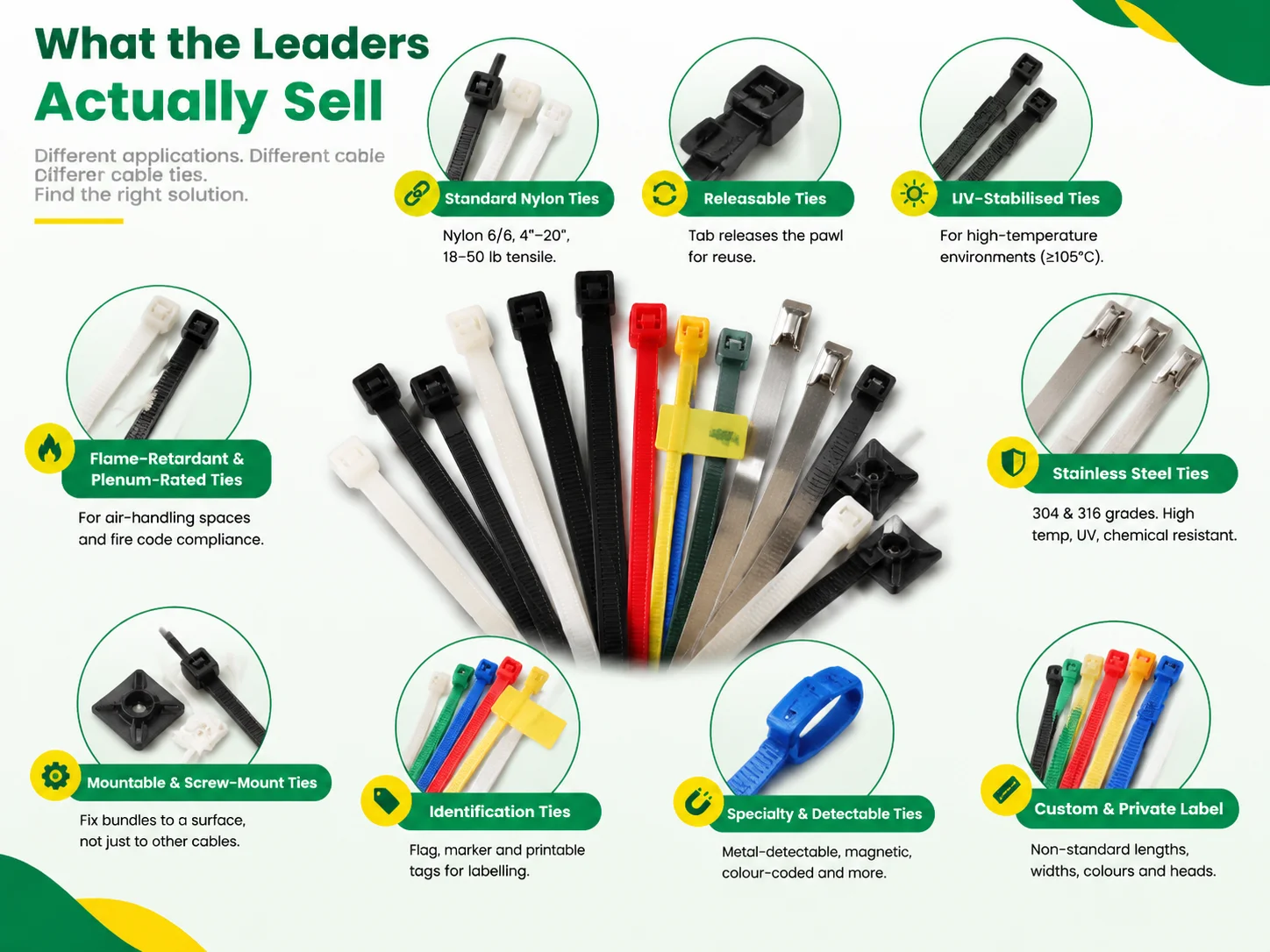
What the Leaders Actually Sell
The range of products is much larger than the conventional black 8-inch tie. Each product type has its own characteristics and properties, making one particular supplier suitable for a given type of application.
- Standard nylon ties — typically mass-produced. Nylon 6/6 can be either black or natural and show a tensile strength of 18–50 lbs. The available dimensions of nylon ties differ from 4 inches to 20 inches.
- Releasable ties allow to release a pawl tab, which means the user can reuse a tie. Thus, a reusable tie is useful wherever constructions are reconstructed.
- UV-stabilized (weatherproof) ties are made of black nylon with the addition of carbon black. The product belongs to the most commonly misunderstood types in the industry: while white or natural ones can be deteriorated by sunlight in several months, the black UV-stabilized ones are perfectly designed for outdoor usage.
- Heat-stabilized ties are predictable for high-temperature environments, normally cited for 105 °C and higher.
- Flame-retardant and plenum-rated ties are essential in locations with air ducts and in places where fire regulations are in use. They are often used together with plenum-rated cables.
- Stainless steel ties are either coated or uncoated and made of grades 304 or 316. They are able to withstand high temperature, UV radiation and chemicals. Their tensile strength exceeds that of nylon.
- Mountable and screw-mount ties allow attaching a cable bundle to a solid surface.
- Identification ties encompass flag ties, marker ties and ties with printable labels for identification.
- Specialty and detectable ties are metal-detectable and are intended for the industries of food production and medicines; magnetic ties and color-coded ties are also included.
- Custom and private label ties can be produced according to customer’s specifications.
Specifications That Decide a Purchase
Four numbers and one material grade cover most of the specification work.
| Specification | Typical range | What it decides |
|---|---|---|
| Length | 4 in (100 mm) to 36 in (914 mm) and beyond | Bundle diameter — the tie must wrap the bundle with enough tail to tension |
| Width | 2.5 mm (miniature) to 12 mm and above (heavy duty) | Tensile strength and head size |
| Tensile rating | 18 lb (80 N) to 250 lb (1,100 N) nylon; higher for stainless | Load and vibration |
| Material | PA66, PA6, PA12, PA46, PP, PE, PTFE | Temperature, chemical and UV resistance |
| Colour | Natural, black, and a full colour range | Black for UV; colours for identification |
When it comes to materials that are commonly used, it appears that there tends to be many instances of mistakes when it comes to specifications. Nylon 6/6 is usually the most popular type of material as it is used for both indoor as well as outdoor projects and which has been stabilized against UV light. Natural nylon 6/6, however, does not offer any UV protection despite being durable. Polypropylene is less expensive than Nylon but lacks durability during winter months. PTFE ties are said to be the best option if one is dealing with chemicals or extreme temperatures.
Before actually placing the order, it is important to have the checks done. One thing that must be paid attention to in the first place is the diameter of the bundle which is more important than counting cables — it has been calculated that there should be a tie for every wrapped portion as opposed to every cable present in the compound. And another thing that should be reminded is that before placing an order, there must be matching of operating temperatures because it is clear that a black tie working under the sun will surely witness high temperatures, however, being installed at home or near a source of heating it can be turned useless and burn out before even reaching the site.
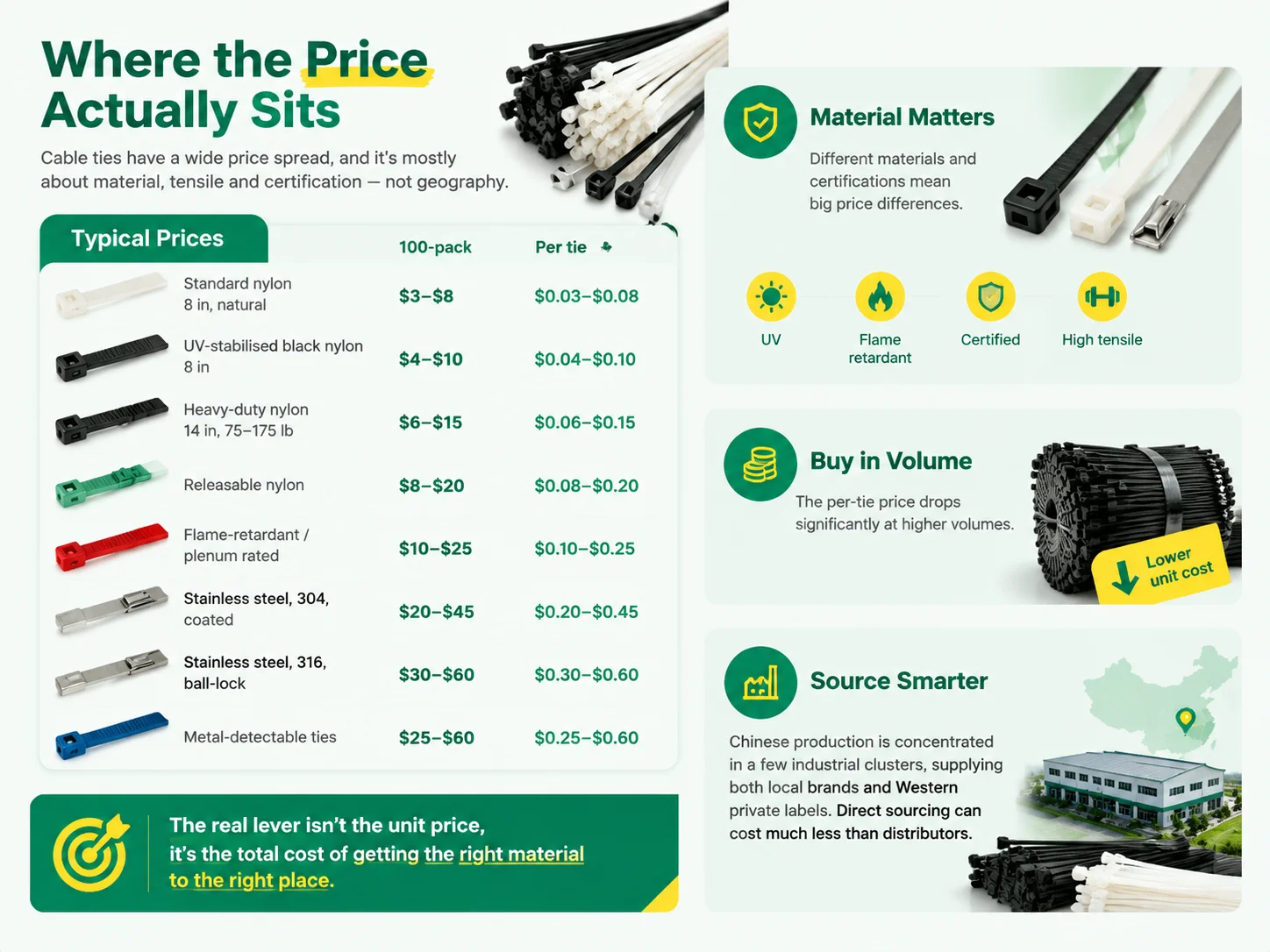
Where the Price Actually Sits
Cable ties have an exceptionally wide range of prices for such a simple component, which can mostly be attributed to the material it is made from, the tensile strength demonstrated by it, and certification rather than the country of origin.
| Product | Typical price, 100-pack | Per tie |
|---|---|---|
| Standard nylon tie, 8 in, natural | $3–$8 | $0.03–$0.08 |
| UV-stabilised black nylon, 8 in | $4–$10 | $0.04–$0.10 |
| Heavy-duty nylon, 14 in, 75–175 lb | $6–$15 | $0.06–$0.15 |
| Releasable nylon | $8–$20 | $0.08–$0.20 |
| Flame-retardant / plenum rated | $10–$25 | $0.10–$0.25 |
| Stainless steel, 304, coated | $20–$45 | $0.20–$0.45 |
| Stainless steel, 316, ball-lock | $30–$60 | $0.30–$0.60 |
| Metal-detectable ties | $25–$60 | $0.25–$0.60 |
As the quantity of ties goes up, the per-tie price drops a lot, and the important thing for the buyer is not the unit price itself, but rather the total cost of getting the tie made and to its destination. If a tie fails after eighteen months outside because it has not been treated to withstand the effects of UV rays, the cost of such a tie is much higher than the price difference between the catalogs of manufacturers.
Another important factor is the location of the production of the ties. The production of nylon ties in China is concentrated in a few industrial clusters, and these suppliers provide products for their own brands as well as a lot of private label material for companies in the West. Consequently, many branded ties are produced on the same equipment as unbranded ones, and the price of a product made directly by the producer can differ dozens of times from the price offered by the distributor.The cluster structure and the practical differences between the main Chinese producers are covered in this overview of the top China nylon cable tie manufacturers.
Certifications and Documents to Demand
In regard to the commodity portion, the documents handle most of the qualification work.
- UL listing to cable tie standard — UL 62275 relates to cable ties applied for electrical assignments. Request for specific file number instead of the logo.
- UL 1565 in which the product is a positioning device as opposed to a tie and the relevant plenum or flame rating if the application is in an air-handling area.
- ISO 9001 quality control at the production facility with the scope statement mentioning the product.
- RoHS and REACH declaration of the material — especially for the products going to the EU.
- Data on materials and tests — tensile tests, UV tests and temperature ratings against the standard they were carried out.
- EN 10204 3.1 mill certificates for stainless steel ties, traceable by the heat number.
- Lot traceability — ability to trace delivered carton back to production lots and this is what actually an audit is checking for.
The supplier who does not have UL file number upon request is not necessarily selling a bad product; they are placing a product which you can’t use in regulation project.The certifications igoto holds and the documents issued per shipment are listed on the certification page — that is the level of disclosure worth asking any supplier for.
How to Choose a Supplier
If you follow the above list sequentially, you will be left with two or three options before discussing price.
- Material/application. According to the purpose of the application, it can be an indoor cabinet, a solar panel installation outdoors, food production processing, a data center plenum, or a marine installation. Such information can eliminate most of the catalog and potential suppliers. For instance, one needs metal-detectable materials for a food production line or flame-rated materials for the plenum space, or one requires grade 316 stainless steel or UV-stabilized nylon for coastal usage.
- Volume and MOQ. Anyone ordering a few ties per year can be served well via a distribution company possessing stock and low minimums, whereas a company ordering 20 million pieces should negotiate directly with a manufacturer in terms of production capacity and private labeling.
- Range depth relative to one’s requirements. If an enterprise wants to get six materials in three different grades of tensile strength, it does not mean that it will succeed with a supplier whose range is only one type of material.
- Certificate and documentation. Already mentioned above and not negotiable in case of regulated projects.
- Consistency of lots. This is the most underrated factor used by customers that causes regret in the future. In practice, tensile strength, head geometry, and pawl engagement must be stable between the deliveries.
- Need for compliance with the lead time and logistics, including stock holding cost in case of overseas sourcing.
- Total landed cost. Unit price + transport charges + customs clearance and exchange losses when buying internationally.
Based on the information above, one must say that premium brands justify their cost in terms of documentation and consistency, while generics may well be equal in products’ physical characteristics and outperform in cost terms. For a view of how the branded and unbranded options compare on the criteria that affect installed performance rather than catalogue prestige, this comparison of what defines the best cable tie brand is a useful reality check.
Where igoto Sits
Igoto lets out manufacturing their cable ties both for OEM customers and for those people who are willing to buy under their own brands. They provide their clients with nylon 6/6 cable ties with standard, UV-stabilized and heat-stabilized properties; heavy-duty cable ties; releasable cable ties and metal cable ties.
Thus, it is necessary to mention two things. On the one hand, there is a cost and fast response. With our own manufacturing, custom lengths, widths, colors and markings do not require negotiations but just tooling and our MOQ is based on OEM needs instead of retail ones. On the other hand, there is an obstacle – the lack of brand awareness. Igoto is not a brand which you can find in US specifications and, therefore, any project where specifications provide for HellermannTyton or Panduit, these brands will be used instead of ours. Thus, igoto is ready to compete where specifications accept general description of properties instead of brand and buyer is ready to select a supplier based on qualifications and lack of brand specifications demands. The full production scope, materials and tolerance capability are described on the nylon cable tie manufacturing programme.
FAQ
Who are the largest cable tie manufacturers in the world?
According to various reliable sources, “the most” popular plastic cable tie manufacturers in the world include HellermannTyton, ABB (via Thomas & Betts), Avery Dennison, Panduit, and 3M, followed by TE Connectivity, Legrand, Essentra Components, KSS and Partex. The major five companies among other plastic tie makers represent about 43% of the world’s plastic cable tie market while the major ten serve the purpose for about 63%. Be careful with every individual ranking: plastic cable ties are a tiny product line inside bigger product lines. Therefore, the estimations can sometimes differ wildly depending on which products and regions were included in the calculations made by the analyst.
What size cable tie do I need?
Sizes are determined by bundle diameter rather than count of cables. Measure or calculate the outer diameter of the bundle and choose a tie that exceeds the maximum diameter of the bundle yet still allows sufficient tail that reaches the tensioning tool. Diameter is based on tensile strength of the ties, which can be broken down into three groups of ties: miniature and standard ties (2.5-4.8mm) which can hold approximately 18-50 lb, intermediate ties that can hold about 50-75 lb, and heavy-duty ties that are 8mm or more in diameter and up to 175 lb or more. The biggest mistake made is buying by length alone, which leads to ties that may be long enough but weak, or strong enough but not capable of wrapping around the bundle.
Are white cable ties UV resistant?
Natural or white nylon material does not have a UV stabilizer or any protection from ultraviolet rays exposure, thus If ties are installed outside, they become fragile within a few months of use. The black color indicates that this nylon has carbon black additive, which provides UV protection. In case you have to use nylon (instead of stainless steel) for the outside application, make sure that you ask for the black nylon and for the test data of the UV exposure test.
What is the difference between a cable tie and a zip tie?
“Zip tie” is the diminutive name and “cable tie” is the kind name by which this product is commonly recognized: comprised of a nylon strip with an interior pawl and ratchet head that closes once the tail is pulled through. Some standards organizations refer to it as wire tie” or: by among others. In the United States, one manufacturer’s proprietary name comes pretty close to being a generic term. Any one of these terms will refer to the same part.
Should I buy branded or unbranded cable ties?
For particularly high-stakes applications, such as where the specification names a specific brand and certification to an auditor is essential, a brand name product has to be purchased. Buy from a qualified generic manufacturer in cases where the requirement is a performance spec such as material grade, tensile strength, UV rating, UL listing. Suppliers audit and first article inspections become substitutes for brand equity. In those circumstances, the physical product is often manufactured on the same equipment; only the associated documentation, lot-to-lot consistency, and price differ.
How do I verify a cable tie supplier is legitimate?
Prior to placing the initial order, there are four things you should ask for which include the UL file number of the specific product, the ISO 9001 certificate along with its scope statement, material and tensile test data of the grade you are purchasing, and the AQL and in-process inspection system employed in the manufacturing process. Then you can ask for samples from two separate production lots and compare them — you should not notice any difference in head shape, tail flexibility or tensile feel between the two. A manufacturer who answers all the four questions promptly is someone you can certify while a manufacturer who evades all four is just a trader.
References
- UL Standards & Engagement — UL 62275, Cable Management Systems
- HellermannTyton — cable ties and identification systems
- Panduit — cable ties and cable management reference
- Avery Dennison — fastening and identification technology
- ABB — installation products including Ty-Rap cable ties
Conclusion
With ten suppliers offering one commodity, it is astounding how dissimilar they can sometimes be! HellermannTyton has depth, ABB’s Thomas & Betts has channel presence, Panduit has data centre and network work-the very capabilities that you need-Avery Dennison and 3M have a range of materials, Essentra has depth and wide availability, and KSS has volume pricing-each excels at different things, and the right answer depends on how much your project values any of those things.
Three takeaways. Size up by bundle diameter, tensile rating and material rather than by length and price since failures often arise along this point. Black UV-stabilised nylon is specified for anything to be used outdoors, and stainless steel where the exposure is meant to be heavy. Also, when comparing suppliers, ask for the UL file number, ISO 9001 scope, testing data and inspection regime before you ask for that price-a supplier that can answer all four is worth paying slightly more than one who can’t.
That’s a qualification of the supplier and not a qualification of the part. That keeps your installation from being static for its fifth summer.


