




Different types of Zip Tie Cutters:Choose the tool best suited for your Zip Ties
Towards the back of the tool bag, the Zip tie cutter ranks least entertaining-until you rear your hand out from behind a bulkhead panel, and a freshly cut, tail-wide, protrudes from the back of your skeletally thin hands. The right one will leave nothing to be caught on. The brave one will leave a micro-thin-tailed plastic blade, frailly clutching every tie you make or easily chipping its own jaw on a diaper it was never built to cut. Being another carbon-fiber tie manufacturer, we at least meet all the ideals. Most mistakes in cutting complaints are, on our side, mismatch complaints. Thus, our guide starts from the ties and goes on to tools.
Here are five kinds of cutters one should know about: a width-by-width matching table, a clear response on Knipex, and a few habits that keep every cut end smooth.
The best zip tie cutter for most jobs is, of course, a flush cutter. With one blade ground flat, it sits tight against the tie head and shears the tail level with it, leaving no sharp stub. Choose by tie width and not brand: slim precision flush cutters usually carry ratings for plastic ties up to about 1/4 inch (6.35 mm) wide, while heavy-duty ties of 7.6 and 9 mm need the sturdier ones or tie guns with a blade built in. For high-volume installation, a tensioning tool cuts every tie evenly, in tension, and to the same length. As for removing a tie from a finished harness, a guarded removal cutter secures the blade away from the insulation.
What a Zip Tie Cutter Actually Has to Do
The task of cutting a nylon tie seems simple. It requires just a bit of stretchable plastic, but there are two points which make the job more challenging.
First, the cut must be performed in the right place with absolute precision. If you cut the tie a bit farther away from the locking head, you will be left with an unnecessary piece of strap. If you do not make the cut at 90°, the strap will have a wedge like shape and be able to cut the flesh, thus causing physical injuries.
Secondly, the cutting process of nylon does not go as smooth as it seems. The more this material crosses the edge of the blade, the tougher is the cut. Experienced users warn that the cutting tool fails for a reason. They often suggest that people simply use it for cutting materials for which this tool was not meant.
Moreover, it should be noted that two different processes are involved here. The first one requires the cutting of the tail immediately after installation of the tie. This means that we have to perform this task quickly and ensure that the cut is even. The second one requires the cutting of the tie when it is already used to hold something. In this case, we have to make sure that the blade won’t affect the harness. That is why people often use two tools at work.
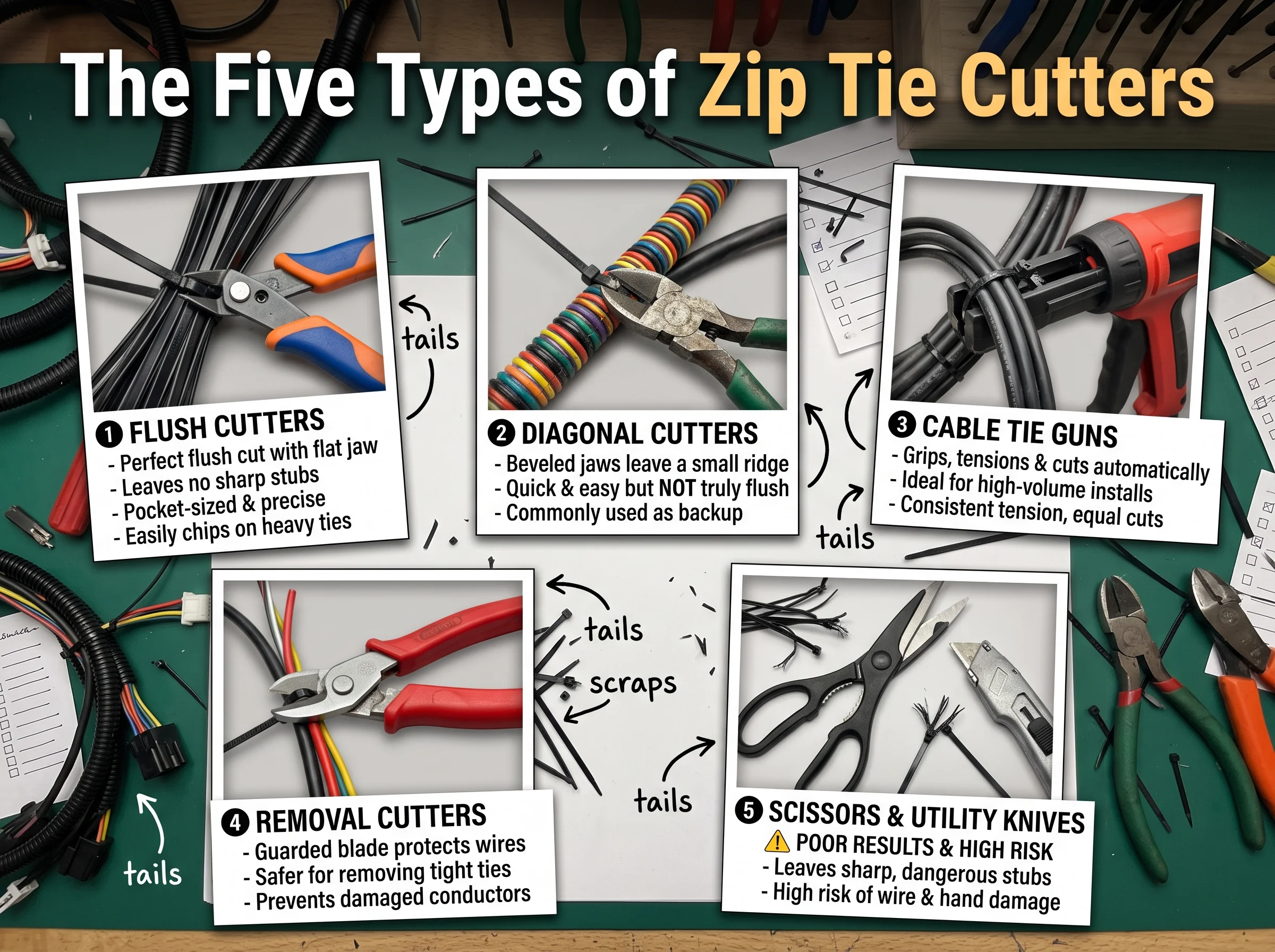
The Five Types of Zip Tie Cutters
Flush cutters
A flush cutter resembles a compact pair of side-cutting pliers, but one side of the jaw is completely flattened. Place that flat side on the tie head and press it to detach the tail perfectly. Your fingers and gloves remain safe from any snagging. This is the tool that all electricians, IT professionals and panel builders rely on, exactly what you search for when looking for zip tie flush cutter.
It’s easy to see the merits: cheap, operates with one hand, small enough to work in tight spots and also perfect for cutting fine wires with a great precision. But the disadvantage is apparent too. Fine and accurate jaws are the first parts to chip off if heavy ties are used.
Diagonal cutters and end nippers
The standard diagonal cutter, also called dike, has an angle on both sides of the jaws. So these offer with an easy cutting process, but the angle creates a small edge of strap left behind, therefore the result doesn’t become totally flush. End nippers perform the cutting at an angle of 90 degrees to the handles, which makes it easier for some workers to cut tails with them, since the jaws may apply the pressure onto the head perfectly. Though they can be used, it’s impossible to outclass true flush cutters when it comes to achieving the best result.
Tie guns with a cut-off blade
The cable tie gun, or the tensioning tool, grips the tail, raises it to the necessary tension and cuts the other part of it automatically with the built-in knife. The result is that all ties are cut in a very equal manner. For more information regarding the use of this tool refer to our guide about how to use a zip tie gun for professional installation. The point regarding tread cutter comparison is simple too – the gun is a must-have in case you install dozens of ties daily.
Removal cutters with a guarded blade
These tools are aimed at removing ties instead of making cuts. The guard is located right in the middle between the strap and the bundle, which helps tooth meet only the nylon. Aerospace and rail companies rely on such unique tools because one damaged conductor may cost much more than the price of the tool. Industrial tools are produced in order to ensure versatility, and they can have from 18 lb to 250 lb ratings.
If the tie can be reused or if someone doesn’t want to damage the strap, there are also ways to undo zip ties without cutting them.
Scissors and utility knives
They can cut the tie, but the result is not good. The problem with scissors is that they cannot come close to the head and leave some sharp piece of strap. If these are the only tools within reach, our step-by-step piece on how to cut cable ties safely explains the least risky technique.
Match the Cutter to the Tie Width
This is the section that most roundups from cuddlers do not discuss. Tool makers assess their cutters based upon the level of materials which they cut, with respect to zip ties, that number usually indicating a maximum tie width. For instance, Knipex lists its 6 inch slim knips for plastic ties as suitable for zip ties measuring up to a quarter of an inch.
| Tie width | Typical tensile rating | Common use | Cutter that fits | Watch out for |
|---|---|---|---|---|
| 2.5 mm | 18 lb (8 kg) | Electronics, small looms | Precision flush cutter | Nothing special; any flush cutter handles it |
| 3.6 mm | 40 lb (18 kg) | General wiring, IT racks | Standard flush cutter | Keep the edge sharp so it shears, not crushes |
| 4.8 mm | 50 lb (22 kg) | Panels, automotive, general purpose | Full-size flush cutter or tie gun | Seat the tie deep in the jaw, not at the tips |
| 7.6 mm | 120 lb (55 kg) | Conduit, outdoor runs, solar racking | Heavy diagonal cutter or heavy-duty tie gun | Beyond the rating of most precision flush cutters |
| 9.0 mm | 175 lb (80 kg) | Heavy bundles, fencing, infrastructure | Heavy-duty cutter or gun rated for 9 mm | Fine jaws chip almost immediately |
These are the regular steps used in this industry. While the exact figures depend on the manufacturer and material, make sure you look at the data sheets of the tie you are going to use. Our small size cable ties, standard cable ties and high strength cable ties list width and tensile figures side by side, and the cable tie sizes guide explains how to choose a width for a given bundle.
A precision flush cutter rated for 1/4 inch ties is by no means a sturdy tool. If you try to feed 7.6 mm or 9 mm ties into the cutter, it will chip the ends of the jaws. A chipped jaw will not be able to cut flush anymore.
One good practice from people who cut thousands of cable ties: always strain the strap near the bottom of the jaws to give maximum leverage instead of using the tips.
Zip Tie Flush Cutter vs Diagonal Cutter
These two get mixed up constantly because they look almost identical in a product photo. The difference is in how the jaws are ground.
| Feature | Flush cutter | Diagonal cutter |
|---|---|---|
| Jaw grind | One flat face, one bevel | Bevel on both faces |
| Cut left on the tie | Level with the head | Small raised ridge |
| Best for | Trimming tails, fine wire | General wire cutting, rougher work |
| Capacity | Lighter, built for precision | Heavier, tolerates thicker stock |
If you will be trimming ties full time, invest in a flush cutter. If you cut wire most of the day but use ties very little, then a good pair of diagonal pliers is sufficient, though you will need to check the cut with your finger and trim away any excess. A little trick some installers have for cutting with the side cutters is to press gently on the tail side toward the head while squeezing, which causes the cut end piece to pull itself slightly back into the head.
Knipex Zip Tie Cutters: Which Model Fits
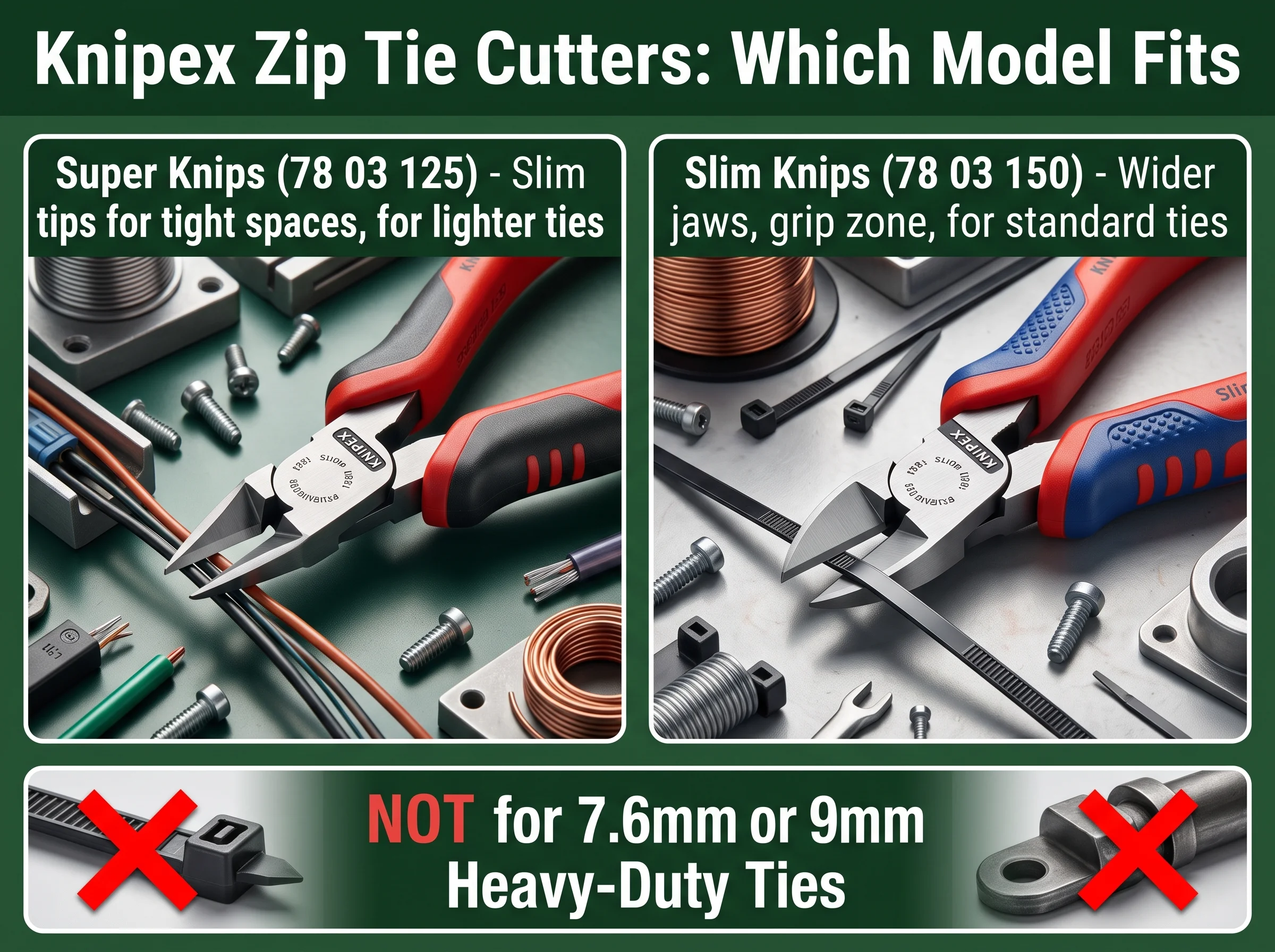
Knipex is always mentioned when talking about cutters, and this is justifiable. Their jaws hold an edge and people in tool forums say that they have cut ties using the same tool only for years. There are two families of zippers to know.
One of them is the Super Knips series, like the Super Knips 5-inch 78 03 125. This tool is an electronics flush cutter. It has slim tips that can fit tight spaces but reviews state that because of their small jaws, these tools can only cut lighter ties.
The second family is called Slim Knips, including the 78 03 150 and 78 61 150 tools. The Slim Knips series has an opening between jaws wide enough, a grip zone for pulling ties tight, as well as rated capacity for plastic ties and soft stranded wire.
None of the tool is suitable for heavy-duty ties 7.6 mm or 9 mm widths. Other brands, like Klein Tools and Xuron produce flush cutters either. All in all, the same rule pertains to every product of this kind: know before you buy what is the ties width indicated in the tool specifications and choose to buy the tools designed for wider ties.
When a Tie Gun Beats Hand Cutters
People often wonder about which ties are superior. However, that is not the main issue. What is important is understanding how many ties are being cut using specific tools. A team that works on a tower, or a crew that is fastening DC cable, or a control cabinets manufacturing team may be cutting hundreds of ties per shift. It is precisely because of this amount that hand cutters may create problems. First, hand cutters cannot provide the same quality for every single tie cut because the tension differs in every tie. Secondly, hands can get tired and make uneven cuts. Using a tie gun, both problems may be solved because a tie gun does the job of tensioning and cutting at the same time.
Of course, hand cutters are still a better choice for situations where space is limited. Moreover, IT and broadcasting engineers may find it hard to use a tie gun in areas cluttered with racks. For more information about the way the ties should be placed, please see the guide to server rack wire management.
Even after taking into account all of the above-mentioned facts, it seems that the best toolkit for the vast majority of specialists would be a production gun and a small thin cutter.
Heavy-Duty, Outdoor and Stainless Steel Ties
Wide nylon ties require enough leverage for use, but do not require much force. To cut a nylon tie, it is advisable to use a cutter for such with a rated width and insert the tie into the cutter’s jaws and squeeze the handle without twisting or rocking the device as this may result in tearing the nylon and leaving a rough edge after cutting.
This, however, does not apply to older nylon ties. Old nylon ties may become brittle due to prolonged exposure to sunlight and instead of cutting, they may splinter creating sharp shards, so it is recommended that eye protection be used when cutting them. Updated, black UV resistant cable ties do not have this issue; that is why they are recommended for use in the solar industry and telecommunications.
Unlike nylon ties, stainless steel ties require a completely different tool. Do not even think of using a nylon cutter on stainless steel ties; instead, use either a cutting tool or a tensioning tool rated for metal cable ties and be sure to put on safety goggles before commencing.
The Tie Matters as Much as the Cutter
It should be stated without ambiguity that a well-designed tie cannot be salvaged by even the finest cutter. The quality of the cut depends on three main aspects of the tie.
Uniformity of the tie head. The flat jaw needs a solid reference to cut properly. Tie heads that have got different dimensions will provide varying results.
Quality of the material. The cut is best made with virgin nylon 6/6. Any tie made from recycled material or dried nylon will have brittle texture and may crack while the tongue is keeping it tightly at the cutting stage.
Proper engagement of the pawl. If the locking pawl does not fit snugly against the teeth of the tie while cutting, the tie will probably slip, resulting in a bad cut.
FAQ
What is the best thing to cut zip ties with?
For most people, a flush cutter. Its flat jaw face cuts the tail level with the tie head, so no sharp stub is left behind. If you install large numbers of ties, a tie gun is even better because it tensions and cuts every tie the same way. Scissors and knives will do in a pinch, but they leave sharp ends and slip easily.
How can you cut a zip tie?
Pull the tie to the tension you want, place the flat side of a flush cutter against the locking head, and squeeze once. Do not twist or saw. To remove a tie that is already installed, cut the strap where it bridges a gap away from the cables, with the blade angled away from the bundle, or use a guarded removal cutter.
How can I cut zip ties without leaving sharp edges?
Cut flat against the head rather than at an angle, use a true flush cutter instead of scissors or a diagonal cutter, and keep the blade sharp so it shears the nylon cleanly instead of crushing it. Run a fingertip over each cut. If you feel a ridge, trim it again. A tie gun with a cut-off blade gives the most consistent finish of all.
What type of cutter is best for cutting cable ties?
It depends on the tie width. Precision flush cutters are typically rated for ties up to about 1/4 inch (6.35 mm), which in practice covers 2.5 mm to 4.8 mm ties. For 7.6 mm and 9 mm heavy-duty ties, use a heavier cutter or a tie gun rated for that width. For removing ties from finished harnesses, a guarded removal cutter is the safest choice, and stainless steel ties always need a cutter rated for metal.
References
- Wikipedia: Cable tie, design and history
- Knipex 78 03 150 Slim Knips product listing, rated cutting capacity
- Garage Journal forum: what to use to cut cable ties flush
- UL Standards: UL 62275, cable management systems
Conclusion
Choosing a zip tie cutter is less about brand and more about fit. Start with the widest tie you use regularly, then pick a tool rated for it. A flush cutter covers most everyday work up to 4.8 mm ties. Heavy-duty 7.6 mm and 9 mm ties need a heavier cutter or a tie gun. Removal jobs on finished harnesses call for a guarded blade, and stainless steel always needs a metal-rated tool.
Get that match right, cut flat against the head, and keep the edge sharp. Every tie you finish will be tight, flush and safe to touch.


