




Reusable Zip Ties vs Standard Cable Ties
Regular cable ties are employed in a single direction manner. Once the pawl snaps in position on the notched strap, the only way to release it is through cutting it open. This means that in the case of a change in the bundle configuration, it ends up costing one cable tie and a scissor. Reusable cable ties function in a different manner since they rely on a releasing mechanism which means that it can be opened, moved around and closed again multiple times. Therefore, this difference in operation affects the economics of a project that may experience changes when through using the traditional cable ties during installation and hence influences the choice of the tie. This article explains how both mechanisms work, mentions their rankings and compares both types of cable ties in terms of costs and situations when it is reasonable to apply one-way cable ties.
The quick answer is: Reusable zippers come with an ability to break their locking mechanism with the help of trigger, ball-lock or release tab. However, a typical nylon zip tie works only in one position. As per UL 62275 specifications, a Type 1 zippers need to hold 50% of their tensile strength despite exposure to different temperatures and sunlight, while Type 2 has to keep 100%. It should be noted that type is of much greater importance than reusability any mention of which can be found on the packaging. The price of reusable ties is 2-4 times higher than that of their regular versions, but this is a value for money purchase if closure procedures are needed on a regular basis.

The Difference in One Sentence
The standard tie looks like a ratchet that turns only one direction. A reusable tie is like the standard tie, with one added feature: it has a mechanism to disengage the pawl from the strap.
In other respects, length, width, material, tensile strength, and temperature range, it is the same as the standard tie. Reuse is a characteristic of the tie, but it is not a class of item in itself. This is important to understand because the packaging would suggest otherwise.
How a Standard Cable Tie Locks
Passing the tail through the head will engage a pawl — a small angle tooth located inside the head — with a set of serrated strips running along the entire length of the strap. This geometry is meant to be asymmetric; the pawl will ride over the sawtooth in one direction but will bite into it when the strap is pulled in the opposite direction.
Nothing is adjustable in this setup and that is desired by the designer. The mechanism is inexpensive, has no mobile parts besides the pawl itself, and does not depend on a user-controlled release. However, the mechanism sacrifices reversibility; after the pawl bites into the strap, pulling back on the strap will either break the pawl or damage the serrations making the tie unusable, even if it appears intact.The full mechanics, including why the pawl angle and serration pitch decide real-world holding performance, are explained in this breakdown of how the self-locking ratchet in a cable tie works.
How a Reusable Tie Releases
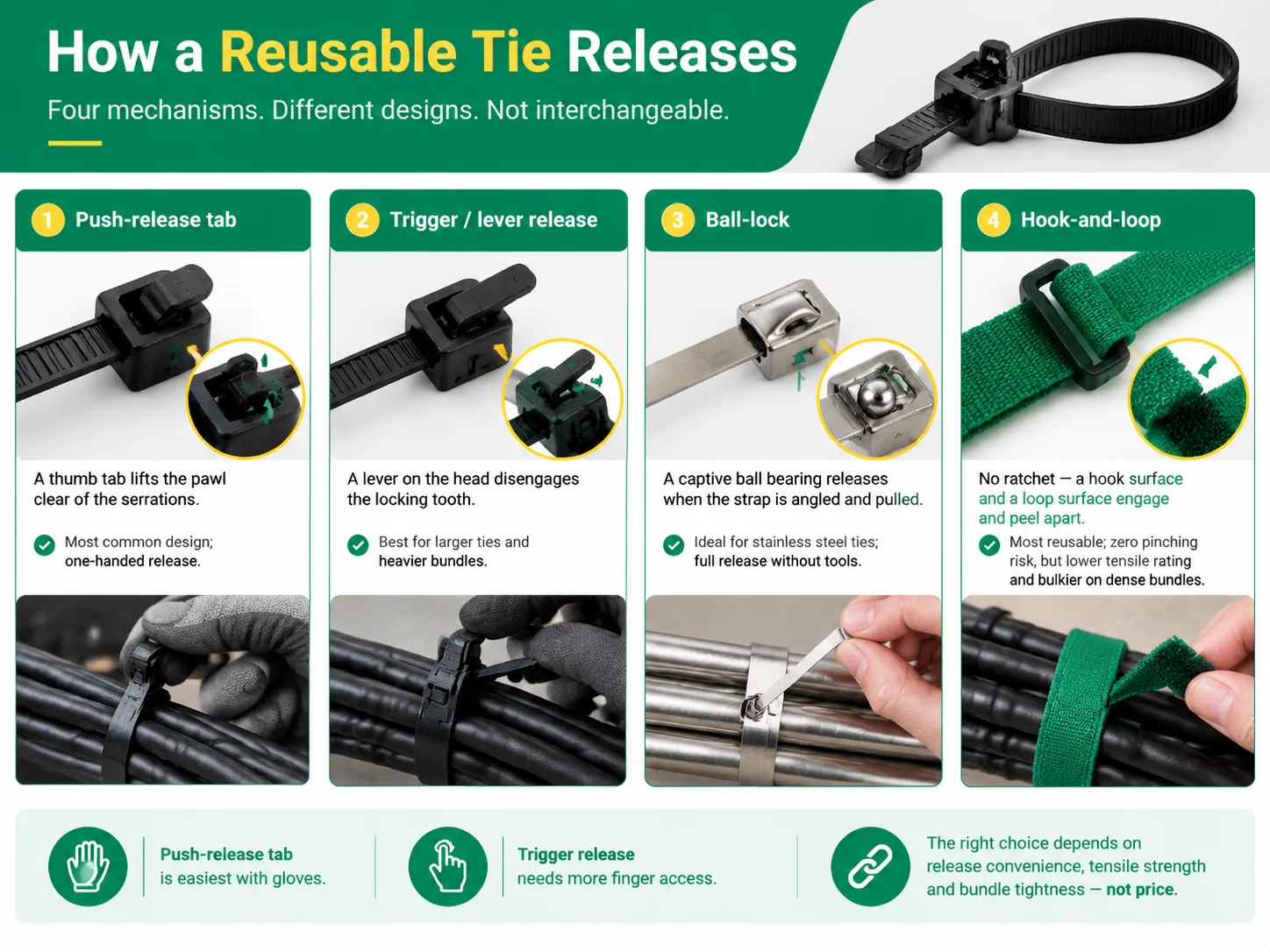
Reusable ties come in four distinct mechanisms, and they are not interchangeable in use.
| Mechanism | How it works | Best for |
|---|---|---|
| Push-release tab | A thumb tab on the head lifts the pawl clear of the serrations | The most common reusable design; one-handed release on small and mid sizes |
| Trigger / lever release | A lever on the head disengages the locking tooth | Larger ties and heavier bundles where the tab would need too much force |
| Ball-lock | A captive ball bearing in the head releases when the strap is angled and pulled | Stainless steel ties; full release without tools |
| Hook-and-loop (Velcro-style) | No ratchet at all — a hook surface and a loop surface that engage and peel apart | Bundles that change frequently and where zero risk of pinching matters |
Two relevant points. A push-to-release mechanism is the simplest to use, since no dexterity is needed; a trigger mechanism requires greater manual dexterity. In addition, a hook-and-loop fastening has better reusability than all other types because it does not pinch the cable at a point of contact, but its tensile strength is the poorest of all types and it takes up too much space in large bundles. Choosing a fastening method means choosing between ease of release, strength and space-saving property, and there is no one best solution; each type must correspond to the bundle being fastened.
It is worth it for a person who has chosen a conventional tie already, as it is possible to take a one-way tie off without cutting it, although it will not be reusable anymore from the point of view of preserving its function. The method and its limits are covered in this guide to undoing zip ties without cutting.
The Rating That Actually Matters: UL 62275 Type 1 vs Type 2
This specification is not read by many buyers. The ties that can still hold within three years time and those that cannot have been separated based on this specification.
UL 62275 is the US equivalent of IEC 62275 and is harmonised with CSA C22.2 No. 62275 in Canada and NMX-J-623-ANCE in Mexico. The ties have been classified into Types according to whether their holding power is maintained after exposure to conditioning or not.
| Type | As received | After heat aging, temperature cycling and UV exposure |
|---|---|---|
| Type 1 | 100% of declared loop tensile strength | Only 50% must be retained |
| Type 2 | 100% of declared loop tensile strength | 100% must be retained |
Revisit that table again, but this time think of a Gulf summer or a solar panel setup on a roof. A Type 1 cable tie that tests well in the box might only work properly for only half the declared strength after several years of heat and UV rays, and the standard allows that. In contrast, a Type 2 cable tie will have to maintain its entire rating after going through the same conditioning. For indoors, climate-controlled purposes, Type 1 is a fairly decent economical solution. Anything else, be it outdoor applications, rooftops, plant rooms or vehicles – Type 2 is the only specification that counts.
Three more facts complete the story. UL 62275’s definition includes North America and Canada-only Types 11, 2S, 21 and 21S, with the numbers 1 and 2 carrying the same meaning with respect to the strength retention; however, the additional number describes the fact that polymeric materials were analyzed beforehand. Types 2S and 21S are the ones that are intended to provide primary support for conduits and cables with the declared minimum loop tensile strength of 220 N (50 lb). All-metal cable ties may only be classified as Type 2 and have to undergo vibration testing.
Reusable Ties in Practice
Two factors determine where the reusable tie will break even in its cost: first, how many times that bundle transfer happens; second, whether the bundle is reachable from its position by the person in charge.
| Application | Reusable makes sense | Standard tie is better |
|---|---|---|
| Test bench and development wiring | Bundles change weekly or daily; reuse count runs into the hundreds | — |
| Server and network racks | Front-of-rack patch cords on equipment that gets replaced | Static trunk runs behind the rails |
| Event, exhibition and staging cable | Rigged and struck repeatedly on short cycles | Permanent venue installation |
| Boat, caravan and trailer wiring | Accessories are added and relocated constantly | Factory loom, once-built |
| Garden and nursery plant support | Stems are re-tied as they grow through a season | — |
| Solar and outdoor energy | Service loops and where racking is reconfigured | Permanent array fixing at high UV and wind load |
| Permanent building services | — | Set and forget; lowest cost and lowest profile wins |
| High-vibration or high-load anchoring | — | Highest tensile and Type 2 retention required |
It’s easy to understand the formula. The reuse situation will lead to reimbursements on a provisional bundle and the one-way link will lead to reimbursements on a permanent bundle. What complicates this in practice is that most setups consist of a mixture of both: a cabinet may have a permanent initiation and a temporary termination, while a system may have fixed internal spools and a reusable service loop. Specifying one type of tie for the whole job is a habit, not an optimisation, and the specification described for a rack build in this guide to reusable fastening for temporary setups uses both for exactly that reason.
Tensile and Working Load: The Number Nobody Reads Correctly
When it comes to loop tensile strength, this should not be confused with safe working load since the two differ, and misunderstanding the difference between these two terms results in failure of ties in application. The loop tensile strength refers to the break of the tie made in the loop formation and tested as manufactured or after conditioning as per UL 62275. The working load calculated using loop tensile strength should be 10 to 20 percent of the loop tensile strength.
- It is advisable that the working load does not exceed one-third or one-half of the rated value under good conditions.
- It should be noted that conditioning changes the values. For instance, the Type 1 tie may drop its value to 50 percent after heat aging and UV treatment.
- Temperature affects the strength performance. At high temperature nylon starts losing strength and hardening as it cools, which means that the operational range should be strictly followed.
As a result, a 50 lb tie in an outdoor sun-stuffed Type 1 application cannot be trusted with more than a few lbs. By dividing the weight of the bundle tied with a printed tensile number, one commits the common mistake that leads to incorrect choice of tie; therefore, choosing 30 lb tie with proper specifications will give better results than wrong specification of 120 lb tie.
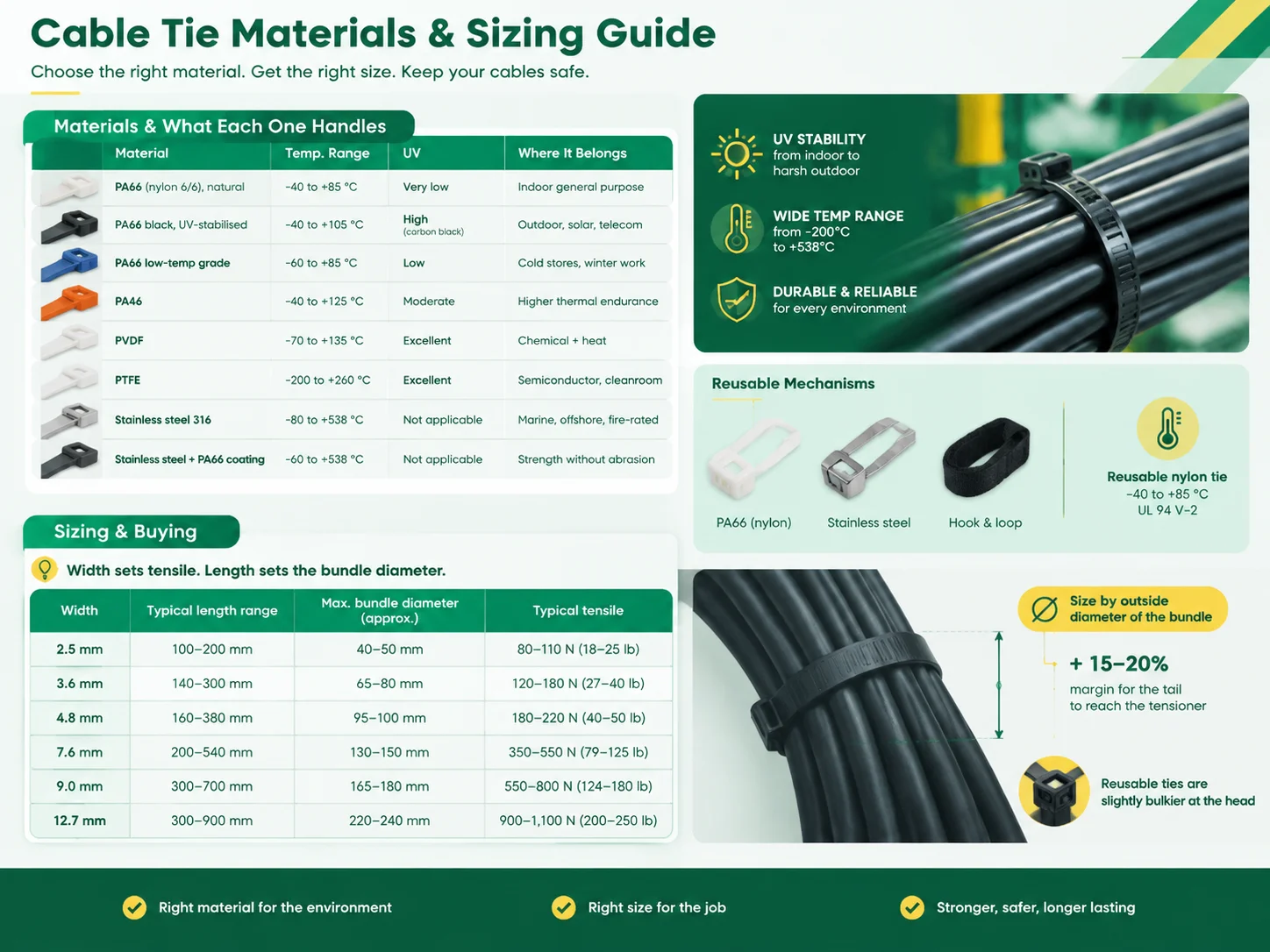
Materials and What Each One Handles
| Material | Typical temperature range | UV | Where it belongs |
|---|---|---|---|
| PA66 (nylon 6/6), natural | −40 to +85 °C | Very low | Indoor general purpose; cost-effective |
| PA66 black, UV-stabilised | −40 to +105 °C | High — carbon black | The default outdoor grade; solar, telecom, exterior |
| PA66 low-temperature grade | −60 to +85 °C | Low | Cold stores, refrigeration, winter outdoor work |
| PA46 | −40 to +125 °C | Moderate | Higher thermal endurance; UL 94 V-0 |
| PVDF | −70 to +135 °C | Excellent | Chemical exposure plus heat |
| PTFE | −200 to +260 °C | Excellent | Semiconductor, cleanroom, extreme chemical |
| Stainless steel 316 | −80 to +538 °C | Not applicable | Marine, offshore, fire-rated paths, high temperature |
| Stainless steel with PA66 coating | −60 to +538 °C | Not applicable | Stainless strength without abrading the cable jacket |
Reusable devices can be found in PA66 material, stainless steel, and hook-and-loop designs. A reusable nylon cable tie typically has a working temperature range of -40º to +85º C and a UL 94 flame classification of V-2 (which is appropriate for most indoor or protected outdoor applications). If the conditions exceed those tolerated by nylon, the reusable stainless steel ball-lok cable tie is an option; however, it comes at a much higher cost and usually requires the use of a tensioning tool.
Sizing and Buying
Whether width provides tensile strength, whereas length provides diameter, both are important and why those who buy bundles by length only end up with an under-tensioned bundle or a totally useless tie with a tail that does not touch the tensioner.
| Width | Typical length range | Approximate maximum bundle diameter | Typical tensile |
|---|---|---|---|
| 2.5 mm | 100–200 mm | 40–50 mm | 80–110 N (18–25 lb) |
| 3.6 mm | 140–300 mm | 65–80 mm | 120–180 N (27–40 lb) |
| 4.8 mm | 160–380 mm | 95–100 mm | 180–220 N (40–50 lb) |
| 7.6 mm | 200–540 mm | 130–150 mm | 350–550 N (79–125 lb) |
| 9.0 mm | 300–700 mm | 165–180 mm | 550–800 N (124–180 lb) |
| 12.7 mm | 300–900 mm | 220–240 mm | 900–1,100 N (200–250 lb) |
Choose the bundle size based on its outer diameter rather than its cable count, and provide an allowance of 15-20% to the maximum bundle diameter for the tail to reach the tensioning point. One should be mindful, in this case, that the reusable tie is a bit bulkier around its head than the single-use one, which might be problematic while the bundle passes through a tight grommet or cable duct.
Cost: Where the Break-Even Actually Is
The unit price gap is real and the break-even is faster than most buyers expect.
| Tie | Indicative price, 100-pack | Per tie |
|---|---|---|
| Standard nylon tie, 8 in, natural | $3–$8 | $0.03–$0.08 |
| UV-stabilised black nylon, 8 in | $4–$10 | $0.04–$0.10 |
| Reusable nylon, push-release, 8 in | $8–$20 | $0.08–$0.20 |
| Reusable, heavy duty | $15–$35 | $0.15–$0.35 |
| Hook-and-loop strap | $15–$40 | $0.15–$0.40 |
| Stainless ball-lock, reusable | $30–$70 | $0.30–$0.70 |
A reusable tie priced at $0.12 in comparison to a standard tie priced at $0.06 reaches breakeven at the second use. The savings here are not the issue, however. The concern is that making a tie takes time and effort, which can be risky when working with a live rack or a rigged truss. By using a reusable tie twice, the cost of the materials is recovered; on the third use, all that is gained is profit after using a bundle once a week for a two-year project.For volume purchasing across a mixed requirement, the material and mechanism options are set out on the cable tie manufacturing programme page.
When to Choose Each
Four questions will clarify everything.
- Is this bundle going to be cut open? If the answer is yes and there will be several occasions when the bundle is opened, there is no doubt that a reusable tie had paid off.
- Will it be indoors or outdoors? If it is outdoors, then Type 2 and black UV-stabilized is the type of material used for any fastening system.
- What is the actual load carrying capacity? The test should be made against 10-20% of the test value not taking into consideration anything printed and derating for temperature and Type rating.
- Is the tie really what one needs? When there is a constant shaking and a risk of pinching, a hook and loop fastening will be better than any rigid fastening that causes the cable to be compressed at one point. The whole array of options such as circular rolls, pre-cut straps, cinch ties and wide straps for large bundles will be described in the information about hook and loop cable ties. In case there is a need for permanent fastening of large loads, a non-reusable fastener of larger width works better than a reusable fastener of the same size.
The truth is that most installations actually need both kinds of ties in the same kit. If everything that a person is going to deal with can be repeatedly handled, they need a reusable fastening for that.
FAQ
What is the difference between a reusable zip tie and a standard one?
A reusable zip tie possesses a releasing mechanism, which can be a pushing button, a trigger lever, or a ball lock, which releases its pawl from the notched strap allowing it to be pulled out and then fastened again. A common tie does not have a release function and is designed to have its pawl locked in one direction only, so it can only be opened by cutting it or otherwise destroying it. All other features — width, length, material, tensile strength, and operating temperature — are options applicable to both versions. Therefore, “reusable” is strictly a mechanism, not an independent category of products.
Are reusable zip ties as strong as regular ones?
A reusable zip tie features a mechanism for releasing, which could be a button, a lever, or a ball lock, which loosens its claw from the notched strap enabling it to slide off and then be fastened again. Whereas a conventional tie doesn’t have a releasing mechanism in it and is made in a way that makes it able to have its claw in a locked state only, which means that the only way to open it is to either cut it or destroy it. All other characteristics such as dimensions, quality, materials, tensile strength, and operating temperatures are the same for both types.Thus, “reusable” is understood only as a feature, not a product type.
How many times can a reusable cable tie be reused?
The lifespan of the product is determined by material and mechanism rather than any fixed number. Push-tab and trigger designs made of nylon usually go through hundreds of open and close cycles in actual use, and some manufacturers of high-end releasable ties give a number in the hundreds of cycles for their custom designs. Hook-and-loop and stainless steel ball-lock ties tend to perform better than nylon pawl systems since there are no ratchet elements that can wear out. The main culprit in shortening life expectancy is over-tightening at the time of each closure, which deforms both pawl and teeth.
Can I reuse a standard cable tie by unlocking it?
The use of a small pick or a thin blade can be an effective way of removing a tie. Although this will not restore the tie’s integrity. It will simply allow you to free your bundle without cutting the tie, but leftover or recovered ties cannot be used again, as they will not hold their declared strength as the very pawl pierced through when you removed the tie.
Are reusable ties waterproof?
The usage of a tiny blade or pick may be an efficient way to get rid of a tie. That said, this does not restore the integrity of the tie. It only offers the possibility of getting away without cuts through the tie, while the old or recovered ties are not usable anymore since they do not have the declared strength due to the fact that the pawl pierced through while removing the tie.
What is the difference between Type 1 and Type 2 cable ties?
Retained strength post conditioning. According to UL 62275, a Type 1 tie should maintain 100% of its specified loop tensile strength when received, and it only needs to have 50% of that strength after conditioning through heat aging, thermal cycling, and UV exposure. Type 2 ties should maintain 100% of their strength in both the above-mentioned situations, while all-metal ties are additionally subjected to vibration testing. Type 1 ties are suitable for indoor and controlled situations, whereas Type 2 ties apply in outdoor circumstances on roofs and in boiler rooms where heat or sunlight is a factor.
References
- UL Standards & Engagement — UL 62275, Cable Management Systems
- UL Standards & Engagement — UL 1565, Positioning Devices
- ISO — IEC 62275, cable ties for electrical installations (international basis of UL 62275)
- NFPA — NFPA 70, National Electrical Code (Article 300.22, plenum cable support)
- Plastics Industry Association — polymer material reference for PA66, PA46 and fluoropolymers
Conclusion
The inquiry on reusables or standard ties encompasses two inquiries: the first one being mechanical in nature — i.e., should the bundling be done without cutting? The answer is an absolute yes in this case owing to the reusable ties ‘self-varnishing’, meaning that they will pay for themselves after the second use and will start making profits from the third use as well; the second one becomes environmental and pertinent for both variants in that in the outdoor environment one has to pay attention to the specification UL 62275 Type 2 with black UV stabilized material when Type 1 ties would have to retain only half of their tensile strength following thermal aging and influence of ultraviolet rays.
While buying a tie several aspects should be taken into account. The first one — the tie size which is to be decided taking into consideration the diameter of the bundle and also the working load of 10-20% of the tensile load not of the level stated on the prints. The materials should be chosen according to environmental conditions, and not according to the prices as the best choice for real work involves using a combination of reusable and standard ties.


