


What Is the Best Brand of Cable Ties?
Consult five electricians and you will get five different opinions regarding which cable tie brand is the best – typically whatever was nearest to hand at the job site. However, the question is more important than most people realize – a cable tie that fails in a data centre, under a hood, or on an outdoor tower may incur much bigger costs than its price. The market can be divided into three main categories – premium engineering brands, such as Panduit, HellermannTyton, and Thomas & Betts, medium manufacturers like 3M, Avery Dennison, and Gardner Bender, and the mass producers such as KSS and IGOTO based in China. Nevertheless, the “best” choice will depend on the application, the cable tying method, and the quantity needed.
The short answer is that there is no one “best” cable tie brand because this depends on the application. Good cable ties can be distinguished from fake cable ties thanks to three markers: stated nylon 6/6 material, printed tensile rating, and UL 62275 listing.
What Makes a Cable Tie Brand “Best”?
Before comparing brands, define what you are actually paying for. Five factors separate a good cable tie brand from a mediocre one:
| Factor | Why It Matters | How to Verify |
|---|---|---|
| 1. Material consistency | Premium brands guarantee virgin nylon 6/6 (PA66); cheap ties often use recycled or blended resin that embrittles | Data sheet states “nylon 6/6” (PA66), not just “nylon” or “plastic” |
| 2. Certification | UL 62275, Mil-Spec, or equivalent means independent testing of strength and flammability | Look for the UL mark or listed part numbers |
| 3. Tensile rating accuracy | Cheap ties overstate strength; a 50 lb tie that breaks at 25 lb fails your application | Printed rating on the tie + verified by testing |
| 4. Consistency across batches | Critical for manufacturers buying in volume — one bad batch = field failures | Process control, batch traceability, SPC data |
| 5. Documentation | Data sheets, RoHS/REACH declarations, and test reports required for regulated industries | Ask the supplier for documents before ordering |
For a deeper look at what goes into a quality tie — material, locking design, and how to test it yourself — our guide on how to distinguish the quality of nylon cable ties walks through the practical checks.
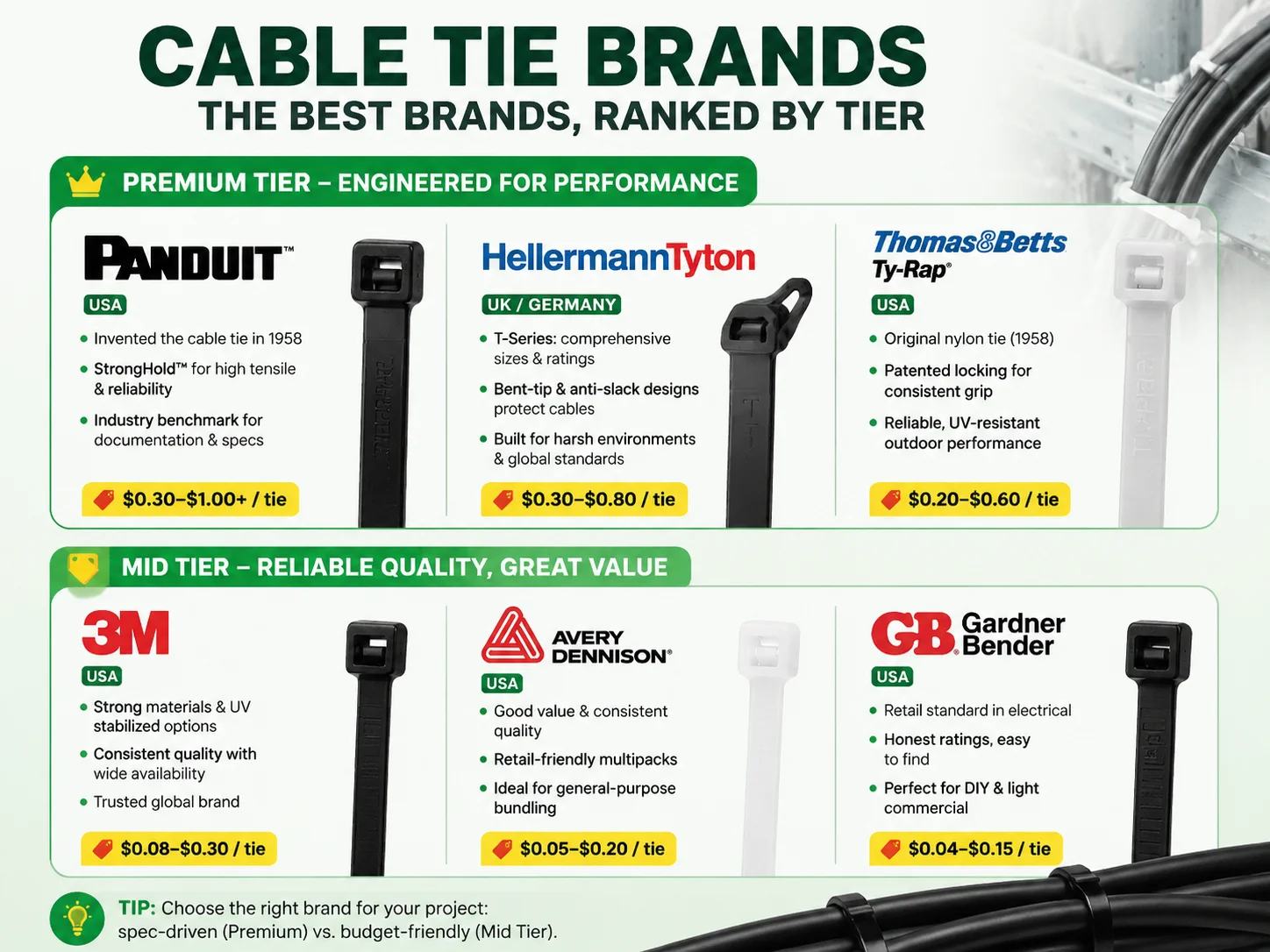
The Premium Tier: Panduit, HellermannTyton & Thomas & Betts
These brands have a strong presence in engineered, specified installations all over the world. These are the names of brands shown in specifications of data centers, aerospace, and telecommunications. It reflects on the price tags.
Panduit (USA)
Founded: 1955, Tinley Park, Illinois | Famous line: Pan-Ty, StrongHold
In 1958, the category of cable ties was pioneered by Panduit. It continues to be the standard used in structured cabling and data center applications. They offer a very high strength rating, have rounded tips for easy application, and feature a rounded profile that is gentle on cable jackets. The quality of their documentation is the highest in the industry (the company publishes data sheets, weathering reports, and UL certificates).
Ideal for: data centers, network infrastructure, industrial applications where documentation and certifications are important.
Prices: retail prices vary between $0.30 and $1 per tie (the price for a pack of 100 is $30-$100), though PLM and StrongHold series cables are more expensive.
HellermannTyton (UK/Germany)
Founded: 1935 | Famous lines: T-Series, I-Series, Cable Management
HellermannTyton has established itself as the leading producer of cable management systems across Europe. The brand has developed the T-Series, an extraordinary cable management project that categorizes its products according to their resistance to temperature, strength, and UV rays. The brand has also developed its patented “bent-tip” design, which is used to help prevent the cables from being damaged by excessive strain. If you need to work on a project in Europe, or if your project needs to conform to European safety standards, then you should use HellermannTyton products.
Who is it good for: European and other industrial projects, including automobile manufacturing process, providing cable management systems for the railway, and working in extreme weather.
Cost: similar premium products in the market, ranging from $30 to $60 for 100 pieces of cables.
Thomas & Betts Ty-Rap (USA)
Founded: 1898 (Ty-Rap invented 1958) | Famous line: Ty-Rap
Ty-Rap is considered the first nylon tie (it was created in the same year as Panduit), and it comes with a patented pawl lock system that guarantees a constant grip with smooth edges that avoid abrasions. The product is widely recommended among electricians due to its low price combined with higher reliability.
Best for use: electrical contracting, outdoors, general industry – the contractor’s premium tie.
Price: average retail price of $0.20-$0.60 per piece; bulk price of 100 ties ranges from $17-$75 depending on size and series.
The Mid Tier: 3M, Avery Dennison & Gardner Bender
The class of the Mid Tier guarantees reliable quality at affordable pricing along with good distribution across both electrical and hardware channels.
3M (USA)
The cable tie product category of 3M exploits the company’s exceptional innovative developments in the sphere of materials. Its cable ties are highly rated, possess great properties of UV resistance, and are distributed through the large distribution system of 3M. In case somebody is in search of a globally recognized brand that can offer good materials of reasonable quality, 3M is the best choice.
Best for: various industries including MRO (maintenance, repair, and operations) as well as industries where brand recognition is important.
Prices: $0.08-$0.30 per cable tie sold in retail.
Avery Dennison (USA)
While Avery Dennison is mainly known for labels and fasteners, its line of cable ties is highly valued due to its great quality and reasonable prices. They can serve as an excellent option for small- and light-industrial bundling if the cut-price Panduit/HT documentation is not to be used.
Best for: retail market; light-industrial applications; general-purpose bundling.
Prices: $0.05-$0.20 per tie.
Gardner Bender (USA)
Gardner Bender, which is part of NSI Industries, is a well-known brand in the electrical retail industry in the US and is found in several stores including Home Depot, Lowe’s and Ace Hardware. It has nylon 6/6 ties with reliable ratings. The brand is a great fit for DIY enthusiasts and small contractors.
Best for: DIY, residential and light commercial.
Prices: $0.04-$0.15 per tie and $5-$15 for the average 100-packs.
The High-Volume Tier: KSS & Factory-Direct Manufacturers
Underneath the levels of branding, there are producers and vendors whom hardly anyone is aware of — the factories that create most of the ties in the world and sell them under their own brands, under private label goods or as OEM products.
KSS (Kaiphone & Success, Taiwan)
KSS is recognized as a top manufacturer of cable accessories in Asia and in fact, exports its products to a large number of markets around the world with an UL, CSA, and CE standard certifications. The company’s ties come with certified quality at a lower price than many US/EU premium competitors, which serves as the reason why KSS products are frequently chosen by distributors who are on the lookout for compliant products that are offered at wholesale prices.
Best for: distributors, electrical panel builders, and exporters looking for approved tie solutions available at value prices.
Prices: $0.03-$0.15 per tie in a bulk order.
IGOTO / Chinese OEM factories
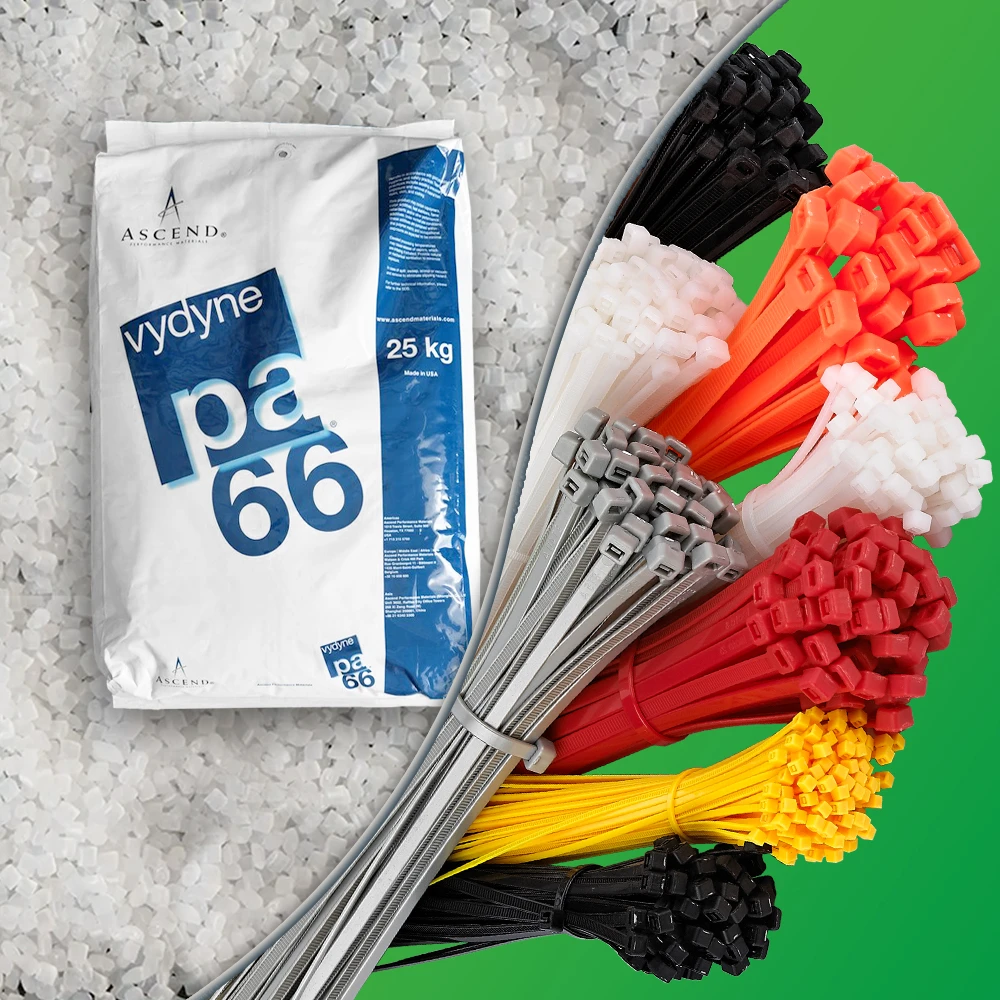
The largest producers of nylon cable ties are manufacturers from China with IGOTO being one of them that supplies both the branded retail lines and the OEM/private label programs to sellers, distributors, and industrial customers around the world. The proposition of value is simple: certified (UL/CE/RoHS) price directly coming from the factory and usually at the 30-60% lower range compared to the premium brands while using the same material (PA66) and being very straightforward with the characteristics. If a customer buys at least 50,000 of the ties yearly, this results in a save of five digits as a difference for the same physical product.
Best for: wholesale customers, distributors, private label customers, OEM programs, industrial buyers who buy in bulk.
Prices: from $0.005 to $0.05 per each tie at the factory volume (100 pcs. retail equivalent $2-9).
What is important here though is that while purchasing directly from the factory you are responsible for ensuring quality which means getting the UL listing number, material data sheet, and inspection.Our guide on how to choose the right cable ties covers the verification checklist in detail.
Brand Comparison Table
| Brand | Tier | Best For | Price per Tie (retail) | Certifications | Standout Feature |
|---|---|---|---|---|---|
| Panduit | Premium | Data centers, spec’d projects | $0.30-$1.00+ | UL 62275, Mil-Spec | Industry-best documentation & consistency |
| HellermannTyton | Premium | European industrial, harsh env. | $0.30-$0.80 | UL 62275, IATF 16949 plants | Most complete size range & data |
| Thomas & Betts | Premium | Electrical contracting, outdoor | $0.20-$0.60 | UL 62275 | Patented pawl grip, UV options |
| 3M | Mid | General industrial, MRO | $0.08-$0.30 | UL, RoHS | Global availability, brand trust |
| Avery Dennison | Mid | Retail, light industrial | $0.05-$0.20 | UL, RoHS | Value multipacks |
| Gardner Bender | Mid | DIY, residential retail | $0.04-$0.15 | UL | Best retail availability (Home Depot/Lowe’s) |
| KSS | Volume | Distribution, exporters | $0.03-$0.15 | UL, CSA, CE | Certified quality at Asia pricing |
| IGOTO / Chinese OEM | Volume | Wholesale, private label, OEM | $0.005-$0.05 | UL, CE, RoHS | Factory-direct cost, OEM flexibility |
How to Choose: A 4-Step Selection Method
Remember to consistently follow these four instructions rather than comparing brand logos:
- Establish the circumstances. Indoor normal usage, outdoor UV exposure, heat under the hood, air ducts, salt in the ocean, or chemicals in factories? The circumstances will dictate the level of quality needed: ordinary, UV-treated, heat-treated, suitable for air ducts, or corrosion-resistant. Brand comes after quality; even a regular nylon tie made by Panduit will break outdoors; a UV-treated tie produced by any manufacturer will last for a long time. Our guides on UV-resistant cable ties and heat-stabilized cable ties explain the grade differences.
- Determine the load. How strong of a tie do you need? Lights (18 lb) for light bundling work, standard (40-50 lb) for most applications, and heavy-duty (120-250 lb) for structural bundling applications. Using a tie rated for 50 lb for an application that only requires 18 lb is an unnecessary expense.
- Define the volume and documentation needs. Just for retail purchase, you can use Gardner Bender or a certified brand from the local store. For regulated/spec’d project, Panduit/HT/Ty-Rap with all proper documentation. For volume purchasing, you can use KSS or factory-direct OEM with a proper checklist.
- Make sure to verify before buying. The supplier must provide: 1. Material must be identified as nylon 6/6. 2. UL listing number (available at UL.com). 3. Tensile rating printed on the tie. 4. Sample TBD for own test. If the supplier fails to provide these four things, it means the brand is not reliable.
Price Guide by Tier
| Purchase Channel | Typical Price for 100-Pack (standard 8″ ties) | Per-Tie Equivalent |
|---|---|---|
| Hardware retail (Gardner Bender, GB) | $4-$12 | $0.04-$0.12 |
| Mid-brand retail (3M, Avery Dennison) | $8-$25 | $0.08-$0.25 |
| Premium brand retail (Panduit, HT, T&B) | $25-$100+ | $0.25-$1.00+ |
| Certified volume (KSS, factory brands) | $2-$9 | $0.02-$0.09 |
| Factory-direct OEM (IGOTO, Chinese mills) | $0.50-$5 (equivalent) | $0.005-$0.05 |
The economic disparity between superior brands and ties that have certification directly from the factory is the main factor affecting budgets for wholesale and business-to-business purchases in the cable management sector. Ultimately, this is the reason why merchants choose exclusive brands from manufacturers instead of simply reselling high-priced brands making small profits in the operations.
Red Flags: How to Spot Cheap Imitations
- “Plastic” or recycled without a specified nylon 6/6 grade will become brittle and develop cracks in a matter of months.
- No tensile rating displayed — ties without ratings are not tested ties.
- Unauthorized UL markings — information can be verified on UL.com (or the associated certification agency).
- Brittle, chalky, or discolored samples — signs of recycled material.
- Sharp mold flash on edges — it can lead to cutting the protective cover and injury to the handler’s fingers.
- No data sheet provided upon request — the biggest red mark for B2B clients.
Finding Suppliers, Distributors & Wholesale Sources
Your purchasing choices depend on who you are as a customer:
- DIY enthusiasts: Home Depot, Lowe’s, Ace, and Amazon include manufacturers Gardner Bender and 3M and low-cost versions of their products for consumers who only need them for basic tasks.
- Construction workers and electricians: electrical supply warehouses (e.g., Graybar, Rexel, Sonepar, or Wesco) offer products like Panduit, Ty-Rap, and HT. They also offer discounted products.
- Industrial customers and MRO buyers: industrial suppliers (such as Grainger, McMaster-Carr, RS Components, and Farnell) stock premium items with technical specifics made available online.
- Distributors and business buyers: contact manufacturers such as KSS in Taiwan or factories in China like IGOTO to get wholesale bulk orders or private label products.
Frequently Asked Questions
What are the best quality cable ties?
The top rated brands for cable ties are Panduit, HellermannTyton, and Thomas & Betts Ty-Rap; they are the original creators of the product and are still the leader in material quality, certification of use and documentation. However, for high-volume buyers, other certified brands like KSS, as well as factory-direct suppliers such as IGOTO, offer the same quality product for lower prices, removing the need for customers to think about certification quality, as they must check the quality themselves.
Who makes the best quality zip ties?
He following zip tie vendors are known to be the best tie makers, especially when quality and quality records are concerned: Panduit and HellermannTyton have the most consistent tensile strengths, the fullest member listings on UL and the highest ratings in terms of dependability. Contractors trust Thomas & Betts Ty-Rap as the best brand for holding and edge quality. In the value bunch, Gardner Bender can be called the best retail brand and KSS/IGOTO the best manufacturer suppliers.
What are some good quality cable ties?
High-quality cable ties will have three distinct markers: virgin nylon 6/6 (PA66) material, which includes a printed tensile strength rating, and a UL 62275 listing. Recommended good-value types include: Ty-Rap 11-inch heavy-duty (120-lbs) for general contracting, Panduit StrongHold for data centers, and HellermannTyton T30R for European specification work. Use only UL-listed factory-backed cable ties such as KSS and IGOTO and be sure to avoid any cable tie claiming to be “plastic” with no rating printed on it.
What are the top 3 tie brands?
By virtue of global image and marketing, the top 3 cable tie names are Panduit (the US – leader in data center & structured cabling), HellermannTyton (the UK/Germany – complete European product line), and Thomas & Betts Ty-Rap (the US – the contractor standard). If we consider volume, Chinese and Taiwanese manufacturers perform in the top positions, but the top 3 remains the same.
References
- Panduit — official site (Pan-Ty, StrongHold product lines)
- HellermannTyton — official site (T-Series cable ties)
- Thomas & Betts (ABB) — Ty-Rap cable ties
- Gardner Bender — official site
- 3M — cable tie product lines
- KSS — Taiwan cable accessories manufacturer
- UL — UL 62275 standard and certification lookup
Conclusion
The best brand of cable ties is the brand that suits your environment, the size of the load, and your purchasing strategy — not the brand with the most dollars to spend on advertising. If you are looking for cable ties for high-stakes, carefully documented setups, companies like Panduit, HellermannTyton, and Thomas and Betts will definitely justify their premium price. For everyday purposes, 3M, Avery Dennison, and Gardner Bender can be counted on to offer affordable, reliable quality. And for those who buy in bulk, such as distributors, OEMs, and industrial buyers, there are certified manufacturers like KSS and local Chinese manufacturers who can supply good nylon 6/6 products for less — as long as you check to see whether they have what is called the Four Indicators: material, UL certification, marking, and samples.
Always remember the cable tie rule: grade comes before brand and certification comes before volume. Get the best grade for your environment, verify the certification for yourself, and buy the cable ties that suit your budget — and you will be able to tie your cables for a long time, regardless of what brand you bought them from.