




What Is the Purpose of Cable Management?
One misunderstanding about what housekeeping includes is that it involves cable management. This leads to people disregarding the job of cable management and not working on it. Cable management is definitely not the same thing as housekeeping because dysfunctional cable management systems do not allow air to cool down devices; even more, it can make the reconnection of wires a long process and lead to wrong connections of different wires. Therefore, the main reason to create a cable management system is to get rid of all the problems described above.
Cable management is often overlooked during cleaning; however, cable management should not be regarded as part of cleaning. Cable clutter restricts airflow required for cooling. Cable clutter makes it very time-consuming to find a particular cable when you want to change it. Cable clutter also creates greater possibilities of disconnecting devices inadvertently. Cable management should resolve the problems mentioned above.

Purpose One: Keeping the Air Path Clear
There is a specific airflow pattern that server racks are created for. The cool air comes from the front, travels through the equipment, and leaves from the backside as hot air. If cable bundles block the area where the cool air comes in or drapes over the area where the hot air leaves, the airflow will be interrupted.
The numbers behind this fact are high compared to the general belief. Because airflow blockages contribute to a drop in cooling efficiency by approximately 15–30%, data centers consume about 1–2% of the world’s electricity, and cooling accounts for 30–40% of operating expenses. Fixing the airflow problem that is caused by cable bundles would allow the system to consume 5–15% less energy for cooling, and thus save money.
There is another effect of airflow blocks in server racks: hardware wears out faster. The fact that overheating will lead to the faster wear of power supplies and capacitors may not be easy to notice but will increase the likelihood of disk failure. The rack-level detail — cold aisle containment, front-to-back flow, where bundles actually belong — is set out in this guide to managing cabling inside a server rack without wrecking the airflow.
Purpose Two: Cutting Downtime and Mean Time to Repair
This is the instance in which there is distinct financial number attached to its usage. If there is a mess in the rack, searching for one issue means checking one cable after another, so each minute of that corresponds to downtime or utilization of a specialist.
A real example taken from a service provider: after good cable management was rolled out across over than 200 racks, the downtime decreased by 62% within a quarter. The average temperature in the rack in one mid-sized financial company that utilizes 42 racks dropped from 24.2 to 20.1 degrees Celsius in four weeks due to MTTR decreasing over the same time span from 47 minutes to 8 minutes with an electricity consumption decrease of 11%. Relatively cheap start-up investment makes it possible to recover the costs in weeks instead of years.
If one takes into account that loss incurred for unplanned downtime can reach millions in one hour, this will not seem to worth mentioning. Even minor server room will cover its costs after avoiding one single incident of errors in cable tracing.
Purpose Three: Protecting the Cables Themselves
Cables have limitations in terms of their physical characteristics, which are violated in practice all the time. Cables made of copper or fibre both have minimum bend radius that should not be broken, otherwise their electrical and optical characteristics will suffer . Furthermore, bending cable more than recommended might cause a conductor or an insulating layer to become damaged over time. Moreover, cables that are stacked too tightly squeeze each other, thus putting additional stress on the cables. In order to be able to take any weight, the cables should hang on their connectors only, so that they could avoid putting stress on any components behind.
Heat is another destroying element. If cables are tightly bundled then cables will run much hotter than they would if those were separated. High temperatures of usage of the cables will lead to their insulation being degraded faster than expected.
Purpose Four: Leaving Room to Grow
All server rooms have a need for more space than available. The goal of managing cables in this context is to make it cheap to bring that space about.
If the environment is messy, then adding equipment entails having to reroute existing cables first before adding any new cables and that tends to take about twice the time. If the environment is managed, however, then there is spare capacity for routing, and labels already indicate the location of cables.This results in differences in construction costs of any change as it accumulates over the lifecycle of the facility. As put by the industry, over a 10-year lifecycle the cable-related costs (including penalties from cooling, troubleshooting time and rework) will be three to five times the cost of the cable itself.
Purpose Five: Audit and Incident Response
Cabling documentation makes two things feasible. First is compliance, as traceable cable documentation speeds audits and makes asset management real instead of just nominal. Second is incident response. When something goes wrong, knowing where the cable goes makes it easy to identify the problem as opposed to guessing.
This story has a predictable failure trend. After about three years in service, 15–25% of the cables in an average facility can be classified as dead runs, i.e. connected at both ends but unidentifiable. Even though they transfer no information, they take space on the route, disturb airflow, and increase fire load.

The Solutions, Compared
Identifying the ideal cable management solution depends on one question: should the joint be permanent, re-openable, releasable, or re-enterable? That is how cable management as a collection of solutions is defined, and thus, one should be diligent in selecting one.
| Solution | Best for | Reusable | Relative cost | Main weakness |
|---|---|---|---|---|
| Nylon cable ties (one-way) | Permanent bundling, cable to tray, fixed runs | No — cut to remove | Lowest | Cannot be reopened; risks over-tightening data cable |
| Releasable / reusable ties | Runs that change, staging, temporary routing | Yes | Low | Lower tensile strength than the one-way equivalent |
| Hook-and-loop (velcro) ties | Frequent changes, fibre and Cat6 bundles, patch panels | Yes, many cycles | Low to mid | Bulkier; lowest tensile of the group |
| Mountable / screw-base ties | Anchoring a bundle to structure rather than to itself | Depends on type | Low to mid | Requires a fixing point |
| Cable trays and ladder racks | Bulk routing between racks, power and heavy copper | Permanent infrastructure | High | Installation cost; needs planning at build stage |
| Raceway, conduit and sleeving | Visible runs, floor and wall transitions, protection | Permanent | Mid to high | Capacity is fixed once installed |
| Vertical and horizontal managers | Rack-level routing, patching, airflow separation | Permanent fixture | Mid | Consumes rack units |
| Adhesive mounts and clips | Light cables, desks, cabinets, short runs | Usually not | Lowest | Adhesive fails with heat, dust or time |
Two different regulations are relevant for the whole table. Reusability and tensile strength oppose each other, therefore it is better to choose per joint instead of per project. Moreover, in any situation that involves data transmission, always go for the least firm fastening, as it is tightening the cord and Cat6 wires that leads to more issues than fastening them improperly. The range itself is broader than most buyers realise; this overview of hook and loop cable ties and what they are used for covers one family in detail, including continuous roll, pre-cut straps and wide versions for large bundles.
Where Cable Ties Fit
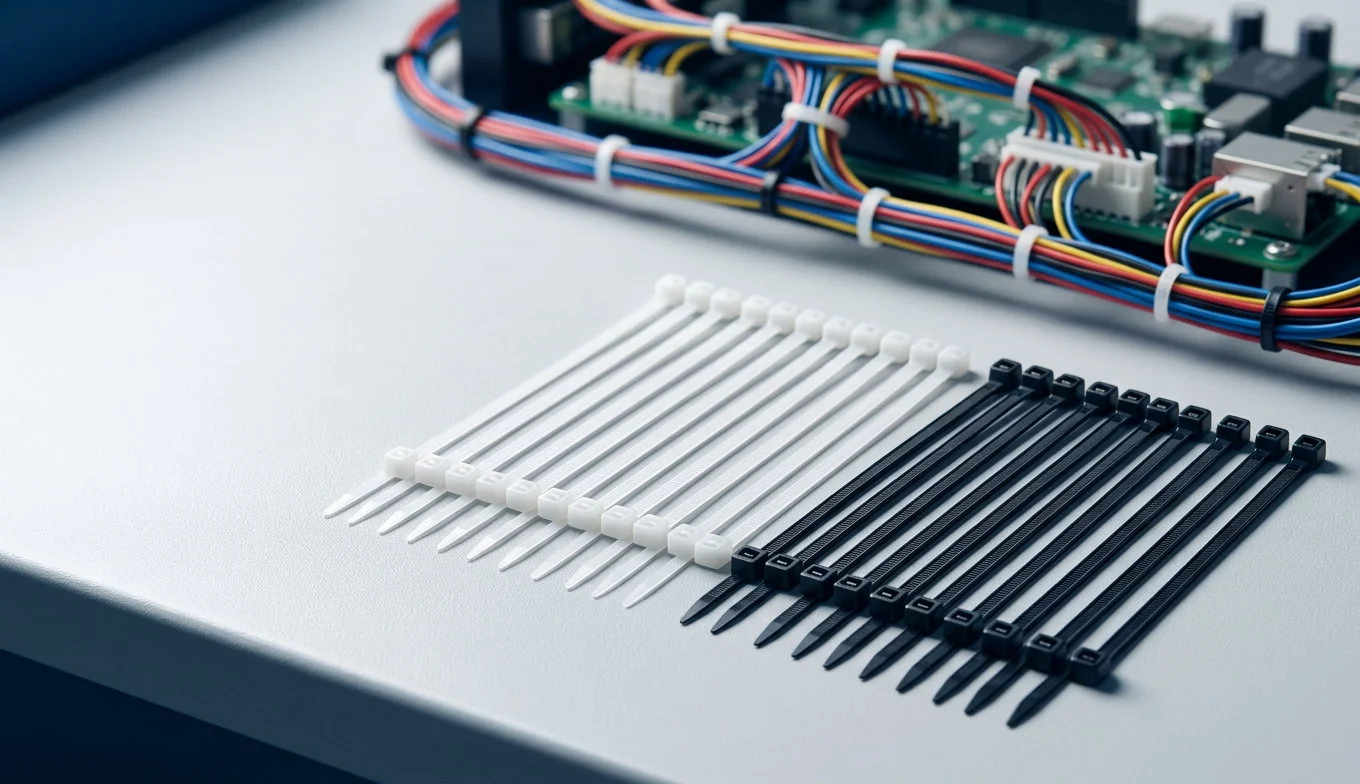
Ties are the ideal choice because they are affordable, quick and can be found in various dimensions to fit almost any bundle. Furthermore, they are also the items that are mostly misused in this entire process.
- Do not use them in any temporary joint. They are good for a cable fixed to a tray or a cable system fixed in a rack. They were created for such purposes.
- Use the appropriate weight. Use the smaller ties on a patch cables and other ordinary purposes; the bigger ones for channels and in the outdoor environments. Even a four-inch tie might not be able to hold a bundle that weighs 20 kg.
- Be mindful of the substance. Use the standard nylon for inside applications; use UV-stabilized or stainless substances if the bundle is used outside or in the places of high temperatures; and use flame-retardant types where the air goes.
- Avoid overtightening. That is why tensioning devices were invented, because the hand-tied clamps on the data cable create excessive tension. If you see a mark of the device on the jacket, then it is too tight.
- Do not use a tie if the joint is to be opened again. Use the releasable products or the hook-and-loop variations.
The question of what actually belongs around a bundle, and why some environments rule out nylon entirely, is covered in this explanation of what is commonly used to secure wire bundles. The short version: the material choice is driven by temperature, UV exposure and the fire-rating requirement of the space, not by preference.
Fixing Cable to Structure, Not to Itself
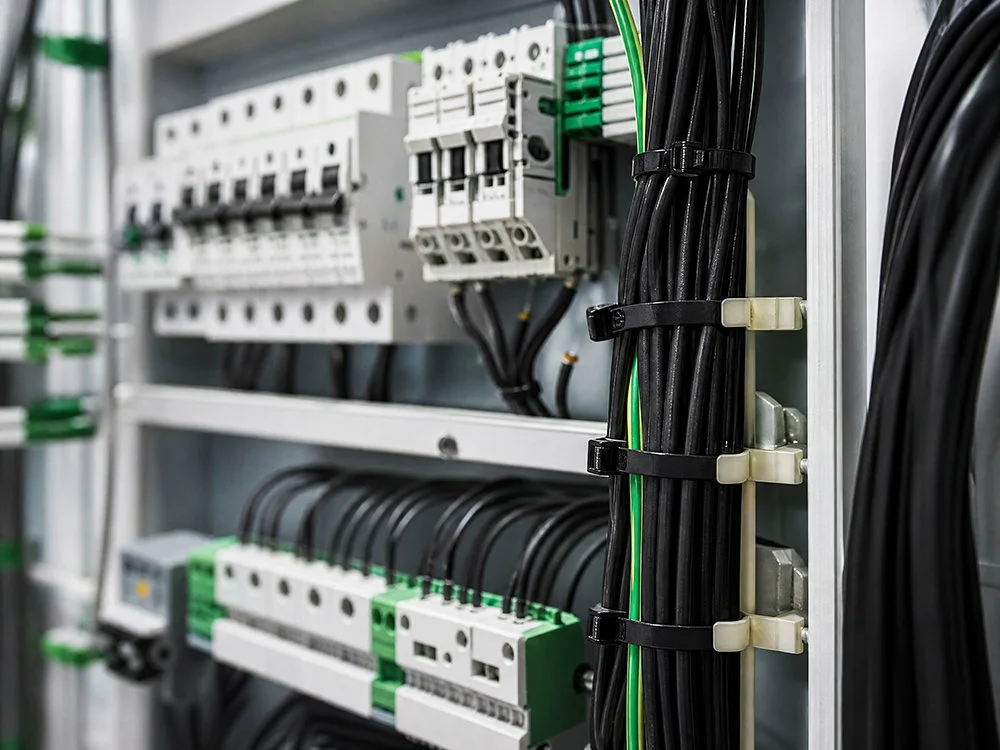
Another issue that differs from bundling is anchoring. Bundles have the ability to move, even when secured to themselves. In other words, even when a bundle is tied, it is still able to swing, rub against other components, and eventually wear through its wrapping layer. To secure the bundle to the structure needs a different technique involving a different component. This may be a basic fastening device, screw or glue-based fastening device, clamp, magnetic device for mounting to a metal box, or a fastening location built in the raceway.
The usual technique that consists of tying an ordinary fastening device to a perforated lame is not capable of holding the bundle properly, and at the same time, it causes damage to the jacket. Therefore, it is advisable to use the fastening device specified for anchoring instead of using a standard fastening device in case one wants to secure the bundle instead of tying it up.This comparison of what mountable cable ties are and how they are fixed sets out the fixing options and where each one works.

Cost and Durability: What You Actually Pay
Looking at the unit price on its own does not help in the analysis of the cost-effectiveness of straps, because, although they are relatively cheaper than any other option, they may actually end up costing more in total than other more expensive supplies. The cost comparison should therefore be in terms of the annual cost of service to the customer in a particular environment.
- Common nylon ties have the lowest purchasing cost per unit and provide good service indoors in a temperature-controlled environment. However, they tend to both harden and fail after just a couple of seasons in sunlight, and in addition to that can degrade quicker than intended at higher-than-allowed temperature.
- UV-resistant ties, on the other hand, cost slightly more and are suitable when it comes to outdoor applications. Nevertheless, they are the opposite of an economical solution for external use as they will incur additional costs.
- Apart from being the most expensive solution in manufacturing, stainless steel ties are also the best choice in terms of high temperature impact, strong chemicals and heavy loads. However, they do require specialized tools for installation because they can cause damage to cables if improperly used.
- Hook-and-loop straps are generally more expensive to purchase than nylon straps, but they actually become more economical with repeated use due to their ease of disassembly.
Buying directly from the manufacturer is more advantageous, especially when buying in bulk, because their prices are lower than those of retail sellers and they allow to order only one type of material and size for the entire project.That is the model a heavy-duty cable tie manufacturer supplying industrial and OEM volumes works on, and it matters most where a facility standardises on one tie specification for everything from patch leads to tray work.
Installation and Maintenance Rules Worth Keeping
- The design process should happen before the installation phase. When the racks are empty, the routes, capacities, and spacing need to be established. Retrofitting material management onto existing equipment tends to incur the biggest expenses and dangers.
- The data and electrical systems of the rack should be kept apart. The systems should use separate paths whenever possible; nothing should overlap. Otherwise, maintaining the installations may turn into a serious trouble.
- It is important to label both ends of the cables. Each of the labels should have the same format and indicate the current position and the destination.
- Color code each cable according to its purpose; create a special coding scheme so the technician can get the necessary cable information very quickly.
- Bend radiuses should also be treated with care. Always follow the specifications given by the cable manufacturer.
- Leave some extra space in the cabinets to accommodate future installations with ease.
- Schedule audits to be able to identify redundant cables as well as check if the labels are correct.
FAQ
What is the main purpose of cable management?
The objectives are to ensure a clear airflow route, that faults can be located quickly, that the cables are shielded from physical harm and heat damage, and that there is space for future development. Appearance is just a byproduct of successful implementation of these objectives.
Does cable management really affect cooling?
Absolutely, it can be quantified. If air movement is blocked, cooling efficiency can fall by as much as 30%, while improving cabling can see a 5-15% savings in this regard. A documented reduction project involving 42 racks was able to reduce the average temperature at the rack inlet from 24.2 C to 20.1 C and cut cooling energy expenditure by 11%.
Are cable ties enough on their own?
Yes, the quantified values do exist evidently. When there is an obstruction in the air movement, cooling efficiency may drop to as low as about 30% while having a better cabling setup saves anywhere between 5 – 15% on coolings. Studies involving 42 racks were able to identify lowering the average rack in the inlet temperature from 24.2 to 20.1 C while spending a little less energy for cooling, which in this case relates to 11%.
Are reusable cable ties better than standard nylon ties?
Reusable connectors which allow for reopening of joints can be a disadvantage in case of joints that will be exposed to very high loads. When it comes to reusables, they offer lower tensile strength compared to one-term alternatives that have the same thickness. This is why they are considered much better for temporary applications such as layering or patching instead of anchoring.
References
- Panduit — physical infrastructure, cable routing and identification systems
- Chatsworth Products — rack, cabinet and cable management hardware for data centres
- CommScope — structured cabling and data centre infrastructure guidance
- HellermannTyton — cable tie materials, tensile ratings and application data
- Vertiv — data centre thermal management and airflow reference material
- Uptime Institute — data centre availability, tier classification and outage cost research
- ASHRAE — thermal guidelines for data processing environments, including inlet temperature limits
- Rittal — enclosure and rack cable management systems and airflow design
Conclusion
It is a common misconception that cable management is only about keeping wires nicely arranged. Nonetheless, the primary objective of cable management is ensuring proper performance of cables, and lowering chances of less-than-ideal functioning of cables in the process. The role of every product belonging to the cable management group is to fulfil at least one of these roles. Therefore, it is also wrong to think that buying one cheap item will save you money for the next decade.


