




Is It Okay to Wrap Cords in Tape (Invisible Tape)?
Certainly not when referring to invisible tape, and even less when referring to electrical tape for the purposes of fixing a defective cord or immobilising it. Invisible tape is a stationery item that has no electrical rating, and occurs exactly in the kind of situation called out by OSHA with regard to taping flexible cords. Hence, the more specific and better answer would be that while there may be one kind of case in which tape can be harmless, there is also a number of cases in which it can be dangerous, and there are a number of purpose-designed solutions which usually cost a couple of cents and are designed to do the job effectively.
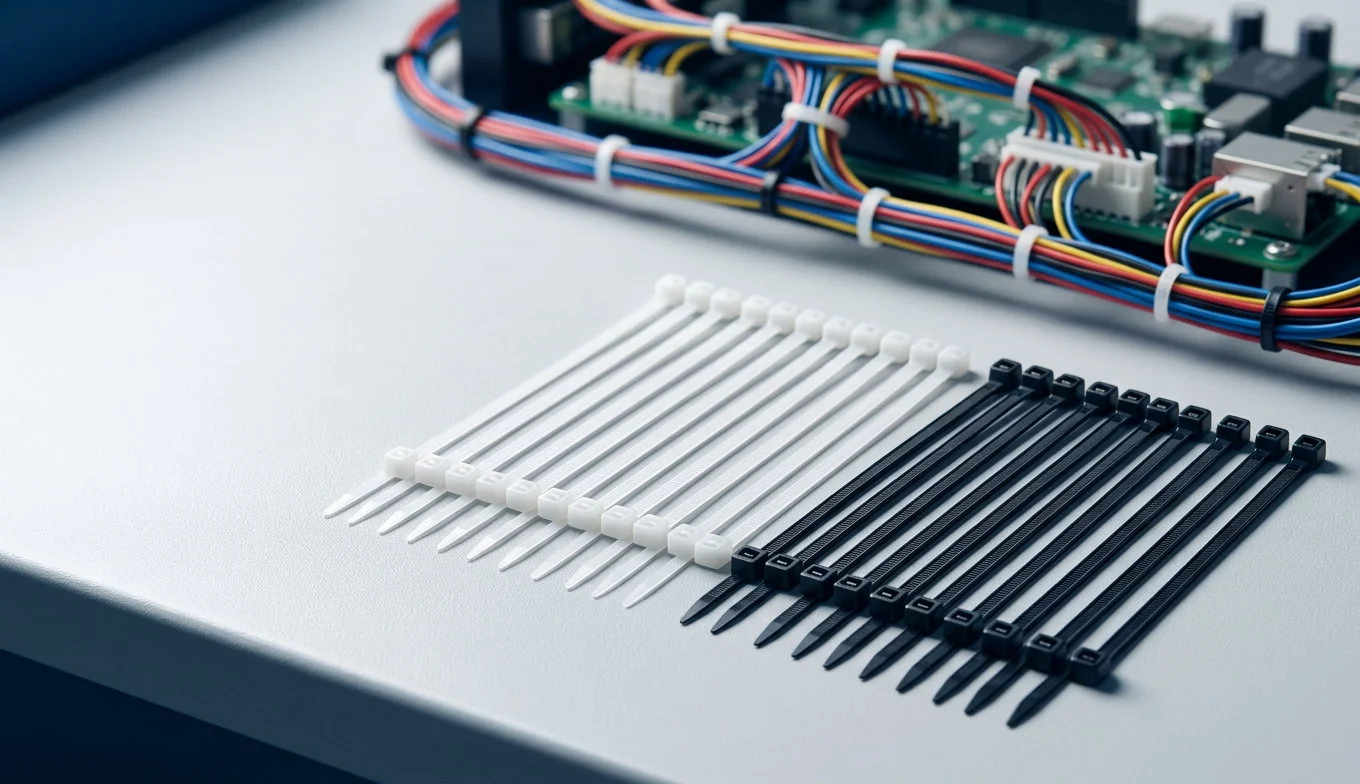
Short answer: It is never correct to wrap a cord with invisible tape. There is no voltage or temperature rating for cellophane (“invisible”) tape, it is not on list of UL 510, and it will not withstand heat that will be produced by the cord while under load. Electrical tape is different from that. The tape listed on UL 510 has voltage rating for splices of maximum of 600 V with temperature rating of 80°C. However, using tape to cover a damaged jacket of the cord is still not repair and OSHA clearly stated it. You should be using cable ties, hook-and-loop ties, adhesive mounts or cord covers instead. Buying these items is not so costly (range is from $5 to $20 for pack that can be used in whole room) and the items are removable, rated and reusable.

What Invisible Tape Actually Is
The term “invisible tape” refers to a backing material made from cellulose acetate or similar materials that is about 20-40 micrometers thick and has light pressure-sensitive adhesive on it. Its purpose is to be hardly noticeable on paper. It means that everything that lacks in this material stems from this very purpose.
- There is no electrical classification. There are no ratings of the product such as voltage, dielectric strength or temperature rating because no one subject this product to such tests.
- It has no classification. Electrical insulating tape is regulated by UL 510, which specifies requirements to thermoplastic and rubber tapes used for insulation with voltage smaller than 600 volts and temperature less than 80 °C. A roll of invisible tape does not have such classification, nor does a roll tagged as “electrical tape” where the UL mark is absent from the package.
- It cannot withstand heat. Cords and wires heat up and the glue of the tape becomes soft. In ceilings behind radiators or cabinets, these tapes cannot stick.
- It leaves a sticky mess. Adhesive sticks to wires and gathers dust, which is the last thing you would want on any insulating surface.
- It does not bend well. Cords and wires are mobile and vibrate. Rigid film on flexible cords creates stress concentration at the edges instead of spreading it.
- It masks damages. This is the main problem. Tape on a damaged surface makes it invisible to the next user thus creating problems for him instead of solving them.
There is an important difference between tape as adhesive and tape as insulation. First is what people usually mean when they reach for the roll but it is the one that fails.The second is a legitimate use for a different product, and even then only in place of a proper mechanical joint — and the safest versions of that job belong to flame-retardant ties that hold a wiring bundle in place without changing its insulation, not to tape.
What the Codes and OSHA Actually Say
There are specific rules around this topic, and indeed there are sections that could be mentioned.
- OSHA 29 CFR 1910.305(g)(2)(ii): according to this regulation, flexible cords must be used in continuous wiring systems without any joint or connector. It is possible to use the hard-service cords, or junior hard-service cords of size no of 14 or larger, as repaired cords if the connection preserves the insulation layer, properties of the outer covering and operation features of the cord.
- NEC Article 400: the regulations apply to flexible cords, which must be used only in the continuous wiring. It is forbidden to use flexible cords if they go through doors or windows, or if they are attached to walls, or if there is an attempt to hide them behind walls.
- NEC 110.14(B): splices, joints, or bare ends of a wire must have insulation similar to that of the wire itself, or be insulated with some identified insulated device.
- OSHA 1910.305(g)(2)(iii): damaged cords must be taken out of service. Tape cannot be used to repair any cord.
- OSHA 1910.334(a)(2): any cord sets, or cords with plugs must be inspected visually before the use, and if it has some defect, it has to be taken out of service until repair happens.
To support this information with practical evidence, it is worth mentioning that in 2023, during the inspection of a certain organization, it was discovered that a power cord of the bandsaw was hooked up with extension cords with tape without preserving the main properties. After that, it was decided to impose penalty of $2,277 according to the standards of 1910.305(g)(2)(ii).
For those seeking a practical interpretation: the tape does not change a poor cord into a good one; rather, its function is to disguise a poor cord. The tool that actually protects the circuit lies farther back; moreover, the most essential inspection routine is the one stipulated by OSHA — examine the cord in advance and stop its usage the very moment the jacket becomes damaged.
The Three Jobs People Are Actually Trying to Do
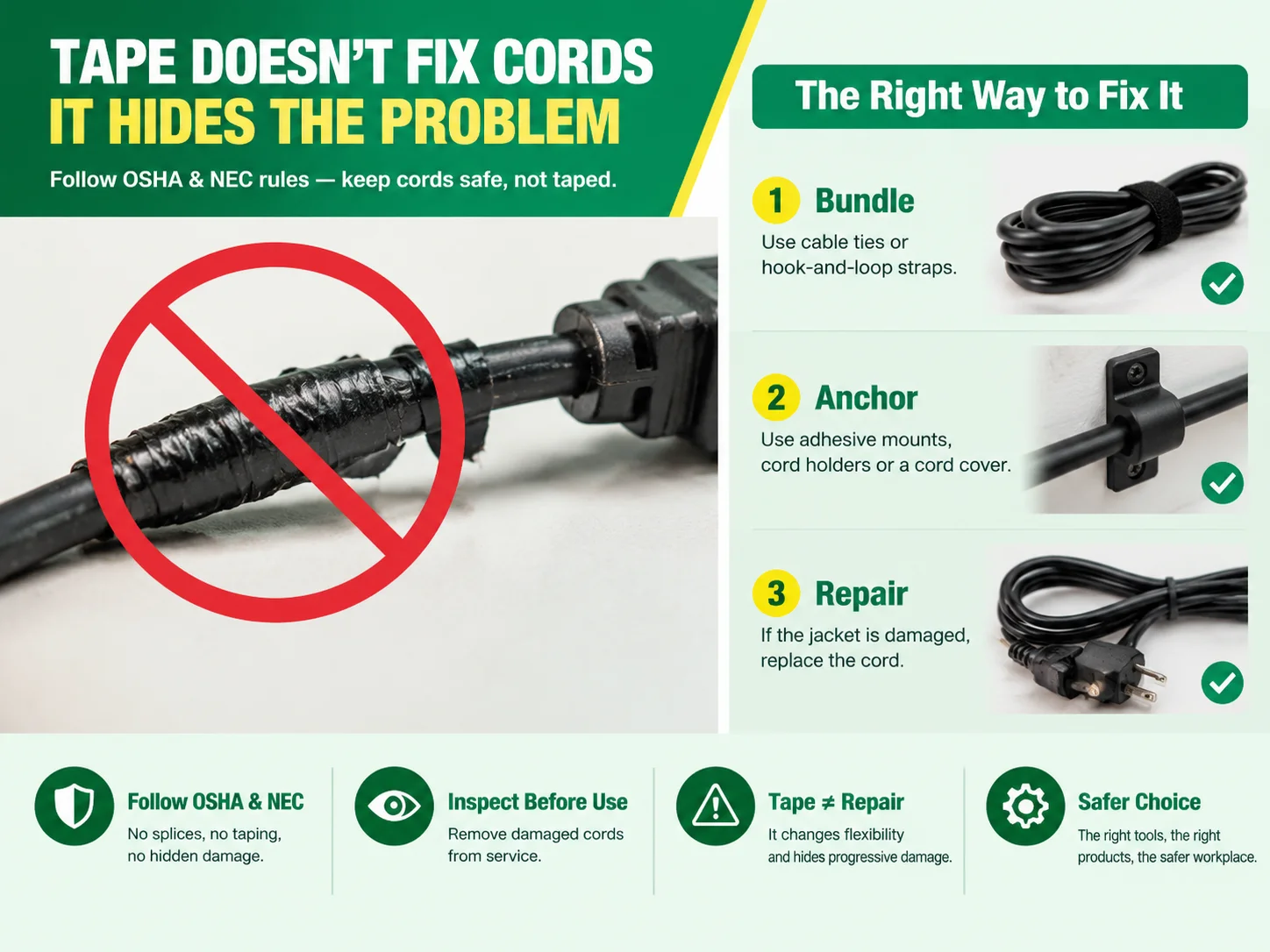
There are three main purposes behind the act of taping an electrical cord and for each of them, there is a right product to use.
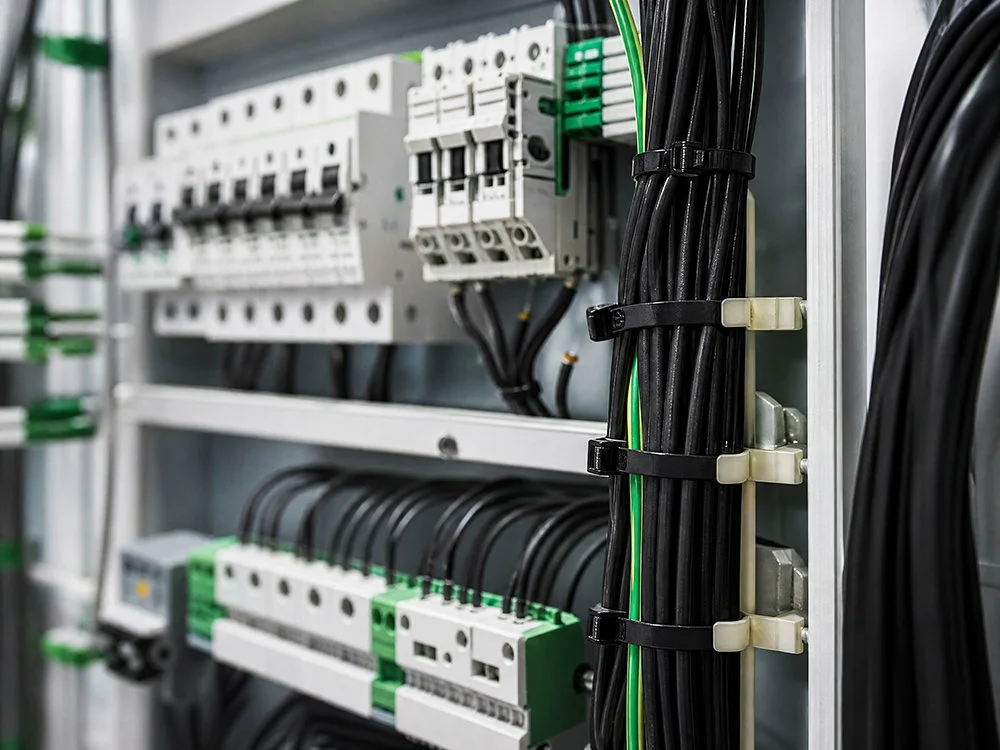
- “The cord is too long and I want to neaten it up.” This is what is known as bundling. The best way to achieve it is by using cable ties, Velcro straps, or reusable ties, all of which get the job done quickly and easily, keeping everything secure, while also making it easy to regain the original length at any moment. Moreover, none of the products mentioned involve an adhesive.
- “My cord keeps falling from the desk and slipping behind the cabinet.” This is known as anchoring. In this case, the right options are adhesive mounts, screw-in cord management clips, or cord covers running on the floor. Using tape to solve this problem would be wrong, as it would have failed exactly because of the glue losing its grip due to the heat.
- “I’m afraid that the jacket has been damaged and I need to make it safe again.” The truth is that if an electrical cord gets damaged, it should be replaced with a new one. Buying a new cord costs less money than wasting time trying to wrap damaged one in tape, plus it provides the cord with the necessary properties instead of patching the damaged one up.
Finally, bundling is the situation when it is really important to choose the right product, as the wrong item can either damage the cord or fail to hold it in place.The convention that the industry uses is a ladder of tensile ratings, and matching the tie to the bundle load rather than to the box it came from is the whole exercise — the practical version of that logic is set out in this guide to cable tie sizes and how to choose the right dimensions, which covers both length for a given bundle diameter and the tensile band appropriate to the load.
Anchoring Cords Where They Need to Stay
In instances where it becomes necessary to keep a cord or small cable harness secured to a surface, selecting the right fastening method comes down to either an adhesive option or a mechanical option; making a choice between the two is quite easy.
- Adhesive mounts. Quick to apply, no drilling, ideal for small and lightweight cables and indoors as long as the surface is smooth and clean. However, the drawback lies in cleaning the surface beforehand; effective gluing can be ruined by dust and dirt, oil and greasy surfaces, and warm and humid air.
- Screw and stud mounts. Stronger and more permanent than adhesive mounts, they are the perfect solution to anything that is in tension or used outdoors or in a workshop environment.
- Slot and loop mounts. Mounting systems such as this one can also be even more efficient because there is no need to take off the existing wiring. The difference between the variants and how each is fixed is covered in this explanation of what mountable cable ties are and how they are fixed.
Specifically, a cord holder is a better and less expensive solution than mount and tape — it hooks on to a desk frame or screws onto the bottom, organizing all the cords in one location. A cord holder does not simply beat tape with its adhesive properties — rather, the holder can be opened and filled with wires again, which makes cable management endure through the first change of technology.
Under the Desk and Behind the Cabinet
Locations where tape is used the most and worked the least include desks, media units and equipment cabinets. There are three contributing factors to this.
- Firstly, there is no flat surface for long. Desk legs and inverse surfaces of desks are usually frames or edges of panels, and the film of tape glued only to one side of the edge of 15 mm has practically no surface that can be used.
- Secondly, everything changes. It is common to have an increase in laptops, monitors, docks and chargers and the number of cords can easily double in a year. Every arrangement that requires opening up for a cable is doomed to fail in the future.
- Thirdly, heat accumulates. The cabinets, media units and desk undersides with a power supply get warmer and hotter, which is exactly the reason why adhesives stop working and the film tape stops adhering.
Сord holders that have been specially designed for this purpose deal with all of these issues and have got the following characteristics. They are capable of being attached mechanically rather than being glued onto the surface of the object they are designed for.The clip-on and screw-fixed versions available in this range of cable tie holders and cord holders for desks and cabinets are the practical substitute for the roll of tape, and one holder generally replaces several metres of it.
Reusable Options for Anything That Moves
When rearranging wires and cords, you require the right type of hardware that allows you to rearrange it without damaging the products. This is specifically true when cords are behind a television set, under a desk or in a rack.
The cleat tie system is the most common solution. It utilizes one wide cleat system that is able to evenly distribute the applied pressure instead of pinching and pulling it at a point. It can be the weakest of all fastening systems but due to the capability of being reused many times it is beneficial for any work related to the desk and AV systems, as well as laboratories. The range of styles — continuous roll, pre-cut straps, cinch straps and wide versions for large bundles — is worth knowing before you buy a single size, and the options are laid out in this overview of hook and loop cable ties.
A neutral choice for reuse is a releasable nylon tie. This is stronger than hook-and-loop and is opened completely using a tab or trigger. It fits applications where weight is an issue, the environment is industrial, and the wires need to be accessed at times. However, it must not be used in place of a malfunctioning cord; no device can replace insulation.
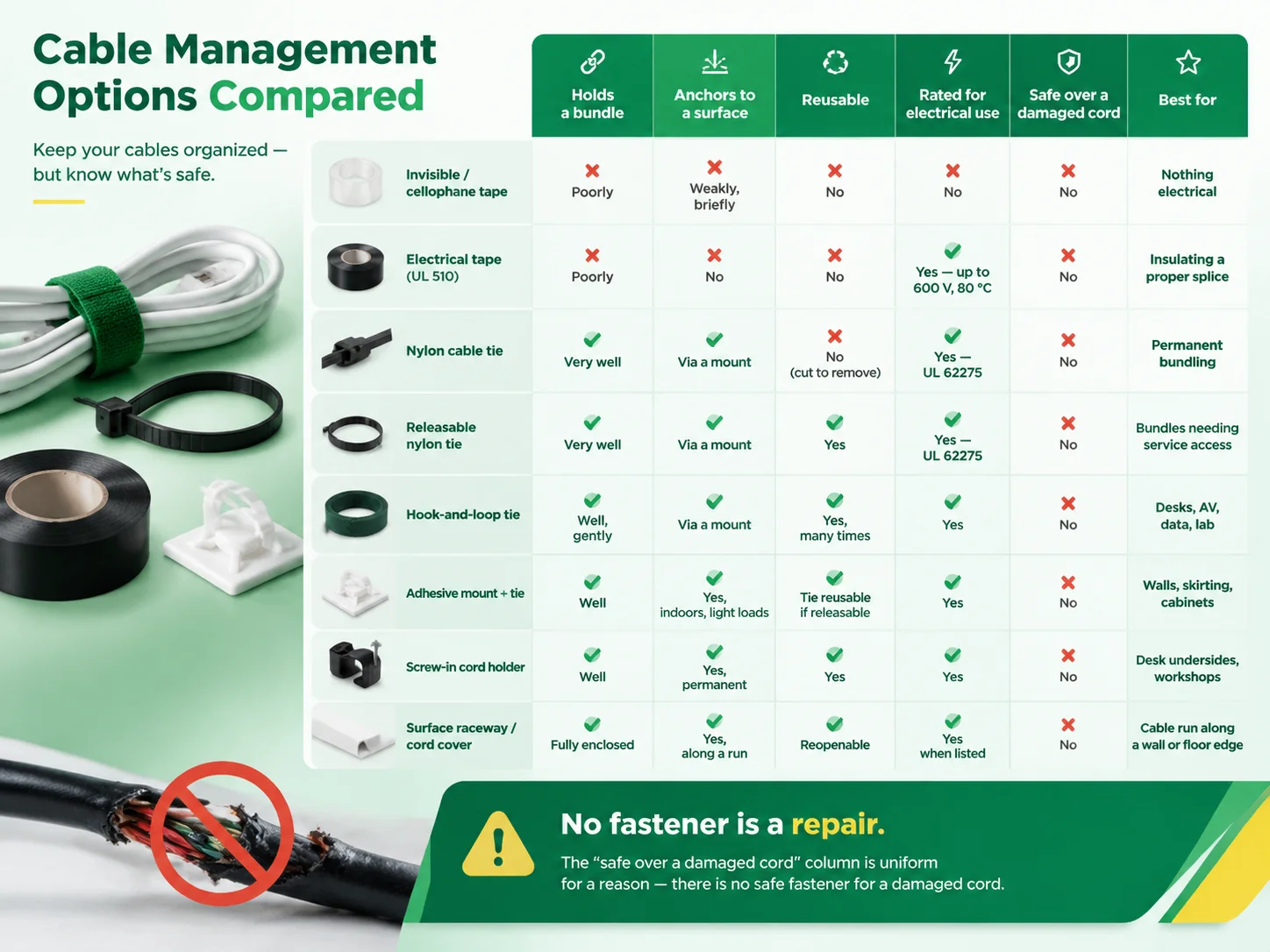
The Comparison
| Method | Holds a bundle | Anchors to a surface | Reusable | Rated for electrical use | Safe over a damaged cord | Best for |
|---|---|---|---|---|---|---|
| Invisible / cellophane tape | Poorly | Weakly, briefly | No | No — no UL 510 listing | No — hides the damage | Nothing electrical |
| Electrical tape (UL 510) | Poorly | No | No | Yes — up to 600 V, 80 °C | No — not a cord jacket repair | Insulating a proper splice |
| Nylon cable tie | Very well | Via a mount | No (cut to remove) | Yes — UL 62275 | No | Permanent bundling |
| Releasable nylon tie | Very well | Via a mount | Yes | Yes — UL 62275 | No | Bundles needing service access |
| Hook-and-loop tie | Well, gently | Via a mount | Yes, many times | Yes | No | Desks, AV, data, lab |
| Adhesive mount + tie | Well | Yes, indoors, light loads | Tie reusable if releasable | Yes | No | Walls, skirting, cabinets |
| Screw-in cord holder | Well | Yes, permanent | Yes | Yes | No | Desk undersides, workshops |
| Surface raceway / cord cover | Fully enclosed | Yes, along a run | Reopenable | Yes when listed | No | Cable run along a wall or floor edge |
Look at the “Secure via Damaged Cable” column and the pattern is clear: no fastening device is a repair. This column is consistent for a reason: it is one instance where there is truly no choice involved.
When Tape Is Genuinely Fine
Three cases that are more or less similar regarding their kind but do not involve a faulty cord or any electrical joint.
- Identification — we have to label items using a piece of tape to which an identification number of a circuit and correct phase has to correspond. This way, we have to know conventions during operation: for example, NEC 200.6 allows us to mark grounded conductors of AWG 4 or larger (except for identification). In practice, to make the task easier, colored tape is usually used.
- Covering a minor damage that does not mean any loss of flexibility. OSHA does not permit this kind of action; still, due to no clear legislation about it, accepts such practice as tape creates flexibility issues. You can try out this method; however, do not forget to check the cord after it!
- Mechanical protection over a real splice. It is indicated in UL 510 standard that rubber tape is used as an insulation and should be covered at the same time with either friction tape or PE or PVC tape. This method implies the usage of multilayered tape system made by a trained user of half-lap wrapping. It does not mean applying a flimsy layer of tape over the damaged wire.
Cost-wise comparison speaks for itself. A pack of cable ties or Velcro straps will cost about $5-20 but will allow you to deal with cords of all kinds of devices without leaving any residues after using them or having any limitations on their reusage.
Frequently Asked Questions
Is it safe to wrap wires in electrical tape?
Yes, tape listed by UL 510 satisfies these purposes as it can insulate at voltage levels up to 600 volts (V) and temperatures up to 80 C. Moreover, according to NEC 110.14(B), the insulation that covers the splice must equal the insulation used for the conductor it joins or be constructed with an appropriate device. However, using tape to cover damaged wire jackets is not acceptable according to OSHA. The explanation for this situation is provided in the 1910.305(g)(2)(ii) rule, which does not permit use of tape where splices do not meet insulation and outer sheath capabilities. Besides, taping a damaged wire does not restore its flexibility and simply hides the defect.
What kind of tape should I use to tape down cords?
Absolutely none. When it is essential to fix the cord to a surface, rather than using tape, a mounting mechanism for the cord should be used instead. Nonetheless, in case tape becomes a necessity for a short period and a low-stress indoor situation, gaffer tape performs very well on common surfaces and peels off much more cleanly than invisible or electrical tape. However, it has no electrical rating and should not be bent, glued, or stapled into a configuration that it was not designed for.
How do I hide cords safely?
How to properly route cords: there are three safe approaches. First is to bundle the slack in the cable tie or in the hook-and-loop strap for gathering the excess in one place; second option is to fix the remaining section with mounts or cord holders on a piece of furniture and not on the wall. Finally, the most convenient way of organizing permanent installation is to use surface raceway or cord cover along the floor skirting. Do not hide it behind the wall, or under the carpet, or above the drop ceiling – all the above-mentioned places are listed in the NEC Article 400 as prohibited locations for cord installation. The best way to make the installation permanent is to install a socket near the electrical device instead of using a longer cord.
What does OSHA say about taping electrical cords?
There are some things need to be clarified. One, according to 1910.305(g)(2)(ii), only continuous unbroken lengths of flexible cords are allowed; however, an exception does exist for hard-service and junior hard-service cord no 14 or bigger, provided that the splice is done in such a way as to maintain the insulation and outer sheath properties and other characteristics of the cord being spliced. Two, as stated in the provision 1910.305(g)(2)(iii), damaged cords must be removed from use since taping does not count as repairing an outer jacket. Three, it is important to mention OSHA letter of interpretation dated December 16, 1998. According to this document, taping a flexible cord jacket is not compliant with the standard. Furthermore, this letter recommends avoiding tapings of any sort to preserve flexibility.
References
- OSHA — 29 CFR 1910.305, wiring methods, components and equipment for general use
- OSHA — standard interpretation on taping flexible cord jackets
- NFPA 70, National Electrical Code — Article 400, flexible cords and cables
- UL Standards & Engagement — UL 510, insulating tape
- UL Standards & Engagement — UL 62275, cable management systems and cable ties
Conclusion
Invisible tape must never be used on electrical cords because it is not rated, listed and cannot handle heat and leaves residue. Moreover, at the time when invisible tape is most needed, since the cord covering is damaged, the effectiveness of invisible tape is counterproductive because it hides a defect by which the cord should have been taken out of service anyway. Electrical tape is a totally different item and is properly rated, and its purpose is to provide insulation to splices, so for the information of those oblivious of it, you can refer to OSHA standards and interpretations. Instead of dealing with the tape issue, one simply get a pack of ties, a couple of mounts and a cord holder for the price of a meal and the problem is solved permanently.


