



Best Cable Ties for Travel
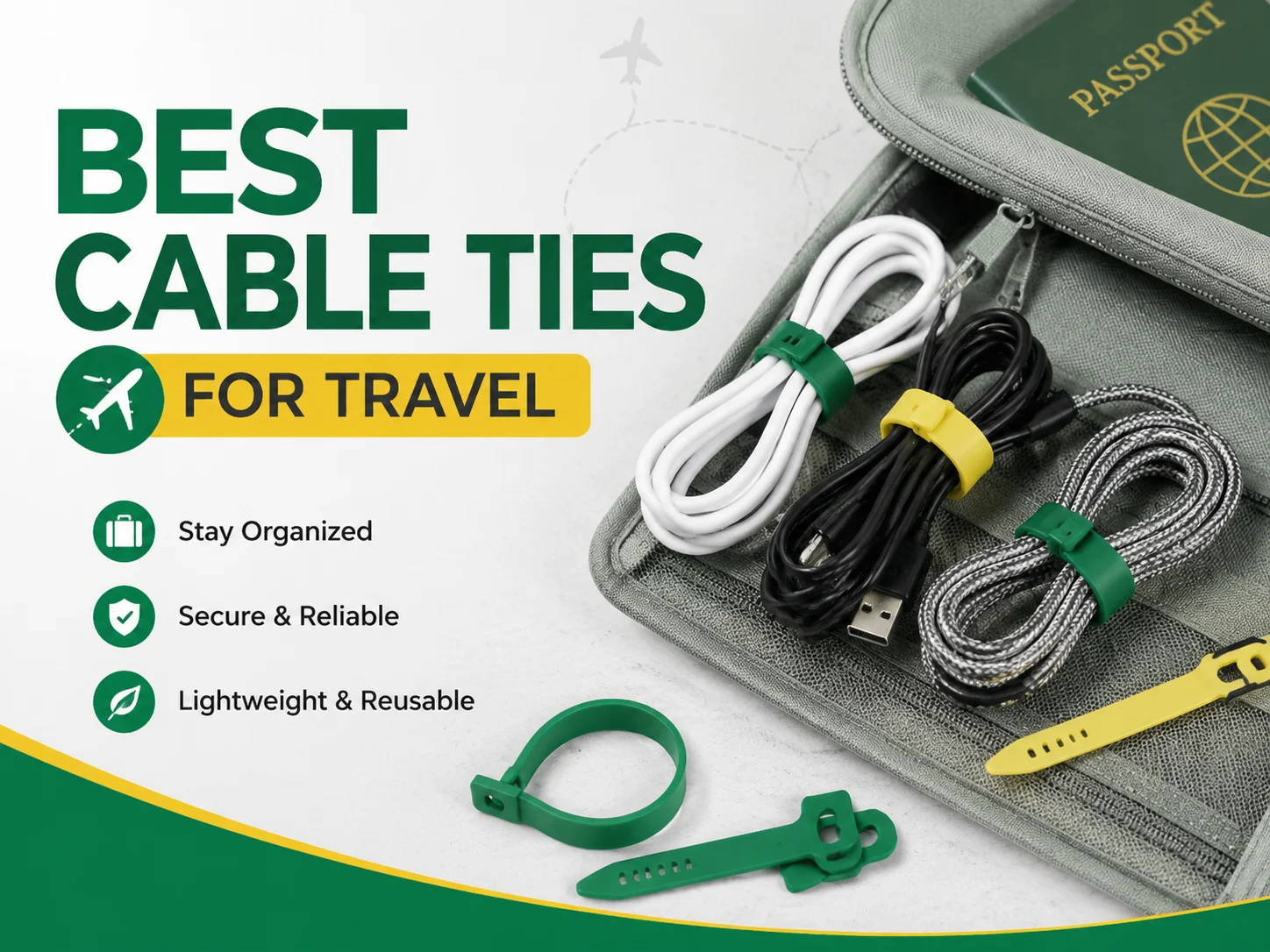
Ask most travelers about an item they will not leave home without, and you will likely be surprised at how high on the list cable ties rank. The unassuming cable tie is actually one of the best travel items known to man. Use it to lock down a zipper on a suitcase against theft, tether your bag to the luggage rack on a bus, organize your charging cords, secure your daypack on your scooter, or fix anything that is rattling, flapping, or otherwise loose on the road. However, not all cable ties are travel-friendly. The best cable ties for traveling are just the right size, strong enough to hold a zipper under load, made of the right type of material that won’t break in a cold airplane or melt in a hot car, and preferably reusable so that you are not cutting off a single-use tie every day. In this guide, you will learn what types of cable ties can be used when traveling, how to use them, what the airport regulations are, and what brands to consider when purchasing them.
Concise answer: When traveling, the ideal cable ties are reusable nylon cable ties. Cable ties should be 100-200 mm tall and be about 2.5-4.8 mm wide. The TSA regulations allow zip ties for carry-on baggage and checked baggage; however, if you use zip ties that lock your checked luggage, the TSA may remove them during inspections. You should keep zip ties in your carry on luggage, as there are no restrictions for your use. The zip ties are best suited for travel because they can lock suitcase zippers together by threading two locks.
What Makes a Cable Tie “Travel-Worthy”
Not all cable ties are appropriate for travelling. To be suitable for travel, cable ties must have the following characteristics:
- Reusable — a releasable tie can be opened without having to use scissors, making sure that you will not have to cut cable ties after every time you use them.
- Proper size — lengths of 100-200mm will be appropriate for luggage locks, cable ties and strap adjustments.
- Temperature-tolerant nylon — standard nylon 6.6 handles the -20°C to +85°C range that covers airplane holds, cold-weather destinations, and hot cars; avoid brittle economy-grade ties that snap in the cold — the cold-weather performance rules from our cold weather cable ties guide apply to travel too.
- Color — black is a good color to hide in luggage but colors such as red make it easy to see if TSA cut it.
- Easy to cut — since you will not always have scissors you will need to be able to access the head and tail of the tie quickly.
Length and Width: The Sizing Sweet Spot
Travel ties come in a few useful sizes.
| Tie Size | Length | Width | Travel Use |
|---|---|---|---|
| Mini | 75-100 mm | 2.5 mm | Bundling earbuds and small cables, cable-organization |
| Small | 100-150 mm | 2.5-3.6 mm | Zipper locks, water-bottle straps, small repairs |
| Medium | 150-200 mm | 3.6-4.8 mm | Bags to racks, strap repairs, heavier lockout duty |
| Heavy-duty | 200-370 mm | 4.8-9 mm | Luggage handle repairs, high-stress fastening |
You need to have practical travel ties of small (100-150 mm) and medium (150-200 mm) sizes. Small ties can be used for cables or zippers; medium ties are suitable for those applications that require a load-bearing capacity, so that products can be used for connecting big objects. You should also carry two strong heavy-duty ties for emergencies. The full sizing reference is in our standard cable tie sizes guide.
Materials: Nylon, Releasable, Stainless Steel
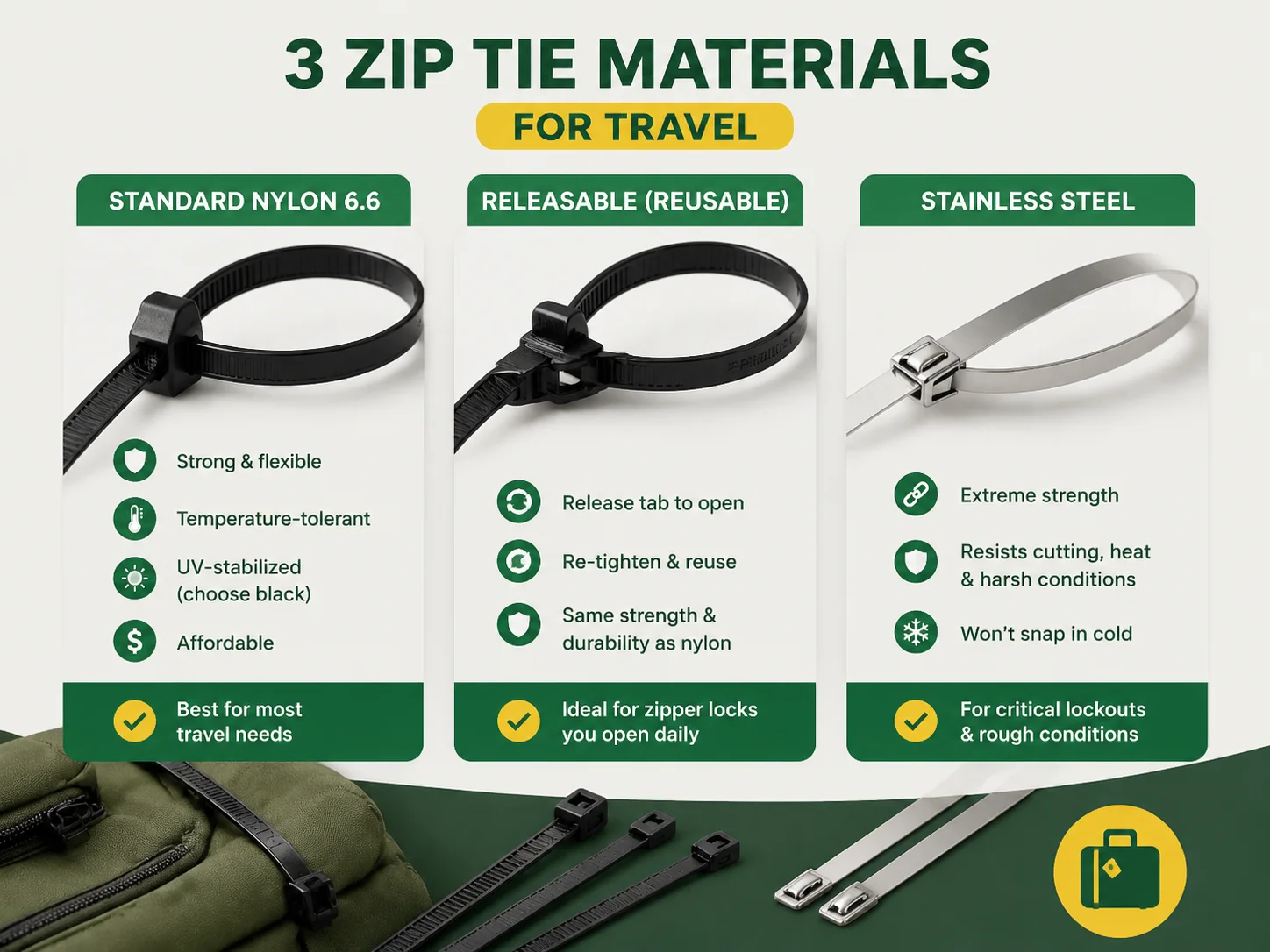
For travel, there are three main materials to consider:
- Ordinary nylon 6.6 — the most commonly used one. It is strong, flexible and temperature-resistant as well as cost-effective. It is the best option in most cases. In case your ties will be left in the backpack under the sun for weeks, select UV-stabilized (typically black) ones instead.
- Releasable ties — a nylon type with a special tab that allows using the tie again. It works best with zipper locks as you will use them every day! Please check our article about zip tie materials to understand why it is the best choice from a scientific standpoint.
- Stainless steel ties — the best option for all extreme situations. Their great advantage is that they are not fragile in extreme cold, resistant to cutting and can endure extreme heat.
If you want to buy a mixed kit for your travels, we suggest you get ordinary nylon and releasable ties.
What to Use Cable Ties for While Traveling
Below are some of the uses of travel accessories, which can be used in both everyday and emergency situations:
- Use locks that are compatible with the luggage zip to lock your suitcase by passing the tie through the zip handle. A lock that works as a tamper-evident lock which shows instantly if someone opened the suitcase. Please note that it is not a security lock but serves as an alert and prevention.
- For securing the bag-to-rack fastening while using a luggage trolley, you can use medium ties to tie it down. This will effectively prevent your bag from falling off.
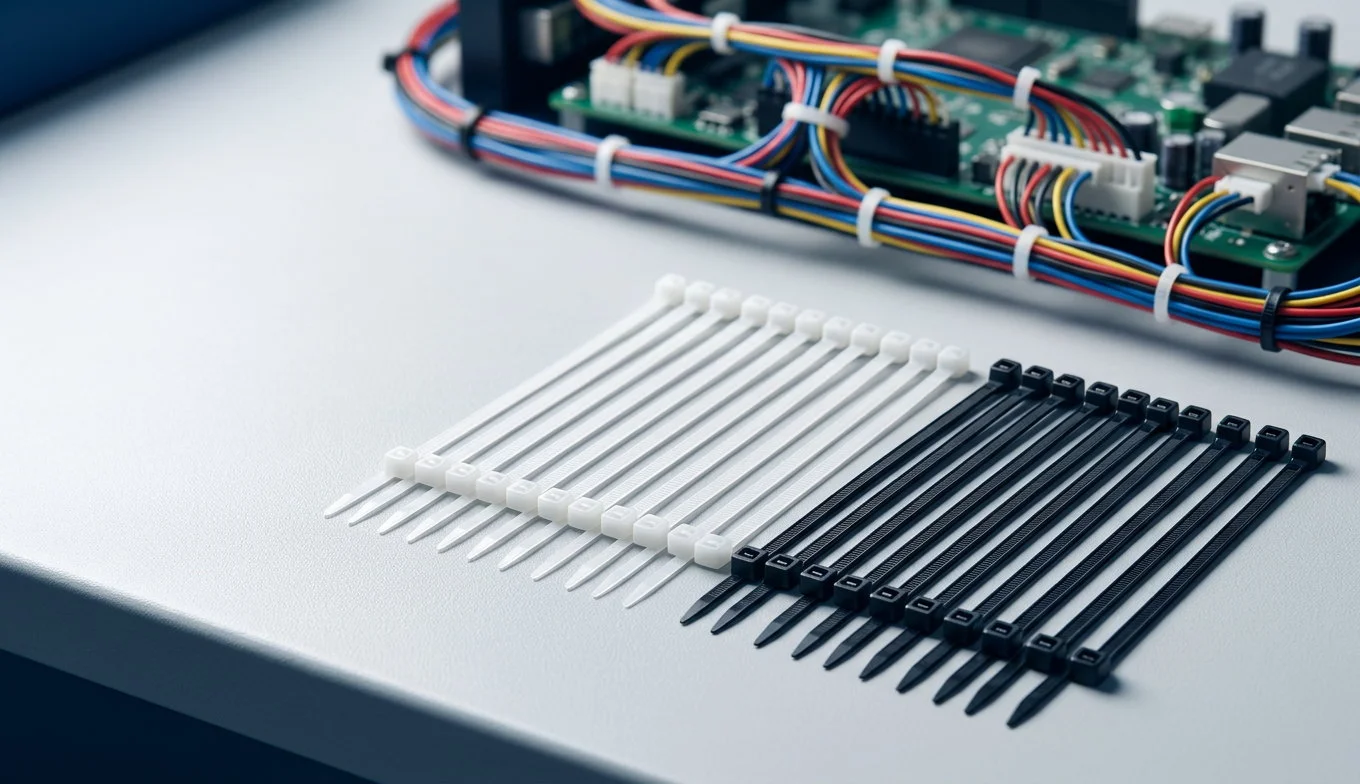
- When it comes to organizing cables and cords, you can use classic techniques to bundle chargers, USB cords, and chargers with the use of mini and small ties.
- Use the ties to do repairs in case of any emergency. If you are travelling and you have broken straps of your backpack or a zipper that is not working, ties can help you to fix it temporarily.
- Use the ties to hold water bottles and umbrellas securely.
- Use a bright tie to label your bag so that you will know if anything is tampered with.
TSA and Airline Rules: Can You Fly with Zip Ties?
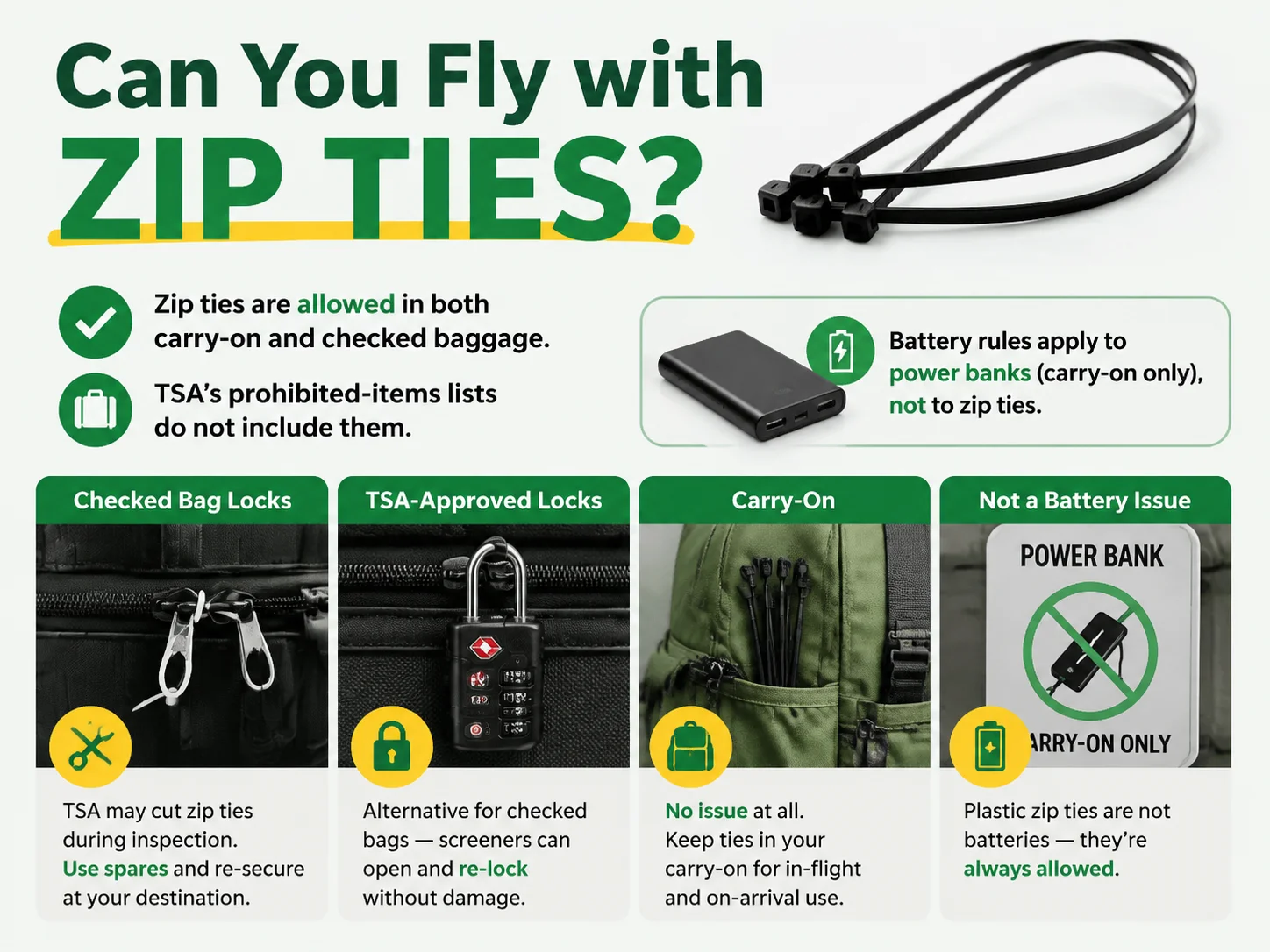
People are constantly asking about using zip ties in airports–the answer to that question is clear: yes you can use zip ties in your carry-on or checked baggage. The zip tie is simply a plastic fastener that is not restricted in any way; the TSA’s prohibited items list does not include zip ties, so they pass through your screening without any issue. The issue with zip ties has nothing to do with the zip tie itself but rather the fact that it is used as a lock.
- When using zip ties as a lock on your checked luggage: if you use the zip tie to lock the zippers on your checked baggage and the TSA opens your checked bag for inspection, they will cut the zip tie. When you arrive at your destination, you will find that the zip ties have either been cut or removed completely–this is the whole point of using zip ties–to show that your luggage has been tampered with. If you choose to use zip ties as your lock for your checked baggage, be sure to pack a couple extra zip ties for the trip so that you are able to lock it once again at your final destination.
- You can choose to use TSA-approved locks rather than zip ties: when using TSA-approved locks on your checked luggage, TSA security personnel are able to open and relock it without damaging the lock. Zip ties are a less expensive option than TSA-approved locks but they won’t work as well.
- Using zip ties in your carry on: a great option for you-they will pass through screening without any problems, and so you can keep them in your carry on for your journey and use them for both inflight and at your destination.
- Power banks, not zip ties, are subject to the battery rule: the FAA and TSA have regulations on lithium power banks in carry-on bags but zip ties do not fall under this regulation.
Removal and Reuse: Cutting and Releasing
Understanding the correct method to remove the tie is a skill in itself:
- Ties that are releasable: you will pull on the release lever (generally a small toggle on the head) and the pawl will release, allowing you to slide the tie off and reapply. This is travel-safe since the closure is quick in closing and opening.
- Ties that are not reusable: You need to cut the tail flush at the head with scissors, a nail clipper, or even a knife — now your tie is complete! You would want to cut it off at an angle so that you won’t have the pointed tip left because it will snag on your clothes.
- Inspect before reuse: a tie that has been tensioned hard or exposed to sun and cold should be checked for cracks before being trusted again — the same inspection habit as industrial use, and the quality checks in our nylon tie quality guide apply at the luggage-rack scale too.
Brands and Prices
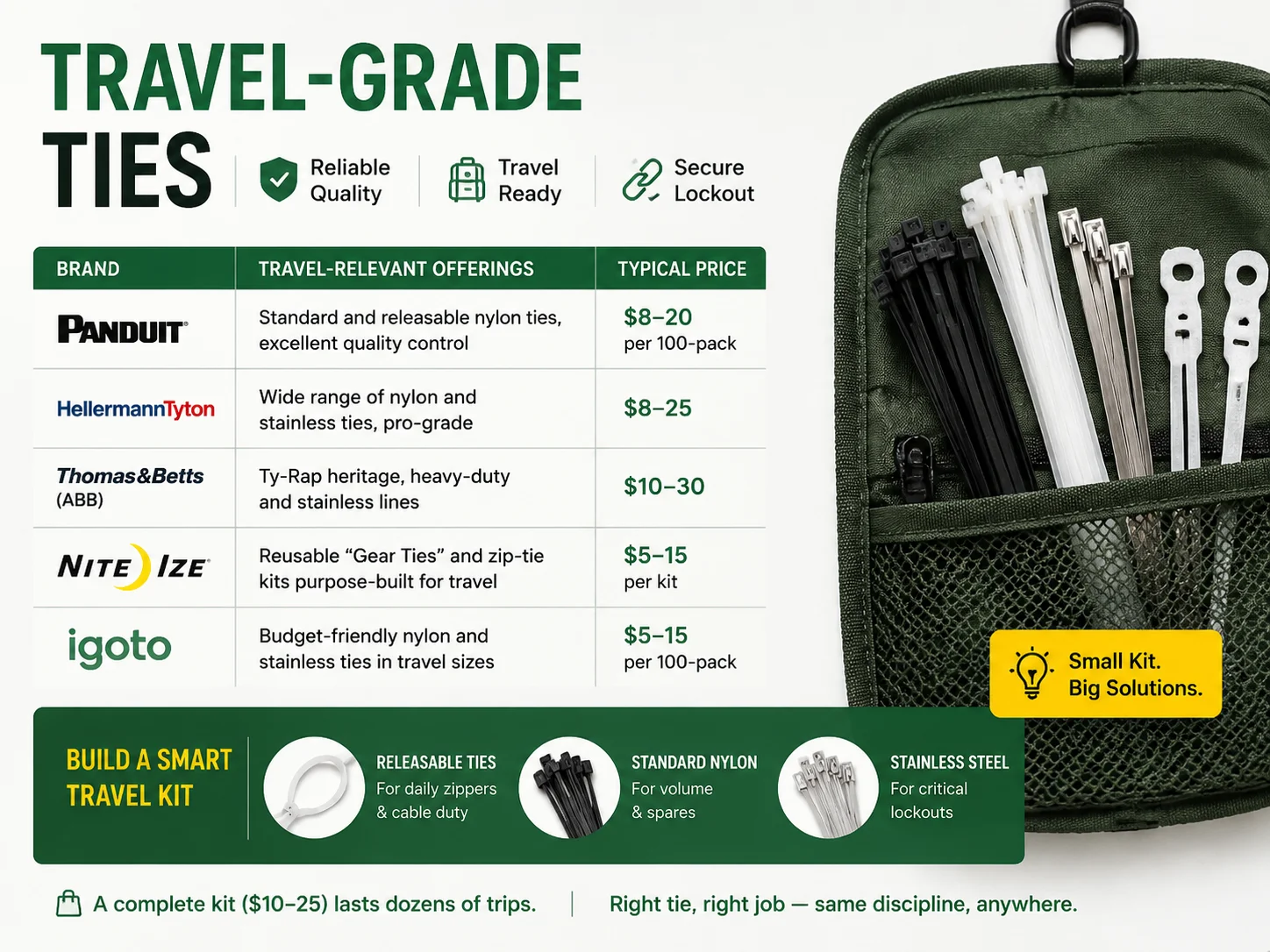
The manufacturers of travel-grade ties are both the same companies supplying industrial-grade ties and certain companies focused on the consumer market.
| Brand | Travel-Relevant Offerings | Typical Price |
|---|---|---|
| Panduit | Standard and releasable nylon ties, excellent quality control | $8-20 per 100-pack |
| HellermannTyton | Wide range of nylon and stainless ties, pro-grade | $8-25 |
| Thomas & Betts (ABB) | Ty-Rap heritage, heavy-duty and stainless lines | $10-30 |
| Nite Ize | Reusable “Gear Ties” and zip-tie kits purpose-built for travel | $5-15 per kit |
| igoto | Budget-friendly nylon and stainless ties in travel sizes | $5-15 per 100-pack |
The prices remain fair on the entire range of products; one can spend around $10-$25 on a complete travel kit consisting of 100 assorted small and medium nylon ties, a pack of releasable ties, and two stainless steel heavy-duty ties, and the combinations last for many trips. Pick according to what you are using them for: use the releasable ties for daily zippers and cables use the normal nylon for volume and spare use and the stainless steel for the one or two critical lockouts, the size, strength, and material matching are the same as for all other cable tie uses.
How to Pack Them
There are some practical considerations concerning what to take on the trip. It makes sense to place your used ties in a convenient compartment of your daypack or carry-on — you need them for convenience when your zipper breaks at the gate instead of after a week’s worth of use. Also, keep the stainless steel or spare ties in your checked luggage as the TSA has been known to cut zip ties in checked bags. And if you are using the ties as suitcase locks make sure you thread the tie through both zipper pulls and around the heavy-duty handle so it will be necessary to break the tie first instead of just sliding the zipper apart.
Frequently Asked Questions
Does TSA allow zip ties on luggage?
Cable ties, when placed in checked baggage or carry-on bags, are generally accepted by the TSA and hence, do not make it to the list of prohibited items. Whenever you lock your checked luggage with zip ties, there is a high chance that TSA may cut your zip tie to inspect your luggage. Therefore, it is prudent to carry a spare cable tie in your carry-on luggage or checked baggage to secure your luggage after inspection. In any case, you can carry your bag with cable ties.
What is the best cable organizer for travel?
To get the best travel out of your bag, bag organizers, which can be used for packing cords, help organize through proper packaging. It involves a small bag organizer (tech pouch), and a combination of types of reusable cable ties to attach cords individually in the pouch while it holds all the necessary chargers and adapters. Hard storage cases and dedicated cable rolls of cords may work; however, the cable organizer tied with the pouch and types of ties that weigh less can do it better at a lower charge.
Can you take cable ties on a plane?
Cable ties may be put into your checked luggage or brought onto a plane, as they contain no banned objects according to TSA/FAA regulations. The regulations that are significant while travelling with electronics relate to lithium batteries (charging devices allowed only in carry-on bags). Nevertheless, cable ties can be placed freely through screening without any problems in your electronic bag.
Who makes the best cable ties?
When it comes to consistency in quality, Panduit, HellermannTyton, and Thomas & Betts are regarded as the industrial standard cables; Nite Ize produces reusable travel cable ties and igoto has a budget line of nylon and stainless ties within the same class of performance. When embarking on your travel, the best cable ties brand is the one that manufactures the right size with releasable cable ties you will be able to carry along frank with you according to the predetermined budget.
References
- TSA — What Can I Bring? (prohibited and permitted items)
- FAA PackSafe — Lithium battery and passenger item rules
- Check In Carry On — Adapters and electronics packing rules
- TravelGoEat — Travel accessories and airline packing rules
- Panduit — Cable tie product range (releasable and standard)
Conclusion
The best traveling cable tie is the one that is the right length, material and reusable so you will actually use it — and the chosen cable tie traveling kit is small. The best traveling cable tie kit is a cable tie kit of 100-200 mm nylon cable ties, with mostly releasable ties, a few mini cable ties for cables, and two stainless steel heavy duty cable ties for “critical” jobs, all packed together in one pocket, for about $10-25. Travel with traveling cable ties to make use of them for a variety of purposes: locked zippers that show any signs of tampering, bags that remain fixed on the racks, coiled cables, and repairs that make a broken strap or handle a non-issue. There is no problem with the airport rules regarding cable ties: TSA permits the use of zip ties in both checked and carry on luggage with the only need being that you must bring along extra cable ties if using zip ties for checked bags since they will be cut during the bag inspection. With the addition of a modifiable release tab, and angled cut, the simple cable tie becomes the easiest-to-use, high-value, lowest-cost item on your packing list: the universal fix it that has saved more trips than any gadget in your bags.