



Heavy Duty Cable Ties: How to Choose Right One
Surprisingly it is usually the cheapest part of the whole installation that fails first at a busy construction site. If a heavy bunch of electrical cables goes down a cheap tie does not withstand the pressure and with it starts a nickel mistake which leads to hours of doing the same work. Heavy-duty cable ties are the solution to this problem. These are wide heavy-duty straps that are used for bundling heavy cables, which cannot be done with the classic zip ties. The purpose of this manual is to explain why this tie is called heavy-duty, how the tensile strength rating works, which materials fit which environment and how to pick and mount the right tie in order to avoid any problems with it from the beginning.
What Makes a Cable Tie “Heavy Duty”?
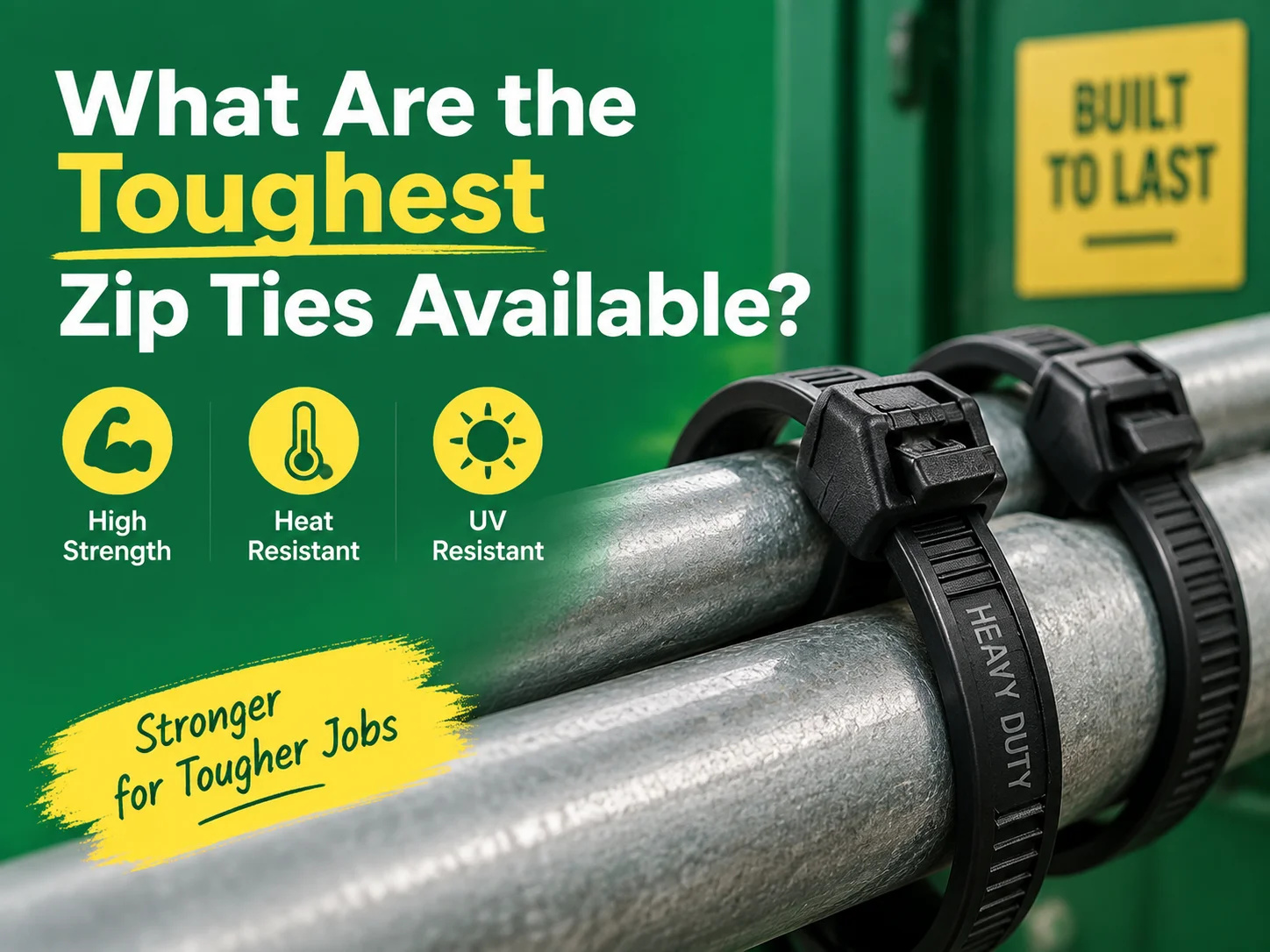
The strength of a tie is determined by two factors: cross-sectional thickness and material used. As a result, a thicker and wider strap together with a sturdier lock is able to hold heavier items. This is the reason why heavy-duty straps appear more massive compared to the cheap ones. A regular tie is about 2.5 millimeters to 4.8 millimeters wide and is able to hold anything between 18 and 50 lbs. Heavy-duty tie, on the other hand, is 7.6 mm to 12.7 mm thick and is able to bear between 120 and more than 250 lbs loaded.
It is essential to pay careful attention to the details of the lock mechanism in addition to the strap. The cheaper option has a mechanism that can very easily click and detach, while the good quality industrial ties utilize a low profiled locking mechanism that properly secures the strap in place. When deciding on the tie of similar length, you have to ask the seller about its thickness and width because these two parameters will determine the maximum load it can manage.
Heavy Duty Cable Tie Tensile Strength Explained
The maximum weight that a tie is able to bear before breakage is called tensile strength, a term also referred to as loop tensile strength. Heavy duty ties are categorized into the following weight classes by most brands:
- Light heavy duty: Approximately 120 pounds (535 Newtons).
- Heavy duty: Approximately 175 pounds (800 Newtons).
- Extra heavy duty: Approximately 250 pounds (1200 Newtons).
- Higher than nylon, specialty nylon achieves 350 pounds, while stainless steel ties can support weights up to 485 pounds or even more.
The table below shows how the classes compare to strap width, length, and types of work to be performed.
| Tier | Loop tensile strength | Typical strap width | Common lengths | Typical use |
|---|---|---|---|---|
| Light heavy duty | 120 lb (535 N) | ~7.6 mm | 8″–14″ | Larger indoor bundles, light structural fixing |
| Heavy duty | 175 lb (800 N) | ~9 mm | 14″–21″ | Cable trays, conduit, wiring harnesses |
| Extra heavy duty | 250 lb (1200 N) | ~12.7 mm | 21″–48″ | Heavy conduit, mechanical bundling, infrastructure |
| Stainless steel | up to 485 lb+ | 4.6–12 mm band | Custom, over 100 ft available | Marine, high heat, fire-critical, oil and gas |
Here is a helpful rule about tie sizing: making use of multiple ties instead of one. For example, a 1,000 lb load can be adequately supported using one of four quarter-ton ties. The cost of spreading weight on different ties would be much lower than the price for the single super-tie.
Important point: A tie should not be used at a rated capacity. Indeed, since shock, vibration and temperature changes influences all over maximum load capacity, one should calculate the load and apply a safety factor (between 1.3 and 1.5). In addition, in case of dynamic loads, the tier must always be upgraded to one above the current tier (for instance, from 120 lb to 175 lb or from 175 lb to 250 lb).
Materials: Match the Tie to the Environment
The power of a cable tie alone will not determine its usage. Its performance in high heat, exposure to sunlight, in chemical applications, or in seawater will depend on the properties of its material. The costly flexible plastic cable tie mistakes occur due to its material choices.
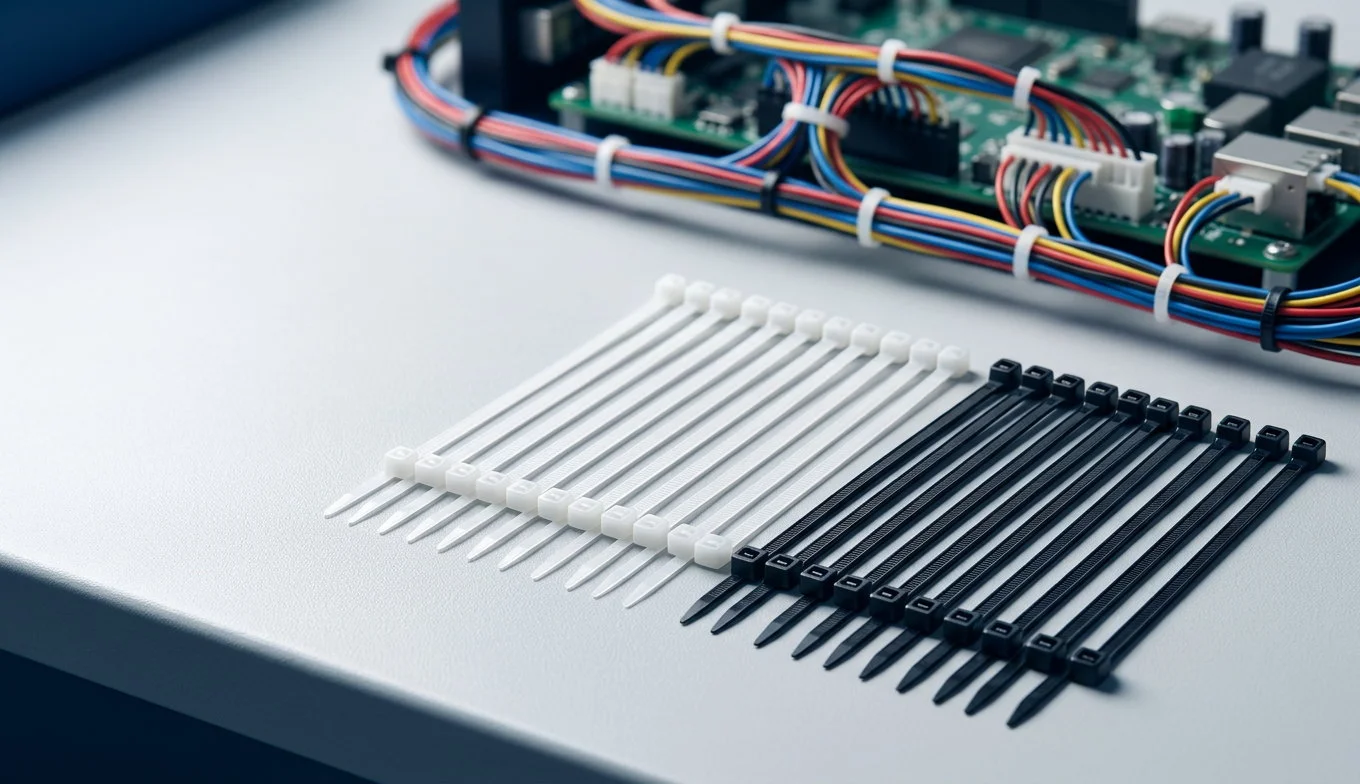
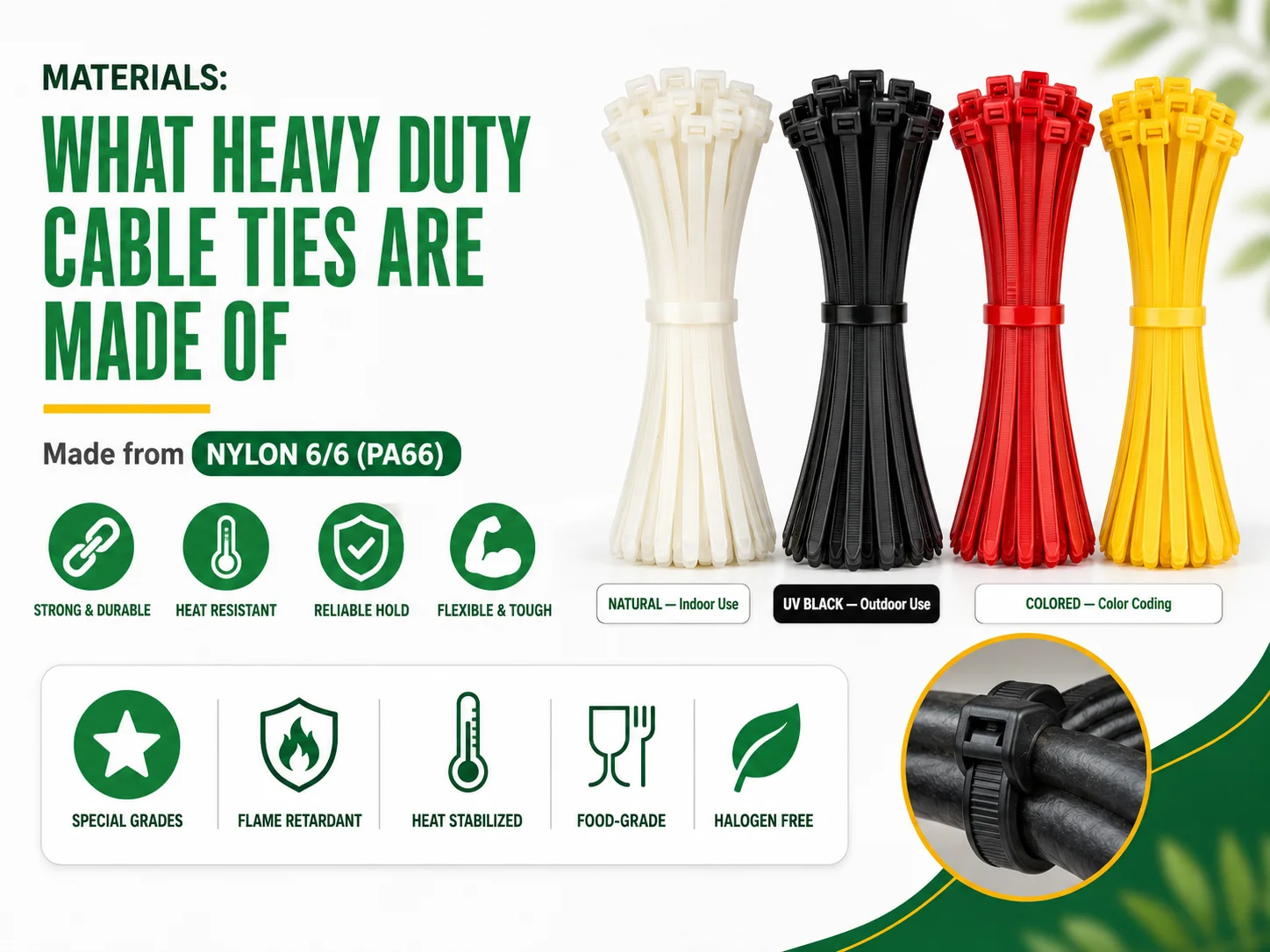
Most commonly, the cable ties are manufactured out of nylon 6-6 (PA66), either white or black. Black nylon is made UV resistant through incorporating carbon black during the manufacturing process. Special processing of the nylon enables its capability to withstand high temperatures. Polypropylene cable ties resist acids, alkalis, and some solvents while steel cables (304 or 316 types) can withstand hot environment and corrosive environments.
For a deeper look at how sunlight breaks down the wrong ties, our guide on whether zip ties are UV resistant explains exactly why carbon black is the only reliable outdoor pigment. And when nylon simply is not enough, our overview of alternatives to cable ties covers stainless bands, lacing cord, and hook-and-loop straps.
The primary issue of outdoor use of natural nylon is the effect of sunlight and weather. Even unstabilized nylon has a tendency to become chalky and brittle within a span of one summer. In applications which involve use in sun rays, it is then sensible to use UV-stabilized black nylon. If there are risks of exposure to salt water, heat, or fire, then it is necessary to use stainless steel. By choosing the right material, one can spend a little money and avoid many failures.
Sizes and How to Read the Spec
Heavy-duty cable ties are available in different lengths of around 8 inches to 48 inches since they are made of nylon, but stainless steel has unlimited lengths. Besides the length, there are the other four factors to keep in mind: width of the strap, thickness of the strap, the maximum bundle diameter, and the tensile strength. Width is quite an important factor since it is directly linked to the capacity of the ties: for example, a 4-inch light-duty tie with the width of 2.5 mm can hold approximately 18 lb, while heavy-duty ones with larger measurements can support hundreds of pounds.Our detailed breakdown of zip tie width and strength shows how those dimensions map to load ratings across the range.
At all times, ascertain the maximum bundle diameter and length of the tie. A tie whose length is sufficient for bundling the bundle but rated for a smaller diameter would be overstrained at the head. When in doubt, it is better to choose a larger tie.
Where Heavy Duty Cable Ties Are Used
Various types of applications exist that use heavy duty cables ties because of the various industrial sectors of application. These usages include:
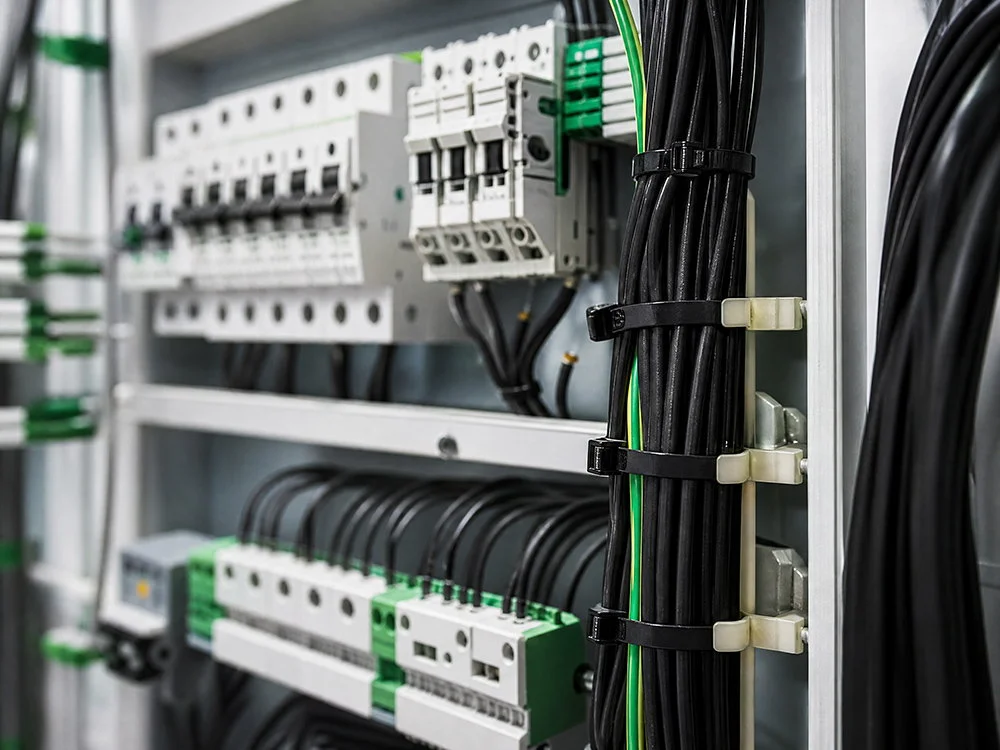
- the application of heat resistant cable ties for ensuring safety in industrial cable trays and methods of cable conduits where the excess weight is borne without affecting insulation
- the usage of heavy duty cable ties in automotive and construction industries for ensuring safety of wire harnesses in difficult operating conditions
- utilization of cable ties in agriculture, construction, and infrastructure sectors
- use of cable ties in solar installations where the black heat resistant cables ties make sure the safety of DC cables used for a long time
- usage of stainless steel heavy duty cable ties by companies from marine industries, oil and gas industries because of their chemical resistance
- application of heavy duty cable ties for bundling in wind and HVAC industries
Due to the fact that there are so many industries and uses of heavy duty cable ties, producers prefer to limit the range of available types of products for clients.
How to Choose the Right Heavy Duty Cable Tie
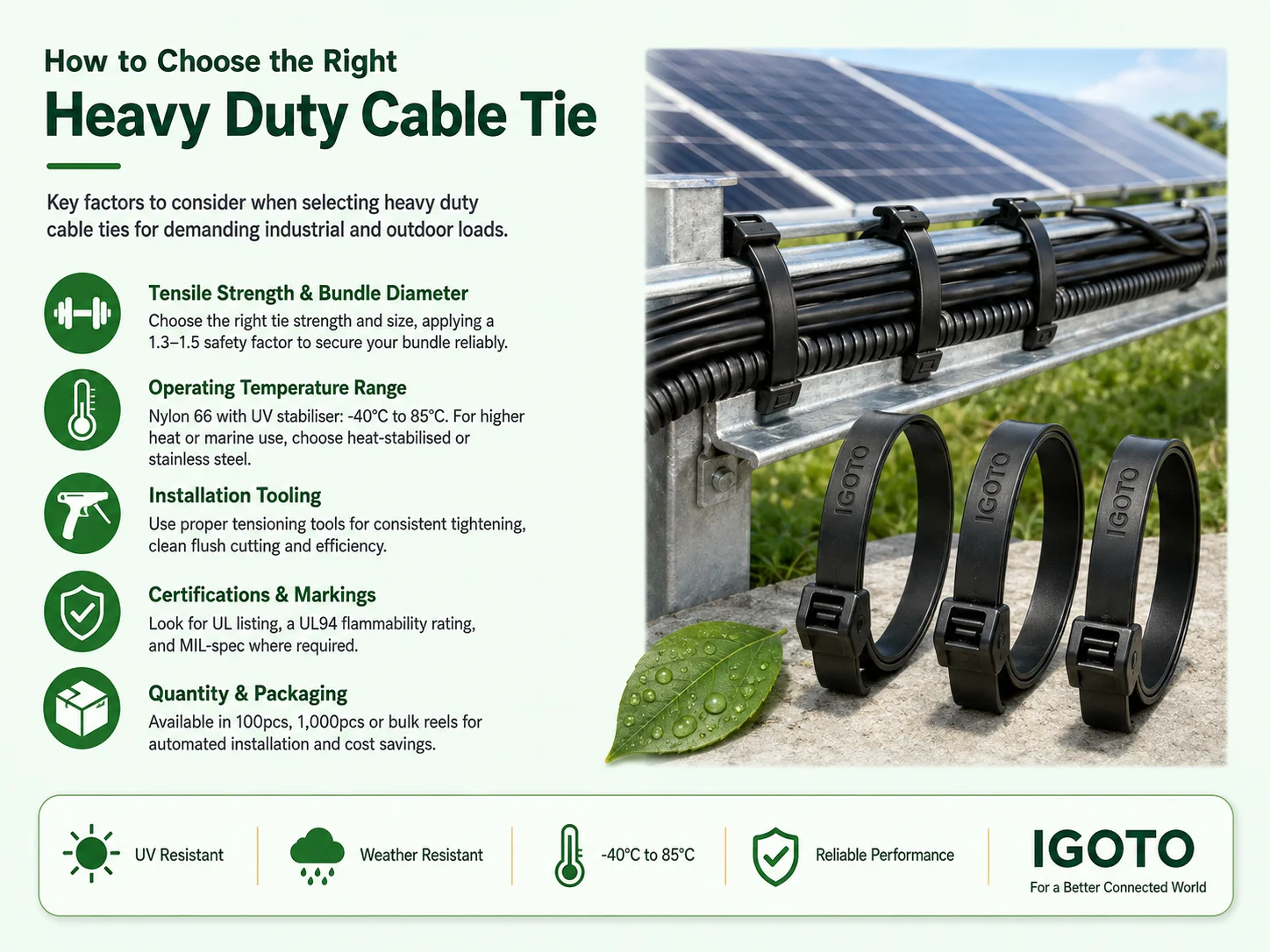
To sum up, the selection process is dependable only when you answer these five questions.
- Load and size of the bundle: determine the load, multiply it by the safety factor of 1.3-1.5, and select the tier accordingly. If the working load is 300 lb, two ties having 250 lb of working load are safer than one.
- Environment: whether it is indoor, outdoor, under sun, in high temperature, and/or exposed to chemicals or used in marine conditions will help you find out the required material.
- Dimensions: match the diameter of the bundle and choose the wider strap for some margin of safety.
- Certifications: for federal jobs, pay attention to UL listing, flammability rating, for example, UL94 V-2, and if required, military standard.
- Tools and installation: large ties need some proper tensioning tool to gather the necessary results.
If you already work mostly in zip-tie terms, our companion heavy duty zip ties procurement guide walks through the same decisions from a purchasing angle, including how strap width and thickness drive price.
Installation Best Practices
The installation of even a very reliable tie can be misled by incorrect usage of the tie. Some basic principles can be used to avoid mistakes: first of all, implement manual or electric tensioning tools in order to set same torque for all installed ties; avoid overtighting since too high tension can ruin cable insulation; while working with the single tie, tighten it till the stable state and cut it with no pointed ends. Get rid of pointed ends and perform installation in standard temperature, in case the temperature is too low, it will affect negatively the nylon material. Special electric tensioning tools help to cope with the packs of ties very effectively.
Frequently Asked Questions
How much weight can heavy duty cable ties hold?
Typically, heavy-duty cable ties have a tensile strength of between 120 and 250 pounds, while their specialty nylon counterparts have a strength of approximately 350 pounds or more and stainless steel ties can manage a tensile strength of up to 485 pounds. The specific strength of cable ties depends on such factors as the length, width, and material being used, so you had better check the pack for the loop tensile rating before making any assumptions about the cable ties you are using.
What is the strongest cable tie?
Stainless steel ties have proven to be exceptionally robust and capable of handling weights beyond 250 pounds, in addition, there are many styles of stainless steel that are capable of resisting heat, corrosion and fire. For nylon ties, the strongest types typically have a capacity of about 250 pounds in strength, which is the maximum range in strength available in this category of ties.
Are heavy duty cable ties UV resistant?
It is only when it comes to UV-stabilized black nylon or stainless steel ties. Natural or brightly colored nylon ties provide no effective UV protection and may become brittle when exposed to the elements in a short time. Only a black nylon tie can be recognized as UV-resistant one.
What is the difference between heavy duty and standard cable ties?
Normal ties require a strap of 2.5-4.8mm and can carry an estimated weight of 18-50 pounds. Heavy duty ties require a strap of 7.6-12.7mm and can carry an approximate weight of 120-250 pounds or higher making them suitable in cases where large item sizes, excessive vibration, and heavy pulling are involved.
Can you reuse heavy duty cable ties?
Conventional heavy-duty ties are meant to be used once only as they lose their strength when reopened. If you need to open a bundle for repair, use a releasable heavy-duty tie, which performs like a standard tie but can be removed without the need for tools.
Do heavy duty cable ties need a special tool to install?
As far as usage is concerned, either hand tension or cutting can be used to apply them but it would be much easier to use a special tensioning tool for heavier duty ties. Manual or electric tools can allow the user to apply the tension which will be desirable. Moreover, the use of a tool allows trimming the tail so that the result is uniform and there is no danger of overtightening the cable. Properly designed tool is especially critical in situations involving big volumes of work.
IGOTO Group provides heavy-duty ties in different parameters including PA66 nylon made of 120 lb, 175 lb, 250 lb, and natural and UV stabilized & thermally treated and fire-retardant. Our prices are very competitive as they are offered directly from the manufacturer, which enables purchasers to select the suitable type of tie without overpaying for making an unnecessary mistake concerning fastening elements.
References
- UL 62275 – Cable Management Systems. This standard outlines the test methodology and evaluation of cable ties with respect to various criteria such as the loop tensile strength test, necessary material conditioning clauses, etc.
- MIL-STD-23190 – Military Specification for Cable Ties. The Department of Defense specification related to the dimensional tolerances as well as minimum acceptable tensile strength of cable ties including heavy-duty and high tensile varieties of cable ties.
- UL 94 – Standard for Flammability of Plastic Material. This standard defines V-0 and V-2 flammability classification which is often referred to with regard to industrial cable ties.
- ASTM D638- Standard Test Method for Tensile Properties of Plastics. It gives a basic methodology on which the tensile data of nylons and other polymer based cable tie materials are published in various journals.
- American Chemistry Council, Plastics Division – Technical information regarding the UV stabilization of engineering plastics and the role of carbon black in aging well in the outdoors.