


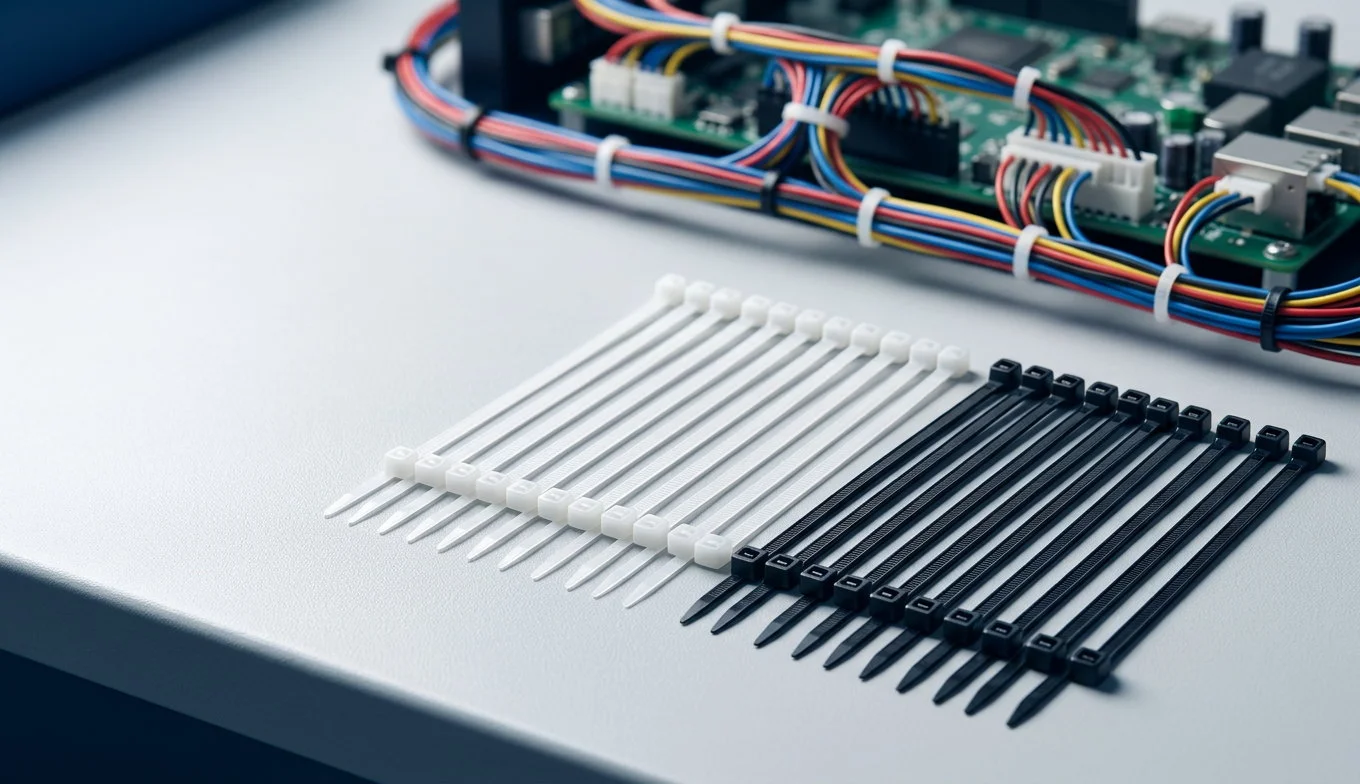



Is Nylon Plastic? The Honest Answer About Nylon vs Plastic
Imagine that you need to use plastic zip ties and a plastic container, and someone points out that everything is made of plastic. Of course, the zip ties are stronger and more flexible, so you realize that they’re also three times more expensive than the container. You realize that you might also need nylon 66 ties and you get an offer for cheap ties that are labeled as plastic. Is it the same plastic product that has two different labels, or is there more to it? You must find the answer to this question in order to save your money and stay safe with the products that fulfill their functions for many years.
This article contains the answer to the question about what nylon really is. In addition, you will find out what makes nylon different from plastics; Chemistry and characteristics of nylon will help you make your choice.
Short answer: It is true that nylon belongs to the category of plastics but it is a special kind of engineering plastic (in other words, polyamide or PA). There are different types of nylon but not all of them can be classified as plastic. Nylon outperforms other types of plastics because for instance it has 2-3 times more tensile strength than other plastics (~80 MPa) and is resistant to damage. Moreover, nylon can withstand high temperatures without problems (120 degrees and higher) while its plastic analogues can handle just around 80 degrees. One should mention also that nylon absorbs moisture in the range of 3-8% which does not make it better than other kinds of plastic.
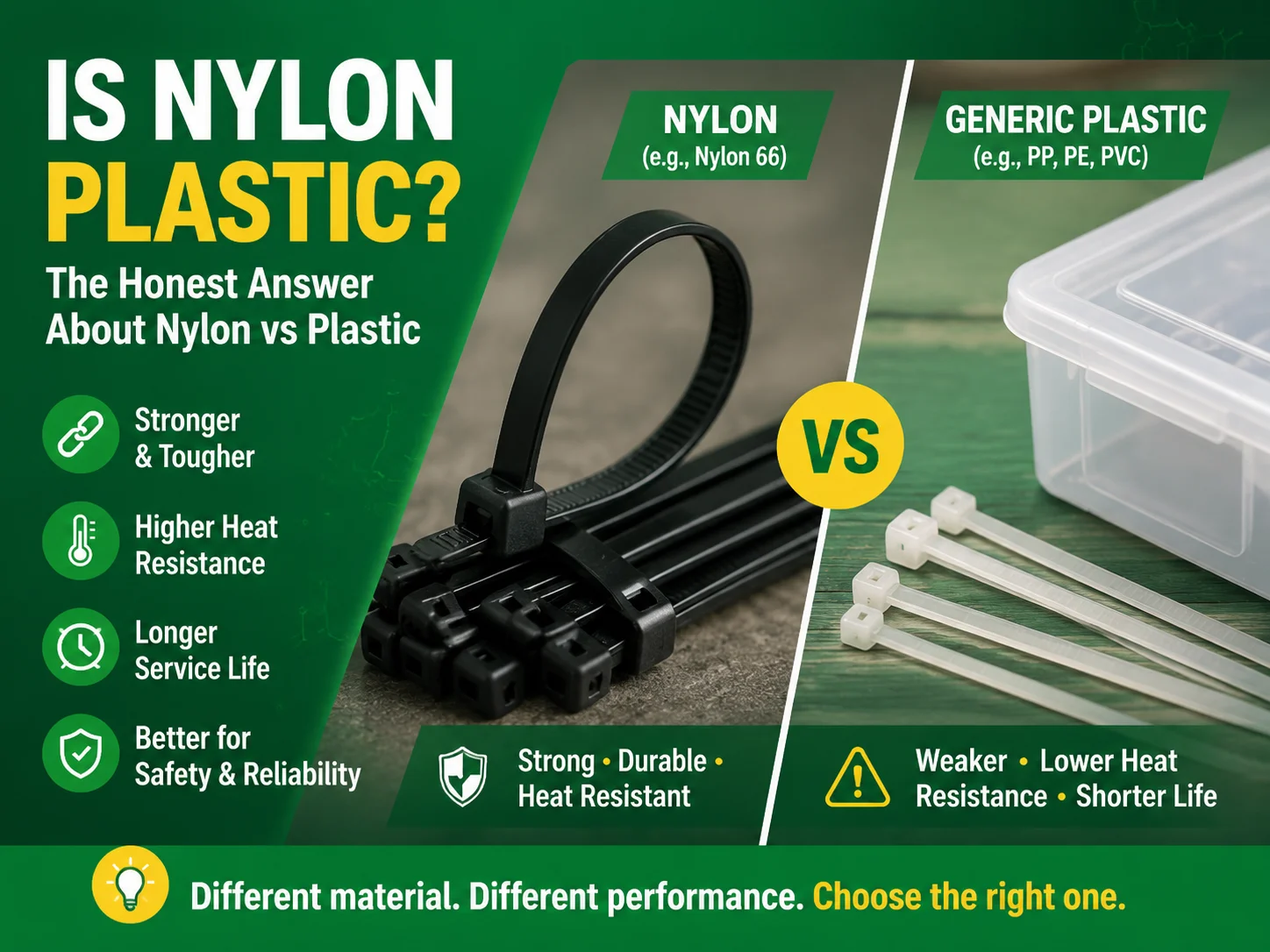
The Short Answer: Is Nylon Plastic?
The answer to the question regarding whether nylon counts among materials called plastic is “yes,” as nylon is in fact a member of this class. In material science, the phrase “plastic” is used in a broader sense in relation to plastics that fall under the category of polymers (substances made from long chains of molecules) that become “plastic” under conditions of heating and shaping. The classification of nylon (as a type of polyamide or PA) as a plastic does not mean that it is inferior to other materials of the class. After all, the relationship here is similar to the one between “animal” and “dog,” which indicates that every type of nylon is a type of plastic, but “plastic” includes numerous other, less high-performing materials
The cause of this peculiar status of nylon is the way the term “plastic” is used in the realm of definitions to name cheap materials that include highly fragile plastics such as those used in toys and bottles. The fact that nylon appears to be of much greater strength than the rest of substances available in the market leads to the inability of people to see that it is still a type of plastic. It follows that nylon is a representative of a category of engineering plastics, which belong to materials designed for load-carrying, friction, and temperature regulations.
What Exactly Is Nylon? The Chemistry in Plain Words
The term “nylon” originates from “polyamide” (PA), which is the first polymer produced by DuPont in 1935. The molecules are glued together by amide bonds (-CONH-) of which the molecular structure forms hydrogen bonds. One can visualize tiny and numerous springs tying molecules. The intricate network of hydrogen bonds gives nylon tremendous strength as in case of other natural fibers like silk and wool.
On the contrary, typical polymers, such as PE or PP or PVC, have less powerful chemical bonds called van der Waals forces making their structure resemble that of bricks rather than springs. This is the first distinction explaining a number of contrasts of their performance in the tables presented below.
| Material | Chemical Family | Key Bonding | Category |
|---|---|---|---|
| Nylon (PA6, PA66) | Polyamide | Amide bonds + hydrogen bonding (strong) | Engineering plastic |
| Polyethylene (PE) | Polyolefin | Van der Waals (weak) | Commodity plastic |
| Polypropylene (PP) | Polyolefin | Van der Waals (weak) | Commodity plastic |
| PVC | Vinyl | Van der Waals (weak) | Commodity plastic |
| Polycarbonate (PC) | Carbonate | Moderate | Engineering plastic |
| POM (Acetal) | Polyoxymethylene | Moderate-strong | Engineering plastic |
Nylon vs Plastic: The Key Differences
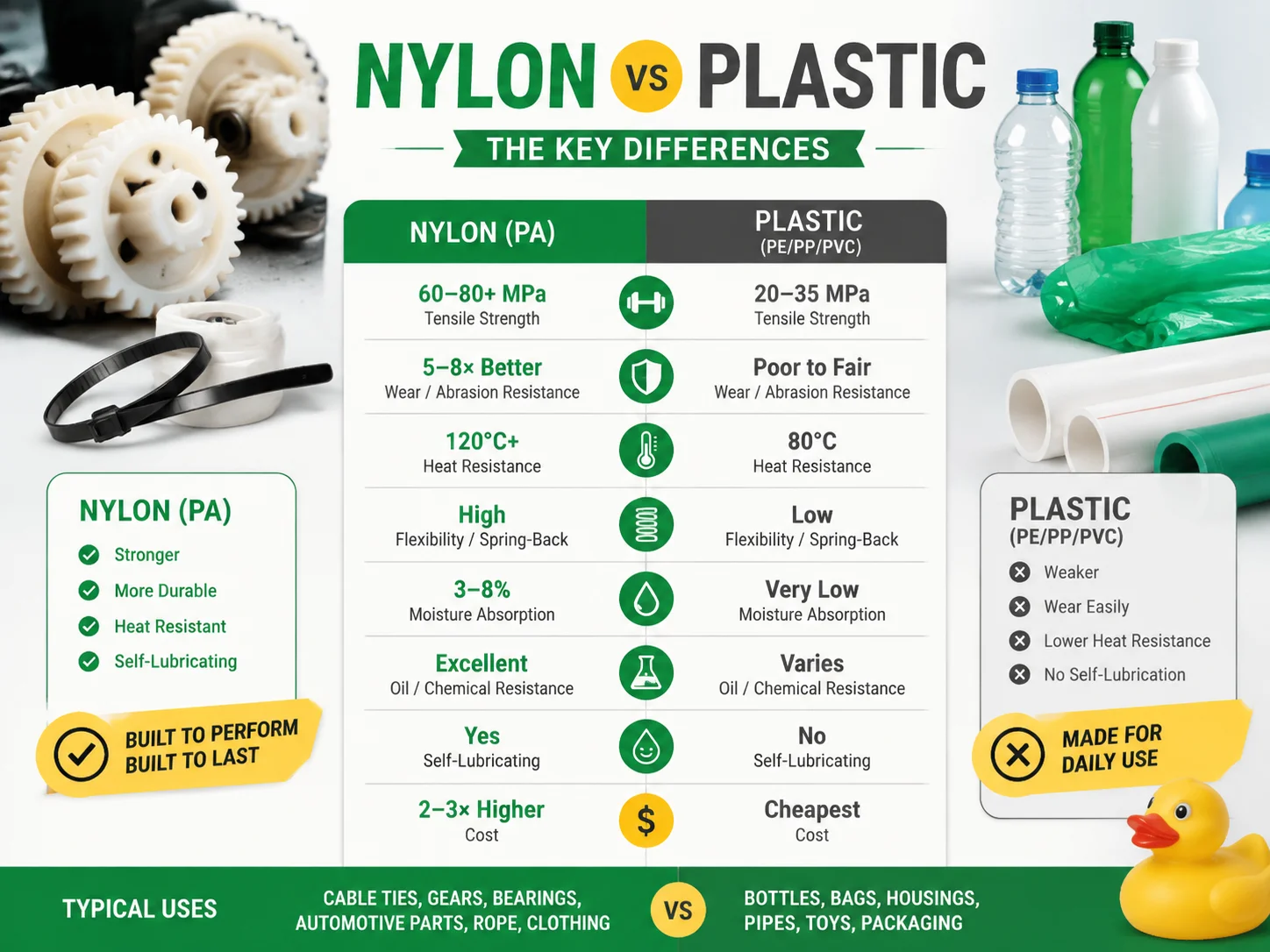
| Aspect | Nylon (PA) | Commodity Plastic (PE/PP/PVC) |
|---|---|---|
| Tensile strength | ~60–80+ MPa (2–3× higher) | ~20–35 MPa |
| Wear / abrasion resistance | Excellent (5–8× better) | Poor to fair |
| Heat resistance | Stable to 120°C+, melts ~220–260°C | Softens above ~80°C |
| Flexibility / spring-back | High, returns to shape | Lower, deforms permanently |
| Moisture absorption | 3–8% (absorbs water — a weakness) | Very low (hydrophobic) |
| UV resistance (unprotected) | Moderate, degrades in sun | Varies (PP similar, PE better) |
| Chemical / oil resistance | Excellent against oils, fuels | Good against acids (PVC); weak vs oils |
| Self-lubricating | Yes (low friction, quiet) | No |
| Cost | 2–3× more expensive | Cheapest |
| Typical products | Cable ties, gears, bearings, automotive parts, rope, clothing | Bottles, bags, housings, pipes, toys, packaging |
Material Properties Compared: Strength, Heat, Moisture
Strength
Nylon has anywhere from two to three times the tensile strength compared to general-use plastics at a similar thickness (around 80 MPa against 20 to 35 MPa), provides better resistance to physical stress caused by cycles of bending and abrasion which makes nylon cable ties, gears, bushings, and rollers popular in the industry.
Heat
The ability of nylon to retain its form even at around 120C means that it can be used for many applications where other plastics start melting and changing their shape at some 80 C. That is why there are many uses of nylon in engine compartments, industries characterized by high temperatures, and anywhere related to heat. Because of this, a plastic zip tie will sag while nylon will stand firm even when near to a hot engine.
Moisture — the honest caveat
This is the specific deficiency of nylon: it uses water (3%–8% by weight depending on the type of nylon). Water acts as a plasticizer causing the nylon products to shrink and become less stiff when exposed to moisture. Unlike common plastics, which can resist the absorption of water, thus avoiding any change in dimensions. Therefore, if engineers are dealing with sensitive parts under humid conditions, they have to work with POM or PA12.
Appearance & Feel: How to Tell Them Apart
There are cases when material can be distinguished as nylon from simple plastic without testing.
- Bending: Nylon bends and comes back to its original shape; simple plastics bend but do not regain their shapes.
- Feel: Nylon is smooth while PP feels waxy and soft at the same time; PVC feels sticky or rubbery.
- Sound: The sound produced when nylon hits the ground is dull while common plastics sound high in pitch.
- Color: Natural nylon comes in cream color while many plastics are bright white.
- Burn test (only in well-ventilated location!): Nylon produces a blue flame and smells similar to plastic burning smoke; PE/PP produces a yellow flame and smells like a candle.
Durability: Which One Lasts Longer?
When it comes to various applications involving loads and friction, nylon outperforms common plastic, often lasting 2–5 times longer than its equivalent while maintaining over 70% of its reliability even after several outdoor usage years in some types. For many simple static applications (for example, a storage container or a pipe), both kinds are good enough that the difference won’t be significant.
One thing to keep in mind is that unprotected nylon, like other plastics, can degrade from constant exposure to UV, which means that all outdoor applications made of nylon (these might be cable ties or some clamps) require using a special ultraviolet-resistant (also called UV-rated or black) nylon, which was developed exactly for that reason.Our article on whether zip ties are UV resistant digs into how outdoor grades differ from indoor ones.
Cost Comparison: Why Nylon Costs More
The production of nylon resin involves more complicated chemical processes than that of common plastics, resulting in more expensive material costs. Typical market relations:
| Material | Typical Resin Price (relative) | Why |
|---|---|---|
| PE / PP / PVC (commodity) | Baseline (cheapest) | Simple polymerization, huge volumes |
| Nylon PA6 | ~1.5–2× commodity | More complex chemistry (caprolactam) |
| Nylon PA66 | ~2–3× commodity | Two monomers, higher performance, tighter supply |
| Glass-reinforced / flame-retardant nylon | ~2.5–4× commodity | Additives and compounding |
As far as manufactured goods are concerned, the price gap is much smaller; for instance, the price of a nylon cable tie is about 1.5–3 times higher than that of a plastic cable tie, but because of its sturdiness and toughness, the cost of using it in the long run is often less from the point of view of industrial users.
Types of Nylon: PA6, PA66, and Reinforced Grades
| Grade | Strength | Heat | Moisture Absorption | Typical Uses |
|---|---|---|---|---|
| Nylon 6 (PA6) | Good | Good | Higher | General parts, cable ties, packaging film |
| Nylon 66 (PA66) | Higher (stiffer, stronger) | Better (~40°C higher melting point) | Slightly lower | Load-bearing parts, automotive, premium cable ties |
| Glass-filled (PA66-GF30 etc.) | Near-metal stiffness | Excellent | Reduced | Structural brackets, housings, pulleys |
| PA12 | Moderate | Good | Very low | Fuel lines, pneumatic tubes, precision parts |
Concerning cable ties, PA66 is the finest material available due to its strength over PA6 and resistance to heat; hence, the packaging for quality zip ties has “nylon 66” printed on it.
Where to Use Nylon vs Where Plastic Is Fine
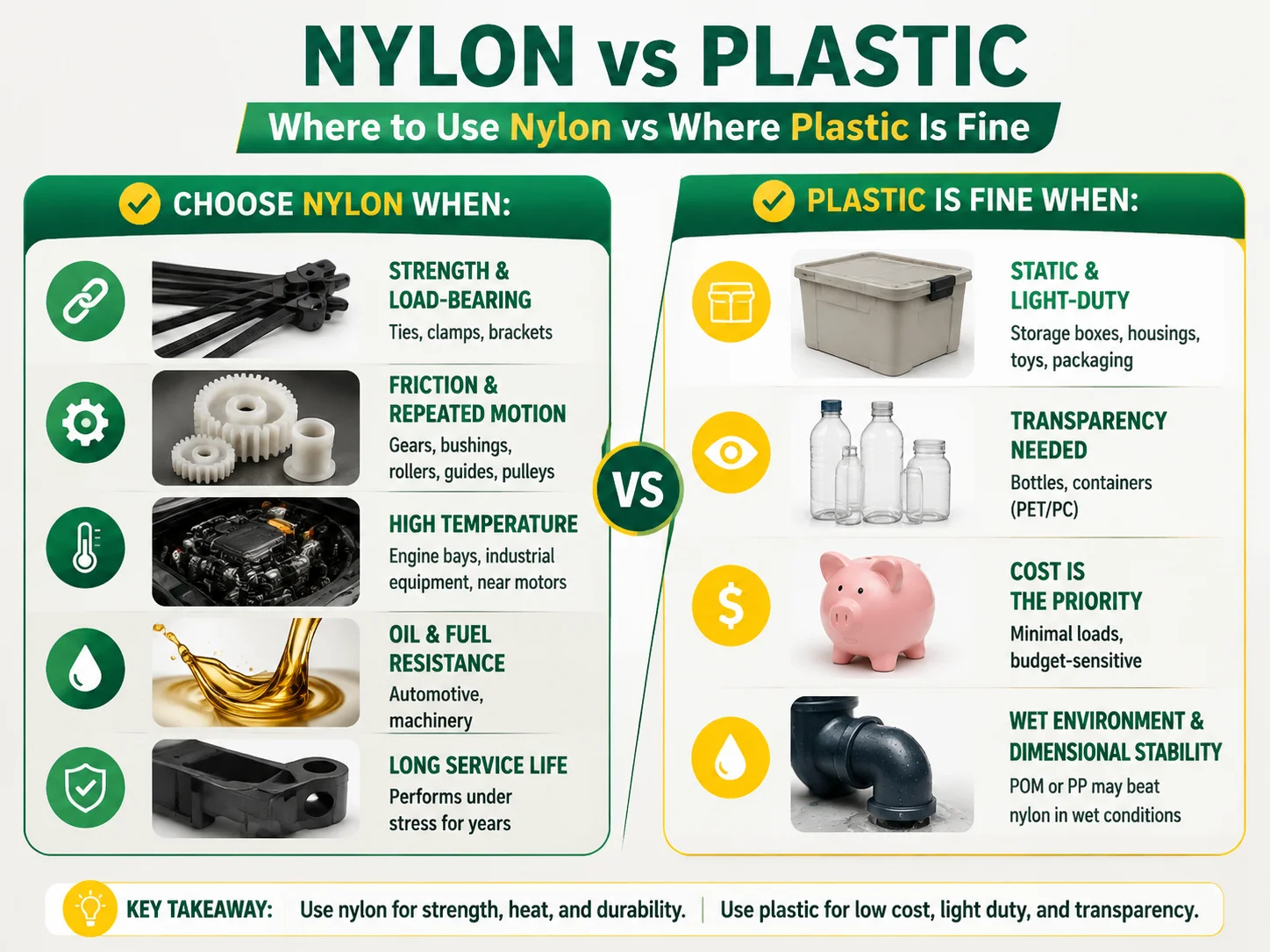
Choose nylon when:
- You need strength and durability for load-bearing purposes (cable ties, clamps, supports).
- There is friction or repeated movements (gears, bushings, rolls, guides, pulleys).
- The environment is warm (engine bays, industrial machinery, near engines).
- You need oil- or fuel-proof (in automobiles and machinery).
- You want to ensure long-term use under stress.
Commodity plastic is fine when:
- The component remains unchanged as well as the nature of work (storage bins, shells, toys, packaging)
- You need transparency (bottles, vessels are made from PET/PC)
- Price is the main concern and load is low
- Influence of humidity is more relevant than strength (in this instances, POM or PP might be superior than nylon)
Is Nylon Safe? Health & Environment Facts
Although nylon is an inert and stable polymer, it is regarded as being safe to use for the general public. It is utilized in films for food packaging, cooking instruments (like nylon spatulas), textiles that touch the skin, and medical items. The unreacted monomers are a hazard when the nylon is raw, but nylon as a product is safe for use.
- Skin contact: Since it is a synthetic material, there are people who may be sensitive to it at some level, but nylon is generally regarded as not being an allergen.
- Heat: it is important to avoid overheating nylon (for instance, cheesing some spatulas made from nylon), as is the case with any other thermoplastic.
- Environment: ordinary nylon is not biodegradable as is the case for most other plastics, although it is recyclable and there are new bio-based nylons like the one derived from castor oil available.This is also why eco-conscious buyers look at biodegradable zip tie options for single-use applications.
Frequently Asked Questions
Should I stop wearing nylon?
No — a general prohibition against wearing nylon has no scientific foundation. Nylon is a common and stable textile fiber that is safe for everyday use. The only potential downsides to using nylon are that it is less breathable than cotton, making the user feel hot or perspiring, and that some people prefer to avoid using it due to comfort issues. The only caution is that, like every synthetic fabric, nylon releases microfibers in washing. If you do not mind these factors, there is no health reason to refrain from using nylon.
Is nylon an unhealthy material?
No, not under ordinary use. Finished products made of nylon are inert and safe for contact, food packaging, and use in clothing. The health concerns that sometimes crop up about nylon include (1) overheating it – being a plastic, it can give out fumes in case of charring, so it should be kept below its rated temperature; and (2) production stage exposure to raw monomers – this is a factory safety issue rather than one for consumers. For consumers, nylon is one of the more durable and well-understood synthetic materials being used in everyday lives.
Is nylon 100% plastic?
Yes, nylon is completely a plastic, it is artificial polyamide polymer. It is not a natural fiber and not a fiber made up of combination of cotton or wool, even though nylon fiber is often combined with these materials while making textiles. It is simply a high-performance product of the plastic family: all nylon fibers are plastic fibers but not all plastic fibers are made of nylon.
Is nylon the same as plastic?
This is not entirely accurate. Nylon belongs to the category of plastics, but the word “plastic” is a general term covering many materials out there in the world. Nylon, being the specific engineering group of plastics, can be classified as the polyamide. This is because it is usually stronger, more durable, and heat resistant than harder kinds of plastics (polyethylene, polypropylene, polyvinyl chloride, etc.). That is: all kinds of nylon are plastics, but nylon and regular plastics are not the same materials, which is why nylon cable ties do the job much better than plastic ones.
References
- Encyclopaedia Britannica — Nylon: chemical compound
- Science History Institute — Wallace Carothers and the story of nylon
- Rapid-Protos — Nylon Plastic: Strength, Moisture Behavior & Machining Guide
- UL — plastics flammability and material standards (UL 94)
- ISO — plastics standards for polyamides (ISO 16396)
- U.S. EPA — plastics and recycling information
Conclusion
Is nylon made of plastic? Indeed, it is — however, it is the best type of plastic. Nylon is classified as a polyamide engineering plastic with 2-3 times the strength of regular plastic, improved durability and resistance to heat, and the strength to replace metals in making gears, bearings, and cable ties. The price is 2-3 times higher as well, but for a valid reason: a product made out of nylon lasts much longer. The disadvantages are the following: its ability to absorb moisture; sensitivity to UV light. But both disadvantages can be managed if you choose the right grade of the material.
It matters when you choose between something — a cable tie, for example. “Nylon 66” means you are dealing with the high-quality material used for production, while “plastic” means low quality. So if you need good resistance to heat and mechanical load or a long lifespan, you have to pay extra for products made out of nylon. In case you are going to deal with the task that is not demanding, ordinary plastic will work.