


What Is the Best Wire Tie? A Buyer’s Guide Across Materials, Brands, and Applications
A solar farm installer in Nevada faced the challenge of how to fasten substantial lengths of DC cables to aluminum racks for a 25-year design life and queried himself as to which is the best wire tie for this fulfilling this requirement. What he was looking for was not another brand name or cost but rather the best material which is of great significance in ensuring that there will be no problems with mechanical strength over two and a half decades of operation in the desert sun with its extreme temperatures, thermal cycling, and occasional sandstorms.
A few months later, an electrical panel manufacturer located in Chicago posed the same question regarding the best wire ties for him and received a completely different answer – black UV stabilized nylon 6/6 which is perfectly suitable for indoor use in a climate-controlled environment with no exposure to sunlight at all. As we can see, what is the best wire tie for one person is not good for someone else. The same question of what is the best cable tie does not have an unequivocal answer as the term best depends on such factors as environment, mechanical impact, service life, obtaining relevant certifications, and financial possibilities that vary from one case to another.
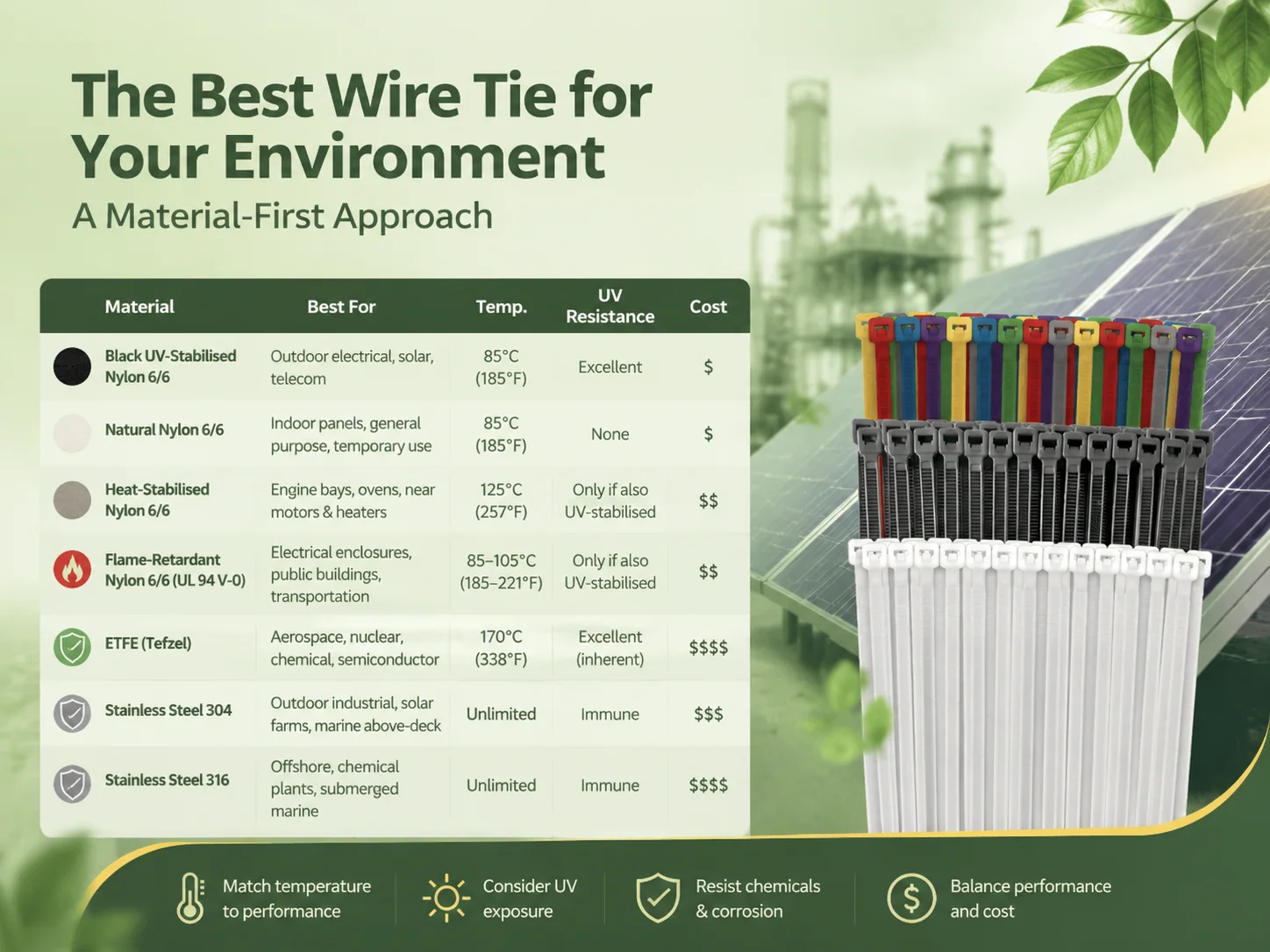
The Best Wire Tie for Your Environment: A Material‑First Approach
Selecting the right material for a cable tie is the most crucial factor since the material will control the temperature range, UV resistance, chemical resistance, tensile strength and cost of the tie. If one picks a wrong material, then the cable tie will fail in its job. This is not because the cable tie was defective, but because it was asked to perform under conditions for which it was not manufactured in the first place. The chart below shows the order of the most common types of cable tie materials from the most versatile to the most specific along with recommendations on where they should be used.
| Material | Best For | Continuous Temperature | UV Resistance | Relative Cost |
|---|---|---|---|---|
| Black UV‑Stabilised Nylon 6/6 | The default choice for outdoor electrical, solar, and telecommunications. The carbon‑black stabiliser provides 5–10 years of outdoor service in temperate climates. | 85°C (185°F) | Excellent | $ – Economical |
| Natural Nylon 6/6 | Indoor electrical panels, general‑purpose bundling, temporary use. The most economical option for controlled indoor environments. | 85°C (185°F) | None | $ – Most economical |
| Heat‑Stabilised Nylon 6/6 | Engine bays, industrial ovens, near motors and heaters. Retains mechanical properties at temperatures that would embrittle standard nylon. | 125°C (257°F) | Only if also carbon‑black stabilised | $$ – Moderate premium |
| Flame‑Retardant Nylon 6/6 (UL 94 V‑0) | Electrical enclosures, public buildings, transportation, plenum spaces. Self‑extinguishes and does not drip burning material. | 85–105°C (185–221°F) | Only if also carbon‑black stabilised | $$ – Moderate premium |
| ETFE (Tefzel) | Aerospace, nuclear, chemical processing, semiconductor fabs. Outstanding chemical and radiation resistance. Inherently UV‑resistant. | 170°C (338°F) | Excellent (inherent) | $$$$ – Several times the price of nylon |
| Stainless Steel 304 | General outdoor industrial, solar farms, marine above‑deck, high‑temperature. Effectively unlimited outdoor life. Immune to UV. | Effectively unlimited | Immune | $$$ – More expensive than nylon |
| Stainless Steel 316 | Offshore platforms, chemical plants, submerged marine, any chloride‑rich environment. Molybdenum content resists pitting corrosion. | Effectively unlimited | Immune | $$$$ – The most expensive common cable tie material |
The Best Cable Tie Brands: Quality, Certification, and Availability
There is material that refers to specification. Brand is related to providing guarantee that specification is being followed. Choosing the top cable tie brand in terms of cables and electricity can be easily determined by the availability of documentation confirming quality and proven performance. Below are the manufacturers that cannot help but satisfy established criteria by producing well-established cable tie brands including several strong sides. The first in North America, Panduit (USA) has its own strong presence in the North American market with a colorful diversity of cable tie models available on the market for international audience. Cable ties produced by HellermannTyton (UK/Germany) have established a great reputation and can be found in every electrical/digital hardware store worldwide. The last two brands ABB with Thomas&Bett, and Ty-Rap, which created the first cable tie in 1958, provide various options on the market.
Alongside these well-known brands, suppliers such as igoto provide a solid option: the same nylon 6/6, the same UV stabilisers, strength ratings, and the same UL listing wherever applicable but at a price which is based on efficient production and direct supply. For a solar installation contractor pitching for a multi-megawatt project, a panel producer manufacturing thousands of components each month, or a distributor equipping his warehouse, a specific supplier like igoto gives access to everything a buyer may need, from natural nylon to different UV and heat stabilized materials including flame-retardant and stainless steel and corresponding certification.
The Performance Specifications That Define a Quality Wire Tie
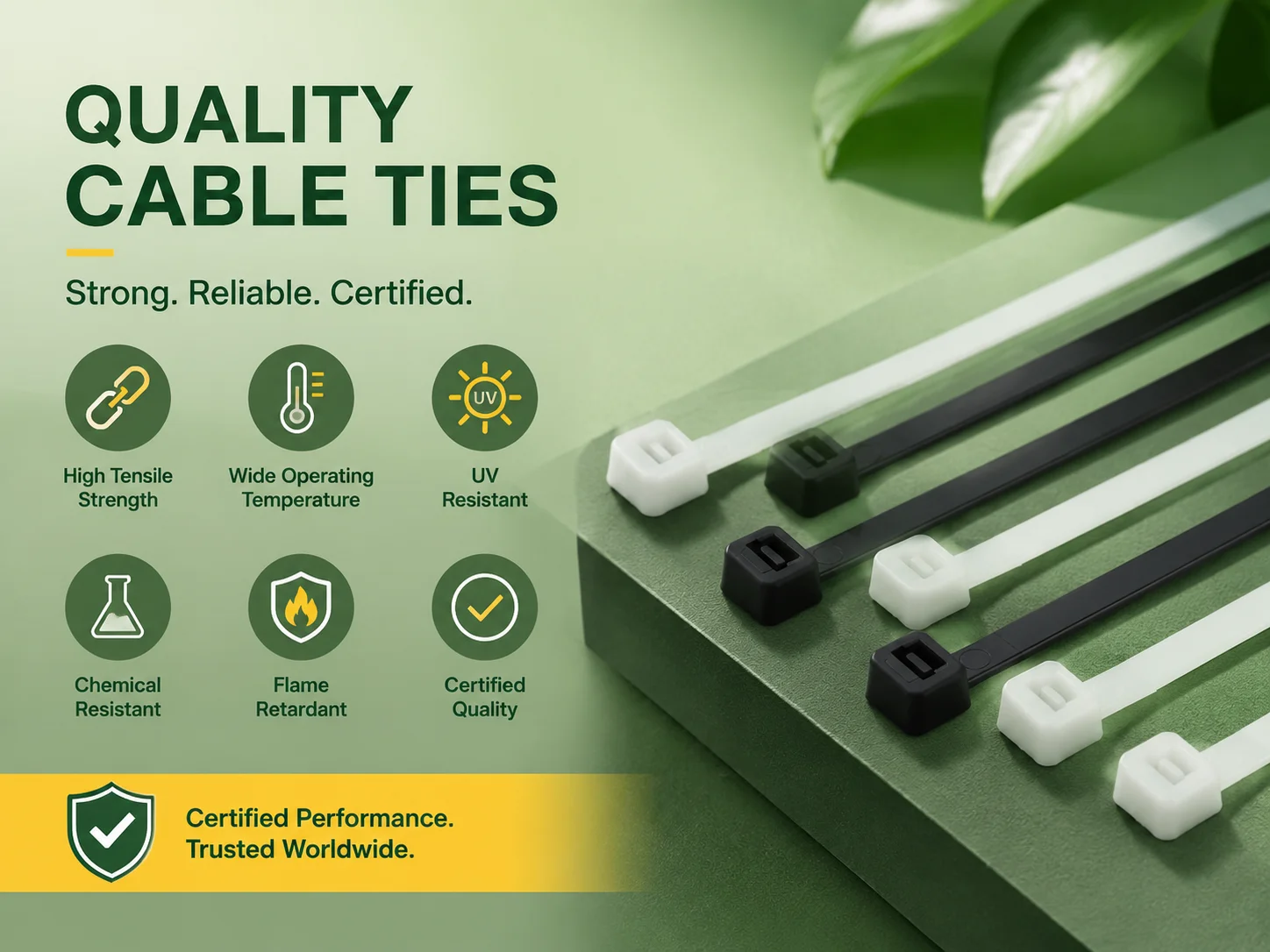
The definition of a wire tie is based on a limited number of measurable parameters. Knowing their significance and appropriate values will allow you to quickly evaluate products from various brands and establish whether the wire tie you plan to purchase will perform the task you need. The most important parameters include tensile strength, which refers to the minimum force the wire tie must support in standard conditions of the pull test, as described by UL 62275 standards (this will appear on the packaging), as well as operating temperature range (this indicates the temperature the cord can withstand without losing significant strength). UV resistance (for outdoor use, the tie must be specifically labelled as UV‑resistant — a black tie is not automatically UV‑resistant unless the manufacturer states it, as detailed in our guide on whether zip ties are UV resistant), chemical resistance (nylon is resistant to oils, greases, and common solvents but is attacked by strong acids and phenols; stainless steel and ETFE provide far broader chemical resistance for aggressive environments), flame resistance (for use inside electrical enclosures, public buildings, and transportation, a flame‑retardant rating — UL 94 V‑2 or V‑0 — may be required by code or by the equipment manufacturer’s listing), and certifications (a UL listing, a MIL‑STD‑23190 qualification, or a material test report from the manufacturer is the independent verification that the tie meets its published specification — a tie that lacks these certifications is an unknown, and an unknown is not acceptable in a safety‑critical installation). For a comprehensive look at how these parameters translate into real‑world holding power, our guide on how much weight zip ties can hold explains the relationship between tensile strength, safety factors, and safe working loads.
How to Select the Best Wire Tie for Your Industry
The ideal cable tie for one industry is not necessarily suitable for another. Depending on a wide array of working conditions, regulations, and possible failure consequences, a tie will need a specific material, certification, and cost. In electrical contracting and panel building, black UV-stabilized nylon 6/6 is the norm for outdoor applications and natural nylon for uses in indoor installations; in any case, ties used in conjunction with UL certified equipment must have UL certification themselves. In the solar and renewable energy businesses, the manufacturing process will dictate which options to choose from, with black UV-stabilized nylon being typically used only in projects with short planned maintenance cycles and 304 or 316 stainless steel being selected for installations not subject to replacement for at least 20-25 years. In the automotive, railway, and aviation industries, heat-resistant nylon (up to 125 degrees), ETFE (up to 170 degrees), or stainless steel will be employed depending on the working conditions, with MIL-STD or AS certification often being required. In the food and beverage processing industry, stainless steel ties are generally preferred in production areas because of their ability to be cleaned using CIP technology, thus preventing bacterial formation in crevices, unlike nylon ties. In pharmaceutical and chemical manufacturing, the appropriateness of the material depends on how chemically resistant it is, with ETFE or stainless steel recommended as the materials with best versatility properties. In the marine industry, stainless steel is the minimum option if being used in direct contact with salty water or in conditions involving exposure to sun and moisture.
In any of these industries, the most common cause of cable tie failure is not an issue that pertains to the manufacture of the product. Rather, it is the incompatibility of the materials used in the manufacturing process with the specific environmental conditions. An example of this is a natural nylon cable tie being used in an external situation. Another example is a common nylon cable tie being employed in the engine compartment. Finally, there might be a case of using a black cable tie which was identified as being UV‑resistant but was not. The ideal cable tie would be one in which materials, tensile strength, and certificates conform to the specific environmental conditions.
Frequently Asked Questions
What is the best quality cable tie?
The highest-quality cable tie is that which is produced from a dependable raw material such as nylon 6/6 or UV-stabilised nylon. It must be made by a reputable company that publishes tensile strength specifications, temperature limits of use, and possesses recognized certifications, such as UL listing. The quality of a cable tie is determined not only by its price and brand recognition but also by its performance as evidenced by documentation.
What is the best cable tie brand?
No single brand of cable ties can be considered ideal for each and every application. Among the most well-known companies in North America is Panduit, which is renowned for its large product catalog and ample technical documentation. HellermannTyton is a leader in the European and industrial cable tie markets. ABB (Thomas & Betts / Ty-Rap) invented the first nylon cable ties and has been a leader in the electrical and industrial markets for many decades. For companies looking for verified products at reasonable prices, there are many small companies like igoto that offer the same materials and specifications as the big companies.
Which zip ties are the strongest?
Stainless steel zip ties are the most reliable, with their tensile strength of more than 600 pounds for heavy-duty model. Heavy duty of nylon ties that have 250 of tensile strength (12.7 mm) has maximum possible polymer strength for such model. In most cases the question is not “which one is strongest”, but “which one is strong enough” — 18-pound one which is sufficient for a small data cable bundle; while for the case of the armored power cables one must use 120-pound ties.
What are the different types of wire ties?
The different sorts of wire ties are classified according to the material from which they are made: natural nylon 6/6 for indoor usage; black UV-stable nylon 6/6 for use outdoors; heat-resistant nylon for high temperature conditions; flame-resistant nylon for building electrical wiring and public places; ETFE (Tefzel) for extreme chemicals and high temperatures; polypropylene for specific chemical conditions; and stainless steel for maximum strength and weather resistance. Each variety comes in various lengths and widths and different classes of tensile strength depending on the bundle dimensions and the working load. For a complete guide to all available cable tie materials and their properties, our article on what zip ties are made of covers each material in detail.
References
- Panduit — Cable Tie Product Range and Technical Specifications. Manufacturer of nylon, stainless steel, and specialty cable ties with published tensile strength, temperature, and weathering data.
- HellermannTyton — Cable Management and Fastening Solutions. Global manufacturer providing detailed material performance data for every cable tie material and size.
- ABB (Thomas & Betts) — Ty‑Rap Cable Ties and Fastening Products. Manufacturer of the original nylon cable tie and a full range of fastening solutions for industrial and utility applications.
- UL 62275 — Cable Management Systems. The defining standard for cable tie testing, rating, and listing in North America and internationally.
There is not just one best wire tie. Rather, the best wire tie is the one that is suitable for your particular purpose, in that its material is capable of withstanding temperature as well as sunlight, as well as the chemicals it will come into contact with; its tensile strength is enough to exceed the load safely; and its certifications will satisfy the inspector, auditor, and insurance underwriter alike. For solar installers in Nevada, the best tie is 316 stainless steel. For panel makers in Chicago, it should be black UV-stabilized nylon. The best tie is the one that can be adjusted without cutting for data center technicians. All of them have one thing in common: they chosen this tie by matching the specifications and material used to the environment as well as the load. igoto supplies cable ties of all possible materials, sizes, and strengths available on the market, because the best tie is the one that can hold.