




How to Read Zip Tie Specifications ?You Order the Right Ties Every Time
If you ask five vendors for “a zip tie,” you will get five different goods back with the following results: One zip tie withstands a maximum weight of 18 pounds, while the other one withstands 175 pounds of weight. One zip tie can last a summer on your rooftop, and the other one will become brittle within a month. One zip tie has a UL listing that would be accepted by an inspector, while the other one is claiming something that cannot be verified. This major difference is the reason every serious buyer should learn how to interpret zip tie specifications before making his/her purchase — since the term included in the PO means nothing until the exact numbers behind it are provided.
This guide is targeted at the person who is responsible for cutting the PO and it provides guidance on what specifications should be included in your spec sheet or RFQ in simple language. You will learn how every specification affects price performance, and ability of the ties to pass inspection. At the end of this guide, you will make a checklist of crucial zip tie specifications.
What “zip tie specifications” actually means
A zip tie cannot be defined by only one specification. A complete specification has many details about the zip tie, including its length and width. Its load capacity and material are included in the specification, as well as its exposure to weather conditions. Different standards are identified in the specification, as well as packaging of tie. If one of the specifications is missing, the seller will fill it in according to the criteria.
Good specifications help get rid of ambiguity. Instead of vague message, the seller receives an order for tie from different producers that are producing the same product. The next sections provide detailed specifications for the tie including its measurements.
The core dimensional specs
Three numbers describe the physical tie: length, width, and the maximum bundle diameter it can close around. They are simple, but each one carries consequences.
Length
Length is measured from the tip of the tail to the back of the locking head, in millimetres or inches. It sets the largest bundle the tie can wrap — a tie can only close around a diameter of roughly its length divided by pi, minus the head. Common lengths run from 100 mm (4 in) up to 1000 mm (40 in) and beyond. Buy too short and the tie will not close; buy far too long and you pay for material you trim off and throw away.
Width
Width is the single most reliable indicator of how strong a tie is, because a wider strap has more cross-section to resist the pull. Standard widths cluster around 2.5, 3.6, 4.8, 7.6, 9.0, and 12.7 mm. As width climbs, so does tensile strength — and price. For a full breakdown of how width maps to holding power, our guide to zip tie width and strength is the deep dive; for a spec sheet, it is enough to know that width and strength move together.
Maximum bundle diameter
Ties are built to secure packages within a specific size range, both in terms of width and length. A very long, narrow tie may work on a large package but may not be strong enough to do the job. Always confirm the size of the package with the manufacturer’s specifications and not just the length.
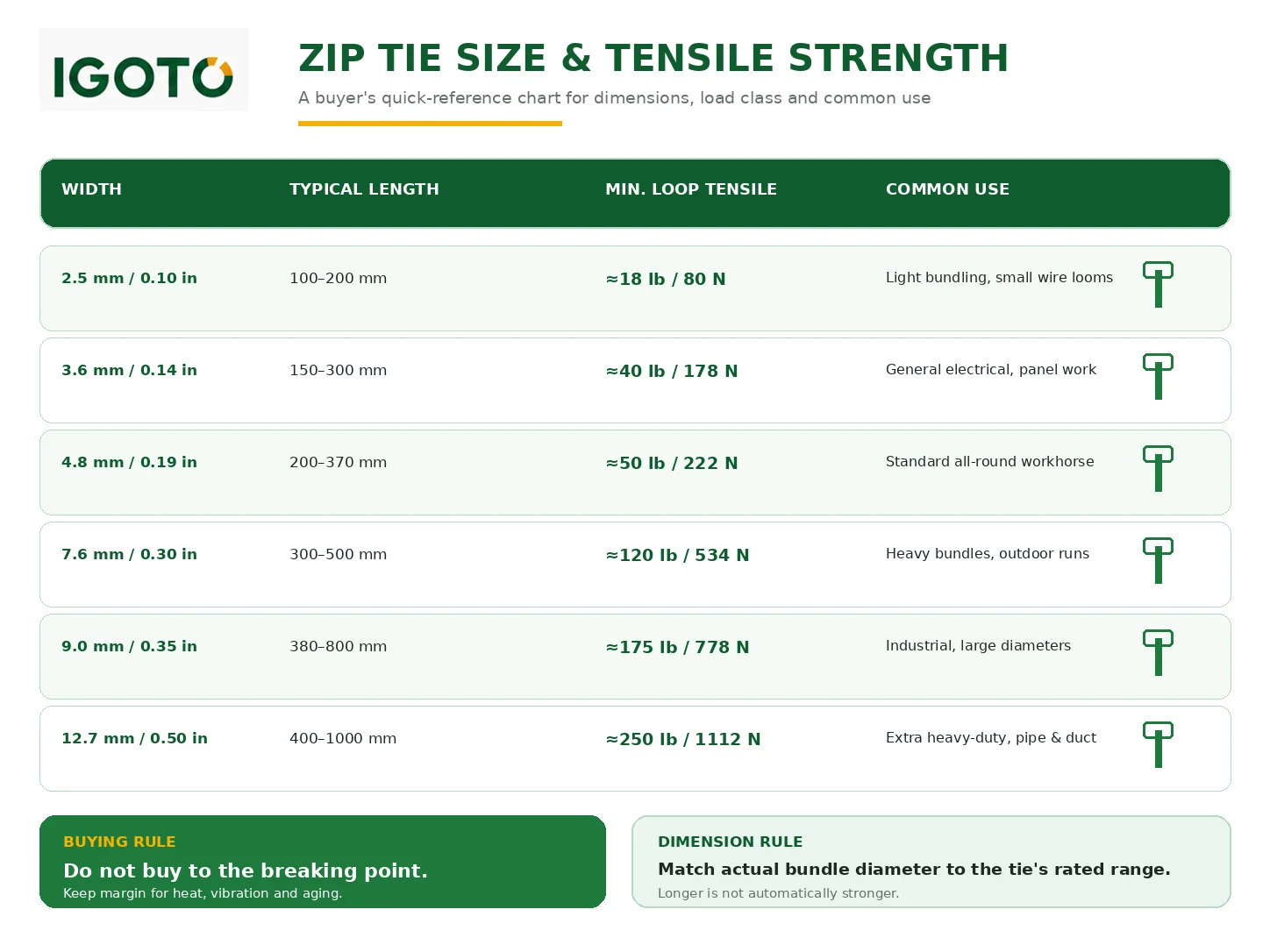
The table below provides some information regarding the widths and lengths of a regular tie published by various manufacturers including its estimated breaking strength. However, do not treat the figures as exact and refer to them as approximate.
| Common width | Typical length range | Typical min. loop tensile | Common use |
|---|---|---|---|
| 2.5 mm (0.10 in) | 100–200 mm | ~18 lb (80 N) | Light bundling, small wire looms |
| 3.6 mm (0.14 in) | 150–300 mm | ~40 lb (178 N) | General electrical, panel work |
| 4.8 mm (0.19 in) | 200–370 mm | ~50 lb (222 N) | The standard all-round workhorse |
| 7.6 mm (0.30 in) | 300–500 mm | ~120 lb (534 N) | Heavy bundles, outdoor runs |
| 9.0 mm (0.35 in) | 380–800 mm | ~175 lb (778 N) | Industrial, large diameters |
| 12.7 mm (0.50 in) | 400–1000 mm | ~250 lb (1112 N) | Extra heavy-duty, pipe and duct |
If your job lives mostly in the standard sizes, our reference on standard cable tie sizes and the fuller guide to choosing dimensions cover the size-to-application mapping in more detail.
Tensile strength: the spec buyers misread most
Tensile strength, often referred to as loop tensile strength or maximum load, is the main figure on the package and is the one factor that causes the most buyer confusion. The marking on the product indicates the breaking strength of the tie, or load necessary to break the tie over a specific test, such as UL 62275 or MIL-STD−23190. This number is not the load the tie is supposed to carry.
In practice you want a healthy margin between the rated break strength and the real working load, because vibration, temperature, and years of service all eat into that headroom. A common rule of thumb is to select a tie rated well above the actual load rather than right at it. For a buyer-focused treatment of this exact trap, our procurement guide to heavy-duty zip ties spells out how loop tensile ratings translate into safe ordering decisions.
Don’t go by the rated tensile strength of the tie. That figure refers to the breaking point, not the working point of the product. Select a tie with a rated strength well above your actual bundle load, and lower that strength even more for heat, vibration, and longer usage. If you choose a tie that operates at or close to its rated strength, it will not be able to perform effectively.
Material grade: what your ties are actually made of
Material is the point at which a specifications document either succeeds or fails. Most ties are made from nylon 6/6, also known as PA66, that is known for its great strength, flexibility, and resistance to temperature. However, not all nylon is the same. Ties made from 100% virgin resins have equal strength and coloring while ties made from regrind or containing fillers might look the same and be unreliable under certain conditions.
This is a spec worth stating explicitly. igoto, for example, moulds its nylon cable ties from 100% virgin PA66, which is why the strength figures on the datasheet hold up in service rather than only on paper. Where the environment is harsher — heat, chemicals, or the outdoors — the base material is modified, and it pays to know which grade you are ordering. Our primer on plastic tie cable materials explains how the resin choice drives nearly every other property on this list.
Environmental and safety specs
Two ties with identical dimensions and tensile ratings can behave completely differently once the environment is factored in. These are the specifications that decide whether a tie survives its posting.
Operating temperature range
Standard nylon ties typically operate from around -40 °C to 85 °C, softening at the high end and growing brittle at the low end. For engine bays, boiler rooms, or ovens, a heat-stabilised grade extends the ceiling considerably. If your application runs hot, specify it — our guide to choosing heat-stabilised nylon zip ties covers where the standard grade stops being safe.
UV resistance
Plain nylon degrades in sunlight within months. For anything outdoors, specify a UV-stabilised tie — in practice this almost always means black, because the carbon black that provides the colour is also what blocks the UV. A natural or coloured tie outdoors is a warranty claim waiting to happen, so make UV resistance an explicit line item for exterior work rather than assuming it.
Flammability rating
Flammability is important when it comes to electrical enclosures, data centres, and in any place where a fire prevention inspector will check. High-quality nylon binders usually come with a UL94 V-2 rating, which means they self-extinguish and do not help the spread of fire. If you have a job that needs flammability ratings, include it in the specifications and check with the supplier.
Chemical resistance
Nylon resists many oils and solvents but is attacked by strong acids and can absorb water in very humid settings. If the ties will meet aggressive chemicals, note it — a stainless steel or specially coated tie may be the correct call instead of standard nylon.
Certifications and standards to require
For any job that requires regulations or is safety-oriented, appropriate documentation for the tie is just as important when determining its specifications in terms of the size as it determines the actual length of the tie. UL62275/IEC62275 is a standard that represents how tensile strength and other performance factors regarding tie functionality are measured in North America and other countries, while MIL-STD-23190 is a specification from the United States Armed Forces about kinds of superior ties that are made within specified sizes with traceability by lots. RoHS regulation is required for any commercial product that is to be exported to EU nations and covers limits on certain chemicals being present in it, while CE mark shows that the item can be sold in the EU market. ISO9001 declaration points out that the production of the product is controlled. Igoto’s nylon ties comply with UL, CE and RoHS and ISO9001 which is basically all industrial and export companies expect to have in the document list. When the certification of a standard is required, name this standard in the RFQ along with the proper documentation.
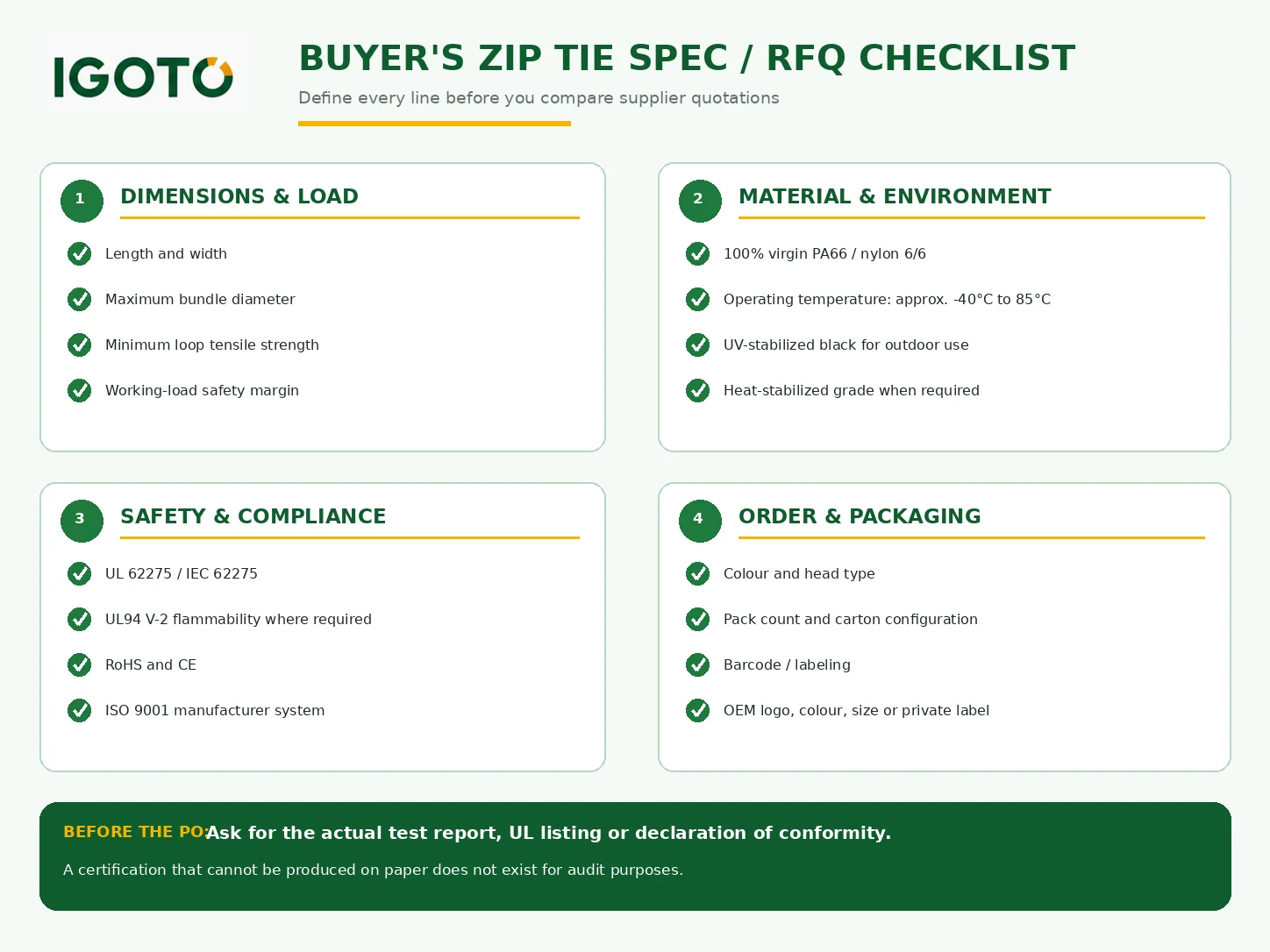
The certification that is not printed on the paper does not count for auditing purposes. It is necessary to require either certain test results or listing of the product before making an ordering, because verbal confirmation provided by the supplier will not pass the inspection stage.
Tolerances, colour, and packaging: the specs buyers forget
The parameters above decide whether a tie performs. These last few decide whether the order is easy to receive, use, and reorder — and they are the ones most often left off an RFQ.
Dimensional tolerance defines how much the finished tie may vary from its nominal length and width; tighter tolerances matter for automated installation tools. Colour is both cosmetic and functional — beyond black-for-UV, colour coding lets crews sort circuits or voltages at a glance, and consistent colour signals consistent resin. Head style is a spec in its own right: standard, low-profile, or releasable heads suit different jobs, a distinction our guide to choosing the right cable ties lays out.
Packaging closes the loop: pack count per bag, cartons per master box, labelling, and barcodes all affect handling and stock control. For volume buyers, this is also where customization lives — private-label bags, printed logos, bespoke colours, and non-standard lengths. igoto offers OEM and ODM service across logos, colours, sizes, and packaging, so the specification can extend all the way to how the product arrives on your dock.
How to write a zip tie spec or RFQ
Pulling it together, a complete zip tie specification on a purchase order or RFQ should name every line below. Copy this as a checklist:
- Length (mm or in) and width (mm or in)
- Minimum loop tensile strength (lb or N), stated as a minimum, not a nominal
- Maximum bundle diameter to be secured
- Material grade — nylon 6/6 / PA66, and virgin versus recycled resin
- Operating temperature range, with heat-stabilised grade if needed
- UV resistance for any outdoor use
- Flammability rating (for example UL94 V-2) where required
- Applicable standards and certifications (UL 62275, MIL-STD-23190, RoHS, CE, ISO 9001)
- Colour and head type
- Quantity, pack count, carton configuration, and labelling
- Any customization — printing, private label, non-standard sizes
Name each of these and two different factories will quote the same product, which is exactly what makes bids comparable and deliveries predictable. Leave gaps and you invite substitutions that surface only when the ties reach the field.
Matching specifications to igoto’s range
Once the spec is written, matching it to a supplier’s catalogue is straightforward. igoto organises its nylon range by tensile class, which lines up neatly with the loop-strength line on your spec sheet: a Small Size tie for light-duty bundling up to about 8 kg (18 lb); a Medium Size tie up to roughly 18 kg (40 lb); a Standard tie at 22 kg (50 lb) for the all-round workhorse role; and a High Strength tie spanning 40 kg (100 lb) to 80 kg (175 lb) for industrial loads. UV-resistant and flame-retardant grades sit across these classes for outdoor and fire-safety work.
Because every grade is moulded from 100% virgin PA66 and made to meet UL, CE, RoHS, and ISO 9001, the strength and compliance lines on your spec are covered by the base product rather than treated as extras. From there, OEM and ODM options handle colour, length, and packaging. To confirm which class fits a given load and environment, the choosing-the-right-cable-ties guide walks a bundle’s requirements through to a product choice, and the wider overview of zip tie types covers the specialty formats.
Quick answers
What is the most important zip tie specification?
Although there is not just one determining factor when it comes to strength, one can consider that, following a hypothetical order, tensile strength and material grade play a role in determining whether the tie will actually hold, while the dimensions tell us whether it will fit. Then again, certification and environmental specifications ultimately decide whether or not it can endure its use and pass inspection.
Does the rated tensile strength equal the safe working load?
No. The rated figure is the breaking point in a pull test. Your working load should sit well below it, with extra margin for heat, vibration, and age. Treat the number as a ceiling, never a target.
What temperature can standard nylon ties handle?
Roughly -40 °C to 85 °C for standard nylon. Hotter environments call for a heat-stabilised grade, and very cold ones call for care because nylon stiffens as it chills.
Which certification should I require for electrical work?
UL 62275 (or its international equivalent IEC 62275) for the tie itself, usually alongside a UL94 V-2 flammability rating and RoHS. For military or aerospace, specify MIL-STD-23190 with the appropriate type.
The bottom line
Reading zip tie specifications well is really just refusing to leave anything to chance. Dimensions decide fit, tensile strength and material decide whether the tie holds and endures, and the environmental, flammability, and certification lines decide whether it survives and passes audit. Write all of them onto your RFQ, ask for the paperwork behind the claims, and match the result to a supplier whose cable tie specifications are backed by virgin material and real certification. Do that, and the humble zip tie stops being a source of surprises and becomes exactly what a good spec makes it: predictable.