

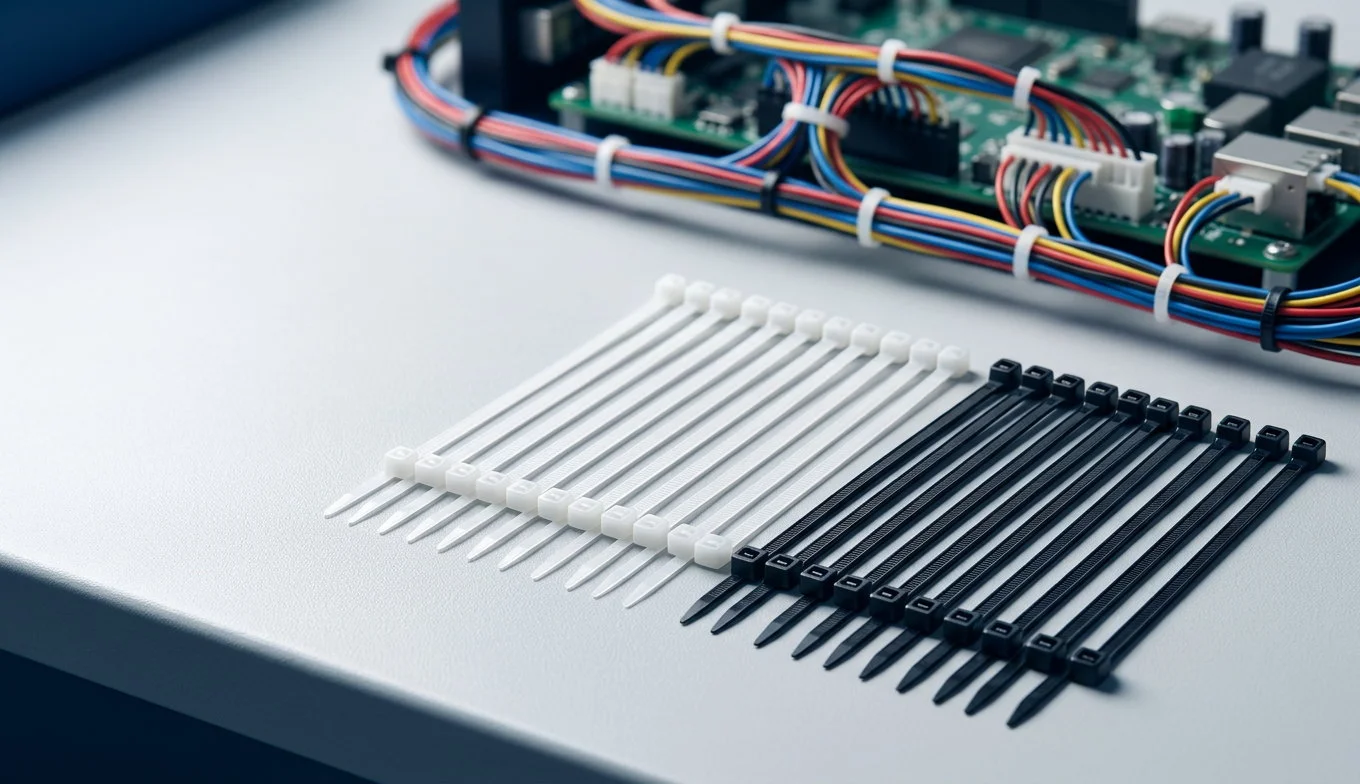

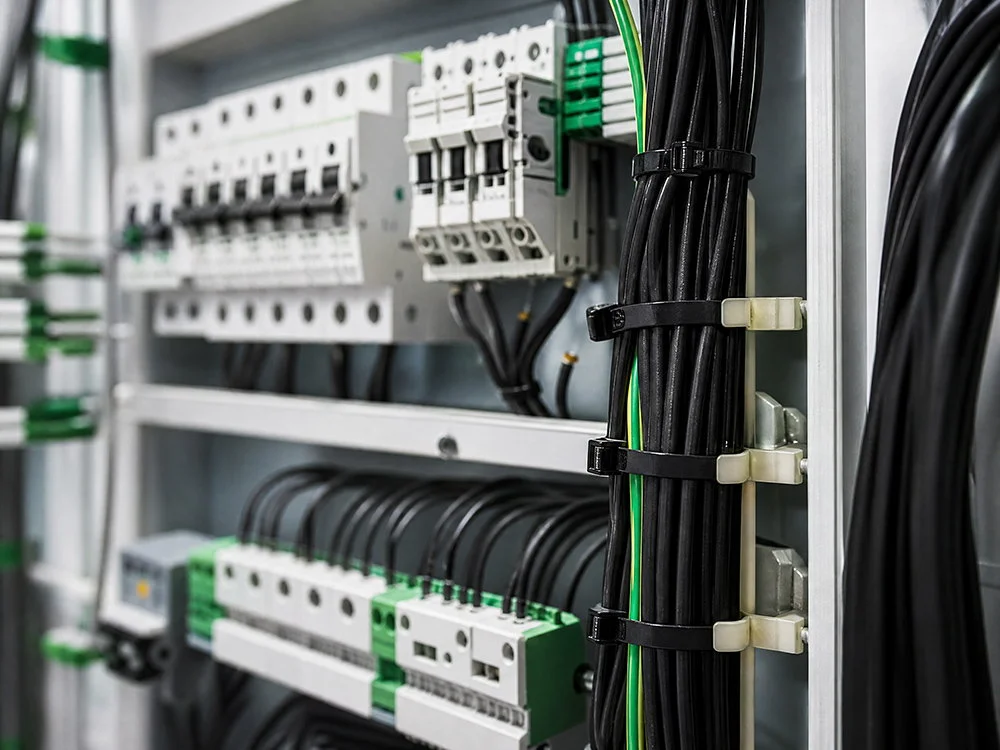

How much do you know about marine grade zip ties?
When it comes to defeating fasteners, saltwater is the most persistent enemy on the planet; the destruction process occurs gradually rather than suddenly, with corrosion affecting the latch mechanism, the belt surface, and the interface point on the metal in the course of eighteen months until the wiring in the bilge is hanging loose, but nobody knows the exact moment when that happened. That is why the term marine grade zip ties is not merely a marketing phrase but rather a specification by itself; it is also the reason for the high costs of an inappropriate choice made at a boat, dock, off-shore platform, or research icebreaker. This guide divides the topic into four factors affecting performance — type of material, core properties, standards adopted, and actual application environments — and presents some extreme cases, such as special subsea cable landings and Antarctic refilling vessels.
In short, true marine grade cable ties refer to the use of stainless steel 316 with roller-ball locking heads for safety-critical and submerged jobs; use of stainless steel 304 for splash protected areas; polyester-coated 316 for applications where cable jackets or dissimilar metals are involved; and use of black heat-stabilized nylon 6/6 which is UV resilient (full specifications are available from major suppliers in PDF); always check suppliers on what alloy grade, what salt spray test hours, and what loop strength. Well-known companies such as Panduit, Hellerman Tyton, or Ty-Rap provide thorough details of marine products and solutions and are good options to begin with; new companies that offer nylon 6/6 and stainless steel at 30-50% less price, such as igoto, can be beneficial too.
What “Marine Grade” Actually Means
There is not one specific certificate that confirms whether a cable tie is marine. Marine is just a short form of different characteristics that survive being attacked by three factors simultaneously: corrosion due to chloride ions, ultraviolet radiation reflected from water, and mechanical movement coming from engines, propellers, and strong waves. If it withstands just one of these three factors, it won’t survive. A standard white nylon tie can be used in a dry electrical cabinet, but it will not survive using it at a mast where it will suffer from the UV only, therefore, it will become yellow and brittle within a season. Being a plain 304 stainless steel tie, it won’t experience the sunshine; however, it will pit where salt is pooling under a clamp.
As a result, marine specification begins with an environment exposure zone and not with a catalog of products. Naval architects usually divide the ship into atmospheric zones (topside, exposed to sun and spray), splash zones (waterline, wet and dry, the most aggressive environment), submerged zones, and machinery spaces (where it is hot, oily, vibrating, and there are fire safety rules). Different zones of exposure dictate the material choice, which is why professionals create bills of materials that include four or five types of ties.
Material Types: What Marine Grade Zip Ties Are Made From
Material is the decision that carries the most weight. Everything downstream — tensile rating, temperature window, service life, price — follows from it.
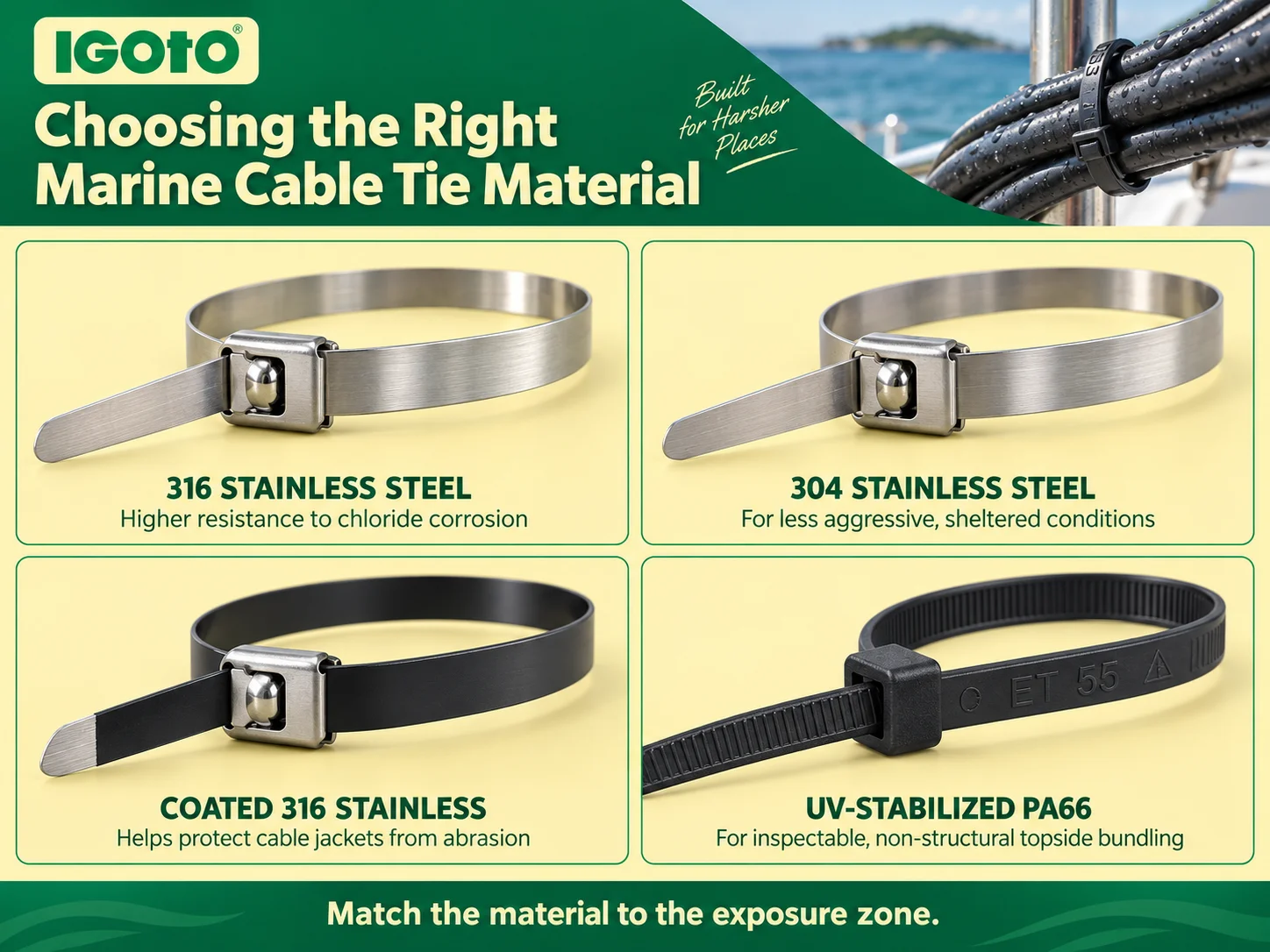
316 Stainless Steel: The Reference Material
Usually, when a specification mentions marine grade, it is referring to 316 stainless steel. However, to differentiate between 316 stainless steel and the widely used 304, there is only one element. In accordance with ASTM A240, while 304 steel does not have any molybdenum in its composition, 316 has between 2 and 3% molybdenum in addition to chromium and nickel. Since molybdenum can make the passive oxide film resistant to chloride attacks, it can be stated that 316 is significantly superior in resisting pitting and crevice corrosion in environments with salt. Manufacturers of 316 straps usually give their products a temperature range of -80°C to +538°C, tensile strength between 90 kg and 227 kg, depending on the width of the strap, and width of the strap of 4.6 mm to 12 mm.
Another important point to verify is the head. A quality marine stainless tie uses a roller-ball self-locking mechanism in its head that grabs the strap by the wedging action of a ball against it. The ball is also 316 steel; however, some low-quality ties use a 304 ball inside a 316 strap, which creates a galvanic couple at the load-carrying point. While this may be a small detail, it will result in the failure of the head in a couple of years due to vibrations.
304 Stainless Steel: The Budget Metal Option
304 type of ties has inexpensive, easy to obtain and ideal for usage in enclosed engine rooms, inland water passages, covered port buildings and industrial plants in the vicinity of the coastal line. However, they are not suitable for an area of splash, tide zone or any location of salt crystal deposition. If in your manufacturing design, the two are not distinguished between then it is advisable to use 316 everywhere irrespective of the expenses as on a ship the expenditure is negligible compared with one corrosion failure.
Coated Stainless Steel: When Metal Meets Cable Jacket
A plain stainless steel band tightly wrapped around an insulated wire will eat away at the outer casing gradually, particularly where movement helps the cutting process. The stainless steel bands that come with a coating made from polyester or nylon are a solution for this: the coating provides protection from the external casing, as well as reduces friction and provides an additional layer of protection from different metals.
UV-Stabilised Nylon 6/6: The Topside Workhorse
It is possible to do many tasks on a ship without the use of metals. For non-structural binding that will undergo maintenance and inspection cycles, black UV-stabilised nylon 6/6 is much easier to use and less expensive and it is non-abrasive and non-conductive. A key point to take note of is that the nylon must be black and stabilised. The black carbon molecules in the nylon prevent it from degrading. If you are unsure how to tell a properly compounded tie from a regrind imitation, our guide on distinguishing the quality of nylon cable ties covers the visual and mechanical tells, and the UV resistant cable tie range shows what a correctly stabilised product looks like on a data sheet.
Something to note even by seasoned installers: nylon has a tendency to absorb moisture. When used in always wet conditions, a PA66 tie absorbs water, expands and loses rigidity, which weakens the tension of the loop. This is ok in the bundling situation but not ok in the retention situation.
Specialty Polymers for Edge Cases
There are also three other polymers in addition to PA66. PA12 has considerably lower moisture absorption and superior performance in cold temperature and is therefore frequently used for wet and freezing applications. ETFE (commercially known as Tefzel) is suitable for applications involving exposure to chemicals, radiation, and extreme temperatures. This is the preferred polymer for applications like aerospace and nuclear energy, where metal tie conductors would cause electrical shorts. Polypropylene may be weak in strength but it is chemically inert and inexpensive, making it suitable for usage in chemical processes involving corrosive elements.
Core Characteristics: What Separates a Marine Tie From a Hardware-Store Tie
Once the material is chosen, five properties determine whether the installation lasts a refit cycle or a decade.
Corrosion Resistance and How It Is Proven
Claims of corrosion should never be regarded as mere adjectives. The accepted proof is accelerated salt-spray exposure according to ASTM B117 or equivalent ISO 9227, in which the samples are placed in a salt fog chamber for specified hours and are subsequently examined for pitting and red rust. Quality 316 products are often quoted for hundreds to thousands of hours. The honest warning, stated in the standard itself, is that salt-spray hours should be compared in like situations rather than predicting field life in years, so one should treat the figure as a relative screening device and inquire about chamber conditions.
Loop Tensile Strength and Its Retention
The key specification when it comes to terms of tensile strength on a label is loop tensile strength, or how much weight the closed loop can withstand prior to breaking. What is important when it comes to use in oceans is the change of this value over time. For example, a nylon tie that has a rating of 50 lb at the start may be able to hold only a small portion of this amount later after it has been subjected under UV exposure. The article on the toughest zip ties available goes deeper into how tensile classes are constructed, and the high strength cable tie range shows the heavy-duty end of the nylon scale.
Temperature Range, Including the Cold End
Marine activity isn’t just hot. Stainless steel cable ties work in temperatures as low as cryogenic levels all the way up to over 500°C with no risk of polymer transitioning. Nylon, however, is different. Regular PA66 has a glass transition temperature that can make it brittle as it cools down. Therefore, PA66 cable ties become a hassle to use at around -5°C and will likely break at about -10°C when installing. Testing shows that PA66 will lose its impact strength if the change of temperature is from +20° C to -20° C! Special cables made from modified PA66 and PA12 can be used at temperatures as low as -40°C. But usually, the “-40°C” inscription on the bag indicates the temperature for normal usage of the strap – once it has been installed, not the temperature where installation can be performed.
Heating the cable tie to hot water beforehand is strictly prohibited for use in very cold conditions for applications in crucial bundles. This method only helps for a short period of time, leaving the strap with residual tension and hardening back again as soon as it is let go of.
UV and Weathering
The UV exposure in water is higher than on land since the water surface reflects sunlight which increases the dose on the undersides and shaded areas that the designer thought were protected. Using nylon or metallic carbon is the right solution for use above deck. Our breakdown of the best zip ties for outdoor use explains how UV stabilisation is measured and what accelerated weathering data to ask for.
Vibration, Fatigue and Fire Behaviour
An ongoing vessel experience a vibration throughout its lifetime. Cable ties in engine spaces have to endure millions of low cycle amplitudes, which causes loosening of badly designed heads and weakening of the thin straps at the point of exit from the head. Metal heads and wider straps perform much better compared to their counterparts of narrow polymer ties. Fire behaviour is another restriction applicable to ships: interiors have to comply with the standards of low-smoke, halogen-free, fire spread-proof construction. Thus, all polymer ties used inside the ship should possess a specific flammability rating level, typically UL 94 V-0 for flame retardant cable ties. Stainless is inherently non-combustible and produces no smoke, which is one reason it dominates engine-room installations.
Applicable Standards: What to Write Into a Specification
Maritime procurement is as much a paper exercise as it is a products one. The importance of these references can be gauged by their reception by classification surveyor or inspection engineer.
IEC 62275 is the international standard for cable ties used in electrical installations, covering metal, non-metal and composite ties and their fixing devices. The most current edition of this standard is the 2022 fourth, with cables being classified according to the types — Type 1 and Type 2 types being classified globally and Type 11, Type 21 and 2S/21S types being classified in North America under UL 62275 and CSA C22.2 No. 62275. An important aspect of this standard is the fact that the minimum test installation temperature is conducted only if the manufacturer mentioned the value of the minimum temperature that is below 0 degrees Celsius.
MIL-S-23190 covers straps, clamps, and other hardware for tying and fixing the cables and is one of the most commonly referenced specifications in naval and defence industries. ASTM A240 is the relevant specification that determines the alloy chemical composition distinguishing 316 from 304. ASTM B117 and ISO 9227 are the standards used to conduct the salt-spray tests for corrosion claims. UL 94 specifies the fire classification for the polymer ties.
At the vessel’s end, the ship-based installations follow IEC 60092, with type approvals being given by classification societies, such as DNV, ABS, Lloyd’s Register and Bureau Veritas, the approval being determined by IEC 61914 and other similar standards, and the type approvals of the accessories could save a lot of arguments in the case with newbuilds or transformed ships. The use of stainless steel ties for cable support on the escape route in the UK is regulated by BS 7671 legislation.
If a supplier cannot understand what standard he is referring to in the claim, that means that he has no claim. “Marine grade” without alloy definition, salt-spray reference, and loop tensile value cannot be considered a specification item.
Application Scenarios: Where These Ties Actually Work
Submarine Cable Landings and Repair Operations
Submarine telecommunications and power cables have become perhaps the most scrutinized type of infrastructure in the modern world. Only from October 2023, around eleven cables have been damaged or severed in the Baltic Sea. Investigations revealed that this damage was picked up by vessels anchoring across the seabed, and yet, in February 2026, the European Commission announced a €347 million package for submarine infrastructure development, including a prompt repair pilot for the region. Overall, approximately 200 faults in underwater cables happen around the world annually, mostly due to unintentional damages caused by fishers and anchors.
Cable ties do not keep the cables on the sea bed; burial methods, articulate pipes, and construction of mattresses do that job. Their use is obligatory during repair and termination works. This means that either spare coils of cables or joints must be fixed on the board of the cable-laying ship, hydraulic and instrumentation lines supplied with a plough or ROV secured and temperature-measuring and fiber-testing leads packaged at a terminal station manufactured. The number of fasteners is constantly exposed to salt spray, washed by the deck wash, and moved frequently. Most importantly, the failure of any fastener leads to the spending of dedicated debts.
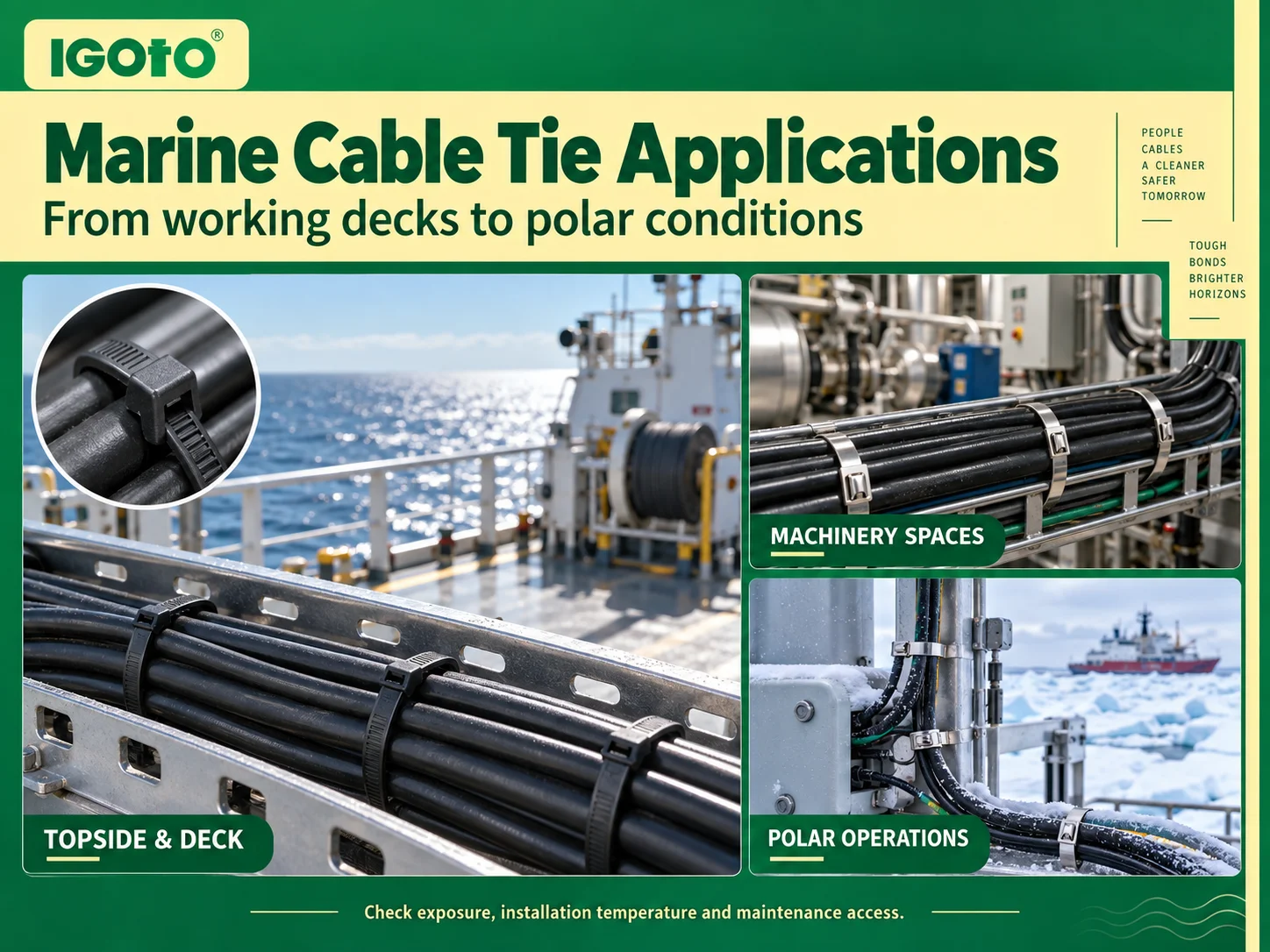
Submarine and Naval Machinery Spaces
Submersible vehicle or warship machine compartment presents a unique set of challenges that do not exist almost anywhere else. High humidity and high temperatures dominate the environment; machines are subjected to continuous vibrations, and high limits on fire and smoke presence combined with design case induced impacts and the absolute prohibition of any material leaving debris in a bilge or fans only contribute to the complexity of this process. In this case, the use of stainless steel 316 is usually applicable, and it needs to be protected from rubbing against cable jackets or hydraulic lines; that’s why specifications of the naval harnesses refer back to such documents as MIL-S-23190 and others instead of common product catalogs. Every aspect plays a role when selecting the wire, including weight and size, and this means that the size of the wire for the given operation must be not oversized just like it is in most cases on land, otherwise it may cause clearance problems in the length of the procedure involving pipes.
Topside, Deck and Rigging
Mast wiring, navigation light wiring, radar and antenna signals, deck lights, wiring for the bilge pump, and harnesses for the solar panels are all exposed to sun and spray all day. Black, UV-stabilized nylon is the material of choice for normal jobs. All structural jobs, high heat jobs, and jobs next to exhaust systems require the use of stainless steel. Mounting is just as important as the actual tie because a tie that is connected to a bad base will come off long before the tie breaks.
Offshore Platforms, Aquaculture and Floating Solar
Fixed and floating offshore constructions rely on stainless steel fasteners in the entire splash zone and in cable trays, where the lifetime is established in decades and maintenance accessibility is costly. Aquaculture cages, mooring devices, and floating solar power plants all have the same combination of permanent immersion, UV exposure, and motion, but the additional issue arises in the form of marine organisms clustering on all surfaces, meaning that fasteners have to resist both corrosion and mechanical cleaning.
Shipyards, Dry Docks and Port Infrastructure
Fixed and floating offshore constructions rely on stainless steel fasteners in the entire splash zone and in cable trays, where the lifetime is established in decades and maintenance accessibility is costly. Aquaculture cages, mooring devices, and floating solar power plants all have the same combination of permanent immersion, UV exposure, and motion, but the additional issue arises in the form of marine organisms clustering on all surfaces, meaning that fasteners have to resist both corrosion and mechanical cleaning.
Extreme Cold: Polar Vessels and Antarctic Research
The most extreme environment for a cable tie is not tropical locations, rather it is polar oceans because salt and cold combination do create high hardships. The polar icebreakers like the new Chinese vessel Xue Long 2 has weight of 14300 tons and Polar Class 3 status, which implies the ability to break the ice of thickness of 1.5 meters and operation in temperature conditions of around -30 Celsius degree. This vessel started the expedition in July 2026 and has covered already large distance in the polar oceans. The vessel does have the cable connections through the board and mast of the ship, using cables presents on deck and everywhere. However, while the ship is working in sub-zero temperature conditions, the engine room works on 40 degrees Celsius.
Therefore, material usage in this sphere should be rational and thoughtful: stainless steel should be used outside and polymer should be used on the ship where it is warm. Moreover, temperature is important during installation and not during work because when the cable zip is tightened, the cable fails and cracks. Most of the installation work is Integrated directly at the polar site by operators wearing gloves. Finally, due to the thermal cycling process the expansion of the cable when installed on them on a warm temperature may make it crack at the sea.
The same ideas could be used in the construction of the research stations and other equipment installed near the polar regions. Many manufacturers prefer to use 316 steels to manufacture the equipment they need and do not consider the cost of the cables because the repair issue will cause much more expenses in the regions far away from civilizations.
How to Specify and Buy
A workable procurement checklist for marine zip ties comes down to seven lines. Indicate the alloy grade and the certification standard for it. Indicate the demanded loop tensile strength and the standard of the tests. Indicate the stipulated number of hours under salt spray test, and the testing methodology, too. Indicate the temperature range, namely the installation and working minima temperatures. Name the width of the strap and the maximum diameter of the bundle, plus the margin factor. Name any requirements for flammability, combustibility or halogen content for the interior spaces. State whether the coating is required and which colour coding should apply.
From the business perspective, it is important to remember three points: when buying marine ties, always go for reasonable quantities, since partially used bags of stainless ties may remain fine even in the wet store, but partial baggage of nylon ties will absorb moisture and behave differently. Always obtain samples first, since the few bucks spent on short salt spray test and loop tensile test of the sample lot is insignificant in comparison to the total cost of the completed order. Finally, when placing your order, do not put all ‘ eggs in one basket’ by getting the best grade for everything as well as the worst one for everything. Our guide on choosing the right cable tie by size, strength and material works through that trade-off, and the quality control page sets out the batch testing applied before shipment. For project quantities or OEM packaging, the sales team can supply material certificates and test reports with the quotation.
Frequently Asked Questions
Are 316 stainless steel ties always needed on a boat?
Not always. They are required in splash areas, underwater positions, engine room and other crucial permanent installations. Black UV-stabilized nylon would be a more economical option for interior bundling of accessible and inspectable cable runs. The mistake is applying one rule to the entire vessel.
What is the actual distinction between 304 and 316 in terms of cables’ ties?
Molybdenum. Adding about two or three percent of molybdenum into the alloy contributes a lot to the increase of its resistance to chloride pitting and crevice corrosion that is produced by salt water. It does not manifest itself much in the dry industrial environment, but it matters a lot in the splash zone.
Are black nylon ties called marine grade?
Yes, they are UV resistant, which makes one of three criteria. The black nylon 6/6 is okay when it comes to sun but it still has the ability to absorb moisture, lose durability under load and lose strength in the cold time of the year. Black nylon 6/6 should be considered marine-grade material for less demanding applications, but certainly not the replacement of stainless steel in a critical one.
How long do marine-grade cable ties last?
Ideally, the life of properly selected 316 stainless steel ties should be up to several decades in the marine environment which does not normally negatively influence them. In turn, black nylon cable ties may need to be replaced every few years depending on the exposure conditions.
Can steel ties cut cables?
Yes, they can do so if we talk about unprotected steel ties tightened too much. The strap edge is capable of breaking the insulation of the cable and using the machine makes the task much easier than you could do it with your hand. It is better to use the nylon or polyester shielded bridge tied by steel ties.
Are there any fire regulations regarding cable ties inside ships?
Yes, there are. The IEC 60092 standards and laws of classification societies apply to marine electrical installations and all the interior spaces should satisfy the requirements regarding low smoke, halogen-free and flame-spread ratings. The use of polymer ties inside the hull involves the availability of the certificate of flammability rating, while the use of metal ties is required for positioning cables along escape routes because plastic can melt during the fire.
References
- IEC — IEC 62275:2022, Cable Management Systems: Cable Ties for Electrical Installations
- ASTM International — B117, Standard Practice for Operating Salt Spray (Fog) Apparatus
- NPFC — MIL-S-23190, Straps, Clamps and Mounting Hardware for Cable Harness Tying and Support
- Baltic Sea Submarine Cable Disruptions — Background and Incident Record
- Xinhua — China’s 16th Arctic Ocean Scientific Expedition Departs Dalian
- Xue Long 2 — Polar Class 3 Research Icebreaker Specifications