




Magnetic Cable Ties and Magnetic Cable Tie Mounts
If you carry out a search for magnetic cable ties, you will see two completely distinct devices. The soft silicone strap with two magnets is available in packets of various colors, while the magnetic cable tie mount is a little magnetic base that grips onto metallic objects and enables the regular nylon cable tie to organize cables in a machine frame or support. Although both pieces of equipment are referred to as magnetic cable ties, they serve totally different purposes. This guide will describe how each of them functions and where to locate the suitable mount option.
The words magnetic cable tie may refer to two distinct types of products. One type of magnetic silicone cable tie is a flexible strap made of silicone with magnets attached to both ends, and it forms a loop around small wires used for chargers, headsets and traveling cables or for office setup. It also includes a magnetic cable tie holder (or magnetic cable tie mount), which consists of a magnetic plate fitted with slot/eye for tying using traditional nylon tie and can be attached to steel surfaces without drills or glue. For organizing small wires, consider a magnetic silicone cable tie, while for routing large volumes of cables on steel objects, use a magnetic cable tie holder along with a nylon tie which meets the requirements of the environment.

Two Products, One Name: Which Magnetic Cable Tie Do You Need?
Before you compare features, you should first determine what issue you are trying to resolve. The quick way to test this is to ask yourself a simple question: Is it a matter of tying up loose wires or attaching something to steel?
| Feature | Magnetic silicone cable tie | Magnetic cable tie mount + nylon tie |
|---|---|---|
| What it does | Wraps and holds a coiled cord | Anchors a cable bundle to a steel surface |
| Construction | Silicone or rubber strap with magnets sealed in both ends | Magnet in a plastic or steel housing, with a tie slot; a separate nylon tie holds the bundle |
| Typical users | Consumers, office workers, travelers | Maintenance teams, panel builders, machine builders, electricians |
| Typical applications | Chargers, USB-C cables, earbuds, desk cables | Machine frames, steel beams, conveyors, cabinets, vehicle bodies, trade show booths |
| Needs a steel surface? | No; the magnets attract each other | Yes; it only holds to magnetic (ferrous) metal |
| Reusable? | Yes, snap on and off by hand | The mount can be repositioned; the nylon tie is usually replaced |
| Load capacity | Light cords only | Rated by pull force, typically in the range of roughly 10 to 15 lb for common small mounts |
If you simply want to arrange some phone chargers, the best solution for you is a silicone magnetic tie. If you need to fasten wires to equipment, keep reading, as this is where the difference between the mounts and the ties is significant.
The Mechanism of Magnetic Cable Ties
Silicone Magnetic Ties
Silicone magnetic ties consist of a flexible strap that has magnets, often made of neodymium, on both ends. By winding the strap around a coiled wire and bringing the ends together, the magnets will attach. In addition to this, there are applications where they can be stuck to the fridge or desk, hence their popularity as small cable, key or bookmark holders. They are effective and reusable but not suitable for heavy loads because the magnet can hold only light objects.
Magnetic Cable Tie Mounts
Magnetic cable tie mounts are similar to other types of cable ties by employing magnetic instead of adhesive solutions. Most industrial versions utilize powerful neodymium magnets placed into metal cup or plastic housing, due to which the magnetic force is focused on the area in contact with the surface. The user puts the mount on steel surfaces and inserts the nylon cable through the gap in the mount, after which the cable is looped around the bundle and locked in. The process does not require drilling holes or screwing anything in and causes no surface damage; the mount can be moved whenever required.
The most important conclusion to draw from the previous discussions is that the magnet substitutes for the mounting hole without changing the cable tie.
Magnetic vs Adhesive vs Screw vs Push Mounts
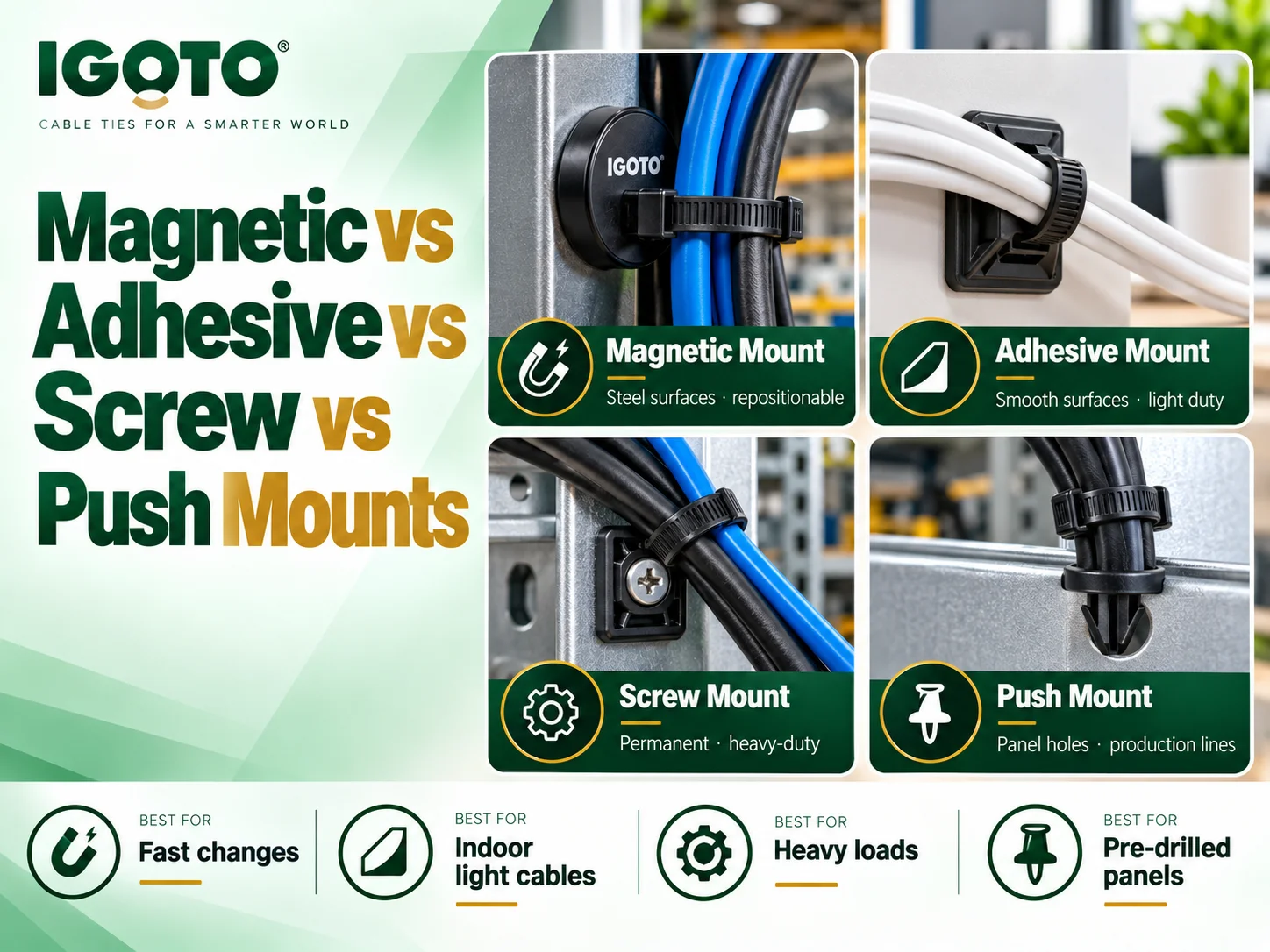
A magnetic cable tie mount is one option available for securing a cable tie in place. The choice of method will depend on the surface type, the weight of the load and the permanence of the installation. If you want to see all differences between the types of mounts, check our cable tie holder guide, and explore the options for masonry and drywall in our masonry and drywall guide to fixing cable ties to any wall.
| Mounting method | Best surfaces | Installation | Permanence | Best for |
|---|---|---|---|---|
| Magnetic mount | Bare or thinly coated steel and iron | Place and go, no tools | Repositionable | Machinery, steel frames, temporary or evolving layouts, rented equipment |
| Adhesive mount | Smooth, clean, non-porous surfaces | Clean, peel and press | Semi-permanent | Light indoor cables, panels, desks |
| Screw or rivet mount | Metal, wood, plastic, masonry with plugs | Drill and fix | Permanent | Heavy bundles, vibration, outdoor runs |
| Push mount | Pre-drilled sheet metal and plastic panels | Push into a hole | Permanent | Vehicles, appliances, production lines |
When Is a Magnetic Mount a Good Option?
You cannot or should not drill: the buildings you rent, dedicated buildings, painted equipment that has not yet dried, or building steel, which requires permission to drill.
Cable routes shift regularly: test benches, repair capabilities, temporary power, and various exhibitions and trade shows.
You want fast fixing without the need to drill or clean.
The surface is smeared with dirt and oil, although magnetic steel is in existence.
When Is a Magnetic Mount a Bad Option?
The surface is not made from ferromagnetic material. Aluminum and a large portion of 304 and 316 types of stainless steel, plastic, wood, glass, and masonry will not hold a magnet.
Steel is covered with a thick layer of paint or rust. Each and every millimeter of coating makes an air gap making holding force lower.
Steel is thin. Thin sheets of steel may become magnetized but cannot serve the needed force of a magnet.
The load is applied from sideways or downwards on the surface. Magnets are able to take laterally held weight not so effectively as in case of straight working.
Strong vibrations could either separate the mount or weld it to the cable to make it secure.
Understanding Magnetic Mount Ratings: Pull Force Is Not Holding Force
The pull force rating determines the force necessary for removing a magnet from a clean, flat surface of a thick steel plate.Magnet manufacturers explain that this is a theoretical value obtained in laboratory conditions, whereas in real life there are a number of factors that significantly reduce it.
1- factor is the direction of the load. In the case of vertical surfaces, one can use a suspended wiring bundle which will try to slide rather than pull the magnet up. The actual sliding force is known to be only 15 to 30 percent of the rated force depending upon the friction.
2- factor is the air gap. The presence of paint, powder coating, rust, dirt, and an uneven surface results in a gap between the steel and the magnet, reducing the magnetic force. The thicker the powder coating is, the greater the reduction.
3- factor concerns the thickness of the steel and the temperature. A thin steel sheet will lose its magnetic property while magnet strength diminishes as its temperature goes up.
4- a mount with a rating of 15 lb pull may hold only a couple of pounds of load. It is advisable to keep mounting areas close to each other, avoid heavy cable bundles, and allow the cable run to distribute weight across several mounts.
Magnetic cable tie mounts must not be used for supporting heavy overhead cables or other obvious hazards that may cause trip or electrocution.
Choosing the Right Nylon Cable Tie for a Magnetic Mount
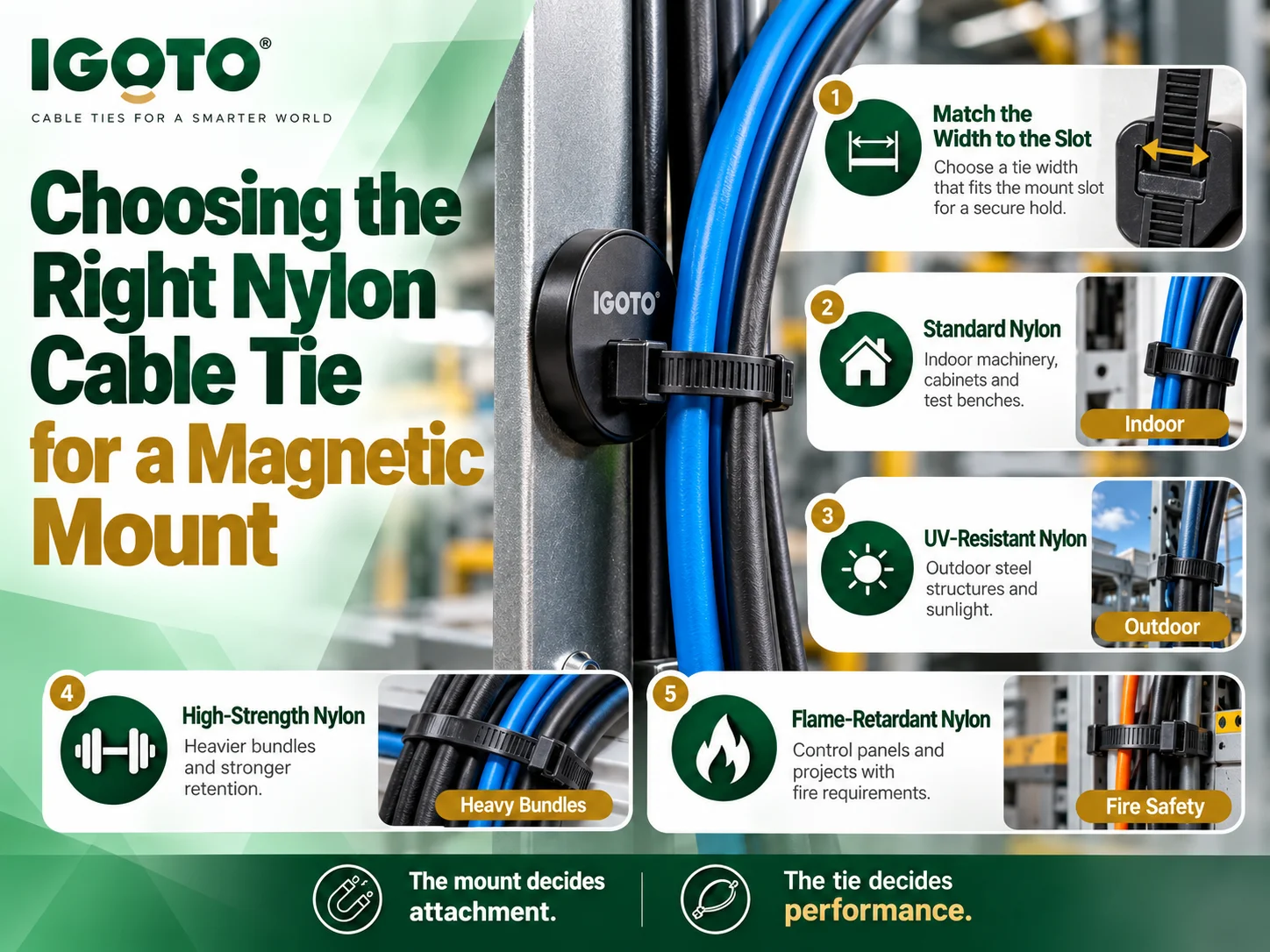
After you fix the mount to the steel, the cable tie will hold the assembly. The mount defines the connection type, and the cable tie defines the performance of the assembly. Choose cable ties depending on the harshness of the environment, not only on the width of the groove.
Choose the Width of the Cable Tie
In most cases, small magnetic mounts allow the use of cable ties with a width of no more than 4.8 mm. Compare the maximum cable tie width with the information on the mount’s data sheet, measure the width of the strap, and select a length that allows the strap to go through the groove, encircle the assembly, and leave an excess length for tightening and cutting.
Pair the Tie Grade With the Environment
- For machines and testing benches indoors: a magnetic mount with standard nylon cable ties.
- For steel structures, trailers and containers: A black magnetic mount with UV-resistant nylon cable ties.
- For warm equipment near motors or stoves: A high-temperature resistant mount with heat-stabilized ties, as mentioned our high-temperature tie wraps guide.
- For heavy bundles: A bigger mount with closer spacing and a robust nylon cable tie of high-strength 4.8 mm nylon cable tie rated at 22 kg.
- For matters of the type of fire: a magnetic mount with flame-retardant cable ties.
A very powerful magnet won’t make a weak tie low risk. If a tie becomes brittle as a result of sunlight or soft as a result of heating, the bundle will come off the mount if the magnet holds the mount tight.
Installation Tips
1. Test with the small magnet first to ensure that the surface is magnetic.
2. Clean the surface so that the magnet is flat against it, removing any dust, grease and loose rust.
3. Use the flattest and thickest steel for the mounts and avoid mounting them on surfaces having thick coating.
4. The mounts should be placed closely, especially in the case of vertical surfaces, so that each of the mounts does not carry too much weight.
5. Thread the tie, wrap the bundle and tighten it well.
6. Once the machine has been used for a while, check if anything has been shifted and if you need to tighten the mounts again or add more of them.
Where Magnetic Cable Tie Mounts Are Used in Industry
- Frameworks and conveyors are where cable relocation is required to ensure seamless production lines. See our industrial equipment cable tie solutions.
- Steel beams, girders, and the roof channels that require drilling permission to access.
Electric boxes and switchgear doors that require cable relocation temporarily for testing and commissioning.
Test benches and labs that require changes from day to day.
Motor vehicles, semitrailers, and containers whereby low-weight cable is used to mount on the steel panels.
Magnetic Silicone Ties
Magnetic silicone ties are useful for organizing phone chargers, laptop cables, headphones, travel cords, and untidy wires on the desk, for the attachment of small wires to the metal frame of the desk, or to the refrigerator. They are not intended for heavy loads, permanent routing, or for outdoor or industrial use. For such tasks it is advisable to use a mount and a nylon cable tie.
A Short Guide for Your Decisions
- Are you looking to manage wires at home, in the office, or while on the go? Use a magnetic silicone tie.
- Are you routing cables across steel machinery without drilling? Use a combination of magnetic mount and nylo0n cable tie.
- Is it aluminum, stainless steel, plastic, wood, or masonry? Use adhesives, screws, or push mounts to hold wires.
- Are you managing heavy, overhead, high-vibration, or safety-critical cables? Use screws, rivets, or push mounts along with high-strength ties.
- Is the environment outdoor, hot, or fire-rated? Use some mount suitable for the task but choose a tie with UV, heat-resistance, or flame-retardance.
Quality Nylon Cable Ties for Magnetic Mounts
At IGOTO we produce nylon ties only, so we can give you the best recommendation on choosing the mount for your task and concentrate on the quality of the part holding the bundle in place.
We can offer high-quality nylon 6/6 ties (made from Ascend Vydyne 21SPC resin, manufactured in the USA) that have been approved to be UL-94, and their operating temperature ranges from -35 °C to +85 °C. The dimensions vary from 2.5 mm to 4.8 mm. Distributors and equipment builders can order in bulk or with OEM packaging to pair with their own mounts. Contact IGOTO for samples and pricing.
Frequently Asked Questions
What are the best magnetic cable ties?
The best magnetic cable ties vary depending on the usage. In case of small cords and chargers, go for silicone ties that have sealed neodymium magnets, that have a good fit and come with an appropriate length. Talking about industrial cable routing, magnetic cable tie mounts that come up with a proper pull rating are said to be the best option in combination with a proper nylon cable tie.
How do magnetic cable ties work?
The design of magnetic silicone ties consists of flexible strap which comes with magnets attached at both ends; the ends are joined around the cable. Magnets magnet mounts stay fixed to steel bearings while the nylon cable tie used in combination with them holds the bundle in its place.
What is a magnetic cable tie mount?
A magnetic cable tie mount is also known as a cable tie holder or magnetic holder, and its meaning stands for a magnet base that comes with a slot for a cable tie. It is mounted to steel cable with no need to drill a hole nor use any adhesive, and is able to move from one place to another whenever it is needed.
Are magnetic cable ties strong enough for industrial use?
Silicone magnetic ties will not do. Meanwhile, magnetic mounts will be good in case of light and average cable runs laid on clean flat steel but do not forget that the amount of force that is produced by magnets is way less than the amount of force that is declared on the package. In case of heavy duty installations, it is better to use mounts that are fixed mechanically.
Can magnetic cable ties replace zip ties?
In case of small home cords, magnetic silicone ties can be used instead of zip ties. In industry, magnetic mounts will do instead of drilled hole or sticky pad but zip tape is used anyway to fix the bundle safely.
Do magnetic cable tie mounts work on stainless steel or aluminum?
No they can not and would not work for state of art steels such as 304 or 316 which are non-magnetic by nature. In this case it would be better to try other options to mount the bundle thus using adhesive, screws or regular push mounts in case needed.
What is the disadvantage of a magnetic charging cable?
Magnetic charging cables in their turn are different may have a detachable magnet tip instead of the cable tie. One of the most common complaints from users is that magnet tips are pretty easy to detach, that they attract small metal debris and in some cases their data transferring capabilities are very limited compared to regular cables. This device is not suitable for cable management.
References
- Magnet Pull Force and Holding Force Explained, Radial Magnets
- Neodymium magnet, Wikipedia
- Stainless steel, Wikipedia
- Cable tie, Wikipedia
Conclusion
Magnetic cable ties are really two products. A magnetic silicone tie is a simple, reusable way to organize small cords. A magnetic cable tie mount is an industrial tool that lets you route cables on steel without drilling, as long as you respect its real holding limits. In industrial work, remember that the magnet replaces the mounting hole, not the cable tie: choose the mount by surface and layout, then choose a standard, UV-resistant, heat-stabilized, high-strength or flame-retardant nylon cable tie by load and environment.


