





How to Use a Zip Tie to Fix a Broken Connector?
You disconnected a sensor to gain access to something, reinserted the plug, and afterward heard a small plastic click. Now the latch no longer works, and the connector slides out very easily with the slightest pull of the wire.The use of a nylon tie to restore damaged and zip tie to fix broken connector is very common in the automobile repair world and works well if done right. However, if done incorrectly repairs can result in malfunctions, warning lights, and brake failures. In this guide, we will figured out how broken latch is supposed to work in principle, how to identify a situation where using a nylon tie might prove to be helpful, how to use it properly, and when to replace the connector instead.
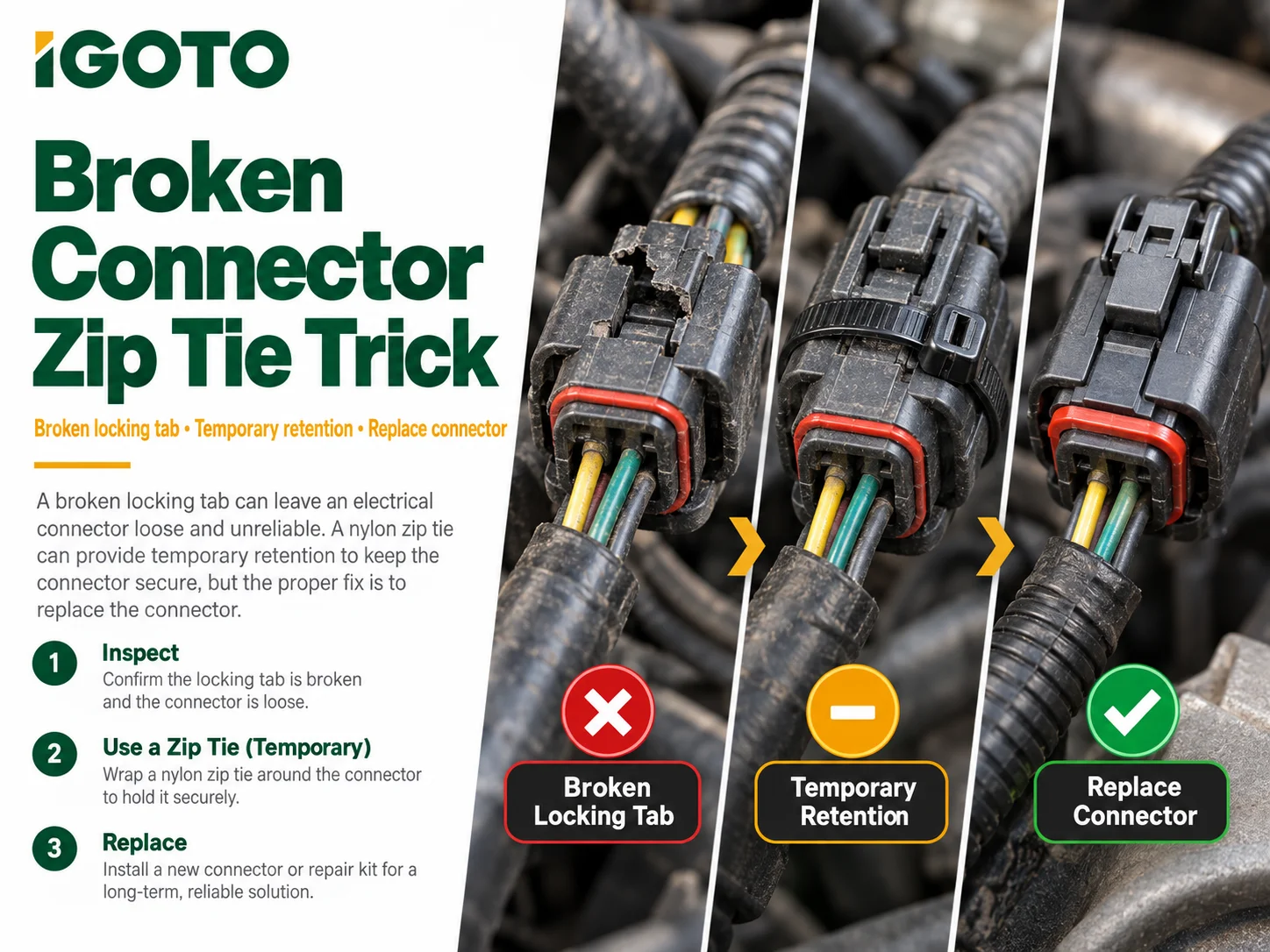
In automotive electrical systems, when plastic locking tabs break, a nylon tie helps to keep the two halves of the connector together given that the terminals are not broken, the seal is undamaged, and the circuit is not life-threatening. It only performs the functions of the latched connector that is holding its halves together. It does not mean that the tie would work for bent or loose terminals or would hold together the torn weather seal of the connector’s plastic casing.

Can You Fix a Broken Connector With a Zip Tie?
Sure enough, and with some qualifications. The latch on a car connector exists purely for the purpose of keeping the plug and socket mated in the presence of vibration. The actual electric connection is made within the connector, where metal contacts are joined. If only the latch is broken, the connection itself may still be perfectly fine. The connector, however, is unrestrained within the housing.
This is where a zip tie comes in handy, and that is why so many people ask for this to solve their problems with the car connector latches. Mechanics on forums report successful use of zip ties to secure connectors during a number of years in cars ranging from Miata to Buicks. They also report zip ties failing to hold on when the electric wires were stretched or plastic shell was broken. Such success and failures depend on the connector condition rather than on the zip tie itself.
So the bottom line is that zip tie solves the problem of retention and nothing else. Thus if retention is the only problem present, zip tie can become a viable solution. Otherwise, it complicates the troubleshooting process.
What the Broken Locking Tab Was Actually Doing
Most automotive connectors nowadays have at least two locking mechanisms, and it is beneficial to determine which of them failed in order to figure out a way to approach the situation.
The primary latch is a flexible tab or hook that you press in order to unlock the plug. It is the piece which usually breaks because it is the one that many people pull on.
Connector position assurance (CPA) is a small bolt that is sometimes of a different color, and it is inserted, when connector halves join together, to prevent accident pressing of the primary latch.
Terminal position assurance (TPA) is an independent component in the interior of the connector, which confirms that each terminal is fully inserted into its position.
Connector manufacturers consider CPA and TPA as two different safety measures: one is responsible for making the connector halves stay together, while the other one is responsible for keeping the connectors in the position. Using a zip-tie around the connector case can solve only the first problem, since it does not help the situation with terminals going backwards, and you need to open the connector to check its inside before closing it.
Why Connector Clips Break in the First Place
The connectors found beneath the hood of a car undergo years of use where the engine is cold and then heats up. The plastic used in the housings is usually some type of engineered plastic like nylon or PBT, and as time goes by these plastics become less flexible. A latch that was flexible enough to withstand pressure at the time the car was brand new may end up breaking the first time it is pressed ten years later. Some of the more common causes of damaged latches are if someone uses a screw driver to pry the latch open, pulling on the wires instead of the housing, unplugging in very cold conditions when the plastic is at its most brittle, and wiring that has become taut due to suspension lifts or engines swaps, in which case the harness will keep pulling on the plug.
This last point is critical. If the latch breaks due to pull from the wiring, the zip tie holding the connector will also fail unless the tension has been relieved.
Check These Four Things Before You Zip Tie a Connector
Spend two minutes verifying. This step distinguishes a trustworthy repair from a comeback.
1.Examine the terminals. Disconnect the connector and shine a light on both sides. Each pin should be at the same depth, with no green corrosion, heat discoloration or bent sockets. If one pin is deeper than others, it has popped out of the socket, and a clamping device will not fix the problem.
2.Examine the seal. Sealed connectors feature a rubber ring at the joining point and terminal wire seals labeled. If the ring is broken or missing, the water will penetrate whatever arrangement has been made.
3.Assert that the connector is positioned properly. Push the two half-structures together manually. It should stop with the same depth as when the latch was working. If it stops before that, something is broken inside, and the latch is not the only problem.
4.Find the circuit. Trace the wires or check the element. A coolant temperature sensor, fog light or intake sensor is the easy place to cope with a simple problem. The airbag circuit, ABS or high-voltage connector is not, as specified below.
If the four requirements are met, the connector is the good candidate to use the broken connector zip tie method. However, a failure of even one of them means that zip tie is not the proper solution.
Step-by-Step: Zip Tying a Connector With a Broken Clip
The objective here is to draw the two sides of the connector toward one another through its center axis while keeping the body of the connector intact and above all, free of tension from any wires. The process for making a zip tie repair to a connector is as follows.
1.Disconnect the battery if there is anything other than a simple sensor in the circuit
and then proceed to clean the connection point so that its body shape becomes visible.
2.Find the anchoring locations on either side of the connector. Anchors usually appear in the form of a ridge or a bump on the plug side and another feature on the socket side, which gives your zip tie a contact point.
3.Fully plug in the two sides of the connector.
4.Insert a zip tie in lengthwise along the connector so that it goes behind the ridge of the connector plug and goes behind the ledge of the connector socket. The zip tie must go along the motion of the connector, not across.
5.Tight the zip tie by hand to a snug position until the two halves of the connector are firmly held together. Be careful to avoid over-tightening as that will create bow in the housing, causing a gap between the two parts of the connector.
6.Cut away the end of the zip tie to avoid any hindrance in the future.
7.Fix the harness at a distance from the connector through another zip tie so that the connection can endure better.
8.Attach the battery back, start the car and test the connector before proceeding with the job.
Avoid using the zip tie to pull the plug from behind, as that will produce strain on the crimped contacts and will make the situation worse. The only things to rely on are plastic features of the connector.
In case a connector does not have any shoulders, it is possible to use two zip ties on the both sides of the connector and pull them together with a third one.
The Broken Connector Zip Tie Trick, and When It Works
In most repair videos and message board threads, what is shown is exactly the same lengthwise tie as previously described – a single tie made from back to front, capturing a ledge on each side. This tie only works under three conditions.
The connector is small and light, such as a two or three pin sensor plug.
There is a bit of slack in the harness behind, so engine movement and vibration are not trying to pull it apart.
The tie is away from the exhaust heat, which is the only place a nylon tie would survive.
The tie generally fails in large multi-pin engine or body connectors where there is a big force needed to keep the parts together and a single tie cannot apply it evenly. It also fails when the connector itself is damaged and the tie may press together the damage, misaligning the terminals. If the plug wobbles even after tying, a broken connector clip is no longer the real problem.
Connectors You Should Never Zip Tie
In designing some circuits, they are done in such a way that a connector that is not fully inserted can cause an alarm to go off. When one makes a connector when it has not been fully inserted in such a case, it is critical to keep in mind manufacturer recommendations. Always use the technician’s work instructions to change the connector.
| System | Why a zip tie is the wrong fix | What to do instead |
|---|---|---|
| Airbag and seatbelt pretensioner (SRS) | These connectors use dedicated locks and shorting features. A bad connection can disable a deployment or trigger a fault. | Replace the connector or harness per the service manual, with the battery disconnected and the system powered down. |
| ABS, brake and stability control | An intermittent signal can drop the system offline at the moment it is needed. | Replace the housing or pigtail and clear codes with a scan tool. |
| Hybrid and EV high-voltage (orange cables) | Interlocks and high voltage make any improvised repair dangerous. | Leave entirely to a qualified high-voltage technician. |
| Fuel pump and injector circuits | A loose connection can cause stalling, and heat at a poor contact is a risk near fuel. | Replace the connector and inspect the terminals for heat damage. |
| Any connector showing melted or browned plastic | Heat marks mean high resistance at the terminals, which a tie cannot correct. | Replace terminals and housing, and find the cause of the overload. |
If a connector carries a safety system, high voltage or shows signs of overheating, do not treat a zip tie as an acceptable repair, even temporarily.
Zip Tie vs Replacement Pigtail or Connector Housing
Zip ties are both inexpensive and an easy solution but you should take time to think of what the right solution might give you. Most auto equipment stores carry pigtails, which are the new connectors that have short leads that you insert into the harness that is already in the car. For many kinds of connectors, you could also purchase the bottom half of the connector and transfer your old wires to this new connector without having to cut any ropes.
| Factor | Zip tie retention | Pigtail or new housing |
|---|---|---|
| Cost and time | Pennies and a few minutes | A part to source and 20 to 60 minutes of work |
| Restores original latch | No, it substitutes for it | Yes |
| Fixes terminal or seal damage | No | Yes, when the terminals or seal are replaced |
| Easy to unplug later | Cut and replace the tie | Yes, as designed |
| Best for | Low-risk sensor plugs with intact terminals | Damaged connectors and any critical circuit |
Plenty of owners run a zip-tied sensor plug for the life of the car without trouble. Still, if the connector is easy to replace, doing it the next time you are working in that area is the cleaner long-term answer.
What Size Zip Tie Works for Car Connectors?
Bigger is not better here. A tie that is too wide will not fit behind the small shoulders on a sensor plug, and a heavy tie pulled tight can distort the housing. Match the tie to the connector.
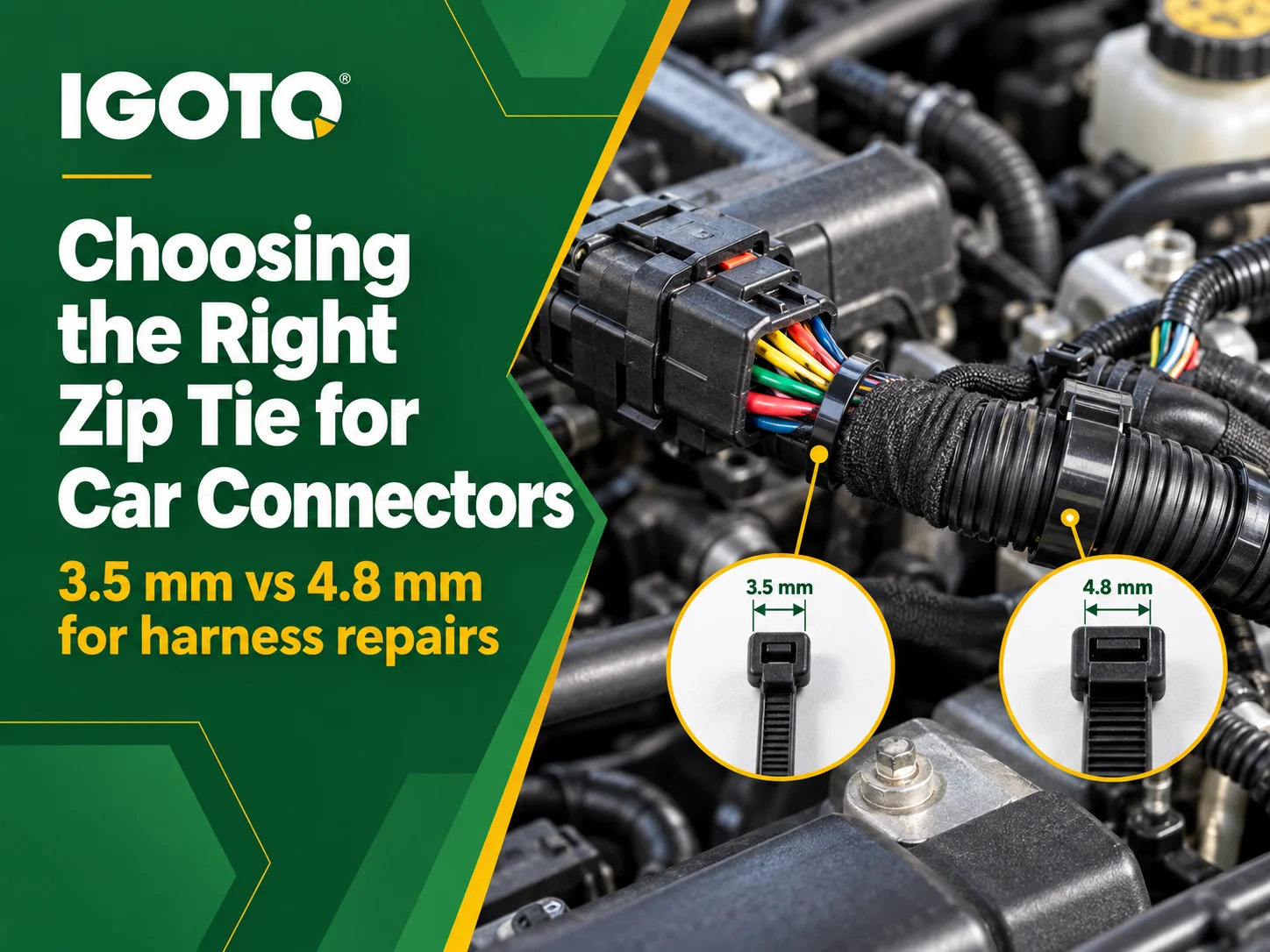
- Small sensor plugs with two to four pins usually need a narrow tie that slips behind tight ledges. IGOTO’s small cable ties in the 4 to 8 inch range are rated around 8 kg and fit most of these.
- Larger body and engine connectors with sturdier ribs can take a stronger tie. The medium size cable ties and standard cable ties offer up to 18 kg of tensile strength, which gives a margin against vibration without needing to overtighten.
- Length should be enough to loop the connector with a comfortable tail, typically 4 to 8 inches for single plugs.
Temperature is the factor most people overlook. Standard PA66 cable ties are typically rated for continuous use up to about 85°C. That is fine for a connector on the inner fender or behind the dash, but too low for anything close to the exhaust manifold, turbocharger or catalytic converter. Our guide on how to choose heat stabilized nylon zip ties explains the higher-rated grades, which run from about 105°C up to 130°C depending on formulation. If you cannot tell how hot a spot gets, assume it is hotter than you think and keep the tie away from direct radiant heat.
Color matters less than people expect for under-hood work, but black ties are the usual pick because of their carbon black content, which improves UV resistance on connectors exposed to sunlight under the grille or near the windshield. You can read more in our black zip ties guide, and the tie wraps sizes chart converts inch and millimetre dimensions if you are matching a replacement.
For the harness support tie in step seven, a push-in mount works well where the panel has a hole. Our article on fir tree zip ties covers hole sizes and panel thickness. If you service many vehicles, a zip tie gun sets consistent tension and cuts the tail flush in one motion, which removes the risk of overtightening a fragile housing.
Manufacturers who build harnesses at production scale use heat-stabilized, vibration-resistant ties designed for the job, which is a different application from a roadside repair. If you source ties for harness assembly or fleet maintenance, see our automotive wiring harness solutions.
Frequently Asked Questions
Is a zip tie a permanent fix for a broken connector?
It could survive for several years when fitted to a low-risk lead having good contacts and a loose cable, but it does not serve the same function as a new latch. Use it as a temporary solution, inspect it at every service, and replace the terminal block or pigtail whenever possible.
Will a zip tie melt in the engine bay?
Nylon strap should not melt under normal engine hood temperature. However, when placed close to hot exhaust parts, it deteriorates faster than usual. Therefore, it is best to use heat resistant strap around hot engine elements while making sure not to touch exhaust manifold or turbo.
Can I super glue a broken connector clip back on?
Adhesives seldom stick well to flexible plastics found in latches, and if they ooze onto the mating surfaces, they can lead to issues with the terminals or obstruct disconnecting the connector in the future. A zip tie only has to be undone and does not produce more issues.
Can a loose connector cause a check engine light?
Certainly. Intermittent connections on a sensor will typically cause the circuit codes to be generated for that sensor, and this can result in a rough running condition. Indeed, in the case where the codes are generated after you connect the connector, put the terminals and the wiring behind the connector on the check list again.
Does the same trick work on an Ethernet cable clip?
In some cases, people apply the same principle in order to retain an RJ45 connector with a defective tab in its port, but this is an entirely different issue. In case of network cables, it is typically better to just re-terminate the plug or utilize a clip-on repair cover.
References
- Amphenol RF, What Is Position Assurance?
- Google Patents, US5928038A: Electrical connector position assurance system
- Wikipedia, Electrical connector
- Wikipedia, Nylon 66
- Wikipedia, Cable tie
Conclusion
A broken latch does not always mean a broken connector. When the terminals are clean and fully seated, the seal is intact and the circuit is not safety-critical, a correctly routed nylon tie can restore the one function you lost: keeping the halves together. Loop it lengthwise behind solid housing features, tighten it only until snug, support the harness behind it and pick a tie rated for the heat at that location. When the inspection turns up damaged terminals, a torn seal or a safety system, skip the shortcut and replace the connector. Used with that judgment, the zip tie trick is a smart, low-cost repair rather than a hidden fault waiting to return.