



What Is Commonly Used to Secure Wire Bundles?
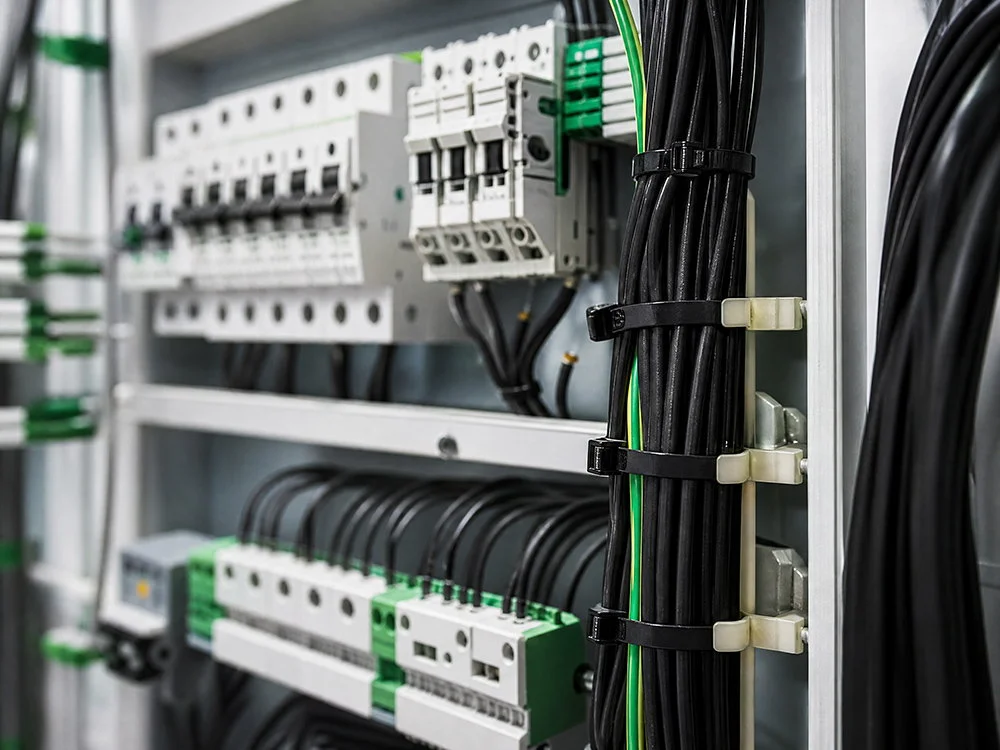
After finishing the wiring job on a motor control panel, the builder took a look at the conductor bundles running from the contactors to the terminal blocks. All bundles have been secured using black ties. Every installation was finished in a neat and professional manner. However, the previous installation was exposed to the vibrations of the plant. Six months after, the vibrations have loosened many of the ties, made the bundles sag, and made one of the conductors rub against the enclosure door and activate a ground fault relay. The ties worked initially but they didn’t fit the requirements of high vibration environment. Therefore, the answer to the question about the way the wires can be secured may vary from cable ties to hooks and straps, adhesive clips, lacing cord, spiral wrapping, and metal clamps.
The Most Common Wire Bundle Fastening Methods and Where Each Excels
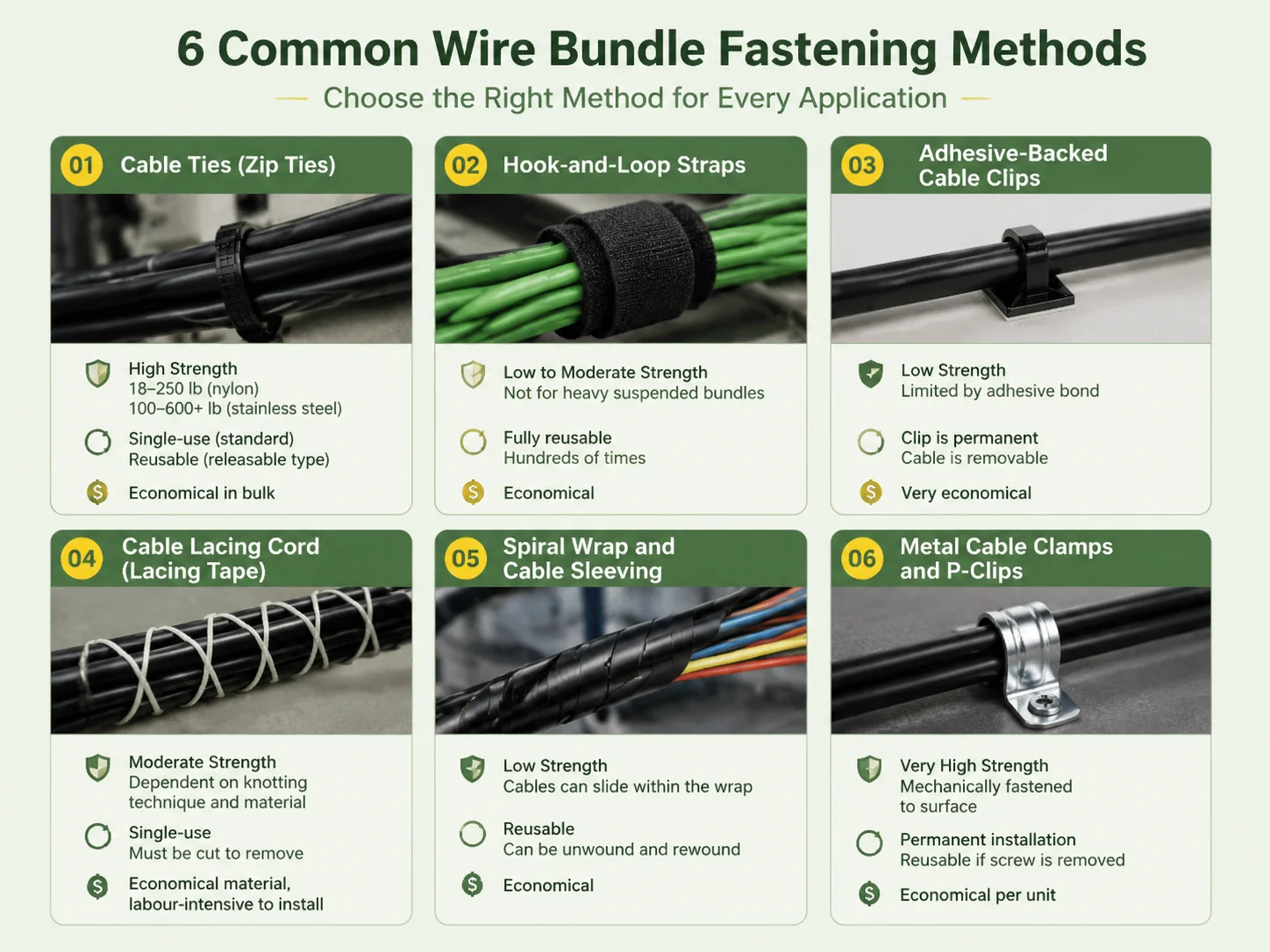
The table below provides a comparative summary of the six most widely used wire bundle securing methods in electrical installation, panel building, and industrial maintenance. Each method is described in detail in the sections that follow.
| Method | Best For | Holding Strength | Reusability | Relative Cost |
|---|---|---|---|---|
| Cable Ties (Zip Ties) | Permanent bundling, indoor and outdoor, general electrical and industrial | 18–250 lb (nylon); 100–600+ lb (stainless steel) | Single‑use (standard); reusable (releasable type) | $ – Economical in bulk |
| Hook‑and‑Loop Straps | Frequently changed bundles, data centres, temporary installations, delicate cables | Low to moderate — not for heavy suspended bundles | Fully reusable hundreds of times | $ – Economical |
| Adhesive‑Backed Cable Clips and Clamps | Routing single cables or small groups along a surface, desk management, light‑duty indoor | Low — limited by adhesive bond strength | Clip is permanent; cable is removable | $ – Very economical |
| Cable Lacing Cord (Lacing Tape) | Aerospace, military, telecommunications, anywhere a traditional, zero‑damage method is required | Moderate — dependent on knotting technique and cord material | Single‑use — must be cut to remove | $ – Economical in material; labour‑intensive to install |
| Spiral Wrap and Cable Sleeving | Protecting bundles from abrasion along their entire length, automotive engine bays, machinery | Low — bundles cables together but does not provide a tight mechanical hold; cables can slide within the wrap | Reusable — can be unwound and rewound | $ – Economical |
| Metal Cable Clamps and P‑Clips | Heavy‑duty fixed‑point securing, high‑vibration environments, structural mounting, outdoor and marine | Very high — mechanically fastened to a surface with a screw or bolt | Permanent installation; reusable if the screw is removed | $ – Economical per unit |
Cable Ties: The Workhorse of Wire Bundle Securing
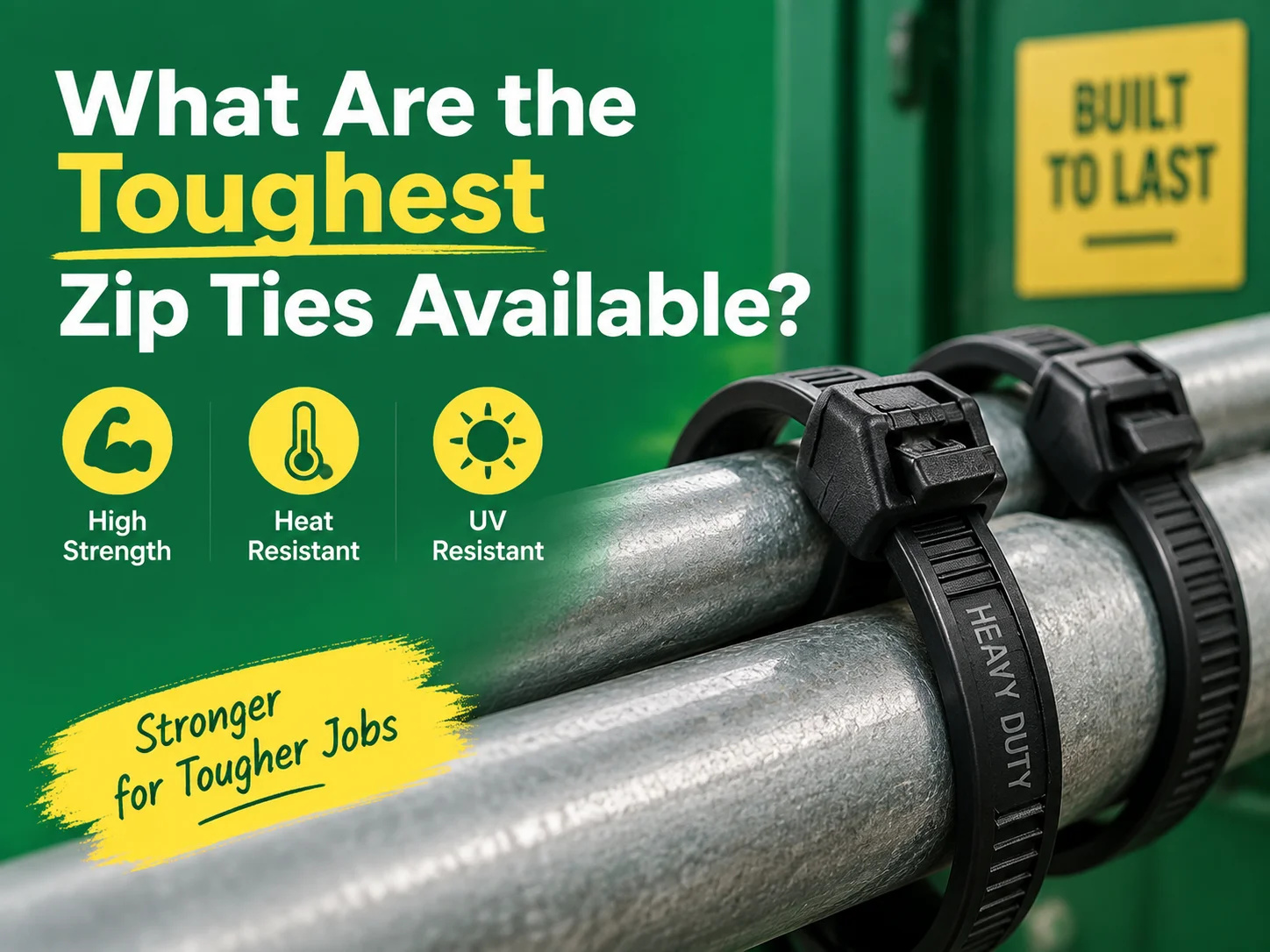
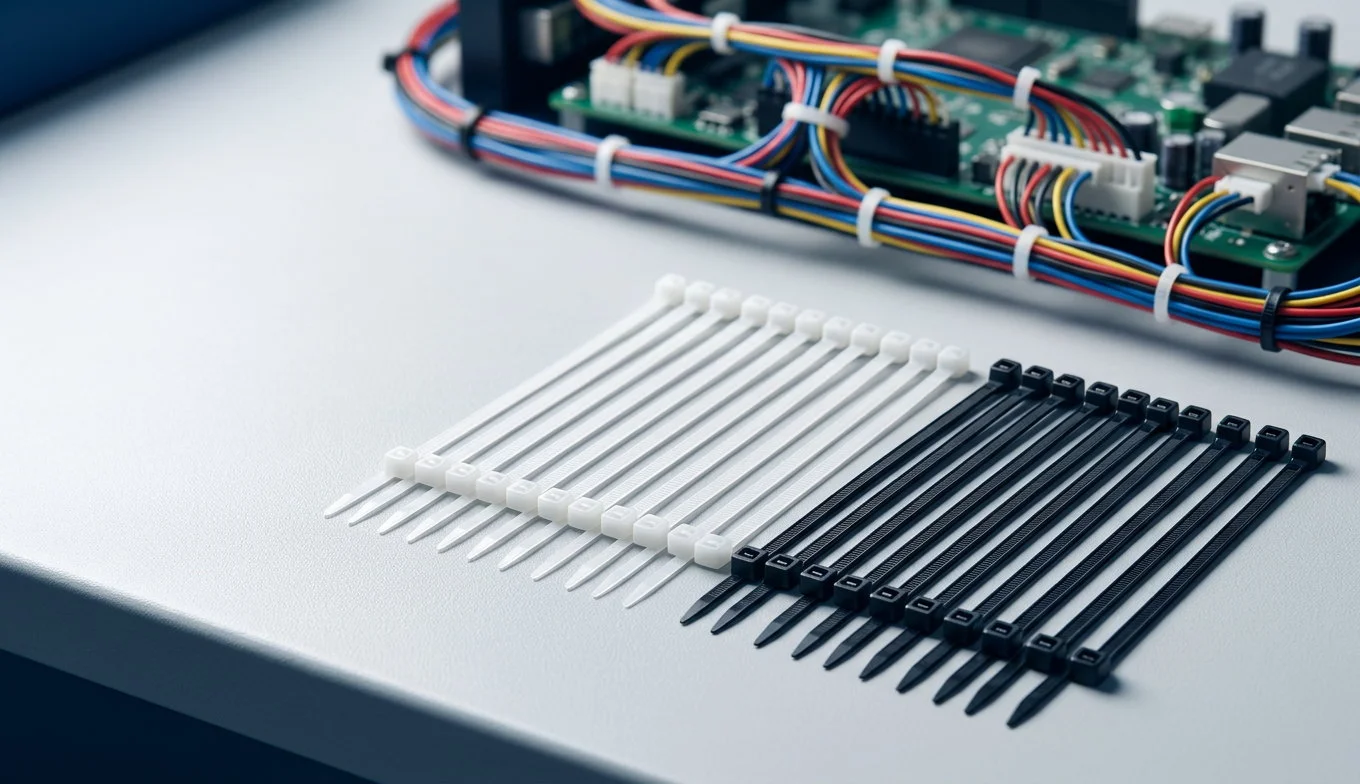
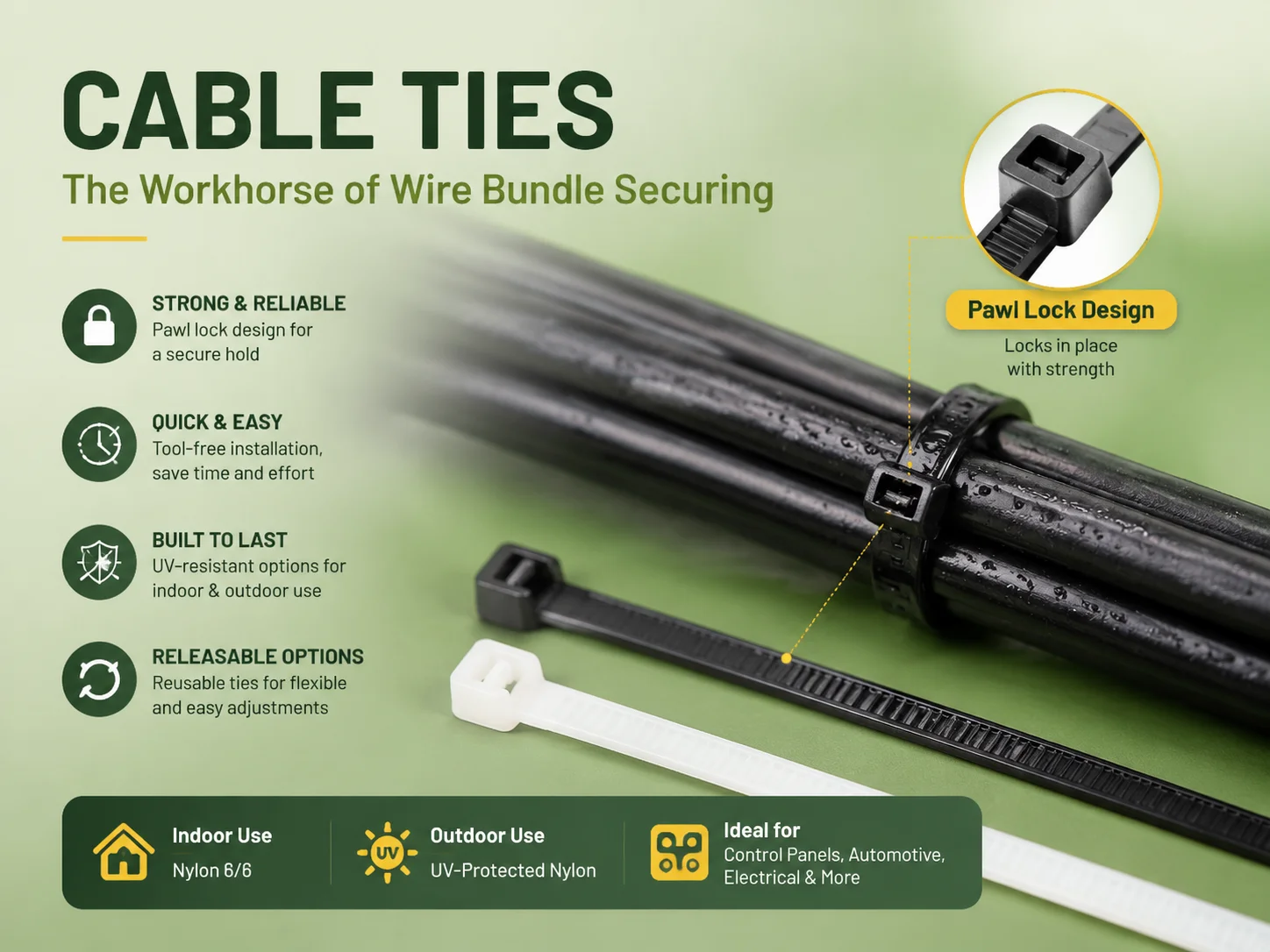
The cable tie, often referred to as a zip tie, wire tie, or hose tie, is the most commonly used method of fastening electrical and automotive cables. The device was first invented in 1958 by Thomas & Betts (now part of ABB). The tie can easily lock itself into the desired position by using its pawl and the serrated flexible part. When pushed through the head section, the tail of the tie, then pulled, engages the pawl, locking the cable in place. The installation process is very quick — no tools are needed for hand tightening. While the cable tie exists in various configurations, it is made using different materials and colors which allows its use in any application. Standard nylon 6/6 is used for indoor wiring; for outdoor use, however, UV- protected nylon cable tie should be used, as only such materials protect the tie from damage due to the UV sun rays.For a detailed comparison of nylon and stainless steel across all performance dimensions, our guide on stainless steel zip ties vs nylon cable ties covers the trade‑offs.
Cable ties are meant to be used once. When a conventional cable tie is fastened, it cannot be loosened again. In some cases, it is necessary to reuse cable ties. These are known as releasable cable ties. Massively used in applications such as control panel installations, where they can be easily manipulated, releasable cable ties are equally strong and made of nylon. For guidance on selecting the right size, our article on cable tie sizes covers the full dimensional range.
Hook‑and‑Loop Straps: The Adjustable Alternative
Hook‑and‑loop fasteners known as Velcro, these are cloth bands with hooks on one end and circles on the other. When wrapped around and pressed closed, they create a very flexible fastening system. The real difference over cable ties is the fact that these bands can be opened and closed many times without creating waste or risking jammed cables or insulation. These bands are the preferred option for data centers, server racks, and structured cabling systems due to their flexibility. For their downsides, these bands have lower tensile strength than corresponding nylon cable ties and maybe damaged by moisture, dust, and UV ray exposure.
Adhesive‑Backed Clips and Clamps: Routing, Not Bundling
Adhesive back cable clips is not a cable-management solution in the same order as cable-fastenings. It is a guiding solution, consisting of a small and flat clip made of plastic or metal with a self-attaching ground, which affixed to smooth and flat areas of a wall, table, or casing and keep one wire or a few wires neatly. Clips are fast, don’t use any tools at all, and have proven to be useful in consumer electronics, in office cable management systems, as well as in temporary setups. Their capacity is based on the adhesive characteristics of the clip, which dwindle in time.
Cable Lacing Cord: The Aerospace Standard
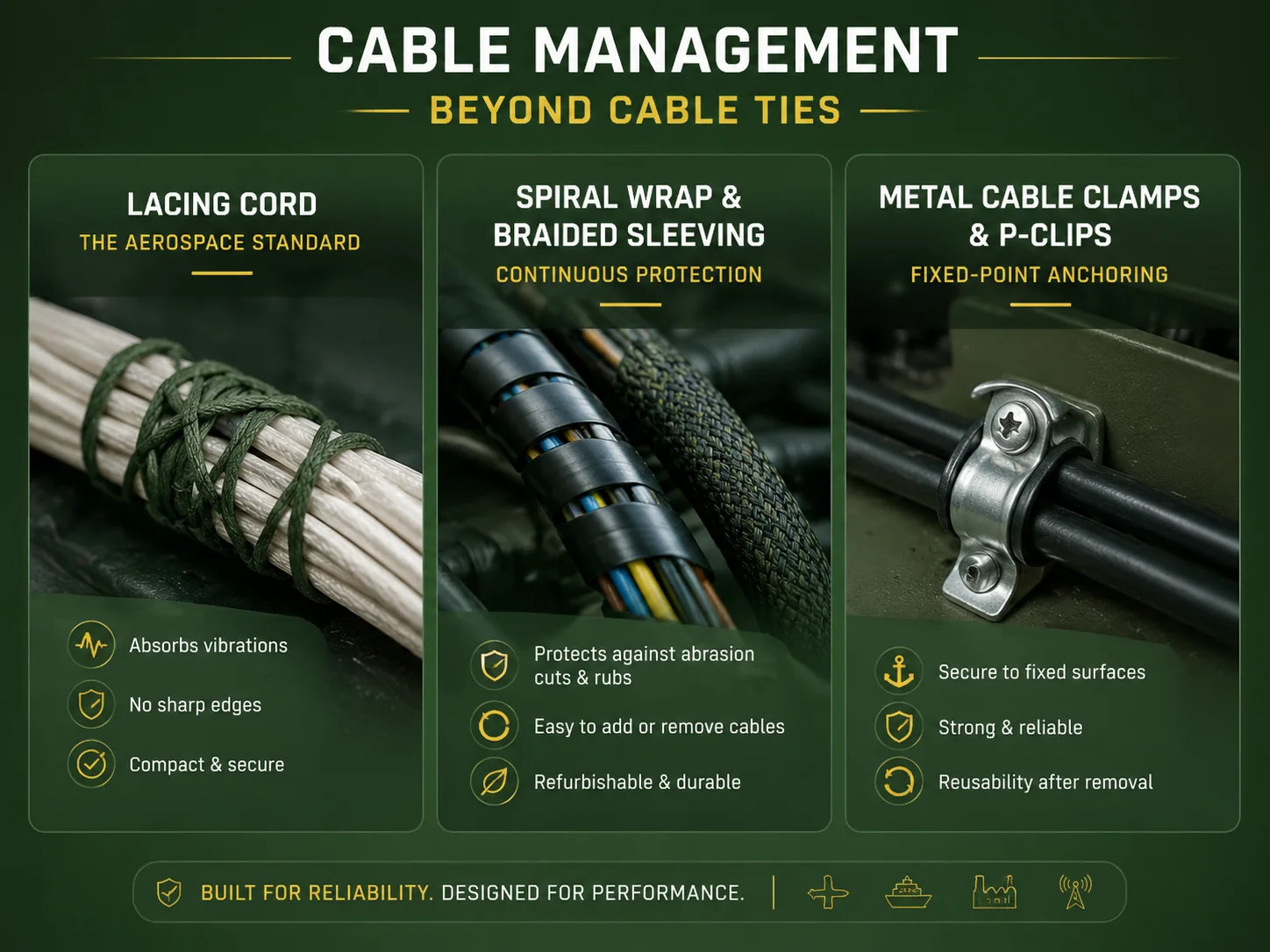
Long before the development of the nylon cable tie, electricians and aerospace engineers were tying conductor bundles manually using waxed lacing cord, which was a braided cord made from nylon or polyester and coated with wax. This process, called cable lacing, involves a series of knot types that hold the bundles tightly together, absorb vibrations, and leave no sharp edges that could hurt nearby wires or insulation. Today, lacing cord is still used extensively in the aerospace, military, and telecommunications sectors, especially where traditional nylon or metal ties would either be too heavy, too sharp, or possess unwanted electrical properties. Although it is a relatively complicated process that requires training and experience, there are no alternatives in the market that provide similar levels of compactness, vibration absorption, and no risk of damage to the surrounding cable.
Spiral Wrap and Braided Sleeving: Continuous Protection
Spiral wrap is a flexible plastic ribbon sliced in spiral form and it is wrapped around a mass of cables. A cable tie fastens cables together more tightly, whereas spiral wrap allows sliding of cables under the wrap. It primarily acts as a protectant against abrasions, cuts, and rubs. Spiral wrap is used in vehicle engines, machinery, and robotics, thus protecting the cables against sharp edges and movements. Braided sleeve performs the same protective function because it is available in continuous tubing and offers neat look and high abrasion resistance. Both methods allow adding and removing cables readily and both can be refurbished. For a complete overview of non‑tie fastening solutions, our guide on alternatives to cable ties covers each method in detail, including their specific advantages, limitations, and best‑use scenarios.
Metal Cable Clamps and P‑Clips: Fixed‑Point Mechanical Anchoring
A metal cable clamp, commonly referred to as a P-clip, is a triangular metal clamp that is made of a strong metal rounded wire. Functions of a clamp in soft clamp applications include (1) holding the ends of the wire together, (2) securing the wire to a wall with screws or bolts. Unlike a plastic tie, whose purpose is to simply tighten a bundle of wires by following the principle of self-locking due to its tensile strength, metal clamps hold the wires firmly tied to a fixed surface (such as a chassis or relative to any constructive member of a construction). Metal cable clamp installation is standard in the aviation, marine, industrial area, and automotive construction. It is a fixed installation, but the clamp can be reused after dismantling screws.
Frequently Asked Questions
What to use to secure wires?
Nylon cable tie or jacket is often the easiest method for holding cables in place because it is quick, affordable, and can be found in different sizes and materials suitable for various situations. In case wires require frequent access, the hook and loop strap or releasable cable tie is the right choice. In case of high vibration, outdoor or high temperature conditions, the metal cable clamp or stainless steel cable tie can be used.
What is commonly used to secure wire bundles in Quizlet?
In the case of an electrical or aviation maintenance Quizlet, the most common methods mentioned for securing wire bundles are cable ties, lacing cord, and metal clamps. Cable ties are considered the universal choice. Lacing cord should be used for aerospace and military applications given the danger of sharp edges created by cutting the cable tie. In situations where vibration protection is crucial, metal clamps are appropriate for securing wire bundles.
What type of clamp is used to secure wire bundles?
The P-clip, sometimes referred to as cable clamp or cushioned loop clamp, is one of the most widely used types of metal clamp for attaching wire bundles onto a solid structure. The metal loop in this variant of clamp is usually made of galvanized or stainless steel with rubber or plastic lining which offers protection to the insulation on the wires. In aerospace, marine, automotive, and heavy industries, it has become a standard equipment.
Which material is used to hold and secure electrical wires?
Nylon 6/6 (or polyamide 66) is the material that is most commonly used in the process of securing electrical wires via cable ties. Outdoor or sun-exposed installations require UV-stabilized nylon. In conditions with elevated temperatures, the material will need to be heat-stabilized nylon or stainless steel. For chemical and marine environments, 316 stainless steel is the material of choice for corrosion resistance. The material must correspond to the specific environmental and mechanical requirements of each installation.
References
- Panduit — Cable Ties, Clamps, and Wire Management Solutions. Manufacturer of a full range of cable ties, metal clamps, and fastening accessories for electrical and industrial applications.
- HellermannTyton — Cable Management and Bundling Products. Global manufacturer providing cable ties, lacing cord, spiral wrap, and metal clamps for every industry sector.
- ABB (Thomas & Betts) — Ty‑Rap Cable Ties and Fastening Solutions. Manufacturer of the original nylon cable tie, plus metal clamps and cable management accessories for industrial and utility applications.
- Velcro Companies — Industrial Hook‑and‑Loop Fastening Solutions. Manufacturer of hook‑and‑loop cable straps and bundling solutions for data centres, offices, and light industrial use.
What is commonly used to secure wire bundles? The cable tie — fast, strong, and available in a material for every environment — is the most common answer, and it is the right answer for the vast majority of electrical, industrial, and general-purpose installations. But “common” is not the same as “correct for every job.” A data centre that changes every week needs hook-and-loop, not a tie that must be cut. An aircraft wiring harness needs lacing cord, not a nylon tail that can cut a technician’s hand. A chemical plant needs 316 stainless steel, not a polymer that will embrittle and fail. The fastener that secures the bundle must match the environment, the load, the required service life, and the maintenance reality of the installation. Choosing correctly at the point of installation is the simplest and most cost-effective decision in cable management. igoto supplies the full range — nylon cable ties, stainless steel ties, releasable ties, and the materials that match every environment — because the right fastener is the one that holds, for as long as it needs to, in the conditions it was built for.