




Price of Nylon Plastic Ties: Complete Cost Guide by Size, Brand & Quantity
If you’re an electrician getting ready for a job, a facilities manager buying in quantity, or a homeowner trying to organize a bundle of cables behind your TV, you might have noticed the differences in prices of nylon plastic ties. Sometimes a pack of 100 4-inch ties can be found at the price of $2.99 on Amazon. However, if you are buying 10,000 industrial quality ties from a manufacturer, you can face the price between $150 and $500. What affects the cost? Is a $0.01 tie really comparable to a $0.12 tie? When buying nylon plastic ties (which go by the name of nylon zip ties and nylon cable ties), you might want to save some money. This guide will tell the prices of plastic nylon ties according to their size and type of purchase.
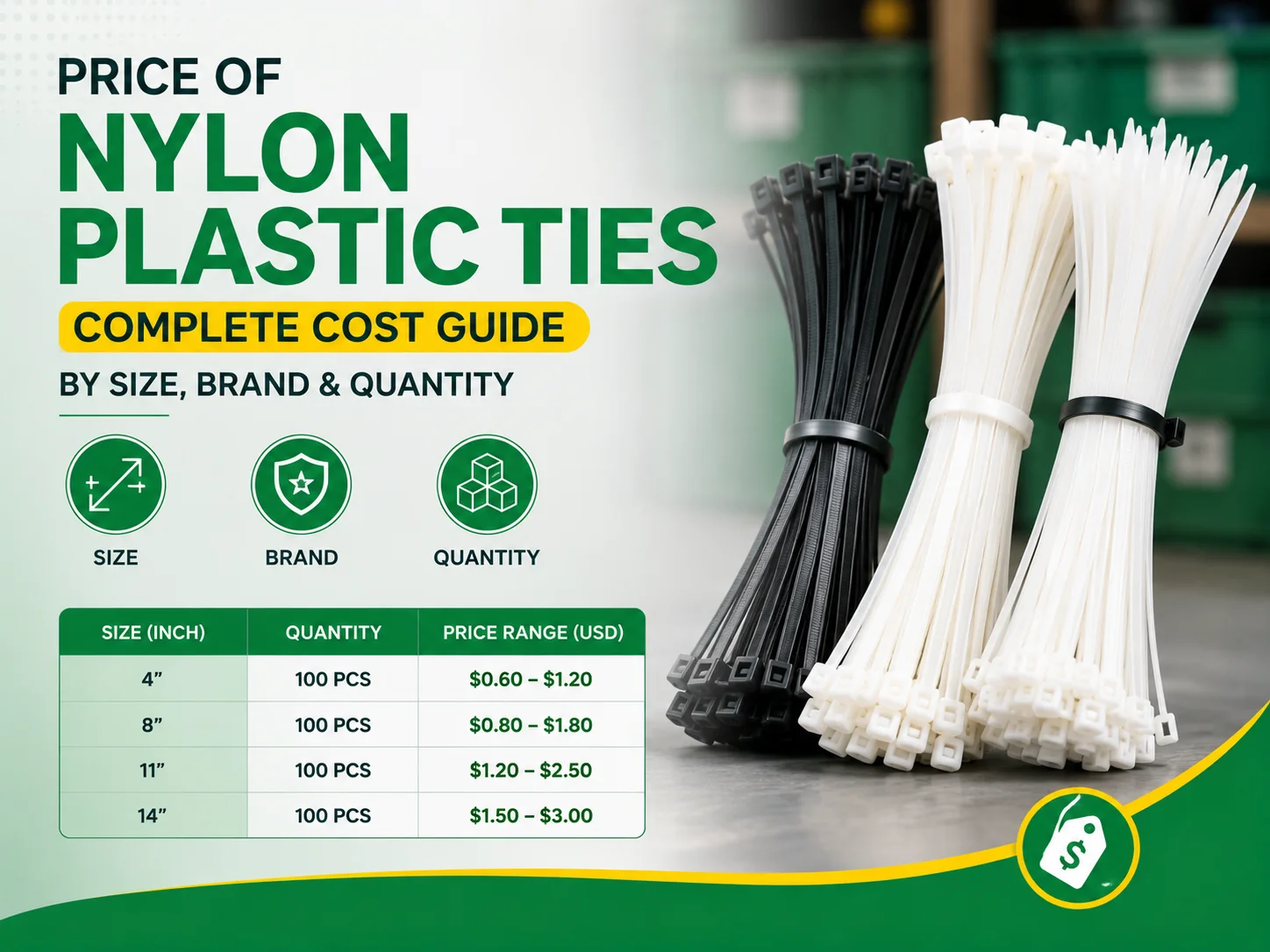
Quick answer: The cost of nylon cable ties varies between $0.005 and $0.15 each, influenced by size, quality, brand, and order quantity. Small cable ties have a price from $2 to $8 per 100-pack in retail, and $0.01 to $0.02 in bulk. Medium ties cost from $5 to $15 per 100-pack in retail and $0.02 to $0.05 in bulk. The price of large cable ties is set from $10 to $30 per 100-pack in retail and $0.05 to $0.12 in bulk. Ordering large wholesale batches of 10,000 pieces or more from manufacturers (mainly from China) brings down the price of overall production to $0.005–$0.03. Special versions like UV, fireproof, and releasable cable ties can be 20-50% more expensive than standard models. The brands that produce theirs (Panduit, Thomas & Betts, 3M) charge at least 2–5 times more for their products than those from other manufacturers.
What Are Nylon Plastic Ties? Names, Materials & Basics
There are many names for nylon plastic ties, including nylon cable ties, nylon zip ties, wire ties, cable wraps, or just zip ties. But all of these names mean the same thing: self-locking fastener made out of Nylon 66 (PA66) — one of the most powerful in terms of tensile strength as well as thermal stability and durability types of plastics. The plastic tie comprises a flexible strap made of nylon with serrations on one side and a ratchet head at one end. The strap goes through the head and tightens, while together with the one-way ratchet mechanism, it keeps it locked in place (except for releasable models).
It can be said that the terms “nylon cable ties” and “nylon zip ties” are interchangeable as they refer to the same plastic product. However, “cable tie” is more of a technical/industrial term than “zip tie”, which is more of a term used in consumer life. Both refer to self-locking fasteners made of nylon that may be used to keep cables in packs, keep things secure, organize wires, and for a number of other purposes. If you’ve ever wondered whether there’s a difference, our article on whether nylon cable ties are the same as zip ties covers this topic in detail.
Key Material Properties of Nylon 66 (PA66)
| Property | Value | Why It Matters for Pricing |
|---|---|---|
| Tensile strength | 18–120 lbs (8–55 kg) depending on width | Higher strength requires more material = higher cost |
| Operating temperature | -40°F to 185°F (-40°C to 85°C) | Specialty high-temp grades cost more |
| Flammability rating | UL 94V-2 (standard); UL 94V-0 (flame-retardant) | V-0 rated ties cost 30–50% more |
| UV resistance | None (natural); added (black/stabilized) | UV-stabilized ties cost 20–40% more |
| Color | Natural (white), black, and custom colors | Custom colors cost 10–25% more |
What Affects the Price of Nylon Plastic Ties?
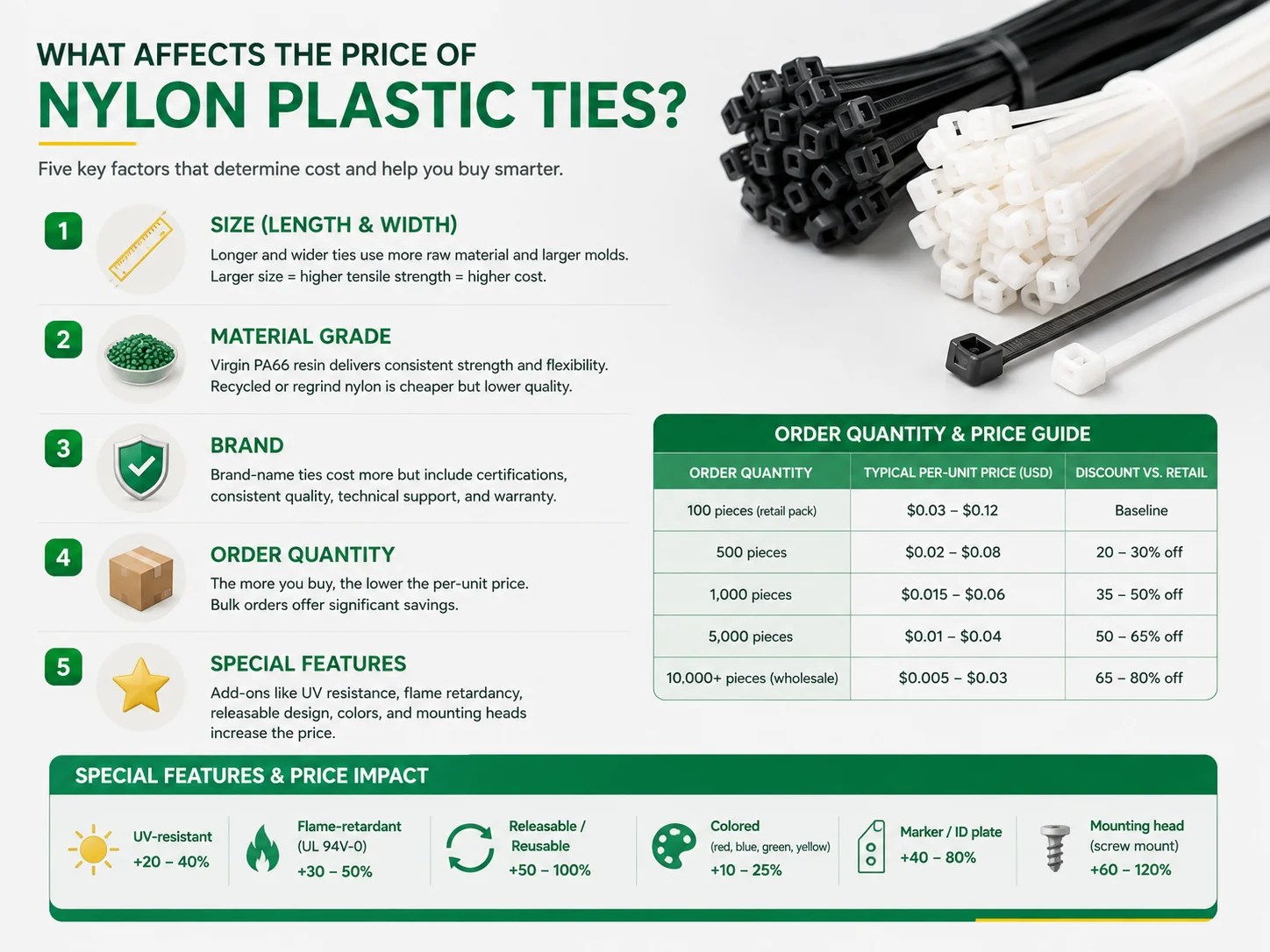
Five primary factors determine the cost of nylon plastic ties. Understanding these will help you compare apples to apples when shopping:
1. Size (Length & Width)
This is the primary factor influencing price. Longer and wider ties require additional raw materials and larger molds. A tie measuring 4 inches wide and 2.5 mm in width uses only around one-fifth of the material as a tie measuring 20 inches wide and 4.8 mm in width, and the price reflects this fact. In addition, width is also important as wider ties generally have greater tensile strength capability. For instance, a tie of 7.6 mm wide and rated 120 lbs will be much costlier than a tie of 2.5 mm wide and rated 18 lbs.
2. Material Grade
All Nylon 66 products are not the same. Premium producers opt for virgin PA66 resin sourced from reliable suppliers such as Dupont and BASF, which guarantees superior consistency and flexibility. On the other hand, budget firms may settle for using recycled or regrind nylon, eliminating high costs, at the same time degrading the welding strength and flexibility.
3. Brand
Brand-name connectors from vendors such as Panduit, Thomas & Betts (now ABB), 3M, and HellermannTyton typically carry a premium of 2-5 times the cost of generic connectors. The premium incorporates factors such as UL/cUL certification, quality assurance, technical service, and warranty. While the advantage is apparent in mission-critical applications such as aerospace, medical, or data centers, generic connections suffice for less demanding applications.
4. Order Quantity
As is the case with many products, the price for a single item decreases sharply with higher volume orders. For instance, a retail pack of 100 ties could cost $0.05 per tie, while a manufacturer bulk order of the same tie in 10,000 pieces could lower the price to $0.01. The following table provides a breakdown of the various discounts that accompany volume orders.
| Order Quantity | Typical Per-Unit Price | Discount vs. Retail |
|---|---|---|
| 100 pieces (retail pack) | $0.03–$0.12 | Baseline |
| 500 pieces | $0.02–$0.08 | 20–30% off |
| 1,000 pieces | $0.015–$0.06 | 35–50% off |
| 5,000 pieces | $0.01–$0.04 | 50–65% off |
| 10,000+ pieces (wholesale) | $0.005–$0.03 | 65–80% off |
5. Special Features
Standard natural (white) ties are the least expensive. The inclusion of additional traits leads to a higher price:
- UV resistant (black, stabilized): +20–40%
- Fire resistant (UL 94V-0): +30–50%
- Releasable/reusable: +50–100%
- Colored (red, blue, green, yellow): +10–25%
- Marker/ID plate (writeable surface): +40–80%
- Mounting head (screw fastened): +60–120%
Price Breakdown by Size and Dimensions
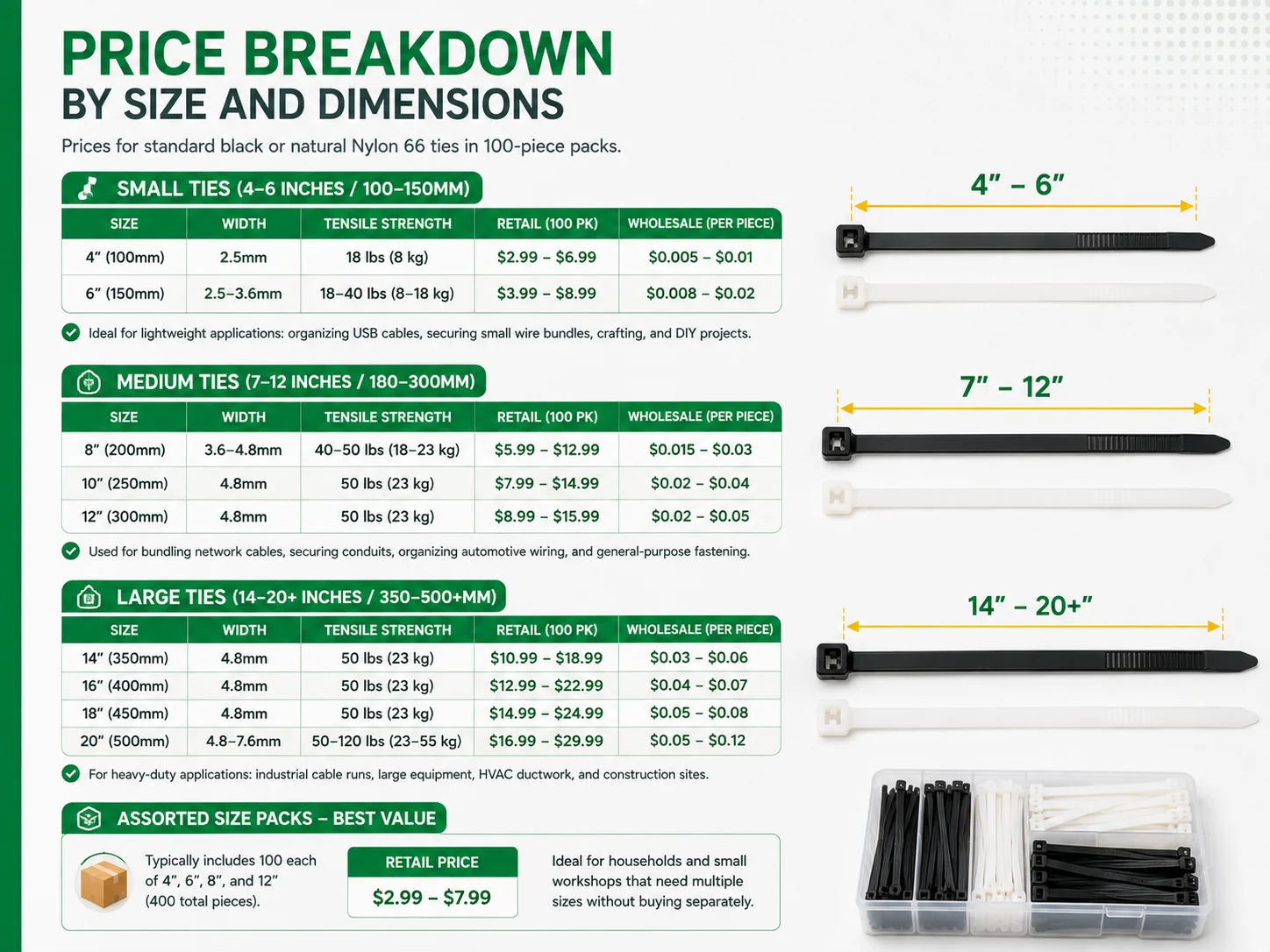
The primary determinant of nylon ties pricing is size. The table below provides a complete list of prices per size, for the most commonly available tie sizes on the market. It provides the retail price and wholesale price of standard nylon ties (Nylon 66) sold in packs of 100 pieces each.
Small Ties (4–6 Inches / 100–150mm)
| Size | Width | Tensile Strength | Retail (100 pk) | Wholesale (per piece) |
|---|---|---|---|---|
| 4″ (100mm) | 2.5mm | 18 lbs (8 kg) | $2.99–$6.99 | $0.005–$0.01 |
| 6″ (150mm) | 2.5–3.6mm | 18–40 lbs (8–18 kg) | $3.99–$8.99 | $0.008–$0.02 |
Using small ties can benefit a number of applications because they are inexpensive: wiring up small gauge cables, making small wire bundles, crafting and any DIY project you have in mind. They are by far the most popular size for residential purposes. Consult the catalogues available from different manufacturers for more information about specifications and dimension charts showing tensile strengths for all sizes.
Medium Ties (7–12 Inches / 180–300mm)
| Size | Width | Tensile Strength | Retail (100 pk) | Wholesale (per piece) |
|---|---|---|---|---|
| 8″ (200mm) | 3.6–4.8mm | 40–50 lbs (18–23 kg) | $5.99–$12.99 | $0.015–$0.03 |
| 10″ (250mm) | 4.8mm | 50 lbs (23 kg) | $7.99–$14.99 | $0.02–$0.04 |
| 12″ (300mm) | 4.8mm | 50 lbs (23 kg) | $8.99–$15.99 | $0.02–$0.05 |
Medium cable ties are the commonest type of tie in the world of cable management. They are used for checking many cables like network cables, conduits, and automotive wiring. The most commonly bought sizes in Amazon are 8 inch and 12 inch. 100 ties packages cost between 6 to 13 dollars. For specific 300mm (12-inch) pricing, our article on cable tie 300mm price provides a focused cost analysis.
Large Ties (14–20+ Inches / 350–500+mm)
| Size | Width | Tensile Strength | Retail (100 pk) | Wholesale (per piece) |
|---|---|---|---|---|
| 14″ (350mm) | 4.8mm | 50 lbs (23 kg) | $10.99–$18.99 | $0.03–$0.06 |
| 16″ (400mm) | 4.8mm | 50 lbs (23 kg) | $12.99–$22.99 | $0.04–$0.07 |
| 18″ (450mm) | 4.8mm | 50 lbs (23 kg) | $14.99–$24.99 | $0.05–$0.08 |
| 20″ (500mm) | 4.8–7.6mm | 50–120 lbs (23–55 kg) | $16.99–$29.99 | $0.05–$0.12 |
Heavy applications make use of large cable ties by bundling cable runs for industrial works, tying heavy machines for shipment, supporting HVAC ducts, and other construction applications. The 7.6mm wide models can withstand 120 lbs of tensile strength, making it more expensive due to the high quantity of material needed in their production.
Assorted Size Packs
The assorted size pack is one of the best buys for regular users—a typical pack consists of 100 4″, 6″, 8″, and 12″ ties (total 400). You can get these packs on Amazon for anything between $2.99 and $7.99 and they are perfect for homes and small workshops that would like to acquire those various sizes in one pack.
Price Comparison by Brand Tier
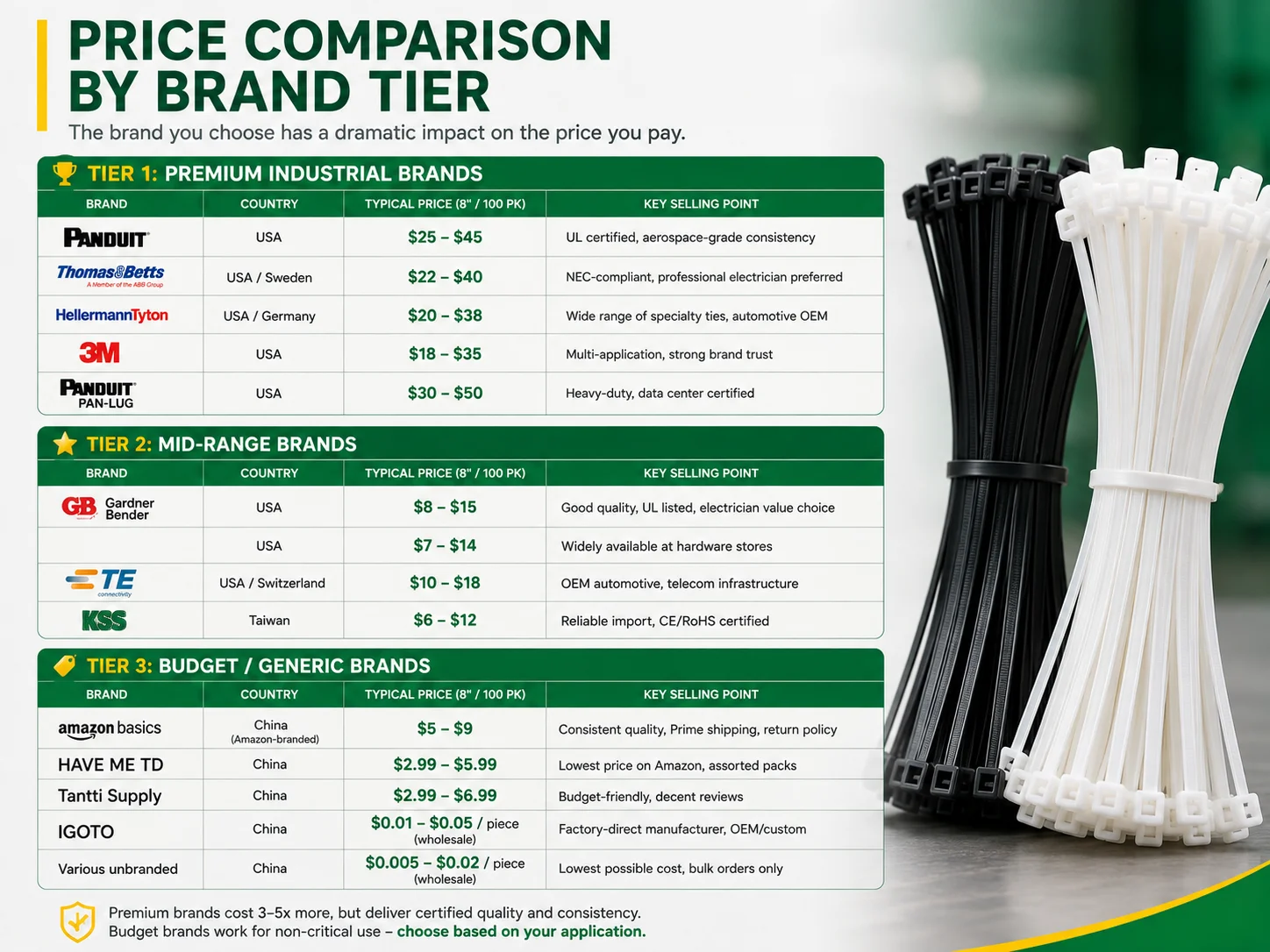
The brand you choose has a dramatic impact on the price you pay. Below is a comparison of the three main brand tiers:
Tier 1: Premium Industrial Brands
| Brand | Country | Typical Price (8″ / 100 pk) | Key Selling Point |
|---|---|---|---|
| Panduit | USA | $25–$45 | UL certified, aerospace-grade consistency |
| Thomas & Betts (ABB) | USA/Sweden | $22–$40 | NEC-compliant, professional electrician preferred |
| HellermannTyton | USA/Germany | $20–$38 | Wide range of specialty ties, automotive OEM |
| 3M | USA | $18–$35 | Multi-application, strong brand trust |
| Panduit Pan-Lug | USA | $30–$50 | Heavy-duty, data center certified |
Premium brands range from 3 to 5 times pricier than generic ties. However, these products are worth their price when needed for electrical installations, data centers, aerospace or any other sector where tie malfunction could result in dangerous situations and equipment damage. These brands ensure complete traceability, UL listing of the products, and’re core specific testing reports.
Tier 2: Mid-Range Brands
| Brand | Country | Typical Price (8″ / 100 pk) | Key Selling Point |
|---|---|---|---|
| GB Electrical | USA | $8–$15 | Good quality, UL listed, electrician value choice |
| Gardner Bender | USA | $7–$14 | Widely available at hardware stores |
| TE Connectivity (AMP) | USA/Switzerland | $10–$18 | OEM automotive, telecom infrastructure |
| KSS | Taiwan | $6–$12 | Reliable import, CE/RoHS certified |
Mid-range brands provide a fine balance of quality and price. Mid-range products can be used for a variety of professional electrical work, automotive usage, and commercial installations. Most of the mid-range products are UL- listed and give similar performance at about 50% of the price of expensive brands.
Tier 3: Budget / Generic Brands
| Brand | Country | Typical Price (8″ / 100 pk) | Key Selling Point |
|---|---|---|---|
| Amazon Basics | China (Amazon-branded) | $5–$9 | Consistent quality, Prime shipping, return policy |
| HAVE ME TD | China | $2.99–$5.99 | Lowest price on Amazon, assorted packs |
| Tantti Supply | China | $2.99–$6.99 | Budget-friendly, decent reviews |
| IGOTO | China | $0.01–$0.05/piece (wholesale) | Factory-direct manufacturer, OEM/custom |
| Various unbranded | China | $0.005–$0.02/piece (wholesale) | Lowest possible cost, bulk orders only |
Amazon’s bestseller rankings are mostly made up of budget brands. These ties can handle all sorts of home tasks, light cable management and all other uses where quality doesn’t matter much. However, the quality can be inconsistent; some production lots contain brittle ties; tensile strength ratings don’t reflect the truth. If you need ties for safety-relevant tasks, go for tier 1 or tier 2.For help evaluating quality, our guide on how to distinguish the quality of nylon cable ties covers visual and physical tests you can perform.
Retail vs. Bulk vs. Wholesale Pricing
The price you pay for your items hinges on the purchasing venue you choose and the quantity of your order. Three key purchasing venues can be summarized as follows:
Retail (Amazon, Home Depot, Lowe’s, Walmart)
Best suited for: Homeowners, DIY enthusiasts, minor jobs (1-5 packs)
Standard pack sizes: 50, 100, 200, 400 pieces
Price range: $2.99-$29.99 per pack
Cost per unit: $0.03-$0.15
Pros: Speedy delivery, easy returns, customer review availability, no minimum order size
Cons: The highest cost per unit, limited to standard sizes/colors
Bulk / Distributor (MSC, Grainger, Allied Electric, ULINE)
Best suitable for: Contractors, electricians, facility managers (500-5,000 pieces)
Standard pack sizes: 500, 1,000, 5,000 pieces
Price range: $15-$150 per order
Cost per unit: $0.015-$0.05
Pros: 40%-60% cheaper than retail prices, branded products, payment at a later date
Cons: Higher minimum order amount required, may necessitate a business account
Wholesale / Direct Factory (Alibaba, Made-in-China, IGOTO)
Best suitable for: Importers, OEM clients, large projects (10,000+ pieces)
Common order sizes: 10,000-100,000+ pieces
Price range: $50-$500 per order
Cost per unit: $0.005-$0.03
Pros: Absolute lowest price, custom printing
Cons: Lead times of 2-6 weeks, shipping fees, customs duties, and requirements for minimum order quantities
Tip: The “price cliff” occurs at around 1,000 items. Prices below that point are best handled through retail or bulk distributor. Above those quantities, the savings achieved through wholesale purchases can more than overcome the delay in delivery. For purchases somewhere between 500 and 1,000 items, it is worth comparing distributor prices with factory-direct quotes since sometimes the factory price (including shipping) can still be more affordable.
Specialty Nylon Ties: UV, Flame-Retardant, Releasable & Colored
Standard nylon ties handle 80% of applications. But when you need specialized performance, the price goes up. Here’s what to expect:
UV-Resistant Nylon Ties
Regular natural (white) nylon ties are affected by sunlight as the ultraviolet rays disintegrate the polymer chains, which leads to their brittleness and failure in a period of 1-3 years. UV-resistant ties are made from Nylon 66 stabilized with carbon black, so they are always black in color. As a result, they last for 5-10+ years outdoors. Expect to pay 20-40% more than for regular ties. For instance, a 100-pack of 8-inch UV ties generally retails for $8-16.
Flame-Retardant Nylon Ties (UL 94V-0)
Standard nylon ties are rated UL 94V-2 for flammability, which means that they will not burn easily, but, over time, they may catch fire. Flame-retardant ties are rated UL 94V-0 for flammability, which means that they will extinguish themselves within 10 seconds of the removal of the flame. These types of ties should be used in plenum areas, data centers, and applications that require fire codes. Expect to pay 30-50% more than for standard ties. For example, a pack of 100 8-inch V-0 ties will typically retail for $12-$22.
Releasable / Reusable Nylon Ties
Basic ties can only be used once – once they are applied, they have to be cut off. Reusable ties features a lever or button on the head of the ties that will unlock them, so that you can take them off and reuse them. That makes them a good choice for temporary installations, events, and for cable management as well. Note that these ties cost approximately 50%–100% more than regular ties. According to the data that available on the market right now, a pack of 6-inch reusable ties costs between $8 and $15.
Colored Nylon Ties
Colored ties (red, blue, green, yellow, orange) are utilized to assist with color-coding of cable bundles and circuits as well as for organization of wire runs. They are priced significantly higher than natural/white ties (in a range of 10-25%) due to the cost of colorant and the low volume of production. Electricians and network installers prefer buying packs with assorted colors, which usually contain 6-10 colors. A pack containing 100 colored ties can be bought for $6-12.
Marker / ID Plate Ties
These ties feature a bonny flat plate at the end so that it could be written on with a permanent marker or a printed label can be pasted on it. They are useful in labeling cables in data centers, telecom setups, and industrial control panels. Expect to pay about 40 to 80 percent more in comparison to regular ties. A standard 100-pack goes for about $12 to $25.
Where to Buy Nylon Plastic Ties at the Best Price
The best place to buy depends on your quantity needs, timeline, and quality requirements:
| Channel | Best For | Price Level | Lead Time |
|---|---|---|---|
| Amazon | Small quantities (1–5 packs), fast delivery | $$ | 1–2 days (Prime) |
| Home Depot / Lowe’s | In-store pickup, immediate need | $$–$$$ | Same day |
| ULINE | Bulk quantities (500–5,000), shipping supplies | $–$$ | 1–3 days |
| Grainger / MSC | Brand-name industrial ties, B2B accounts | $$$ | 1–3 days |
| Alibaba | Wholesale (10,000+), custom specs | $ | 2–6 weeks |
| Factory direct (IGOTO, etc.) | OEM, custom branding, maximum volume | $ | 2–4 weeks |
For more guidance on choosing the right cable ties for your specific needs, our article on how to choose the right cable ties walks through the selection process step by step.
How to Save Money When Buying Cable Ties
Here are proven strategies to get the best value when purchasing nylon plastic ties:
1. Purchase Assorted Size Packs
Assorted packs (100 each of 4″, 6″, 8″ and 12″) are priced at $3-$8, which amounts to 400 ties of different sizes. If you take on the prices of buying the same sizes of ties separately, the total amount can come to $15-$30. This purchase helps to save 60%-75% with each tie.
2. Purchase in Bulk Once, Benefit for Years
Nylon 66 ties can be stored for 5-10 years with proper storage conditions away from sunlight. A pack of 1,000 ties will cost the same as 10 packs of 100 ties for retail use, while offering 10 times more ties. If ties are used often, it is better to buy a bulk pack once and keep replenishing your stock.
3. Do Not Over-Specify Non-Critical Use
If you bundle HDMI wires under your desk, generic 4-inch ties priced $2.99 will perfectly fit. It is not possible to justify the use of $25 UL-listed Panduit ties for the management of your wires when the inspections are not carried out. Always match the quality of ties to the use you have in mind.
4. Check Factory-Direct Options for Large Orders
If you need to order 5,000 ties, ask for quotes from 2-3 manufacturers. Per-unit costs can be very low due to the fact that you can get the price of $0.005-$0.02, and many factories can give you samples for the quality verification.
5. Do Not Buy Specialty Ties Unless Needed
UV-resistant and flame-proof ties cost much more. There is no reason to buy UV ties for indoor use; regular ones will work just as well. The same is connected with V-0 ties, for instance используйте их tylko в случаях, когда применяется противопожарное законодательство.
Quality vs. Price: Is Cheaper Always Worse?
Not necessarily. The relationship between price and quality in nylon ties is nuanced:
| Factor | Cheap Ties ($0.005–$0.02/piece) | Mid-Range ($0.03–$0.08/piece) | Premium ($0.10–$0.30/piece) |
|---|---|---|---|
| Material | May use recycled/regrind PA66 | Virgin PA66 | Virgin PA66, DuPont/BASF certified |
| Tensile consistency | ±30% of rated strength | ±15% | ±5% |
| Brittleness | May snap in cold weather | Good flexibility to -20°F | Excellent flexibility to -40°F |
| UV stability (black) | 1–3 years outdoors | 3–7 years | 7–10+ years |
| Certifications | None or self-claimed | CE, RoHS | UL, cUL, CSA, CE, RoHS |
| Best application | Home, craft, non-critical | Commercial, automotive, light industrial | Aerospace, data center, code-compliant electrical |
The main point here is that the quality of the ties should fit the function you will use them for. So using the $0.30 Panduit ties to keep your phone cord in check is a waste of money, and using the $0.01 generic ties to secure a 480V cable run at a commercial building is dangerous. For the vast majority of the cases, users tend to find out that medium-quality ties with prices ranging from $0.03 to $0.08 give the best compromise between quality and price.
Frequently Asked Questions
What is the cost of plastic cable ties?
The price of plastic cable ties differs according to their size and brand as well as packaging quantities. A consumer can find 100 pieces of standard 8-inch nylon cable ties for $5–$13, meaning that one tie costs $0.05–$0.13. Smaller plastic ties can be bought for $2.99–$6.99 for every 100 pack (the price is $0.03–$0.07 each), while larger ties cost $10–30 per 100 pack ($0.10–$0.30). Buying plastic ties in wholesale helps to reduce the cost per unit significantly: a 1,000-piece order costs $0.015–$0.05 each, while bulk orders from manufacturers may cost $0.005–$0.02 each. Some plastic ties that have special features such as UV-resistance or flame-retardant qualities can cost 20–100% more than the base price. In general, one may need to pay $5–$15 for an assorted pack of about 200–400 ties.
Are nylon zip ties better than plastic?
Nylon zip ties are plastic ties since nylon is a plastic. The crucial difference is between Nylon 66, which is the industry-standard material for quality cable ties, and other cheaper forms of plastic, such as polypropylene or polyethylene that some low-priced manufacturers use. Nylon 66 zip ties are more durable due to greater tensile strength (18–120 lbs compared to 10–30 lbs of polypropylene), better heat tolerance (up to 185°F compared to 140°F), flexibility (will not turn brittle in the cold), and self-locking teeth. Polypropylene zip ties are inferior in terms of construction because they cost less, but they are also weaker and more fragile. As soon as you see “nylon zip ties” vs. “plastic zip ties,” you should know that nylon zip ties will be the superior choice in almost every instance.For a detailed comparison, our article on whether nylon zip ties are better than plastic covers the full material analysis.
How much do zip ties cost?
When it comes to pricing of zip ties or nylon cable ties, the costs can vary between $0.005 and $0.30 per unit based on various criteria including size, brand name, and quantity ordered. For example: Normally the small size ties (4-6 inches) would cost buyers $2.99 to $6.99 for 100 pieces or $0.005-0.02 each if bought wholesale while medium size ties (8-12 inches) would go for $5.99 to $15.99 for 100 pieces in retail and they would cost buyers $0.015-0.05 if they decided to buy this size wholesale. The largest sizing of ties (14-20 inches) would cost consumers $10.99 to $29.99 for 100 packs retail or $0.03-0.12 wholesale pricing, i.e., if they decided to buy it in wholesale. A package of assorted packs (400 counts) including different sizes of ties would cost buyers $2.99 to $7.99 giving good pricing agreement for different consumer needs. Special established brand names ties like Panduit or HellermannTyton could cost consumers as much as 3-5 times that of other generic alternatives. Almost like any other product, the price of special ties (UV-resistant, flame-retardant, releasable ties) would be 20-100% higher. The average home user buying the ties in bulk of 100-200 packet in any retail chain should expect an expenditure of $5-$15.
What are nylon ties?
Nylon ties, otherwise referred to as nylon cable ties, nylon zip ties, and wire ties, are self-locking fasteners and are typically made of Nylon 66 (PA66), a polyamide plastic resin. The nylon tie combines a flexible strap on one side and a ratcheting head on one end. To use the nylon tie, the strap should be threaded through the head, and one should pull tight such that the one-way ratchet mechanism locks the tie permanently in place (unless the releasable version is being used). Thomas & Betts (now part of ABB) invented nylon ties in 1958 under the trade name “Ty-Rap” and they have become one of the world’s most common fastening products since that time. Nylon ties find applications in cable bundling, wire runs securing, automotive harnesses organization, hanging signs and labels. Industries using nylon ties include construction, telecommunications, electrical, automotive, and consumer DIY. Standard nylon ties can withstand tensile strength of anywhere between 18 to 120 lbs depending on their width and temperature ranging from -40F to 185F and lengths can vary from four inches to 48 plus inches. Common sizes include four, six, eight, ten, twelve, and fourteen inches in either the natural (white) or the black (UV- resistant) color.
References
- UL (Underwriters Laboratories) — UL 62275 standard for cable ties, including flammability ratings (UL 94V-0 and V-2) and tensile strength testing requirements.
- NEMA (National Electrical Manufacturers Association) — Standards for wiring device quality, cable management products, and electrical installation code compliance.
- DuPont Zytel (Nylon 66 Resin) — Material specifications for virgin PA66 resin used in premium cable tie manufacturing, including tensile strength and temperature ratings.
- Panduit Cable Ties — Premium industrial cable tie product catalog, pricing, and technical specifications for code-compliant applications.
- HellermannTyton Cable Ties — Manufacturer’s cable tie product range, material grades, and application guides for automotive and industrial use.
- IEC (International Electrotechnical Commission) — IEC 62275 international standard for cable management systems, including cable tie performance and classification.
- Amazon Nylon Cable Ties — Retail pricing reference for consumer-grade nylon cable ties across multiple brands, sizes, and pack quantities.
The cost of nylon ties varies greatly; they may be priced as low as a penny for wholesale purchases of small-sized ties to as high as $0.30 for retail sales of high-end and large-sized products. Five criteria that affect the price level include the tie length, brand (generic, average, and top-end), the order volume (from a 100-pack for retail consumers to 10,000-pack for wholesale purchases), the material quality (recycled and virgin) and the presence of additional features (e.g. UV resistance, flame protection, and color). Nevertheless, a pack of assorted nylon ties costing approximately $3-$8 in total will meet the needs of most homeowners. Electricians and contractors can buy ties at a price of $0.03 – $0.08 from resellers, which is lower than the retail price. Manufacturers can acquire nylon ties at the lowest price possible within 2-6 week time, but they have to make wholesale purchases.
In order to buy nylon ties at the right price, one has to ensure that the quality of the ties corresponds to the nature of use. For example, cheap ties can be used in the home, while mid-level and high-quality nylon ties should be used by professionals. It is also worth mentioning that one should pay for only those features they need when buying nylon ties.