



Do Cable Ties Work on a Strimmer?
If you have ever looked at your trimmer, or weed eater (or line trimmer, depending on where you live), and seen that the guard is loose and the line or cord spool is being disobedient, you probably wondered whether you could simply attach it with a cable tie. The answer is not a simple yes or no. While there are certain situations when it is fine to use a cable tie, it is not suitable for all situations. In this guide, we will take a look at the situations when you can use cable ties and when there are better solutions.
In summary, cable ties can prove useful in strimmers in non-intensive and stationary tasks like fastening anything such as the line-spool cover or the bump knob that has fallen from its place, stabilizing the blade guard or securing the electric tool’s cord, fixing the spare spool near to the boar or keeping the device in safety mode without the risk of damaging the trigger. A tie of 150-200 mm in size is preferred, made from black nylon and with breaking strength higher than 50 lbs. However, it is impossible to use cable ties as a substitute for a trimmer line (the required line must be the line recommended by the manufacturer and supplied in the spool) and also they cannot be used on rotating or hot elements as the heat and vibration will affect them within a minute.
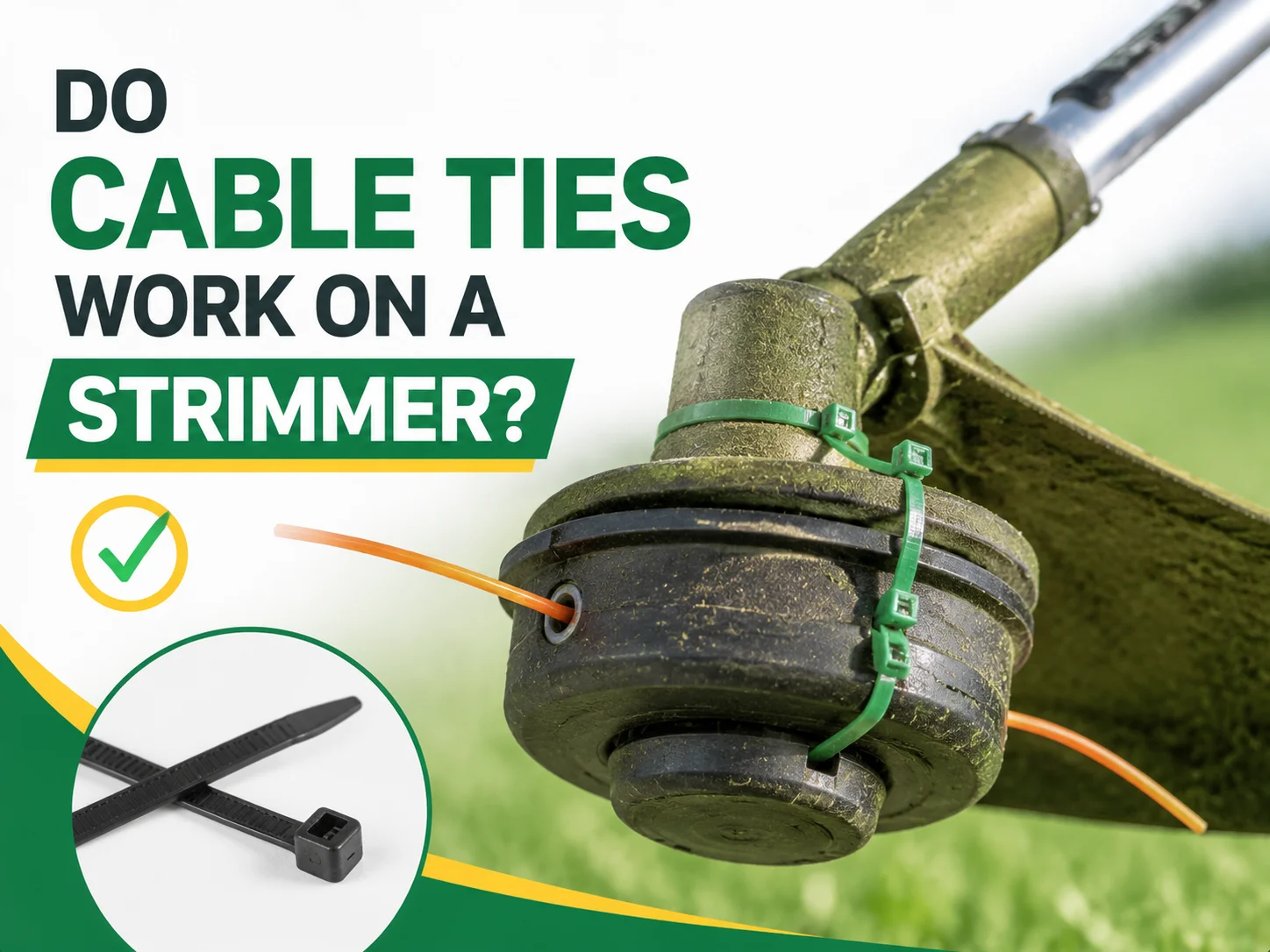
The Direct Answer: Where Cable Ties Work on a Strimmer
A strimmer is always vibrating strongly and continuously, and this is why cable ties were created — a well-tightened nylon tie can remain tightly secured and immovable when subjected to a lot of shaking. The applications where a cable tie can be truly useful for strimmers are the following:
- Line spool cover or bump feed button: these can become loosened due to vibration, and a tie fed through the slots of the cover or wrapped around the housing secures them until you can install a proper part or any thread lock.
- Retaining blade guard: if the screw securing the guard is stripped, heavy ties can be fed through the holes in the guard which can be a good temporary solution until the screw is fixed.
- Management of power cord or throttle cable: when a strimmer is electric, securing the wire to the shaft will help improve safety when cutting as it will not be able to swing into the head — this is an ideal usage for the cable tie.
- Storing spare line: rolling up a spare spool or line and securing it with a cable tie to the shaft will ensure that you will never run out of line while using the strimmer.
- Trigger lock for storage: a tie can be passed through the trigger to keep the tool inactive while it is stored, which is a very effective method.
These tasks share one thing in common: they all involve static operations, i.e., the cable tie is not used on a moving part, near the exhaust, or under cutting load. For static fastening under vibration, nylon cable ties are arguably the best tool in the shed. The removal side matters too — when a tie has done its job, the how to remove cable ties guide shows the clean way to cut them off without nicking paint or plastic.
Where Cable Ties Do NOT Work
It is crucial to identify the areas on trimmers where using cable ties could lead to problems that would not be easy to overcome.
- On the cutting line. The line is made from special nylon filament, which means cable ties can’t be substituted for it. Besides, a cable tie will prevent proper functioning of a feeding system.
- On rotating elements. Any rotating part like the cutting head or shaft connection will simply cut the cable ties.
- When near the engine and the exhaust. The engine and exhaust of a two-stroke mechanism operate at such temperatures that they damage ordinary nylon.
- For fixing any structural issue. It is not a job for a cable tie if there is a need to fix something like the outer casing or a handle, as cable ties do not withstand loads when they are subject to bending.
To summarize, cable ties will hold the objects that should not be moved, while moving parts should either be replaced with the right ones or fixed in some other way.The material difference — when nylon is right and when you must step up to metal — is covered in the stainless vs nylon comparison.
What Kind of Cable Tie to Use
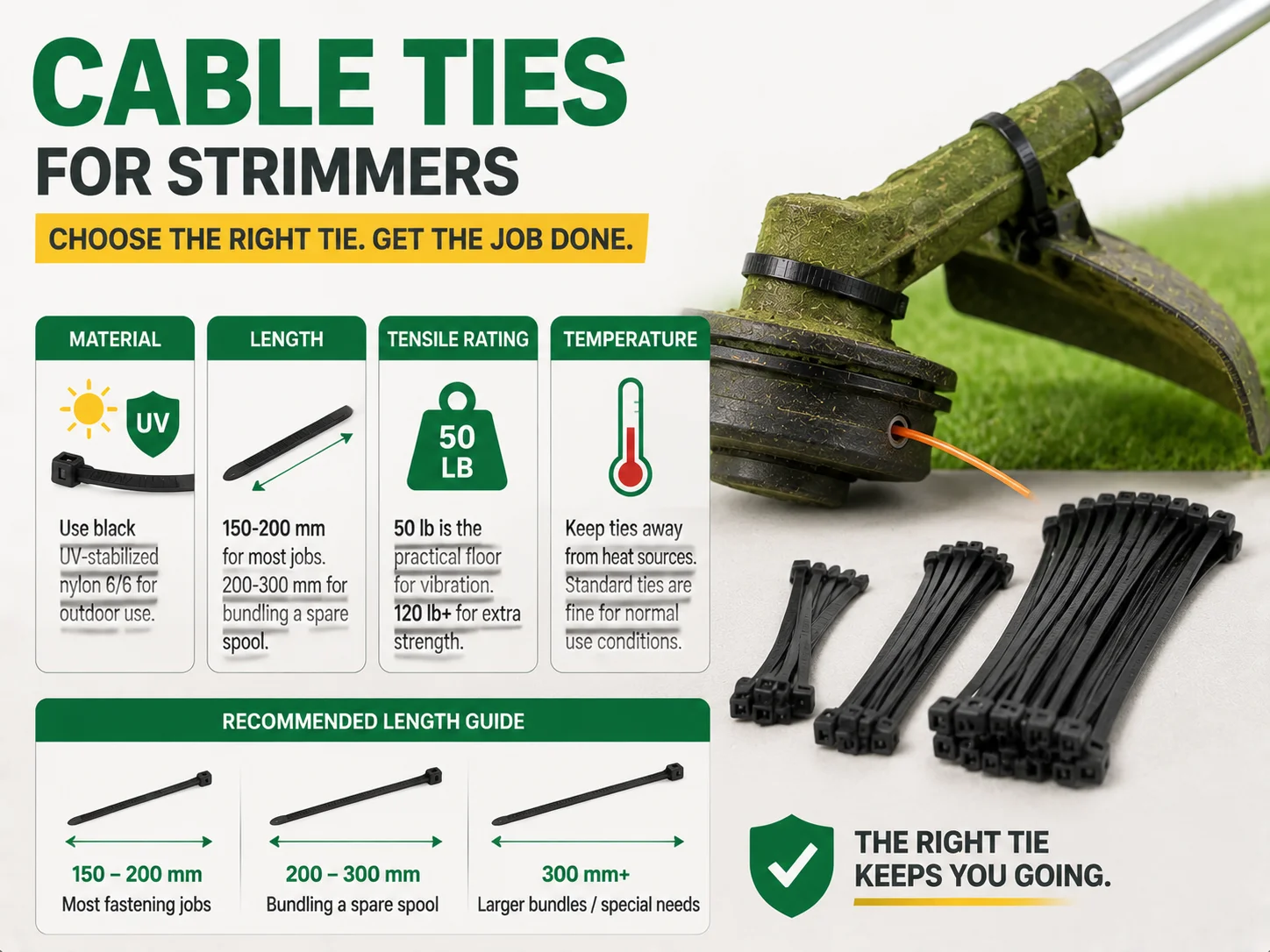
Different cable ties can be better fitted for certain jobs and some simply don’t work!
- Material: regular nylon 6/6 ties are good for an indoor job, but if the strimmer is going to be used outside, it is better to choose black UV-stabilized nylon 6/6 ties, because natural nylon plastics get brittle within several months being outside.
- Length: optimum cable ties are from, say, 150 mm to 200 mm, just enough to hold the shield or the shaft.
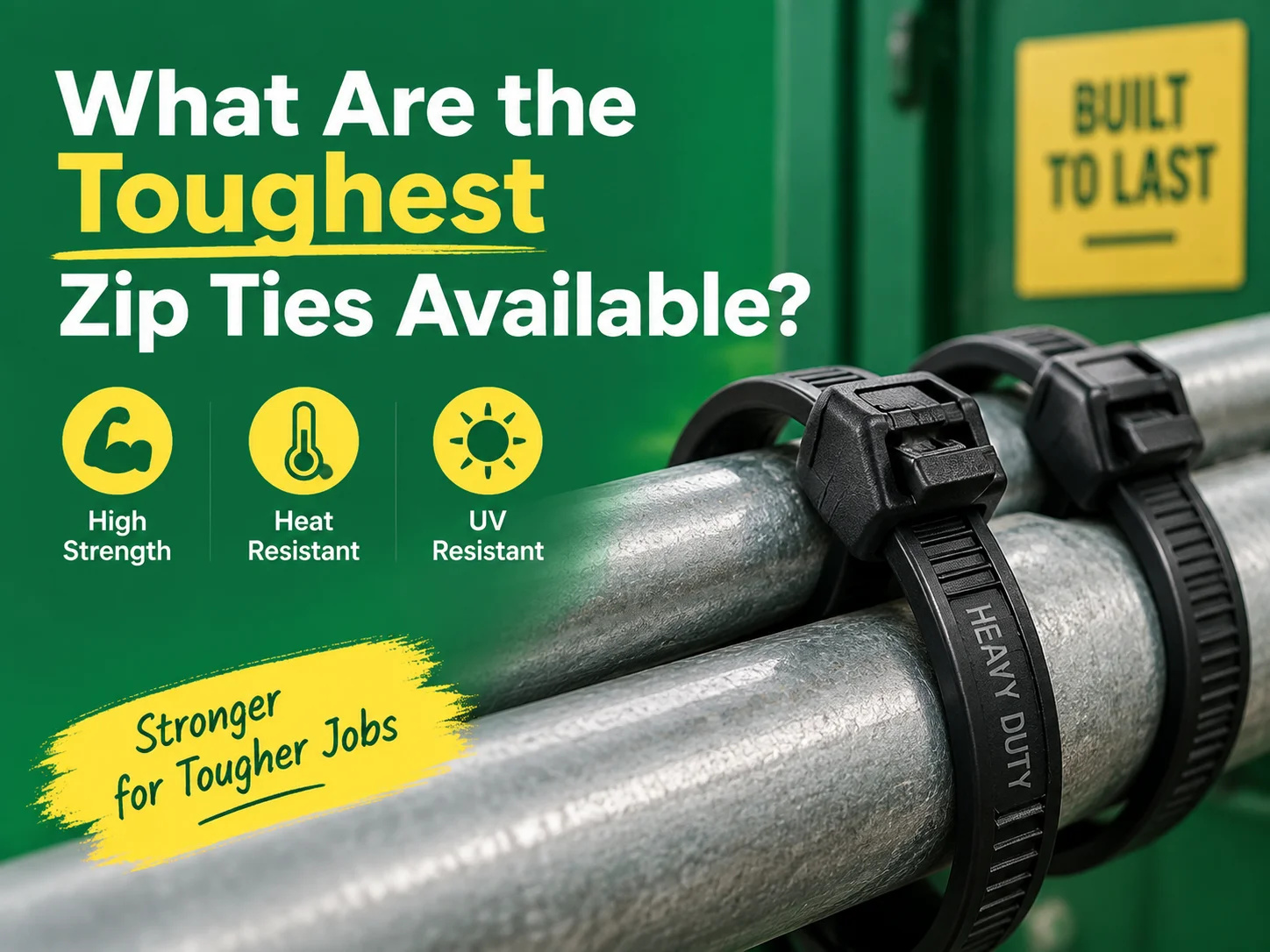
- Strength: 50 lb would be the minimum for any product used with vibrational loads; heavy-duty ties are preferable (minimum strength is 120 lb).
- Temperature resistance: make sure you choose cable ties that can withstand conditions they will be exposed to during use. For instance, a nylon tie near the exhaust will break no matter its specifications, so don’t bother with “heat-resistant” cable ties in such cases.
Buying the right grade matters more than the brand — and for garden tools that spend their lives in sheds, garages, and sunshine, the how to choose cable ties guide is the systematic way to match size, strength, and material to the job.
The Cutting Line: What Actually Does That Job
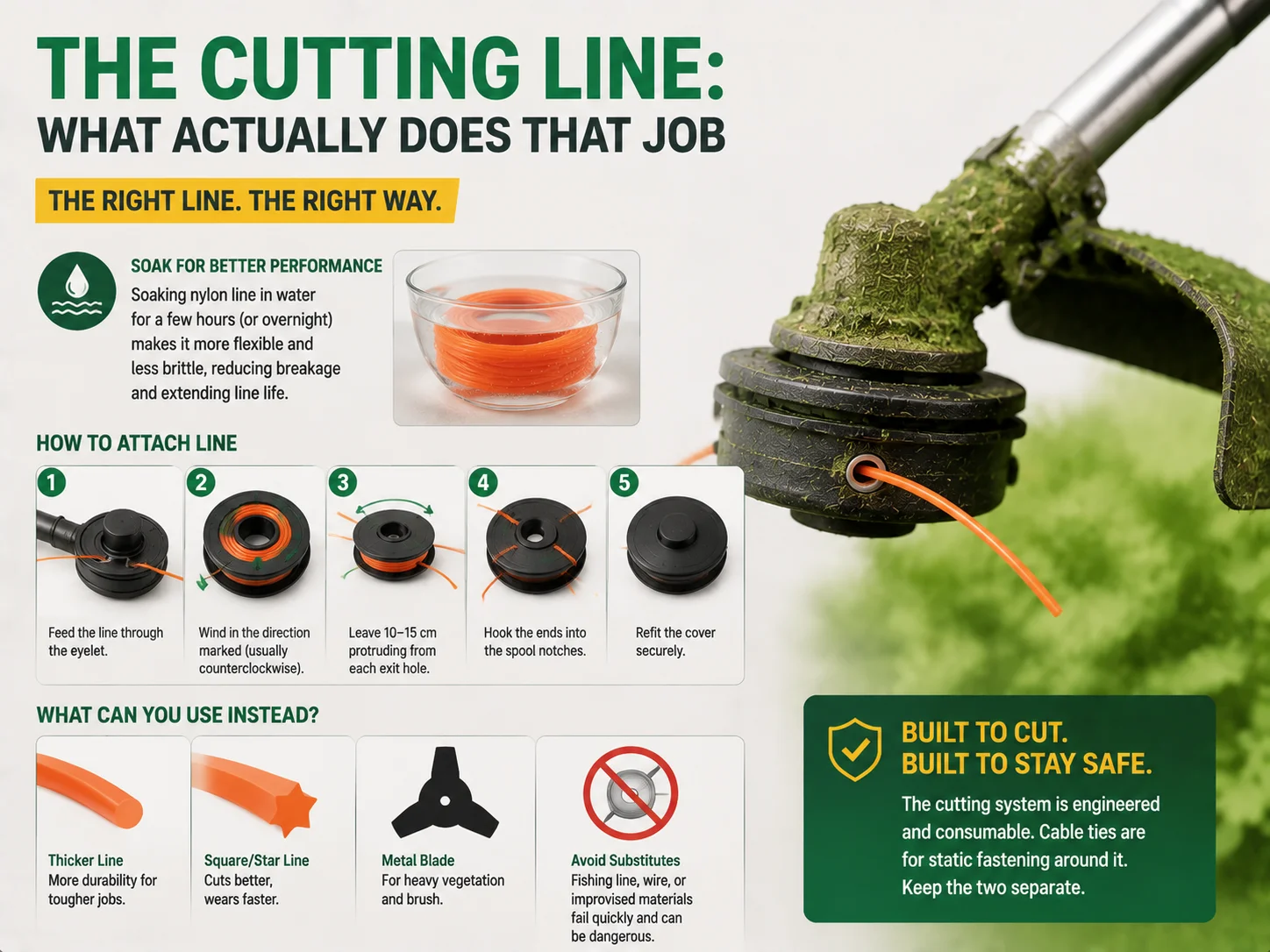
Since the question “do cable ties work on a strimming machine” raises the bigger question about the cutting line, let’s clarify some facts about trimming lines:
- Why do we soak strimmer line in water? A few hours (or overnight) soaking process in the water helps to make its nylon line more flexible and less fragile, thus helping to avoid breaking during the first process of using a brand new spool, which is a simple trick that significantly extends the life of the line.
- How to install line into strimmer? Follow the arrows of the spool’s way — put the line through the eyelet, wind it in the direction indicated by the markings (usually counter-clockwise), leave 10-15 cm outside each hole and hook the end of the line in the spools notches before putting on its cover. As regards double line heads, put both lines in from the hole at their equal length.
- What can be used instead of strimmer wire? Thicker lines, square or star-shaped ones (cutting well but wearing down quickly), or if in serious need of transforming the line into a metal blade kit. Alternatives at home like fishing line or wire fall apart in no time being unsafe at the same time — so it is better to focus on a special trimmer line.
All this is not about cable ties, which proves the idea completely; the cutting system is designed and made for being a consumable material, whereas cable ties are only fixing mechanisms. The ability to keep them apart is truly the point.
Other Garden Uses for Cable Ties
The strimmer is one tool among many, and the same tie that secures its guard has a dozen garden applications: training climbing plants to stakes, securing fence netting, bundling extension cords and hose ends, fastening trellis joints, hanging bird feeders, marking irrigation lines, and tying gates shut. Outdoors, every one of these should use the UV-stabilized black grade, and for jobs under constant sun, wind, and rain — fences, trellises, netting — the strength and size questions are the same ones the heavy-duty cable tie guide answers for structural loads. One mental model covers all of it: if the part is static and the environment is outdoor, a black UV-stabilized nylon tie in the right length and strength is a legitimate engineering choice; if the part moves, spins, or gets hot, it is not.
How to Choose and Apply Ties Safely
You can create a five-stage routine for fastening or cutting with any strimmer or garden tool.
- Make sure that the part is not rotating, is not exposed to extreme heat and is not stressed while being flexed, and operating with such a part should be avoided.
- Choose black nylon 6/6 that is UV stabilized if item will be exposed to sunlight, and ordinary nylon for indoor use only.
- Choose the length that passes around the bundle with 20-30% of excess yarn remaining for the fastening, usually ranging between 150mm and 250mm.
- Make sure that it is tight enough but not too much, as an overtightened strap will break easily.
- Cut the end in a smooth way using a proper cutting tool, or leave a little tail to make the removal easier later.
FAQ
Can I use a zip tie instead of a hose clamp?
When it comes to low-pressure and minimally important anchoring, a robust nylon zip tie may do the job of attaching a flexible hose to a barb connector on a cable or the end of a garden hose just as well. But for any device carrying an actual pressure or pump or using fuel, one must resort to a real hose clamp. This is due to the incapability of zip ties to apply uniform pressure, deteriorating under heating and slipping with time. The rule is to use zip ties for low-pressure work only.
Why soak weedeater line in water?
The reason for soaking the trimmer line in water is to improve the nylon quality — after a few-hour soaking, the line will become softer, more flexible, and less breakable when using a new spool for the first time.
How to attach string to a strimmer?
You only need to follow the arrows on the spool: feed the string through the hole, wind it the way shown, keep 10-15 cm of the string sticking out, save the spool notches, and put on the cover. In case of double-line heads, first insert two strings of equal size through the center hole. Check the owner’s manual for more accurate instruction.
What can you use instead of strimmer wire?
It is better to use either a thicker line, square or star line for cutting tougher materials, or metal blades for heavier brush instead. Common materials like fishing lines, cables or wires are not recommended as they break easily and can cause serious injury.
References
- Family Handyman — String Trimmer Maintenance and Line Tips
- Lowe’s — How to Use a String Trimmer (Weed Eater)
- Husqvarna — Trimmer Line Selection Guide
- This Old House — String Trimmer Tips
- ASTM G154 — UV Exposure Standard (Cable Tie Weathering)
Conclusion
Are cable ties effective when being used together with a strimmer? Yes, cable ties can be used in situations that require static and vibrational fixing, such as locking the line spool cover, supporting the guard, guiding an extension cord, packing a spare spool, locking the trigger before storing the strimmer, etc. Just keep in mind to use black UV-stabilized ny 6/6 cable ties with length between 150 mm – 250 mm and a tensile strength of not less than 50 lbs. If these recommendations are followed and the cable ties are tightened properly, cable ties will work till the end of the season. On the contrary, cable ties should be avoided in any applications dealing with the line, moving parts, and exhaust system since this is an implemented or heat rated system that will create lots of problems instead of solving any.