


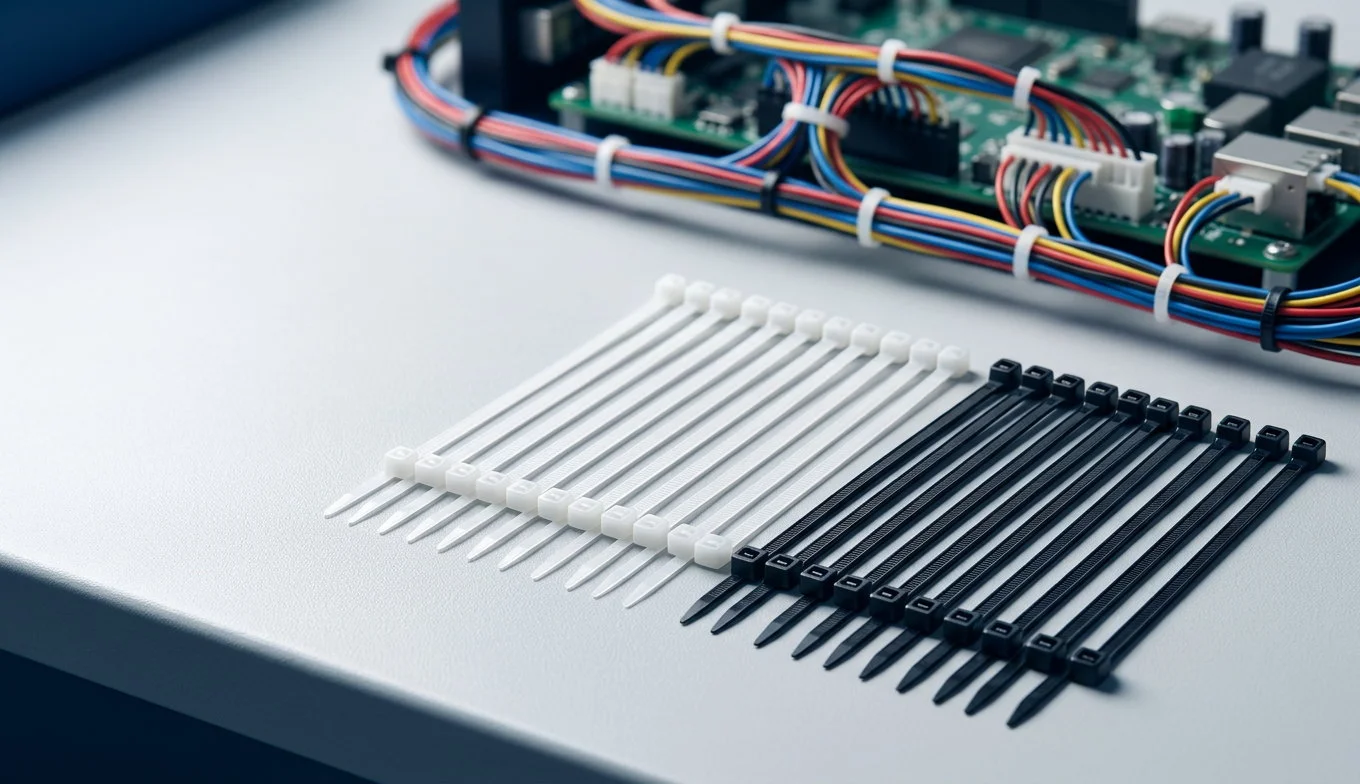



Are Nylon Cable Ties the Same as Zip Ties?
The apprentice fetched a bag labelled nylon cable ties in response to a request by a maintenance technician at a food processing plant to bring him a bag of zip ties. The technician acknowledged this, stating that the two were identical. That was indeed true, as nylon cable ties and zip ties can be viewed as synonymous in the real world. However, the hesitation demonstrated by the apprentice was not unfounded. Some distinctions exist between the terms “nylon cable ties” and “zip ties” in an industrial supply catalogue or in the mind of a buyer. Whereas one of the terms represents a material, the other one corresponds to the use of the material. Knowing the distinction may be useful in the procurement process.
Summary: Most of the time, nylon cable tie and zip tie refer to the same thing. “Zip tie” is the common name given to a self-locking cable fastener — a name that has entered everyday vocabulary because of the distinctive sound made while fastening the tie. On the other hand, “nylon cable tie” is the more accurate technical term applied in engineering, electrical catalogues, and industrial procurement indicating both the material that is being used (which is nylon 6/6, also known as polyamide 66) and the use of the product (useful in bundling cables together).
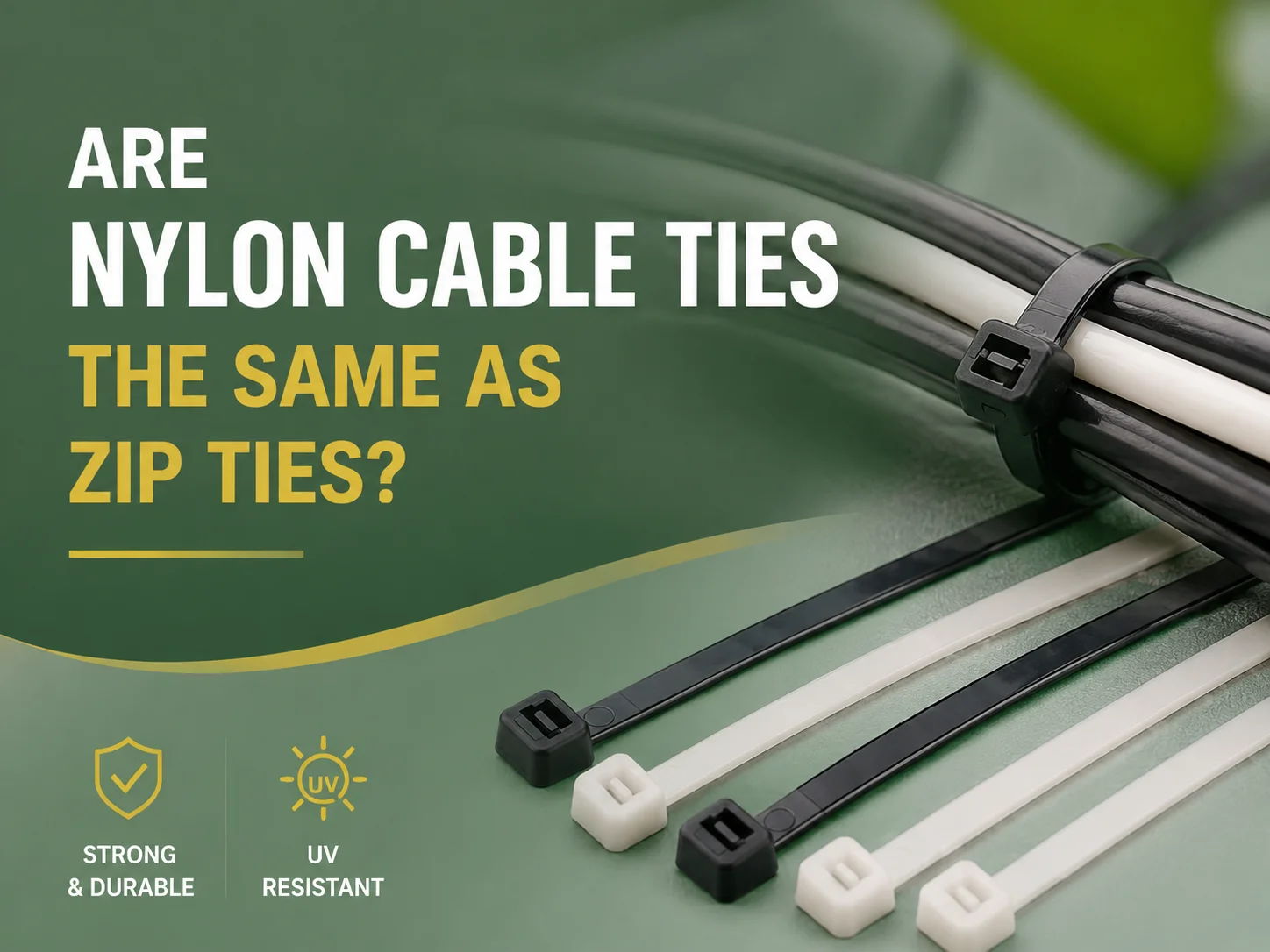
Where the Two Names Come From: A Brief History of the Zip Tie
The zip tie was first invented in the year 1958 by Thomas and Betts employee who developed a plastic fastener that would lock itself when being utilized to bundle cable wires in an aircraft. The developed product is referred to as Ty-Rap, which has been manufactured out of nylon 6/6, which remains to be the product of standard technology for over sixty years. The term zip tie rose from the sound produced during fastening the cable tie, and the snap sound made while the tail passes through the main part of the device. While the term “zip tie” is widely used but “cable tie” is still used as a technical term of sorts.
The criteria to differentiate frequently comes down to material, as nylon 6/6 is not the only type of plastic from which cable ties can be made. Polypropylene ties act as a less expensive option for light, temporary, and/or non-critical applications. ETFE (Tefzel) ties are used for aerospace, nuclear, and chemical applications that require high levels of temperature and chemical resistance. Stainless steel ties are used for outdoor applications and in marine environments as well as in situations when plastic materials would fail. All these are zip ties, meaning that they can be defined as self-locking and made from one continuous piece of serrated ribbon with locking mechanism. However, they are not nylon cable ties. When a customer says “nylon cable tie” when placing an order, they mention the material and exclude the option of polypropylene, ETFE, and stainless steel. When saying “zip tie,” customer indicates product type, while the material will be relevant based on what supplier will deliver. For a comprehensive look at every material used to manufacture cable ties and how to identify them, our guide on what zip ties are made of covers nylon, polypropylene, ETFE, and stainless steel in detail, including the physical tests that distinguish one material from another.
Nylon Cable Ties vs. Plastic Zip Ties: The Material Question
A common phrasing of the question is “Are nylon cable ties better than plastic zip ties?” The question itself reveals a misunderstanding: nylon is a type of plastic. Specifically, nylon 6/6 (polyamide 66) is an engineering thermoplastic — a semi‑crystalline polymer that combines high tensile strength, good stiffness, excellent creep resistance, and a continuous service temperature of 85°C (185°F). When people ask whether nylon ties are better than plastic ties, they are usually asking whether nylon ties are better than ties made from a different, lower‑cost plastic — most commonly polypropylene (PP). The answer is yes: nylon 6/6 ties are stronger, more heat‑resistant, more durable, and more reliable than polypropylene ties of the same dimensions. The table below summarises the key differences.
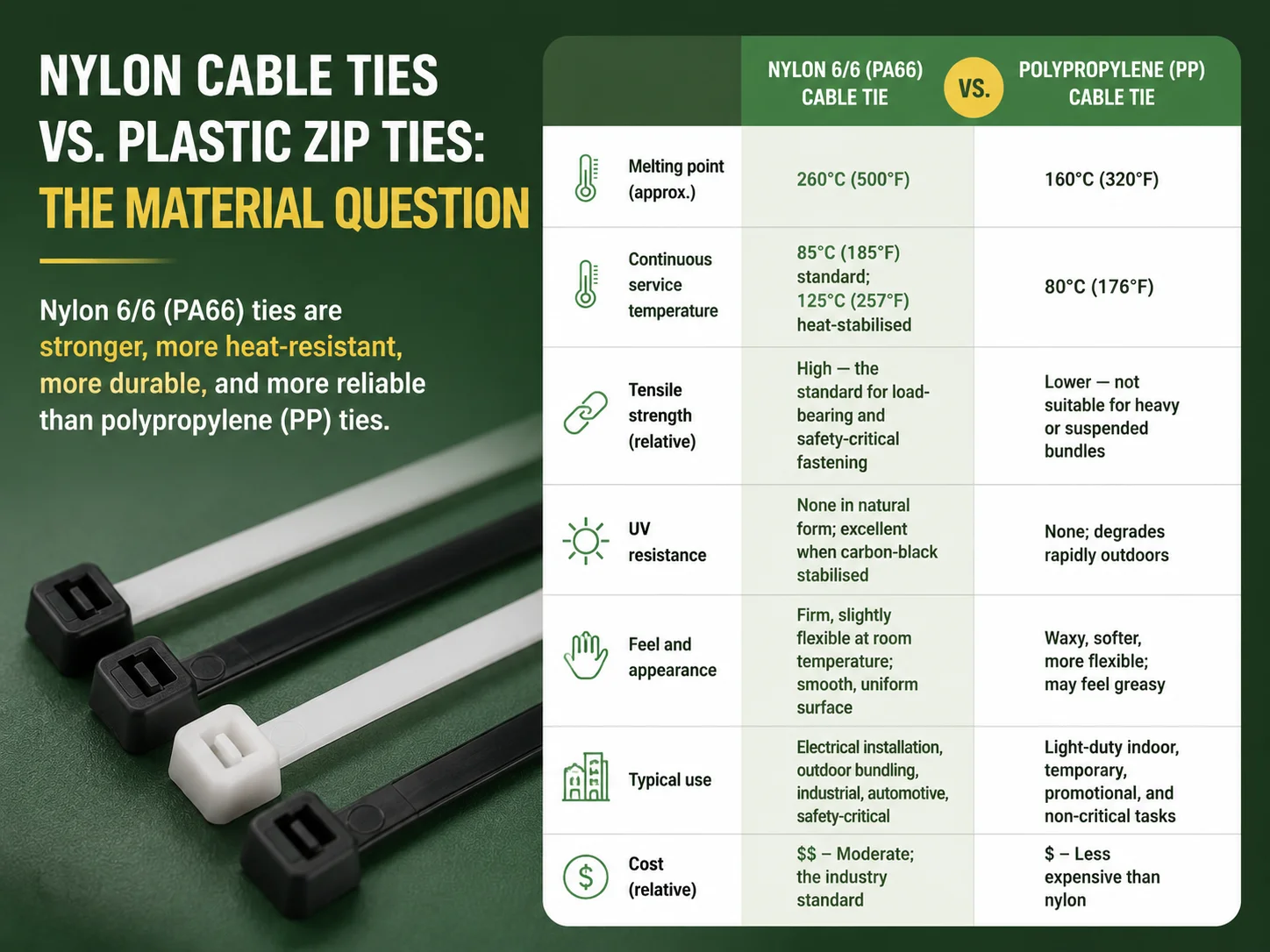
| Property | Nylon 6/6 (PA66) Cable Tie | Polypropylene (PP) Cable Tie |
|---|---|---|
| Melting point (approx.) | 260°C (500°F) | 160°C (320°F) |
| Continuous service temperature | 85°C (185°F) standard; 125°C (257°F) heat‑stabilised | 80°C (176°F) |
| Tensile strength (relative) | High — the standard for load‑bearing and safety‑critical fastening | Lower — not suitable for heavy or suspended bundles |
| UV resistance | None in natural form; excellent when carbon‑black stabilised | None; degrades rapidly outdoors |
| Feel and appearance | Firm, slightly flexible at room temperature; smooth, uniform surface | Waxy, softer, more flexible; may feel greasy |
| Typical use | Electrical installation, outdoor bundling, industrial, automotive, safety‑critical | Light‑duty indoor, temporary, promotional, and non‑critical tasks |
| Cost (relative) | $$ – Moderate; the industry standard for quality fastening | $ – Less expensive than nylon |
For a professional purchaser such as an electrical contractor, a panel builder, or a facility manager, using nylon cable ties is standard procedure, whereas using polypropylene cable ties is a step backward, and polypropylene should only be specified in low-stress, temporary, indoor applications. For the average consumer buying a package of cable ties at a home improvement store, this distinction is often not apparent, and information about the material used in making a tie is available merely on the packaging. If the packaging says “nylon” or “polyamide,” the tie is made from nylon. If it says “polypropylene” or “PP,” then the tie is one made from polypropylene. In case the label does not mention anything concerning the cable tie materials, then it is likely to be made from polypropylene as well and cannot be trusted for tasks involving strength, heat, or outdoors. For guidance on selecting the correct tie for outdoor, high‑temperature, and safety‑critical applications, our article on what the best wire tie is covers the material‑matching process across every environment and load class.
What Are Nylon Cable Ties Used For? The Full Range of Applications
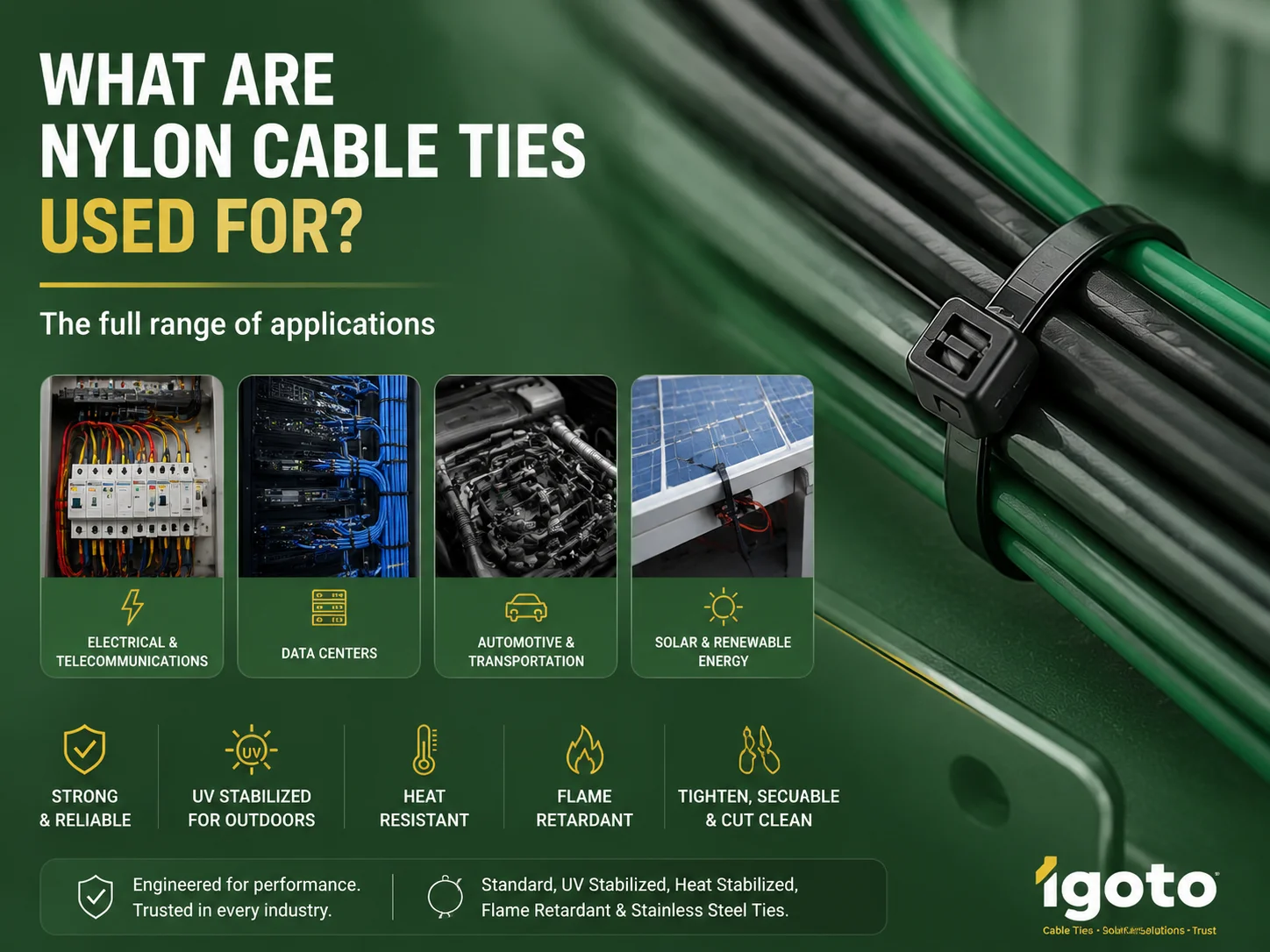
Nylon cable ties are applied for a more extensive variety of works than it seems judging by their title. Their fundamental usage is the application, which contributed to naming them: bundling and fastening electric cables and wires in panels, conduits, and cable trays. The manner of their usage has grown over the course of six decades up to almost all the sectors of industry, but also to all environments where one can find the need for fast, reliable, tamper-evident fastenings. One of the frequent uses is in the telecommunications and electrical systems sector, where nylon cable ties help to organize the wires in the switchboards and distribution boards to make it easier to keep track of the wiring. Sometimes the nylon cable ties are also used in data centers where the colored nylon cable ties are help to separate the fiber, copper, wires, and electric wire on the server racks. The same goes for automobile and transport manufacturing. In automotive production the nylon cable ties are used to secure wiring harnesses in the engine compartment of the vehicle, and other types of nylon ties are used in the vehicle interior. The solar and renewable energy industry uses black nylon cable ties that are UV stable in order to bundle different kinds of DC wiring.
When nylon cable ties are being selected for usage, it is important to note that it is not only cheap and quick; it is also able to provide proper tension precisely with the help of tools, and also makes flush cuts so there would no sharp edges and the necessary materials that will fit the working environment like UV stabilized material for outdoor work or heat-stabilized one for high cooker temperatures or flame-barrier materials for enclosures that hold wires in electrical devices. Though nylon cable tie is a small item, still its usefulness is the result of proper engineering of this material. What distinguishes those cable ties that will work during their useful life cycle from those that will break in just a season is the manufacturing quality and right choice of the nylon cable tie. The B2B buyer looking for certified reliable cheap nylon cable tie supply in all sizes and other specifications can find everything needed including standard nylon cable ties, UV stabilized ones, tapes which can withstand heat, fire-retardant ones, and those made of stainless steel at igoto, the company that offers all types of nylon cable ties including corresponding technology and pricing and certification details necessary for a professional buyer to make an order.
What Is a Stronger Alternative to a Zip Tie?
In cases where nylon zip ties are not up to standard or when conditions are too harsh for any polymer, stainless steel is a viable alternative. A stainless steel cable tie is usually made from either Type 304 or Type 316 stainless steel and has a tensile strength ranging from 100 pounds for the smallest type to over 600 pounds in the heavy-duty variant, hence making it generally stronger than nylon ties that fall within the 18-pound to 250-pound category. Furthermore, stainless steel is unaffected by UV light, does not become brittle with age, is resistant to corrosion, and does not melt in heat. The downside of using this type of tie is that it is more costly, heavier, and needs a special tool for proper tensioning as it cannot be tensioned manually. For a complete comparison of nylon and stainless steel cable ties across every dimension, our guide on stainless steel zip ties vs nylon cable ties covers the performance, the cost, and the installation differences in detail. For applications that require adjustability rather than raw strength — data centres, temporary bundling, delicate cables — a hook‑and‑loop strap is a reusable alternative that can be opened and closed hundreds of times without cutting. The right fastening is the one whose strength, material, and adjustability match the job.
Frequently Asked Questions
Are nylon or plastic zip ties better?
Nylon zip ties are better than other varieties of plastic….zip ties, like polypropylene, for those applications that require strength, heat tolerance or durability in an outdoor environment. Nylon 6/6 is stronger, heat superior and longer lasting than polypropylene….thus constituting the preferred material when electrical, industrial or outdoor fastening is required. The confusion arises from the fact that nylon is a type of plastic but it should not be confused with other plastics that are less expensive, for example, polypropylene. Therefore, the use of nylon (in its both definitions) is advisable for [critical, load-bearing, outdoor] applications.
Do cable ties work like zip ties?
Absolutely. Cable ties and zip ties refer to the same thing. The mechanism used is identical: a flexible strap with saw-toothed protrusions is passed through a head with a pawl and a lock is engaged when the tail is tightened. The two terms are interchangeable in the electrical and industrial fields as well as in everyday life. Hence, the technical term is cable tie while zip tie is the informal term.
What are nylon cable ties used for?
Nylon cable ties are utilized for the purposes of tying and securing cables and wires in electrical panels and data centers, automotive wiring installations, solar installations, and general industrial fastening. Their applications also include color coding, temporary fastening, tampering evidence, and securing hoses, conduits, and structural components. Available in an infinite number of materials and sizes suitable for almost any environment, indoor or outdoor, solar farm or high-temperature engine bay.
What is a stronger alternative to zip ties?
A stainless steel cable tie can be regarded as a more effective alternative to nylon cable ties, boasting tensile strength that exceeds 600 lbs in the case of heavy duty varieties, which is greatly superior to the maximum 250 lbs of nylon. Additionally, stainless steel is resistant to UV rays, heat, and corrosion, making it suitable for being used in extreme environments. However, in situations where flexibility rather than strength is needed, a hook-and-loop strap or metal clamp might be a better solution.
References
- Panduit — Nylon Cable Ties and Zip Ties: Product Range and Specifications. Manufacturer of nylon, stainless steel, and specialty cable ties with published material data sheets and application guidance.
- HellermannTyton — Cable Tie Materials and Selection Guide. Global manufacturer providing detailed material performance data for nylon 6/6, polypropylene, and specialty cable tie materials.
- ABB (Thomas & Betts) — The History of the Ty‑Rap Cable Tie. Information on the invention of the nylon cable tie in 1958 and the establishment of nylon 6/6 as the industry‑standard material.
- UL 62275 — Cable Management Systems. The standard that defines the testing and performance requirements for cable ties, including the tensile loop strength test and the material conditioning requirements.
So, are nylon cable ties the same as zip ties? For the electrician bundling cables in a panel, for the solar installer securing DC conductors on a roof, for the homeowner tidying a computer desk — yes, absolutely. Nylon cable tie is a term that is synonymous with the zip tie. The reason for the zip tie’s name is the sound created upon its installation. Nylon cable tie derives its name from its material and function. Both terms refer to the self-locking fasteners that are molded from one piece of plastic. In practice, they are used interchangeably. The only difference is that the zip tie can be made from materials other than nylon. If a zip tie is made from any other material, it can still be a zip tie, but not a nylon cable tie. Thus, specifying the term nylon cable tie ensures the user that the fastener is made from nylon. In contrast, the user may use any other term and still use a nylon cable tie. The company that supplies the full range of nylon cable tie types is igoto.