




SAE Hose Clamp Size 28 165 332
When searching for “SAE hose clamp size 28 165 332,” one can find a baffling jumble of automotive message boards, industrial hose catalogs, and random product listings, thanks to the fact that part of the term refers to an actual SAE size while part of it doesn’t. Knowing which is which ensures that the clamp will not be purchased in a size too small or too big for the purpose.
Quick response: SAE size 28 is a true worm-drive hose clamp size including a diameter range from about 33 mm to 57 mm (1-5/16 inch to 2-1/4 inch) according to SAE J1508. The numbers 165 and 332 are not included in the SAE size designation — while the number 165 mm refers to a larger clamp size appearing in some catalogs, 332 appears in other products. You need to look for an SAE 28 clamp.

What SAE J1508 actually defines
SAE J1508 establishes the standard for hose clamps for surface vehicles. This is what automotive and industrial suppliers refer to when discussing the size of a product, and it includes many types of clamps like spring types, worm types, t-bolts, ear clamps, etc. In total, the document features more than 30 types of clamps in its current version J1508_202301.
When discussing the SAE sizing system, it should be noted that the number is not a true measurement. So, size 28 does not mean the clamp has a 28mm diameter and size 36 is not a 36 mm clamp either. The numbers correspond to ranges of sizes of clamps, which is necessary for people in need of replacements.
What size 28 actually measures
An SAE 28 worm-drive clamp has a range of 33 mm to 57 mm (about 1 5/16″ to 2.25″ hose O.D.) and some manufacturers give the range 35 to 57 mm because the effective clamping band is slightly narrower than the total distance between the two ends of the clamp band. Gates also quotes it at 33.3 to 57.1 mm but they all mean the same thing — a size 28 is for hose of about 1.5 to 2 inches in diameter.
Normally, the band width for a clamp of this size is ½ in (12.7 mm) or 9/16 in (14.3 mm) and there is a hex head screw of 5/16 in. Width of the band is more important than people realize — a narrow band focuses force on a narrow area of the hose which increases the chances of cutting it. Therefore, anything above 1.5 in in diameter should better have a wider band.
Reading a size chart is the same no matter what fastening product you use, and if you have ever had the experience of looking for a cable tie to match a bunch of cables without this type of chart. This guide to reading cable tie sizes and dimensions walks through the same logic for ties, and the principle transfers directly to clamps.
So what are 165 and 332?
Both numbers do not appear in the SAE 28 specifications, so it is best to stick to the truth and not pretend that there is any relationship between them.
165 is getting close to the higher limit of a clamp considerably bigger than SAE 28 — larger than the just under 57 mm size limit. It would be reasonable to assume that “165” appearing with the clamp description would refer, if anything, to the maximum millimetre size of one rather sizable clamp or may be one of the measurements sourced from an individual manufacturer’s specification but certainly not an additive to the SAE number.
332 appears in the relevant part numbers, designating the industrial hose specific series, product codes, and even sometimes the manufacturing date. This number cannot be referred to either as SAE clamp size or as a measurement like the other two.
This means that what we have now is some sort of mixture of a real size designation and some numbers taken out of other contexts. If you are looking for a clamp for your hose with a diameter of around 1.5 to 2 inches, you have to go for an SAE 28 clamp but check the millimetres values on the clamp catalogue to make sure you order correctly.
The SAE size table
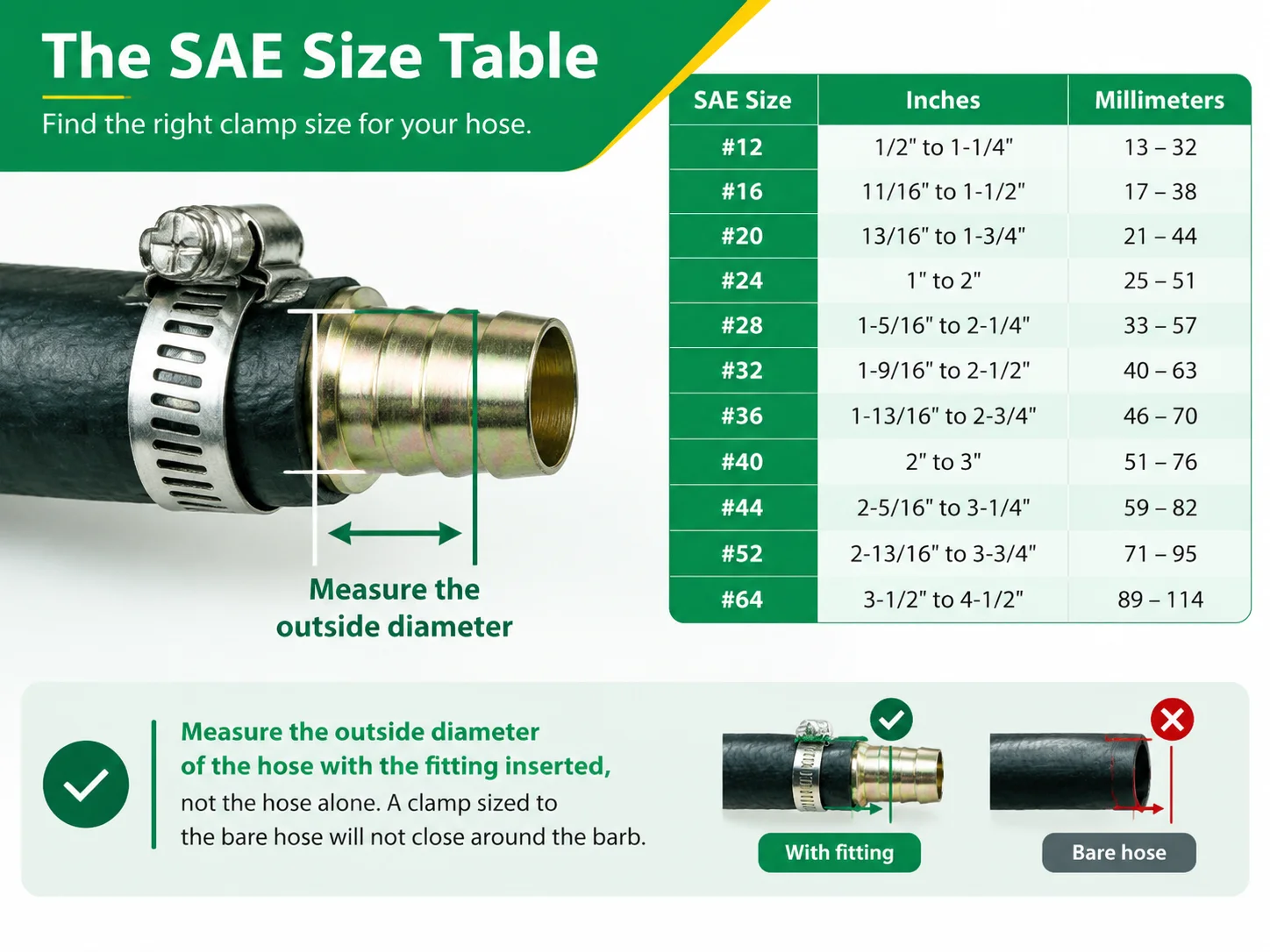
Here are the ordinary sizes within the middle size segment, and their details measured in inches and metrics. Please don’t overlook one point: that the size intervals usually overlap with one another, and more than one size category might apply in this situation. Make sure you have chosen the category where the corresponding size is located in the middle of the measurement scale rather than at its beginning or end.
- 12 — 1/2″ to 1-1/4″ (13–32 mm)
- 16 — 11/16″ to 1-1/2″ (17–38 mm)
- 20 — 13/16″ to 1-3/4″ (21–44 mm)
- 24 — 1″ to 2″ (25–51 mm)
- 28 — 1-5/16″ to 2-1/4″ (33–57 mm)
- 32 — 1-9/16″ to 2-1/2″ (40–63 mm)
- 36 — 1-13/16″ to 2-3/4″ (46–70 mm)
- 40 — 2″ to 3″ (51–76 mm)
- 44 — 2-5/16″ to 3-1/4″ (59–82 mm)
- 52 — 2-13/16″ to 3-3/4″ (71–95 mm) #64 — 3-1/2″ to 4-1/2″ (89–114 mm)
Make sure that you measure the outer dimension of the hose and take into consideration the insert that connects the hose with the perfect diameter with the right insert. When a device is sized to connect what is considered to be an un-dimensioned pipe, there will be no chance to create a secure connection.
Materials and grades
The material selected is of great importance in determining the lifespan of the clamp as the differences in cost between types of material are negligible when compared to the cost of coolant leak.
- Zinc-coated carbon steel, being the basic economical type, works well in dry engine bays but quickly deteriorates in the presence of road salt and water.
- 301 stainless steel band – better spring retention than regular steel., more commonly used in middle-ranged clamps.
- 304 stainless steel – the general-purpose type of stainless steel, features good resistance to corrosion from coolant, water and most car applications.
- 316 stainless steel – the one that contins molybdenum and is used for marine and chemical and washing purposes.
European suppliers have different abbreviations that represent W1 for galvanised band with zinc screw, W2 for 430 stainless band, W3 for 304 band and unit with zinc screw, W4 for all-304 unit and W5 for all-316 one. If you compare a DIN3017 clamp with an SAE model, this is what you need to know.The same stainless-versus-plastic trade-off decides clamp life as it does for cable management hardware, and the reasoning behind it is set out in this comparison of stainless steel zip ties versus nylon cable ties — corrosion resistance and temperature range, in that order.
There is a specific piece of advice applicable to size 28: standard hose worm-drive clamps are ineffective when used with flexible silicone hose. Silicone shifts and compresses under excessive load, meaning a clamp which seems secure on Monday might become flimsy by Friday. Instead of using the standard hose worm-drive clamp, try a lined clamp, constant tension spring clamp, or silicone hose clamp.
Heat, chemicals and where a clamp gives up
Worm drive clamps made of stainless steel withstand constant temperatures far exceeding those produced in an engine bay. The band usually does not fail, but the hose underneath or the screws becoming stuck after prolonged exposure to heat are often the real culprits.
People are often surprised by the contrast to fastening using plastic materials. Nylon ties can generally withstand up to 85°C for normal grades and 105°C for heat-resistant grades, ruling their use near an exhaust manifold or on a hot cooling line out of the question. If you are trying to work out whether a plastic tie can survive in a given location, this explanation of how heat resistant zip ties are gives the real numbers by material.This is exactly the rationale behind the invention of stainless steel ties and clamps: to overcome this problem.
The resistive properties of 304 and 316 stainless steel to oils and coolant as well as most cleaning agents are not in question. However, what can harm them are chlorides at temperature and the long-term use of road salt — at this point 316 earns its price tag.
Can a zip tie replace a hose clamp?
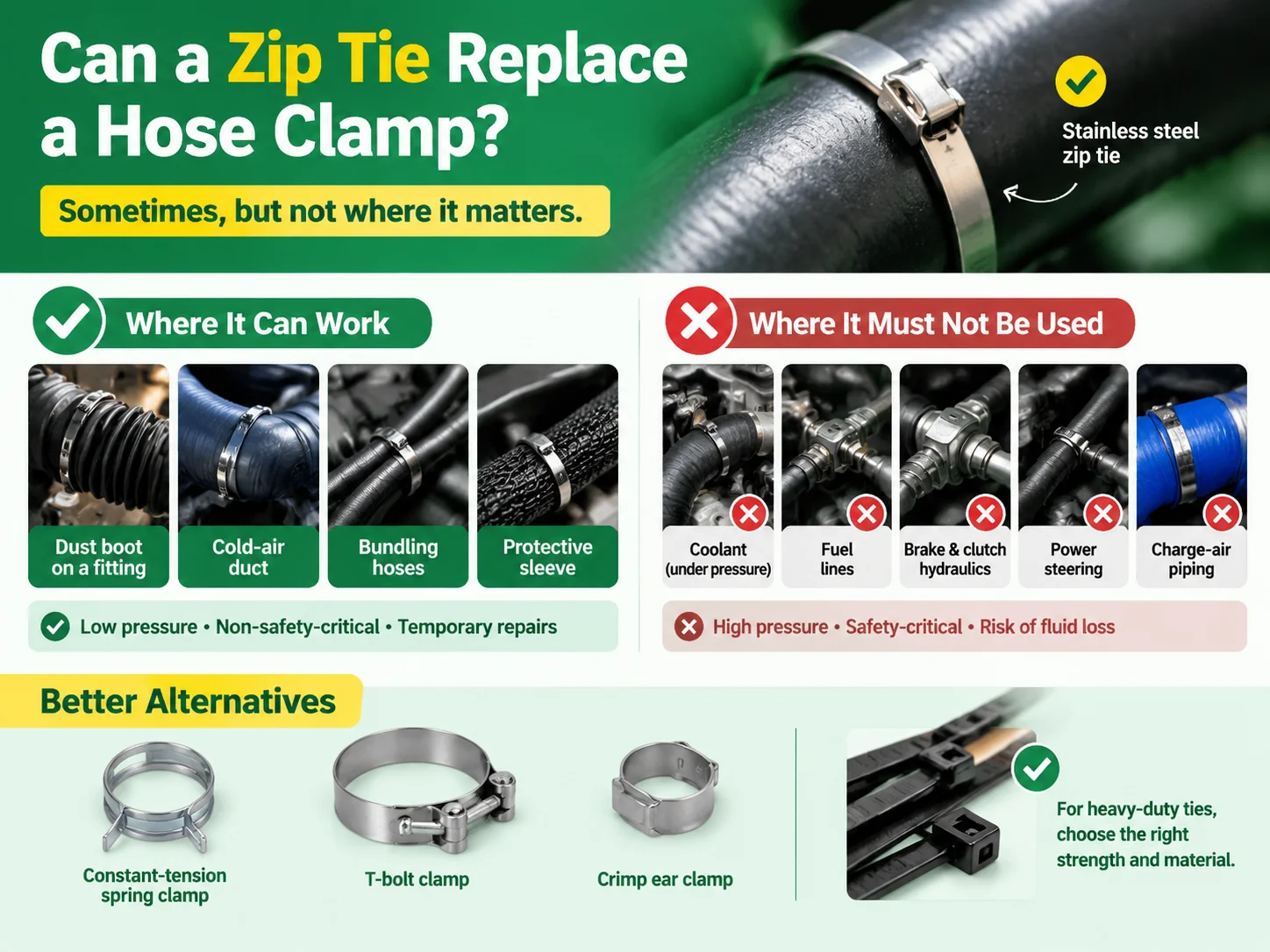
This is the question that led many to the original article, and the answer is: Yes, but only in certain situations.
When you should use stainless steel zip ties: for low-stress, non-critical applications. For example, the zip tie can hold a dust boot in place, secure a cold air duct, fasten hoses together, attach a protective sleeve, or even serve as a temporary fix to get you home when something breaks down. Stainless ties are heat resistant and are not going to stretch like nylon ties, and heavy-duty zip ties have enough strength to do genuine work.
When not to use it: anything under pressure or anything that’s critical for safety. For example, this includes coolant hoses under system pressure, fuel lines, brakes, hydraulic lines, people steering systems, charge air lines, or anything else that would cause danger if released. A zip tie only applies point load so it creates pressure ruptures and isn’t even able to be re-torqued after the hoarding has settled. Just remember that it will work until it fails, and when it fails, fluid will be lost.
If you are looking for a proper substitute of a worm gear clamp rather than merely something similar, the alternatives are: constant tension spring clamps for thermal cycling, T-bolt clamps for pressure and charge air applications, and crimp ear clamps for OEM applications. For selecting heavy-duty ties where a tie genuinely is the right answer, this guide to choosing heavy duty cable ties covers tensile strength and material selection.
Brands and what they cost
The mentioned names comprise Breeze, Gates, ABA, NORMA, Ideal, and Murray brands, with the Oetiker brand as the leader when it comes to the crimp ear clamps industry. All of the abovementioned companies publish vocabulary size reference charts, which make it possible to find if size 28 from one brand is compatible with size 28 from another brand; indeed, the standard ensures compatibility, but construction of the band differs.
Approximate retail prices for one SAE size 28 clamp:
- Zinc-plated worm drive: $1.50 – $4
- 304 stainless: $3 – $8
- 316 stainless: $6 – $15
- Constant tension spring clamp: $3 – $10
- T-bolt clamp, of a similar diameter: $8 – $25 depending on the materials used and the maximum allowable level of pressure.
Buying 10 clamps at a time dramatically reduces the price for a single unit, which should remind buyers that it is a good decision to buy stainless steel clamps due to expenses for delivery. If you are sourcing in volume rather than buying one, the manufacturer side of this is the more relevant conversation, and it is where our heavy duty cable tie manufacturing capability sits alongside clamps and other fastening hardware.
Frequently asked questions
What is the SAE hose clamp size?
SAE J1508 provides definitions for various kinds of hose clamps as well as their nominal sizes. Each designation contains a range of diameters meaning that the size in case does not refer to a single measurement, e.g. size 16 would cover the range of sizes that are approximately 17 mm to 38 mm in diameter and size 28 would cover about 33 mm to 57 mm. The number presented in the document is simply a designation and not a definite diameter which would explain some of the overlaps between adjacent sizes.
What size is a number 28 hose clamp?
An SAE 28 worm-drive clamp accommodates hoses that measure approximately 33 mm to 57 mm or 1-5/16 inches to 2-1/4 inches in diameter. Some manufacturer’s catalogs list the range of 35 mm to 57 mm, which pertains to the effective size of the clamp band and not the entire range covered. This clamp is commonly used with hoses manufactured with diameters between 1.5 inches and 2 inches.
What do the numbers on a hose clamp mean?
The large number refers to the SAE nominal size designation — which shows a range, not a diameter. You may also find the band width in the package marked as generally 1/2 inch or 9/16 inch for a clamp this size and the material grade. None of these numbers are helpful in determining the actual diameter of the clamp, so always consult the millimetre table provided by the supplier.
What is a size 36 hose clamp?
SAE 36 ranges from about 46 mm to 70 mm, or 1-13/16-inch to 2-3/4-inch. This means it shares its bottom end with size 32 and its top end with size 40, so be sure to check the hose with the fitting attached before making a decision.
Is 165 mm the same as SAE size 28?
No. Size 28 tops out at 57 mm, so 165 mm is about a threefold distance. A 165 mm concept is in a way that from the catalogue perspective, it falls under much bigger clamp dimensions than size 28; if you happen to find 165 mm being used alongside “28”, keep in mind that it comes from two distinct references.
References
- SAE International — J1508 Hose Clamps standard
- Gates Corporation — hose clamp size charts and cooling system technical data
- Oetiker — crimp ear clamps and clamping technology reference
- ASTM International — stainless steel material specifications
- Thomasnet — industrial hose clamp supplier and specification listings
Conclusion
When you cut through the excess noise, “SAE hose clamp size 28 165 332” corresponds to one basic solution: an SAE 28 clamp for hoses with diameters between 33 mm and 57 mm and is designed for hoses ranging between 1.5 to 2 inches. The characters 165 and 332 were caused by the other tables and product codes included in your reference so they can be ignored.
The correct procedure for measuring a hose is to measure the hose with the fitting already attached to it, choose the clamp with a size falling in the mid-range rather than at the edge, select the right material suitable for the working environment — 304 being appropriate for regular automotive applications and 316 for marine or chemical use — and never use a standard worm drive clamp when you are replacing the damaged clamp of a soft silicone hose.
With respect to the questions about zip ties, stainless steel zip ties can be used for low-pressure, non-critical applications but are very dangerous for pressurised fluids.


