





Are Sex Traffickers Using Zip Ties on Cars?
Evidence that sex traffickers using zip ties on car door handles to tag potential victims has not been substantiated. Although this notion has been expressed by social media users for many years, police departments and organizations fighting against trafficking have denied it multiple times. Polaris, which manages the National Human Trafficking Hotline in the US, announced that it couldn’t find any case of zip-ties used as markers in the data received from the hotline.
Nonetheless, the anxiety causing the spread of this idea is not without a cause. The issue of human trafficking is real, and so is the instinct of protecting one’s own safety and safety of one’s beloved ones. The article makes an overview of the truth behind this story and its reproduction on social media, as well as what one can do if he/she finds zip-ties on his/her car in reality.
The claim of traffickers using zip ties to mark the victims has been disproved by Politifact and rejected by Polaris. Data from the National Human Trafficking Right Hotline also didn’t show any cases of the zip tie usage that had any relation to potential victims. Police departments in Texas, Colorado, and Canada haven’t reported any corresponding cases either. Despite the fact that ordinary zip ties have been used in many crimes as binding devices, this issue is different and should not cause any panic.
Where the Zip Tie Rumor Came From
The narrative has multiple interpretations, but they have a major aspect in common. An illustration accompanied by a message showcases zip ties placed around a car handle, a car’s current mirror, or windshield wiper. The message highlights that smugglers use zip tie either to distinguish drivers they are planning to target or confuse them. In other versions, a driver is said to bend over to look for scissors in the bag and virtually that is the moment when he or she might be abducted.
Per PolitiFact, the fake news potentially originated in October 2018 when social media alerts claimed there were cases of zip ties in San Angelo, Texas. The police from San Angelo reacted announcing in its Press Release that they received no information about human trafficking, abductions, or attempted abductions relating to human trafficking and had absolutely no cases reported on zip ties being used for any crime. They added that the owner of the vehicle did not possess the car seen in the image used to support the hyperbola.
The news did not stop. In January 2020 new posts have indicated that zip ties found on door handles can abduct people. PolitiFact marked this version false too. Burnaby police of Canada announced that they have found no evidence of the activity mentioned and that such posts lead to unnecessary fears. In August 2025 Thornton police received numerous inquiries about an investigation from social media regarding zip ties left on car doors, so they published an announcement to clarify the situation.
The pattern stays similar: warnings become viral, people worried about the news contact police, police finds nothing about such news, and in a few years the same news appears but with another location mentioned.
What the Facts Really Show
Do traffickers use zip ties on cars?
There is no valid proof to validate it. Polaris has stated that rumors about the use of zip ties by traffickers are unfounded. The hotline data supported this as it outlines that zip ties are not used as lures or markers for trafficking. PolitiFact dug deep into news archives to confirm that there is no record of the door handle device mentioned in the posts being used to lure women.
Zip ties on car door handles, mirrors and wipers
The content of the post may change, but the evidence stays the same. Whether it is a zip tie on the door handle, side mirror or windshield wiper, police and fact-checkers have not managed to find a confirmed case linking it to trafficking case. Similar rumors about coins in door handles, chemical soaked tissues at gas stations or the infamous white vans were also researched and were found wrong. PolitiFact did not find proof of the tissue rumor in 2022 and in addition to that, Polaris did mention the point that traffickers drive various types of vehicles.
While the zip tie warning is fundamentally problematic
The bigger issue with the zip tie warning is that it gives the wrong definition of trafficking. Polaris says that most of the times traffickers use psychological methods to harm their victims and in many cases the victims, especially if they are children, know their traffickers. Shared Hope International told PolitiFact that trafficked victims do not get kidnapped or taken from their families. Furthermore, Polaris emphasizes that a person can be trafficked without even leaving his/her place.
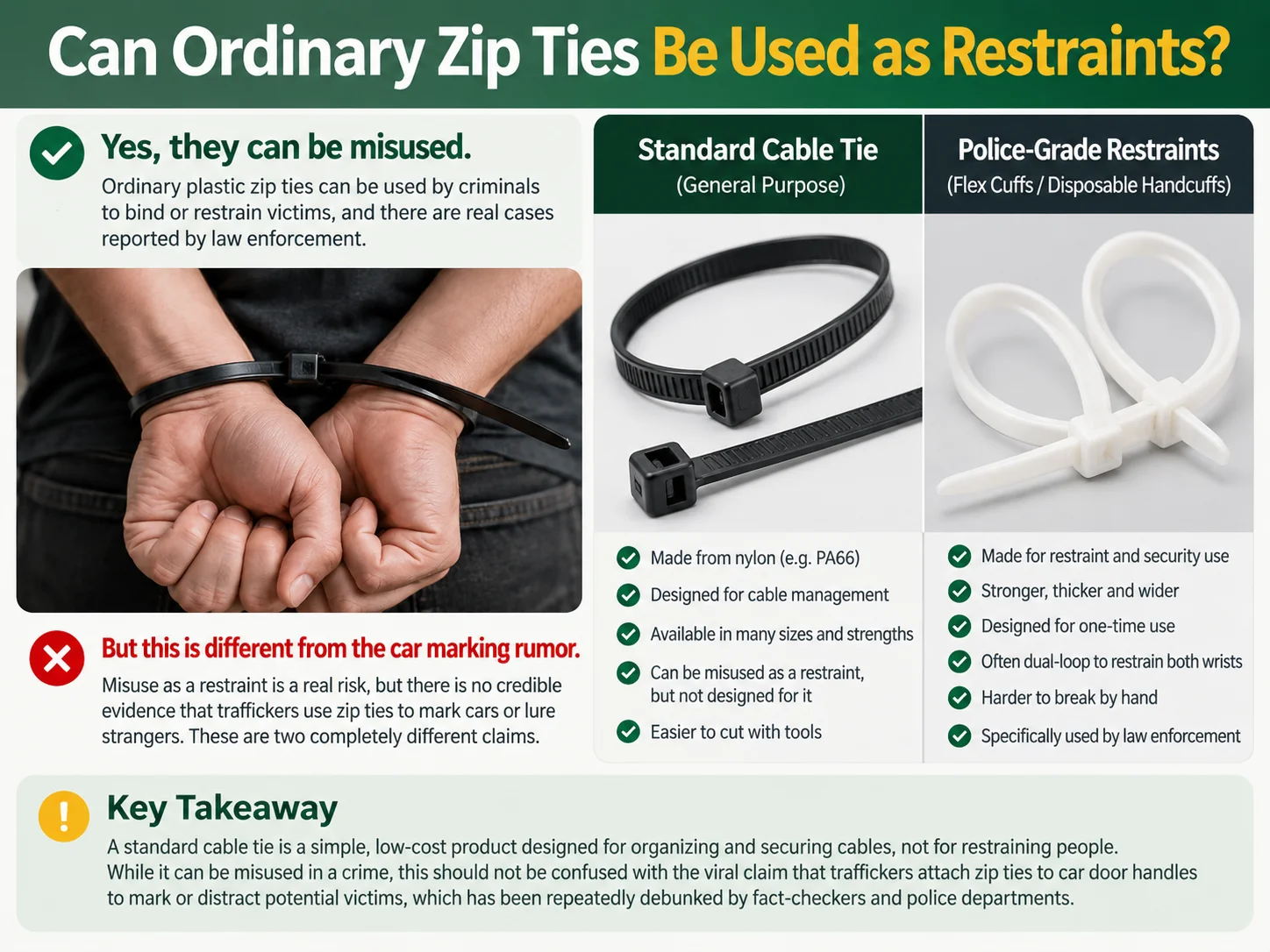
Can Ordinary Zip Ties Be Used as Restraints?
Two very different questions are often confused in discussions about zip ties: one is whether criminals might misuse plastic zip ties.
First, PolitiFact did confirm in their investigation of the marking rumor that law enforcement agencies reported troublemakers used zip ties to illegally restrain victims, but they did not find credible evidence of zip ties being used to mark cars or attract strangers. Misuse of something as a restraining device is not the same thing as misusing it as a marking device; only one of these activities has support in the record.
Second, it should be understood that ordinary cable ties are not actually designed to be used as restraints. For example, IGOTO – a manufacturer of these nylon devices makes tie wraps, which are specifically designed for fastening cables and hoses together. Their self-locking head, explained in our guide to how a self-locking cable tie works, is built to hold a wire bundle in place, not to restrain a person. Purpose-built flex cuffs used by police are a different product: wider straps, two separate wrist loops, smoother inner edges and reinforced heads. We cover that history and those design differences in the story of zip tie handcuffs and why police still use them.
The conclusion to be drawn from the discussion above is very straightforward. The fact that there are many zip ties and that they are cheap and durable explains why these devices can be seen everywhere, including on cars, as well and why the presence of one zip tie does not indicate any wrongdoing.
Why People Believe the Zip Tie Warning
The understanding of why rumors circulate is more advantageous than just calling it misinformation. There are a few aspects that make this rumor exceptional:
- The rumor presents a straightforward solution in threatening conditions. To “look for the zip tie” provides protection against an otherwise hidden crime.
It is transmitted by caring people. The majority of all posts come from family and friends trying to look out for someone, so the audience accepts the message from this person even if it is incorrect. - It is easy to “prove”. Zip tie is one of the most popular fastening devices worldwide, having been used for the first time in the 1950s when the first Ty-Rap cable tie was invented. People will eventually find it somewhere near or on their car.
- Moreover, replacing locations makes it novel. Each new story has a unique mall, parking place, or hometown, which gives it a sense of immediacy instead of being seen as a chain.
“This is better than regretting” looks innocent. However, fake messages waste police resources, scare the public unnecessarily and distract from the real signs of human trafficking.
Therefore, it is important to check the information with local police department or anti-trafficking organization before sharing a human trafficking warning.
What Does a Zip Tie on My Car Mean?
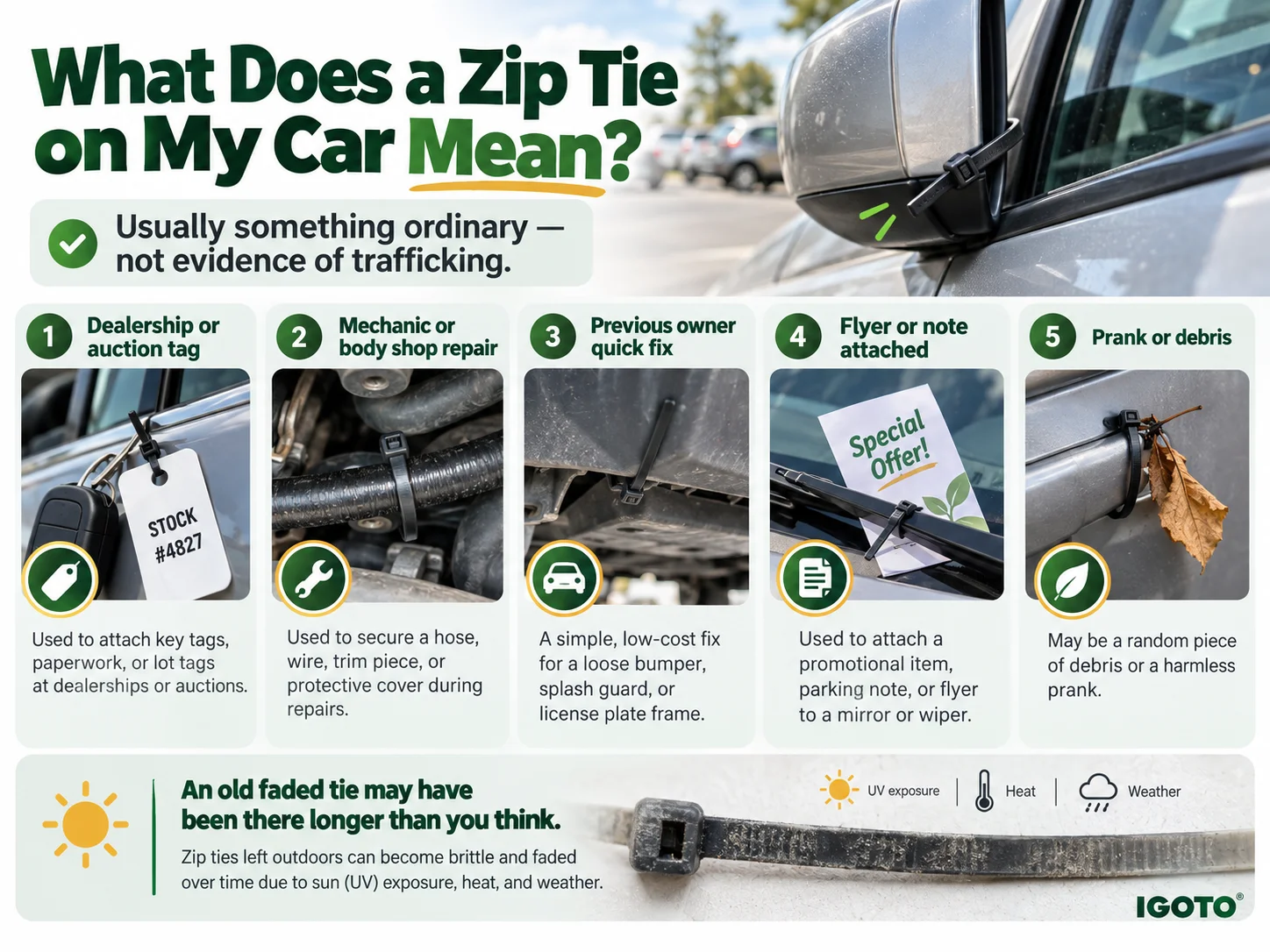
Most of the time, it is not something important. Zip ties are found practically anywhere around the vehicles and can end there for completely casual reasons:
- Receiving from a car dealership, auction or lot with a key or paper tag on it. Tagging belongs to one of the most common applications for zip ties and is further explained in our writing on identification cable ties .
- Received from a car dealer or car repair shop with various items fastened or repaired by it.
Applied by the previous owner as part of some quick repair, like with a license plate frame.
Use for some other purposes, such as for tying up papers and brochures to a windshield or wiper.
Being part of practical jokes or caused by some rubbish, such as a construction site or something else.
Having been outside for a considerable time, zip ties gradually become unusable, as discussed in the article on how long zip ties last outside, and you probably are not aware of how long the old and malfunctioning zip tie has been on your vehicle.
What to Do If You Find a Zip Tie on Your Car
There is no doubt that a peaceful and rational attitude is better than being panicked:
1.Be attentive to your environment. It is a wise step in any parking lot, zip tie or not. If there is anyone near you who appears to be gazing at you or moving towards you in a suspicious way, simply listen to your inner voice.
2.If you feel in danger, do not spend time removing it. Get in your car, lock all doors of your vehicle and leave. You can remove the tie later.
3.Get rid of it when you are in a safe place. You can either use scissors or a knife to cut it or unlock it, if you wish to keep it unbroken. In the second case, see the method of untying zip ties without cutting them.
5.Do not report about suspicious activity but, rather, about the action. If you witnessed someone approaching your vehicle or following you, report it to the nearest police station.
How to Tell If Someone Is Being Trafficked
Due to the fact that trafficking often occurs via manipulation and control and not so much via abduction, the red flags are often connected with the individual’s situation rather than a particular event.
Possible signs include:
Someone else appears to be controlling the individual’s movements, finances, phone or identification papers.
The individual provides unconvincing or evenly rehearsed answers and does not seem to be able to speak for themselves.
They seem frightened, anxious or obedient especially in the presence of a certain person.
They work a lot in return for a very little payment or own a debt that they can never pay off.
They live either in the same place where they work or in a limited area that is tightly controlled.
Any minor involved in sex-business in any capacity would be regarded as a victim of trafficking in accordance with the national legislation in the USA, regardless of the means of coercion employed.
No single indicator can provide evidence of trafficking. If you are worried about a suspected victim of trafficking, do not confront the possible trafficker.
If you are in the USA, contact the National Human Trafficking Hotline at 1-888-373-7888, by text at 233733, or by chat via the official website of the National Hotline. If someone is in a state of immediate danger, please call 911.
Frequently Asked Questions
Are sex traffickers using zip ties on cars?
There is no reliable proof that they are. PolitiFact has rated several iterations of this claim false. In addition, Polaris did not discover any cases of zip ties being used as lures or markers in its analysis of the National Human Trafficking Hotline data while there were no incidents matching the description reported by officials in San Angelo, Burnaby, and Thornton.
How to tell if someone is sex trafficking?
Focus on indications of trafficking instead of looking for an isolated sign. Examples of such signs might be an individual who cannot communicate freely and is unable to get his or her hands on his or her personal identification or money, an individual who demonstrates fear of his or her companions, a laborer who is receiving less than fair payment for his or her work, or a minor who is doing commercial sex. If you see something troubling, call the National Human Trafficking Hotline at 1-888-373-7888 or law enforcement professionals instead of trying to intervene yourself.
What are the 5 P’s of human trafficking?
From the UN trafficking protocol and federal government law, the term “3 Ps” of prevention, protection and prosecution came to be well known over the years. Under the United States government initiative, partnership was added to form the fourth P to be compliant with the U.S. national action plan in combating human trafficking. Some bodies or training programs add the fifth P which is policy to explain the laws that support the rest.
Is there a hand signal for human trafficking?
A specific hand signal associated with human trafficking does not exist. However, the most popular signal is the Signal for Help, designed by the Canadian Women’s Foundation in April 2020 and aimed at individuals undergoing domestic abuse in need of silent communication. The signal consists of raising one’s hand, placing the thumb in the palm, and respectively folding the fingers downwards. Over time, the hand signal has also been used as a distress signal in general. In fact, in 2021, it was reported that the gesture had been used to notify someone about a disappeared teenager from North Carolina found in Kentucky later on. The campaign calls for contacting the person only if the conditions are safe and urges that emergency services be called only if the person is in danger or asking for help.
Who is the greatest asset in the fight against human trafficking?
There is no universally accepted definitive response to this question, but organizations that fight human trafficking emphasize two categories of people. The first of these is the informed everyday people—people such as friends, teachers, health workers, colleagues and neighbors of victims—because victims tend to know their traffickers and are more likely to be noticed by people around them than in a parking lot. The second category is the survivors, because their experience contributes to more effective programs on prevention and assistance.
What should I do if I find a zip tie on my car door handle?
In case you don’t feel safe, it’s better to enter the vehicle, lock the doors, and drive away. However, if you want, you can just get rid of the zip tie at your convenience by simply removing it. Report the individuals or behavior that is suspicious to the local police but do not consider the zip tie as a threat for trafficking.
References
- Human Trafficking Rumors, Polaris
- No, sex traffickers aren’t using zip ties to mark victims or abduct women, PolitiFact (November 2019)
- Social media posts issue alarmist warning about zip ties, sex trafficking, PolitiFact (February 2020)
- No evidence human traffickers are using toxic tissues, PolitiFact (December 2022)
- Fact Check: Abductions and Human Trafficking in Thornton, Thornton Police Department (August 2025)
- National Human Trafficking Hotline
- National Action Plan to Combat Human Trafficking, Wikipedia
- Signal for Help, Wikipedia
- How a made-in-Canada distress signal may have helped save the life of a North Carolina teen, CBC News
Conclusion
The idea of sex traffickers using zip ties to mark cars is a persistent internet rumor, but it has not been found to be a real tactic. Fact-checkers, police departments, and the agency which operates the national trafficking hotline have all investigated the rumor and have not found proof. The ordinary zip tie has been used as a restraining device in some crimes, but this is not the same as the marking situation, and with a zip tie on your car door you are most probably dealing with something common. The best way to protect yourself from traffickers is not by checking your parking lot with a list. It is understanding what trafficking is, recognizing the signs of sexual exploitation and manipulation in the behavior of the people around you, and knowing who to call in case something does not seem right.


