





What Hole Size Do Fir Tree Zip Ties Need?
Fir tree zip ties are used for at least two purposes. They are able to gather together wires and their Christmas tree-like head with ribs goes through a hole in a panel and doesn’t come out. This means that no screws, adhesives, or other hardware are needed for installation, which is why they are so widely used in car bodies, appliances, and machine bodies. However, it also means that troubles occur when the holes are too big or too small so that at first, while fir tree ties fit their holes they work very well, while those which do not fit will rattle, turn, and fall out at the very beginning of the harness’s work.
This guide does not discuss the general types of this mounting element itself but concentrates on the factors that should be taken into account for fir tree tie to function properly such as dimensions of the holes, thickness of panels, the difference between the strength of the strap and the pull out strength of the stem, etc.
Fir tree ties or fir tree-style cable ties are cable ties equipped with a flexible stem fitted with ribs which is easily inserted into a pre-drilled hole. Most of them are designed to fit the hole of 1/4 inch in diameter but each model of a fir tree tie has its own hole range. For instance, one model fits the holes with diameter from 6.25 mm to 7.0 mm in the panel with thickness from 2.3 mm to 13.9 mm, while other type of ties fits panels from 0.6 mm to 6.75 mm Despite the fact that it is mentioned in the description of the tie packaging that they could withstand up to 50 pounds it refers only to their strap but not to the head pull-out capacity.

What Fir Tree Zip Ties Are
A fir tree zip tie is simply a standard cable tie equipped with an anchor. This anchor consists of a short stem that is wrapped by flaps that will widen towards the head, which is where the names fir tree and Christmas tree come from. When the stem goes through the opening, it flops back down. After going through the hole, it bounces back up and will not be taken out without considerable force.
Fir tree zip ties are available in two forms:
– One-piece ties (the stem, the head, and the strap are produced as a single piece). These types of ties are used on automobile assembly lines most of the time, since they do not need to be assembled.
– Two-piece ties (the base and the ties are manufactured separately). In this case, the base remains attached to the panel while the ties can be easily replaced in case they are broken.
Moreover, it is worth mentioning that some types of fir tree ties come with a domed disc (or an umbrella) located under the head. The moment the stem is inserted, the dome flattens against the panel and acts as a small spring. This pressure keeps the tie from vibrating in contact with metal, thus preventing the noise from being produced.
If you want the bigger picture of where push-in ties sit next to screw, adhesive and rivet mounts, our overview of what mountable cable ties are covers every type in one place.
How the Barbs Hold a Harness in Place
The holding power comes from geometry, not friction. The fins are angled so they slide in easily and lock against the back edge of the hole when pulled the other way. Two conditions have to be met for that lock to work.
First, the hole must be small enough that the fins have to fold to get through. If the hole is oversized, the fins never really compress, so they have nothing to spring back against.
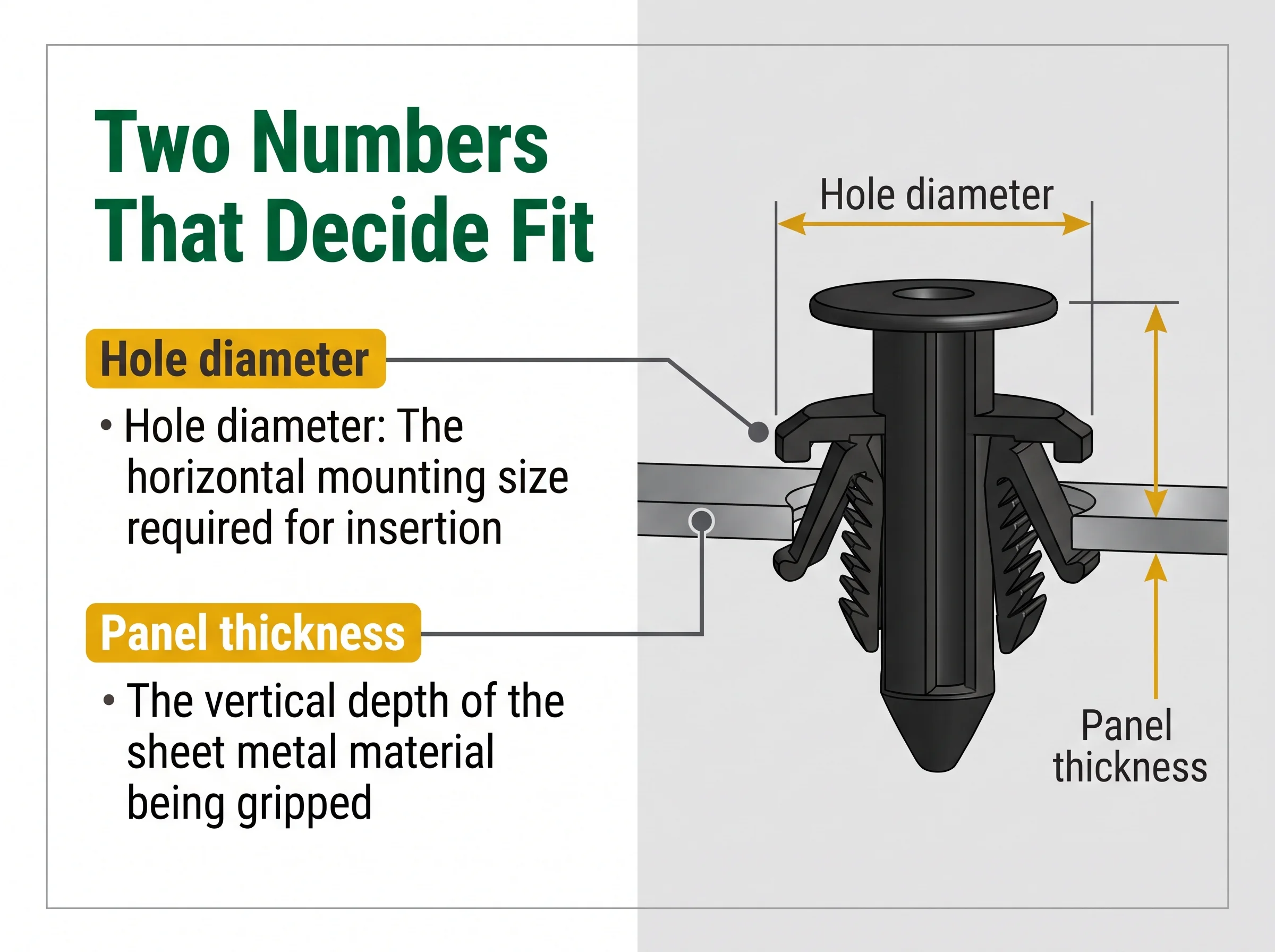
Second, at least one fin must sit fully behind the panel, with the head or dome pressed against the front. If the panel is too thin, the stem sits loose and can rock. If the panel is too thick, the stem never gets all the way through and the head stands proud of the surface.
That is why every fir tree tie has two dimensions on its data sheet instead of one. Ignore either and the tie will fail, usually long after installation, when it is much harder to reach.
Hole Size and Panel Thickness: The Numbers That Decide Fit
The standard size for the fir tree zip tie is likely 1/4 inch since almost all round holes fir tree fasteners are designed around this size. However the expression “about 1/4 inch” does not provide a large range of complimentary attributes concerning the size of the panel this zip tie can connect. Below it will be noted three actual items received from the catalogs of real manufacturers and sellers:
| Fir tree tie type | Hole size | Panel thickness | Tie width | Strap rating | Temperature |
|---|---|---|---|---|---|
| One-piece, round hole, 8 in | 6.25–7.0 mm | 2.3–13.9 mm | 4.7 mm | 50 lb (222 N) | -40 to 100 °C |
| One-piece, automotive oval hole, 8.5 in | Oval, about 6.5 × 12.5 mm | 0.6–6.75 mm | 4.7 mm | 50 lb (225 N) | -40 to 110 °C |
| Domed push mount, round hole | 6.5 mm ± 0.4 | 0.7–4.0 mm | Varies by tie | 50 lb | Varies by material |
The first column is the column with the panel. Two zip ties that will fit through 6.5 mm hole may use totally different thicknesses of the panel. One is intended for thin metallic sheets of about 1 mm while the second was designed for large amounts of molded plastic or several brackets combined together. Taking one of the ties instead of the other misses the point completely.
It is inadmissible to think that every fir tree zip tie will fit any 1/4 inch hole. Always check the both hole size and the thickness of the panel in the data sheet that describes the item on sale.
Below there are some practical tips regarding the drilling of the holes:
1.Always drill a hole at the level of the middle range of the size, not at the highest level. Holes always increase slightly as a result of the removal of sharp edges and painting tasks.
2.Deburr the both edges of the hole being drilled. Too sharp burr on the back edge can also ruin fins as they go through the holes of 1/4 inch.
3.Make sure that you measure actual thickness of the panel taking into account the top coating or any other plating and/or additional layers included. The most successful measure is stack thickness that is equivalent to the thickness met by fins.
Loop Strength Is Not Holding Strength
The biggest misapprehension regarding cable ties made from fir tree material is that people see on bags that it says “50 lb” and conclude that the product will be able to hold the same amount of weight on the surface it is used with. Unfortunately, the correctness of this conclusion is pretty much unverified.
The strength rating of any cable ties is based on a tensile loop test that consists of looping the tie up and exerting force until the locking head or strap breaks. The outcome of this test indicates whether the tie will be able to keep the bundle securely tightened. It does not provide conclusions regarding how much force would be required to pull tie out of the hole in which it is inserted or what is called pull-out force, which is determined by the size of the hole, type of panel, thickness and design of the tie.
Pull-out force as a characteristic is not mentioned in almost all catalogs. Thus, it is not critical for the light harnesses which simply need to be kept away from difficult surfaces. For cases when there is necessity to transport something heavy though, it can become rather important and the supplier of the ties should be asked to provide information about the pull-out force.
How to Install Fir Tree Zip Ties
1.Verify the hole. Make sure the diameter and thickness of the panel is within specifications.
2.Install the harness first. Lay out the wires in the correct place so that the tie don’t bend the harness at an unfavorable angle.
3.Insert the stem perpendicular. While pressing into the hole with your thumb, ensure the dome is sitting evenly against the panel. You should feel it lock into place. If you need to use a hammer, it indicates the panel is too thick or the hole is not wide enough.
4.Bundle and tighten the strap. Pull it tight around the bundle without damaging the insulation.
5.Cut flush. Eliminate any sharp surface that can cause any harm when it comes into contact with body panels or trims.
6.Perform tugging test. Apply some pressure on the bundle. The stem must not shift and wobble.
The general installation principles for all mount styles, including spacing and load, are covered in our guide on how to choose mountable cable ties.
How to Remove Fir Tree Zip Ties Without Damaging the Panel
The construction of fir tree stems prevents easy removal of the protrusion from the hole. When you pull on the assembly, it often breaks the fins and leaves a part stuck inside. Some better methods to deal with the problem:
Squeeze from the back. If you can access the back of the panel, one can squeeze the fins together with the help of needle-nose pliers and push the stem through the hole further.
Use a forked trim tool. Removal trim tool made of plastic helps push the stem out without causing damage to paint and plastic parts of home appliance.
Cut the strap first. By disconnecting the harness first, you will not have to deal with the problem of weight of the wires as you do the task.
Remove broken stubs completely. Having a fin left in the hole will prevent mounting of the new tie.
Be ready to replace ties made of one piece since it cannot be used again after extraction because the fins will be less effective after the extraction. New two-piece ties are better: the base should stay in the panel and the strap should be replaced.
Why Fir Tree Zip Ties Rattle, Spin or Pull Out
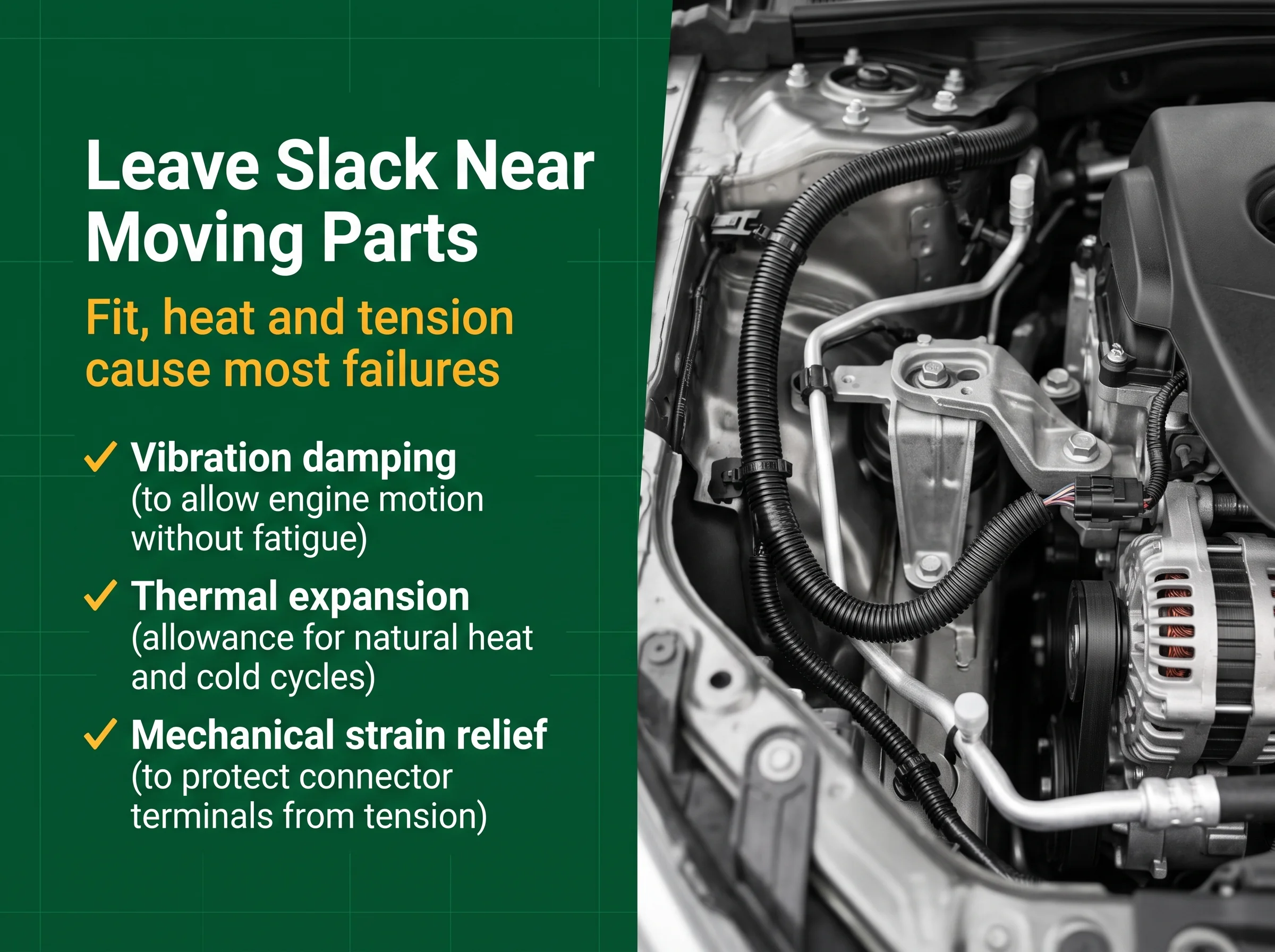
Almost every fir tree failure traces back to fit, material or tension. This table covers the usual symptoms:
| Symptom | Likely cause | Fix |
|---|---|---|
| Tie spins in the hole | Hole too large, or a round stem in a round hole where rotation matters | Use the correct hole size, or an oval hole with an anti-rotation stem |
| Rattle or buzz | Panel thinner than the tie’s range; no domed head | Choose a tie rated for thinner panels, or one with a spring dome |
| Head sits proud of the panel | Panel or stack too thick | Use a tie with a longer stem and a higher panel range |
| Stem pulls out under load | Pull-out force exceeded; hole oversized | Correct the hole, reduce load, or switch to a screw mount |
| Fins crack or turn brittle | Heat or UV beyond the material rating | Use heat-stabilized or UV-stabilized nylon 6/6 |
| Noise from a component the harness is tied near | Harness pulled too tight to a fixed point | Leave a service loop so the moving part does not drag on the harness |
That last line is not simply theoretical, since the 2025 General Motors service bulletin for the 2026 Cadillac OPTIQ (rear-wheel drive) mentions that there is a knocking or helicopter sound coming from the A/C compressor. One of the ways to fix the problem is by loosening the fir tree zip ties on the cable and correcting the wiring for there to be slack to the compressor. The ties were working as it was intended, as the harness did not have enough room to operate.
It is important to never place a harness tightly in between a fixed panel and a working component, such as a compressor or a door. Instead, it is better to leave a small slack loop in order to avoid vibrations traveling directly into the wires.
Heat is another invisible failure. Standard nylon 6/6 works, when used in a cabin or inside a cabinet, but when it comes to exhaust or engine components, it is necessary to use heat-stabilized materials. Our guide to high temperature tie wraps explains where standard nylon stops and when to step up.
Fir Tree vs Arrowhead, Screw and Adhesive Mounts
Fir tree ties are not always the right choice. Here is how they compare with the other common ways to fix a harness to a surface:
| Mount type | Needs | Strengths | Limits |
|---|---|---|---|
| Fir tree | Pre-drilled round or oval hole | Fast, tool-free, works across a panel thickness range, good vibration hold | Hard to remove cleanly; pull-out force often unlisted |
| Arrowhead push mount | Pre-drilled hole, narrow panel range | Very fast, positive snap | Tighter panel window; can rattle if the panel is off-spec |
| Screw or bolt mount | Threaded or through hole and a fastener | Highest, most predictable holding force; easy to service | Slower; needs hardware and tools |
| Adhesive base | Clean, flat surface | No drilling | Weakens with heat, oil and time |
A simple rule: fir tree for production speed in a known panel, screw mount for heavy loads or anywhere you need certainty, adhesive only for light, indoor, temporary work.
Choosing the Tie for Two-Piece Fir Tree Mounts
With two-piece mounts, the base stays and the cable tie is the part you replace. That makes the tie choice more important than it looks. Three checks keep the combination working:
- Width. Every mount slot has a maximum tie width, often around 5 mm. A 4.8 mm tie usually fits that kind of slot; a 7.6 mm heavy-duty tie will not. Our standard cable ties list exact widths so you can match them to the mount.
- Environment. Outdoors or under a vehicle, use black UV-stabilized ties. Natural nylon in direct sun goes brittle long before the mount does. See our UV resistant cable ties for exposed runs.
- Heat and chemicals. In engine bays, match the tie to the mount’s temperature rating and to the oils and fluids nearby. Our automotive wiring harness solutions page lists the heat-stabilized grades we supply for vehicle work.
A mount rated to 110 °C paired with a tie rated to 85 °C gives you an 85 °C assembly. The weakest part sets the limit.
FAQ
What are the strongest zip ties for outdoor use?
When it comes to nylon materials, black and UV-stabilized nylon 6/6 are the top choices. You can find strong nylon zip ties that can hold about 120 lb and 175 lb, respectively, in the following heavy-duty sizes: 7.6 mm and 9 mm. However, if you are looking for zip ties that can withstand direct sunlight and heat, then choose stainless steel zip ties. Our comparison of the best zip ties for outdoor use goes through materials and ratings in detail.
Can you zip tie a tree?
Yes, it’s going to work-or not-a few days depending on the tree cabling. A skinny tan zip tie is not a good choice on a living tree. After the trunk grows, a tight narrow band cuts into the bark and might girdle it. Instead, they recommend wide, flexible rubber, nylon, or pony tree ties and pad any wire with hose. Loosen ties as soon as they make marks and remove stakes after one growing season. If you must use zip ties, loop them loosely through sections of garden hose to prevent contact with the bark, and remove the zip ties at the earliest opportunity that the tree can right itself.
How long will a zip tie last outside?
It depends almost entirely on UV protection. Natural or white nylon can turn brittle within months in strong sun. Black UV-stabilized ties typically last several years, and stainless steel lasts far longer. Our detailed answer on how long zip ties last outside breaks this down by material and climate.
Is there a difference between cable ties and zip ties?
No. Both “zip tie” and “cable tie” refer to the same type of fastener: a nylon strip with a ratchet head that closes after the tail has been fed through. The term “zip tie” is generally used in conversation, while “cable tie” is more widely used in catalogs for electrical and industrial applications. A fir tree zip tie is a cable tie equipped with a panel anchor. We cover the naming in more depth in are nylon cable ties the same as zip ties.
References
- NHTSA: GM service bulletin PIC6537E, A/C compressor noise on 2026 Cadillac OPTIQ
- Kansas State University Extension: Staking and Guying Landscape Trees (MF1120)
- Wikipedia: Cable tie
Conclusion
Fir tree zip ties are one of the fastest ways to fix a harness to a panel, and they hold extremely well when they fit. Fit is everything. Check two numbers before buying: the hole range and the panel thickness range. Remember that the strap rating is not the holding force. Use heat-stabilized or UV-stabilized nylon where the environment calls for it, and always leave slack where the harness meets anything that moves.
Get those details right and a fir tree tie becomes the part nobody ever thinks about again, which is exactly what a good fastener should be.


